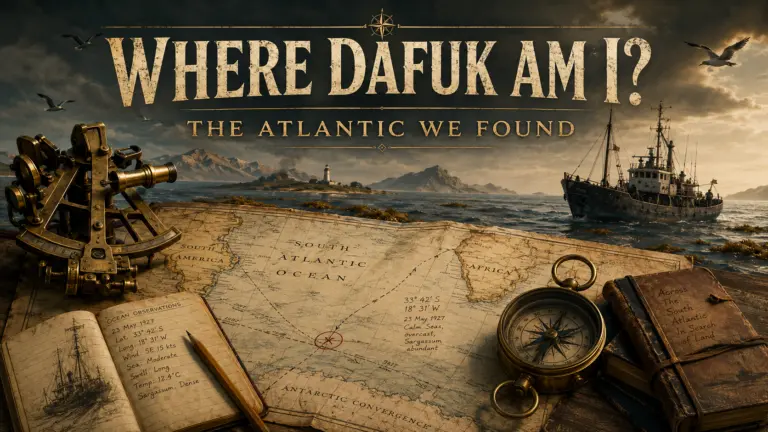
Where Dafuk Am I? — The Movable Powers
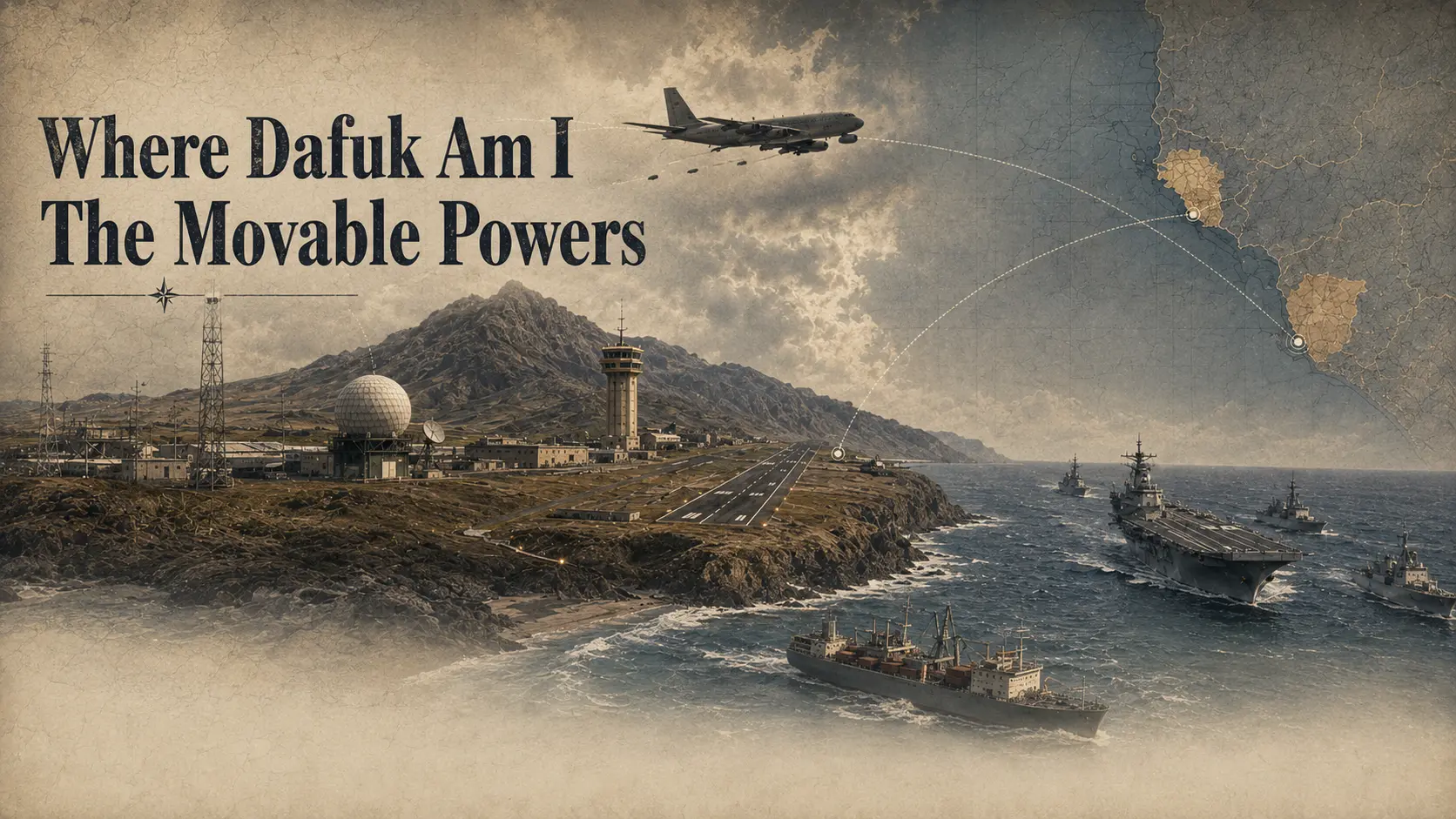
On 26 April 1983, the South Atlantic map looked stable. The power moving across it was not. From Ascension and Conakry to Angola, Haiti and the Falklands, sovereignty, access, force, culture and communication rarely belonged to the same actor.
On 26 April 1983, the islands are where they were the day before.
Ascension has not moved. Conakry is still on the coast of Guinea. Angola is still Angola, and the Falkland Islands remain exactly where generations of cartographers have drawn them.
The interesting question is no longer where the land is.
It is where the power is.
Territory tends to move slowly. Power can move overnight.
A country may possess an island without operating everything built on it. An aircraft may belong to one government and depend on another government for permission to land. An army may temporarily occupy territory without settling the sovereignty dispute beneath its boots. A singer may possess no official authority at all and still force a government to answer a question it never intended to ask.
By 1983, the South Atlantic had become particularly good at exposing those differences.
The island that belonged to one country and worked for another
Ascension Island was British territory.
That statement was perfectly correct and almost completely inadequate.
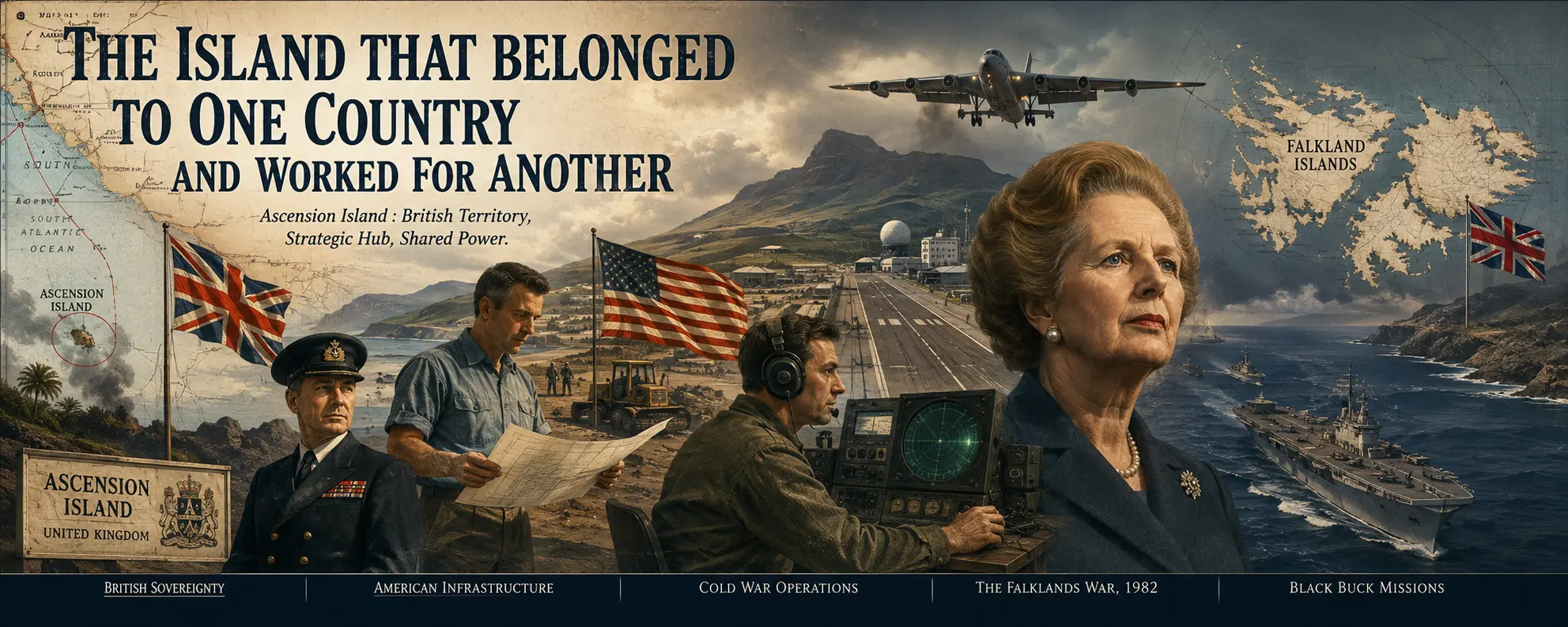
The Union Jack answered the legal question, but it did not explain what somebody actually found on the island. During the Second World War, the United States helped transform Ascension into an Atlantic military platform by constructing Wideawake Airfield. American military activity returned during the Cold War, while communications, tracking and scientific installations accumulated on a volcanic island that remained British even as it became useful to several institutions for several different purposes.
None of this required the United States to conquer Ascension, and Britain did not need to surrender sovereignty. A foreign power could construct and operate strategic infrastructure there because permission had been granted. Sovereignty remained in one place while use, investment and operational capacity accumulated through agreements with someone else.
Then Argentina invaded the Falkland Islands on 2 April 1982.
Suddenly, the little island halfway down the Atlantic mattered enormously.
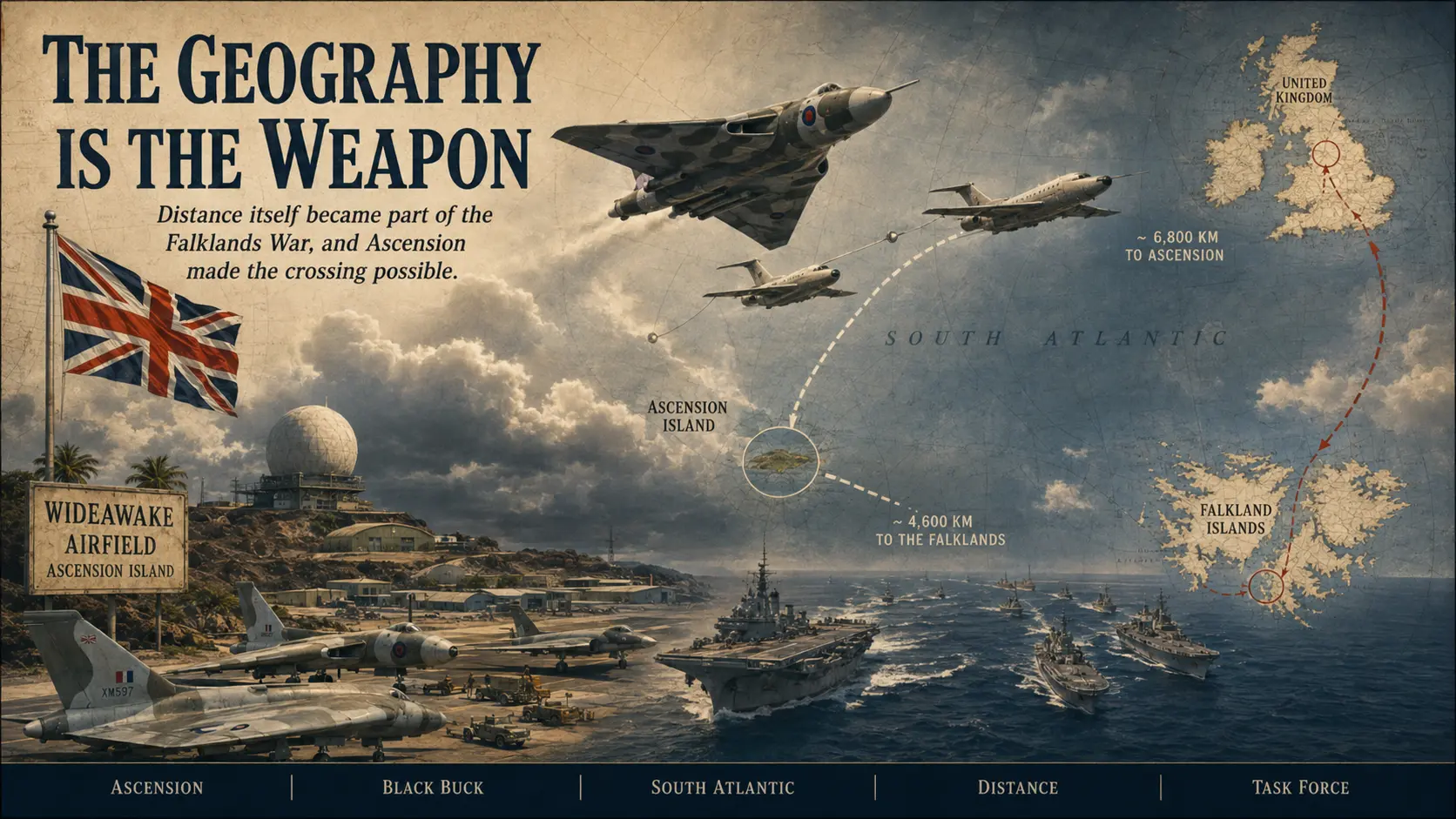
Britain possessed ships, aircraft, soldiers and weapons, but none of those things could abolish distance. The Falklands were thousands of kilometres from the United Kingdom, and military power still had to cross all of that ocean before it became useful. Ascension happened to be sitting in the middle, and almost overnight Wideawake became a hinge connecting Britain to a war occurring far beyond the normal reach of its land-based aircraft.
Aircraft began arriving, fuel accumulated, supplies passed through and personnel moved south. The island did not change sovereignty, yet its practical function changed completely.
The Black Buck missions made the geography almost absurdly visible. Vulcan bombers departing Ascension required an elaborate relay of Victor tankers to reach the Falklands and return. Whatever one concludes about the direct military effect of those raids, the logistics demonstrated something more fundamental than the value of any particular bomb dropped near Stanley.
Britain possessed the bomber, the crews and the objective. Geography still determined whether those things could meet.
Ascension itself had done nothing. Its rocks had not moved, and its runway had not suddenly grown longer. What changed was the purpose attached to it.
A British territory containing infrastructure strongly shaped by American investment and use had become one of the critical staging points of a British war.
The map still said United Kingdom.
The more interesting question had become: who could use the island, and for what?
That distinction appears all over the Atlantic once we begin looking for it.
The permission moved
Conakry had already learned that a coastline could become part of somebody else’s war.
In the early hours of 22 November 1970, armed men landed in Guinea and attacked targets around the capital. The operation combined Portuguese military objectives with the ambitions of Guinean opponents of President Ahmed Sékou Touré. Portuguese prisoners were freed, installations associated with the PAIGC were attacked, and for several hours the capital of an independent African state became an extension of Portugal’s colonial conflict.
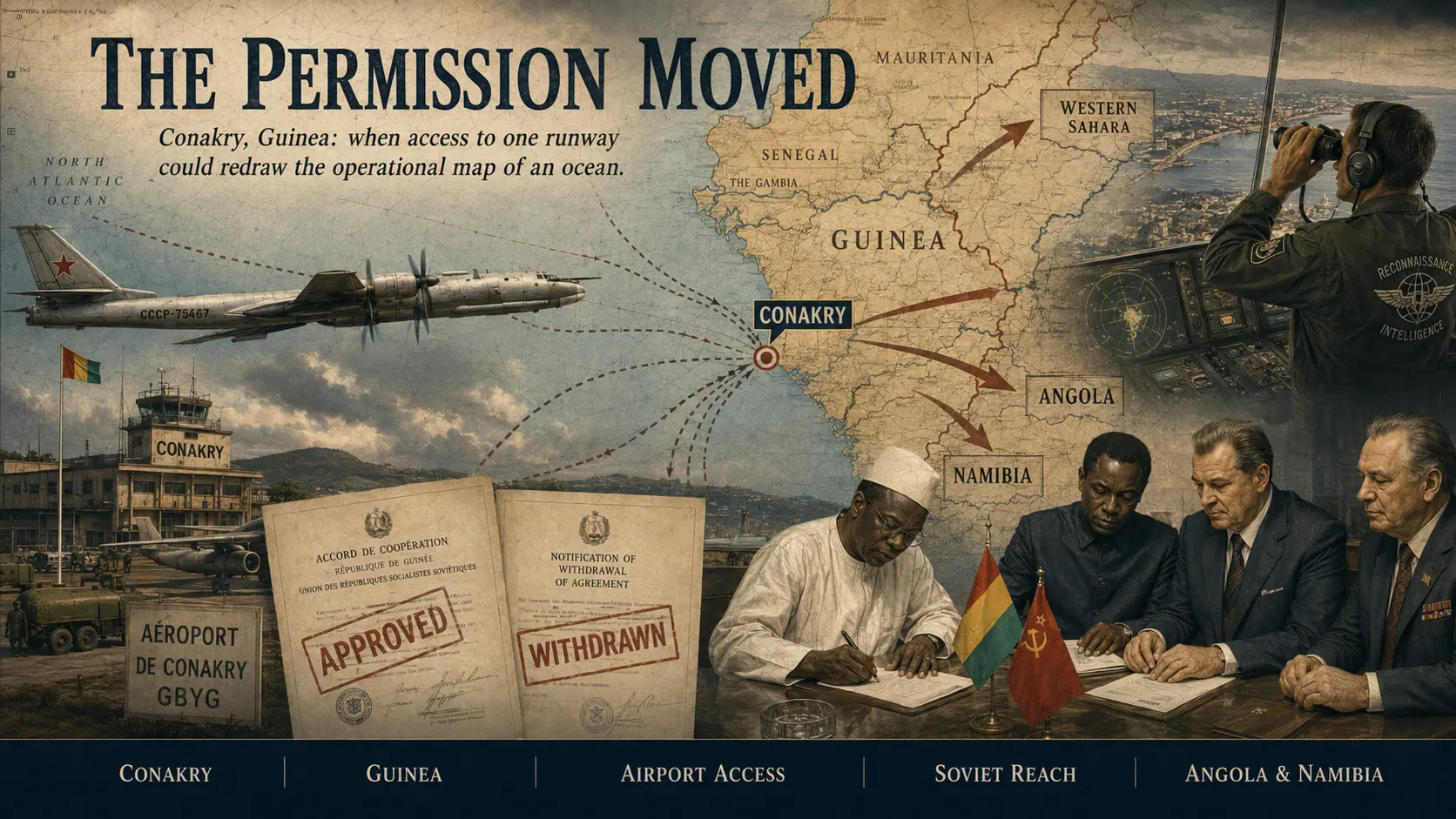
The attackers eventually withdrew and Guinea remained Guinea, but foreign power did not disappear from Conakry.
During the following years, the Soviet Union found an entirely different use for the same geography. Long-range Tu-95 reconnaissance aircraft could operate through Conakry and extend Soviet observation across enormous areas of the Atlantic. Guinea did not become Soviet territory, and Soviet aircraft did not need a red flag beside the runway. They needed something much simpler and, in operational terms, almost as valuable: permission to land.
That permission transformed Guinean concrete into part of a Soviet surveillance network.
Then, in 1977, Sékou Touré withdrew those privileges. The aircraft still existed, their crews still existed and Moscow still wanted to watch the Atlantic. The airport had not moved an inch.
Yet the strategic map changed immediately.
The permission moved.
The Soviet aircraft had to operate somewhere else. Nothing spectacular needed to happen. No beach was invaded, no bridge exploded and no frontier changed colour. One government simply stopped saying yes, and aircraft thousands of kilometres away suddenly had a different operational problem.
Power does not always travel in tanks. Sometimes it travels in agreements, and sometimes it disappears with a signature.
The same problem became much larger farther south.
When Portugal’s dictatorship collapsed during the Carnation Revolution of 25 April 1974, the colonial map of Africa began changing rapidly. Angola became independent on 11 November 1975. One foreign flag disappeared, but the space it left behind did not become politically empty. Instead, several other powers immediately began moving through it.
That does not mean Angolans became spectators in their own war. The MPLA, FNLA and UNITA were not inventions of Moscow, Washington or Pretoria. They had their own constituencies, ambitions and histories. But once the Portuguese colonial structure collapsed, those conflicts became connected to interests much larger than Angola itself.
Soviet equipment arrived. Cuban troops crossed the Atlantic. South African forces pushed north. American and Zairian support reached opposing factions. Offshore oil continued leaving the country while armies contested roads inland. The political border remained beautifully simple on the map, but the war did not respect that simplicity.
To understand what was actually happening, colouring Angola one colour was almost useless.
We need arrows.
Those arrows did not stop at the Namibian frontier. South Africa continued to administer Namibia even though the United Nations had rejected the permanence of that arrangement. SWAPO fought for independence and used support networks extending into Angola. South African forces repeatedly crossed northward to attack them, so Angola’s civil war and Namibia’s unfinished decolonization became physically entangled.
By 26 April 1983, a person standing somewhere near that frontier could encounter an administration, an army, a liberation movement and an international legal position all offering different answers to what appears to be a simple question: who has authority here?
Western Sahara presented another version of the same problem. Spain agreed to withdraw during the crisis of 1975 and formally ended its presence in February 1976, Morocco and Mauritania advanced claims, the Polisario Front fought for independence, Mauritania abandoned its claim in 1979, and Morocco remained. By our date the territory still had no universally accepted final status.
Once again, ownership, administration, occupation, recognition and the ability to enforce a claim were not interchangeable.
The map could show the land.
It struggled to show the argument.
Enemies can dock
The Cold War makes all of this especially visible because it encourages us to imagine two enormous fixed blocs: Washington on one side, Moscow on the other.
Reality was considerably messier.
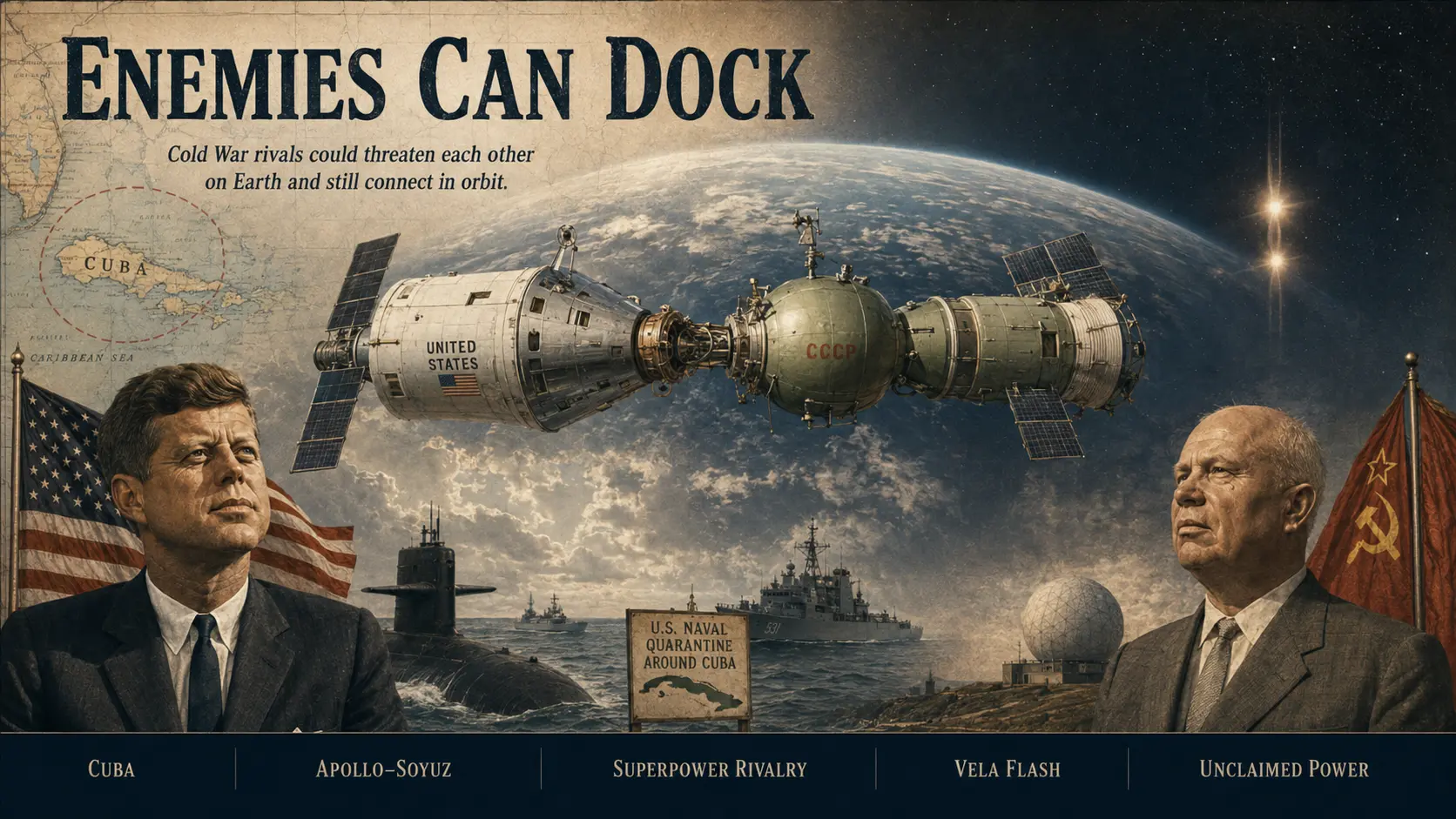
In 1962, Cuba became one of the places where sovereignty and superpower confrontation collided most dangerously. The Soviet Union secretly deployed nuclear missiles to Cuban territory. The United States discovered them and imposed a naval quarantine. Washington and Moscow then negotiated the withdrawal while the world came frighteningly close to nuclear war.
Cuba was sovereign, but Cuba was also the physical platform on which two much larger powers confronted one another.
That does not mean Cuba had no agency. It means sovereignty could coexist with circumstances in which another country’s weapons and another country’s decisions drastically reduced the room available to act independently.
Thirteen years later, the United States and Soviet Union produced one of the strangest images of the Cold War.
On 17 July 1975, an American Apollo spacecraft docked with a Soviet Soyuz. Thomas Stafford and Alexei Leonov shook hands in orbit. The same two states that maintained nuclear arsenals designed around the possibility of destroying one another had spent years making their spacecraft compatible enough to connect physically.
Their rockets belonged to technological families inseparable from the missile age. Their military planners continued preparing for conflict, while their astronauts opened a hatch between two spacecraft.
Power did not always move in one direction. Competitors could threaten one another, cooperate with one another, use one another’s geography and still remain competitors afterward.
Sometimes even enemies could dock.
And sometimes power appeared without anybody admitting it belonged to them.
On 22 September 1979, an American Vela satellite detected the famous double flash over the far South Atlantic and Indian Ocean region. A nuclear test was immediately suspected. Possible involvement by South Africa and Israel has been debated ever since, while scientific and intelligence assessments failed to produce universal agreement.
For our purposes, the uncertainty is almost more interesting than certainty would have been. Vela had detected something. It could not show us what happened.
A satellite saw something. Governments investigated it, intelligence agencies argued over it and diplomats worried about it, yet nobody placed an uncontested flag on the flash.
There was no occupied territory and no government publicly claiming responsibility. There was simply a possible demonstration of enormous destructive capacity somewhere over an ocean.
Power without an acknowledged owner.
By the early 1980s, the superpowers no longer needed to be nearby to watch one another.. Aircraft, ships, listening stations and journalists still mattered, but orbit had added another vantage point.
On 26 April 1983, the Soviet Union launched Kosmos 1457, a photographic reconnaissance satellite. Its eyes were not turned toward space, but back toward Earth itself.
Not all powers wear uniforms
By now it would be easy to believe that power means governments, aircraft, soldiers, borders and weapons.
During the same period, another form was becoming increasingly difficult to ignore.
Attention.
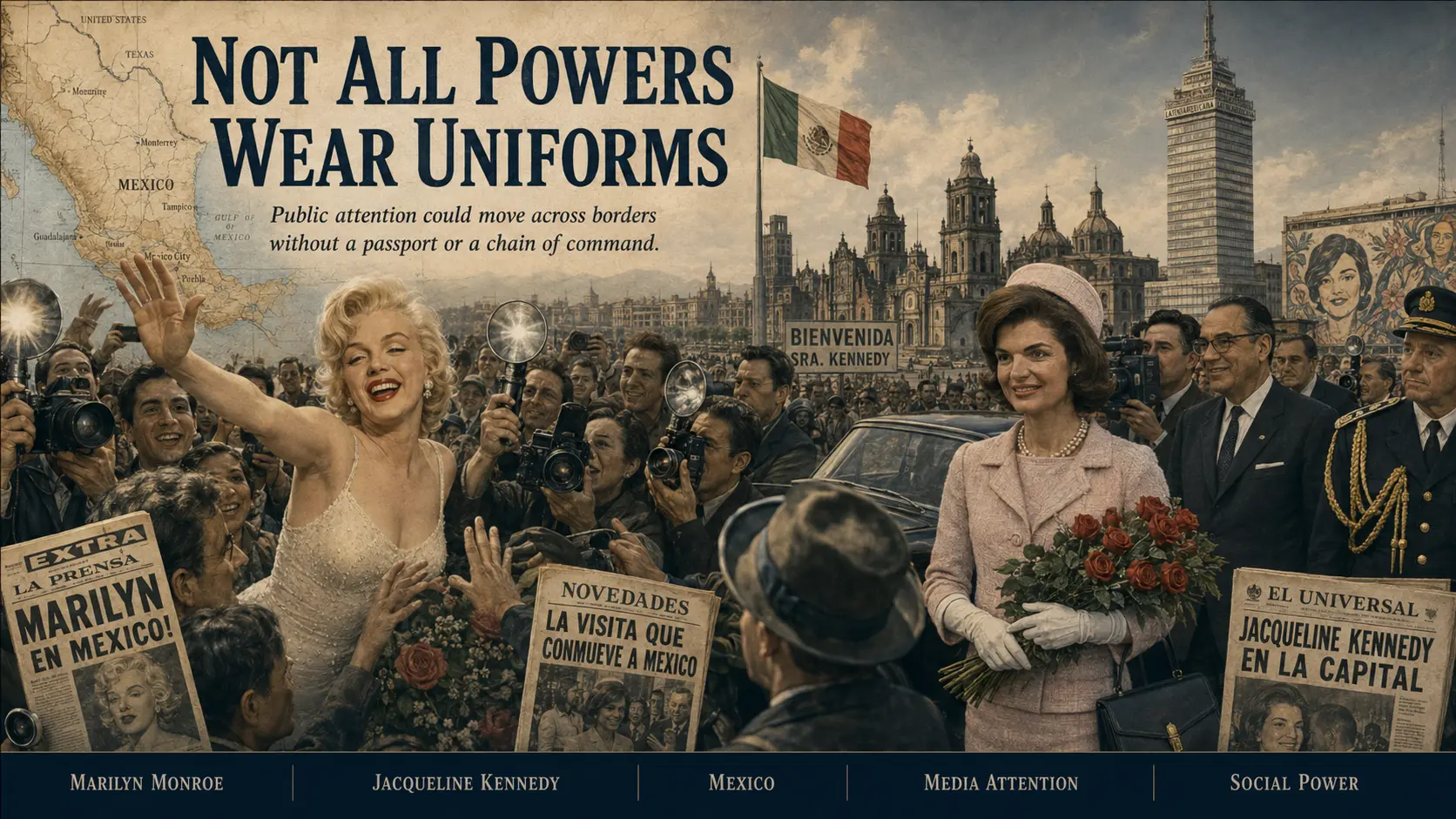
In February 1962, Jayne Mansfield was involved in a highly publicized boating accident in the Bahamas. A few weeks later, Marilyn Monroe travelled to Mexico.
Monroe represented no government. She carried no diplomatic credentials and commanded no institution. Yet when Marilyn moved, photographers moved, reporters moved and public attention moved with them. American authorities were sufficiently interested in her associations and activities that the FBI kept records concerning them. Celebrity had become significant enough that political power itself paid attention to where a private individual went and whom she met.
During her Mexican trip, Monroe visited the Instituto Nacional de Protección a la Infancia, associated with Mexican First Lady Eva Sámano de López Mateos.
The important detail is not the amount of money she contributed. The interesting thing is what she could do with visibility.
For a few moments, one of the most photographed people in the world could point the cameras somewhere else.
Four months later, Jacqueline Kennedy arrived in Mexico with the President of the United States. The presidential visit had been planned before Monroe’s trip, so Marilyn did not cause it. She did not need to.
Jackie entered a social environment in which another famous American woman had already demonstrated how much affection, curiosity and media attention could be generated there, and on 30 June 1962 Jacqueline Kennedy visited the same child-protection institution.
No conspiracy is required. Social power rarely leaves behind a document saying copy what happened last time. A precedent changes the environment simply by existing. Someone discovers that a gesture works, and everyone who comes afterward now operates in a world where that gesture has already happened.
Marilyn did not open a diplomatic door for Jackie.
She did something subtler.
She paved a social road.
Jackie arrived later with the motorcade.
The relationship could also work in the opposite direction. Public affection was not simply something famous people extracted from a crowd. A population that gave extraordinary attention to a visitor could create an expectation that the affection would be returned.
Governments could demand protocol. They could not order genuine enthusiasm.
A president could possess constitutional authority while a film star possessed the crowd.
Both were forms of power.
Only one appeared on the organizational chart.
When the microphone entered politics
By the late 1960s, politicians were no longer the only people capable of defining a political problem for millions of people.
Newspapers and television still reported wars. Governments still held press conferences. Editors still decided what appeared on the front page. But musicians, filmmakers and performers had acquired something different: the ability to influence how people felt about what they had just seen in the news.
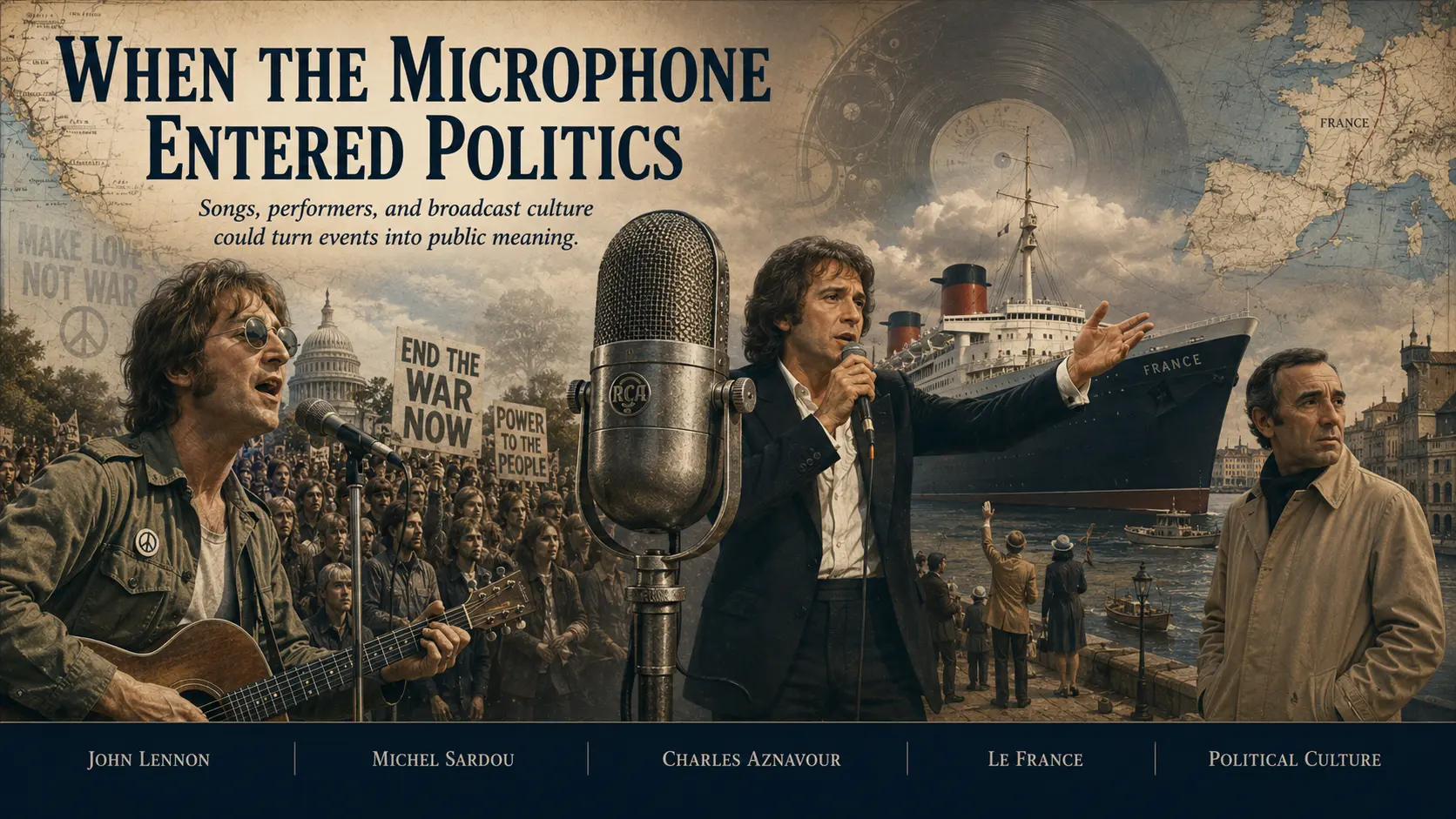
Vietnam made this particularly visible. John Lennon, Joan Baez, Bob Dylan, Creedence Clearwater Revival and many others did not need elected office to enter the argument. A government could announce troop deployments and a newspaper could explain conscription, but a singer could turn those events into fear, anger, solidarity or ridicule.
The news could explain what happened.
Culture could suggest what it meant.
John Lennon represents one mechanism particularly well because he often tried to stand ahead of a crowd with an idea and persuade the crowd to move with him. A complicated political position became a phrase; the phrase became a chorus; the chorus could then be repeated by thousands of people who had never met the person who wrote it.
Nobody elected Lennon. He did not need an election to move opinion.
A politician and a songwriter were using surprisingly similar machinery. Both compressed complicated visions into forms a population could remember. A campaign promise asks people to imagine a particular future. A protest song can do the same thing, except the audience is capable of repeating the message long after the original speaker has left the room.
Michel Sardou demonstrates almost the reverse mechanism.
Lennon often wanted the crowd to rise with him.
Sardou could rise from a crowd that was already moving.
When Le France appeared in 1975, Sardou did not invent French frustration over the liner’s withdrawal from service. The ship had already stopped, its crew had already protested, and arguments about subsidies, national prestige, employment and the changing role of France in the world were already circulating.
He gave those feelings a voice.
The comparison with the Queen Mary changed the argument completely. One great transatlantic liner had been retired and preserved at Long Beach, while the French liner appeared destined to become evidence of something France no longer wished, or could afford, to preserve.
The government could discuss operating losses. Sardou could ask why another country had found a way to preserve its maritime symbol while France appeared willing to abandon its own.
Once the ship begins speaking almost as France itself, the subject becomes much larger than a liner. A listener can hear the merchant marine, tourism, industry, the end of the transatlantic passenger age, memories of empire, military prestige and France’s changing place in the world.
Even the song’s challenge to the navy has a strange power: the abandoned civilian symbol of national prestige effectively dares the military symbol of national power to finish the job.
The government could calculate the subsidy.
The song changed the question.
Sardou did not create all of those anxieties. He condensed them, amplified them and sent them back into the population.
Lennon wanted the crowd to move. Sardou heard that it was already moving and climbed onto the sound.
Charles Aznavour shows another form again.
Emmenez-moi, released in 1967, is not a protest song. Its worker watches ships arriving from distant places and imagines another life somewhere warmer and farther away.
Culture does not need to make people angry to move them.
It can make them want somewhere else.
For a French audience in the 1960s, the warm distant world did not have to mean an imaginary Pacific paradise. France’s colonial sovereignty in Africa was disappearing, but language, shipping routes, businesses, military cooperation and tourism did not disappear with the flags.
Dakar could stop being French territory while remaining deeply present in a French cultural imagination. Côte d’Ivoire could become sovereign while French travellers continued imagining Atlantic beaches around Abidjan, Grand-Bassam or Assinie as attainable versions of elsewhere.
Sovereignty moved faster than familiarity.
Aznavour looks at a ship and imagines the world it can reach. Eight years later, Sardou looks at a ship that can no longer leave and wonders what world has disappeared.
The Atlantic changes meaning between those two songs: first a road toward somewhere else, then evidence of something being left behind.
There were also places where exercising cultural power carried a much greater price.
In Brazil, Caetano Veloso and Gilberto Gil were arrested after the military regime hardened repression in 1968 and later went into exile. South African singer Miriam Makeba used her international platform against apartheid and spent decades unable to return home. Víctor Jara was arrested and killed following the Chilean coup of September 1973.
The important difference was never that London or New York produced political artists while Africa and Latin America did not. The difference was what becoming politically inconvenient could cost.
An artist might face boycotts, angry editorials or cancelled performances in one country. Somewhere else, the passport disappeared. Somewhere else, the artist did.
Governments sometimes treated culture as dangerous for a very simple reason.
Culture was power.
Cinema demonstrated the same problem. Roberto Farias’s Pra Frente, Brasil depicted an ordinary Brazilian drawn into the machinery of political repression during the military dictatorship. Brazilian public structures associated with Embrafilme had helped support national film production, yet a film emerged from that environment that challenged the political system itself.
The state had helped create the conditions in which the work could exist and then attempted to control what the work was allowed to say.
The film nevertheless travelled.
By 1983, it could cross borders and appear before international audiences that did not answer to Brazilian censorship. The sequence is wonderfully uncomfortable: the state helps finance culture, culture criticizes the state, the state attempts to restrict culture, and the work crosses a frontier where another audience gets to decide what it means.
The film had crossed a boundary its censor could not completely control.
None of this required the Internet.
Long before social media, governments were already discovering that controlling a screen inside the country did not necessarily mean controlling the story outside it.
The voice that escaped the state
Haïti offers an unusually clear example because the struggle eventually became almost literally about who could speak.
François Duvalier came to power in 1957 and built a dictatorship around intimidation, political violence and the destruction of independent centres of authority. His son Jean-Claude inherited the presidency for life in 1971.
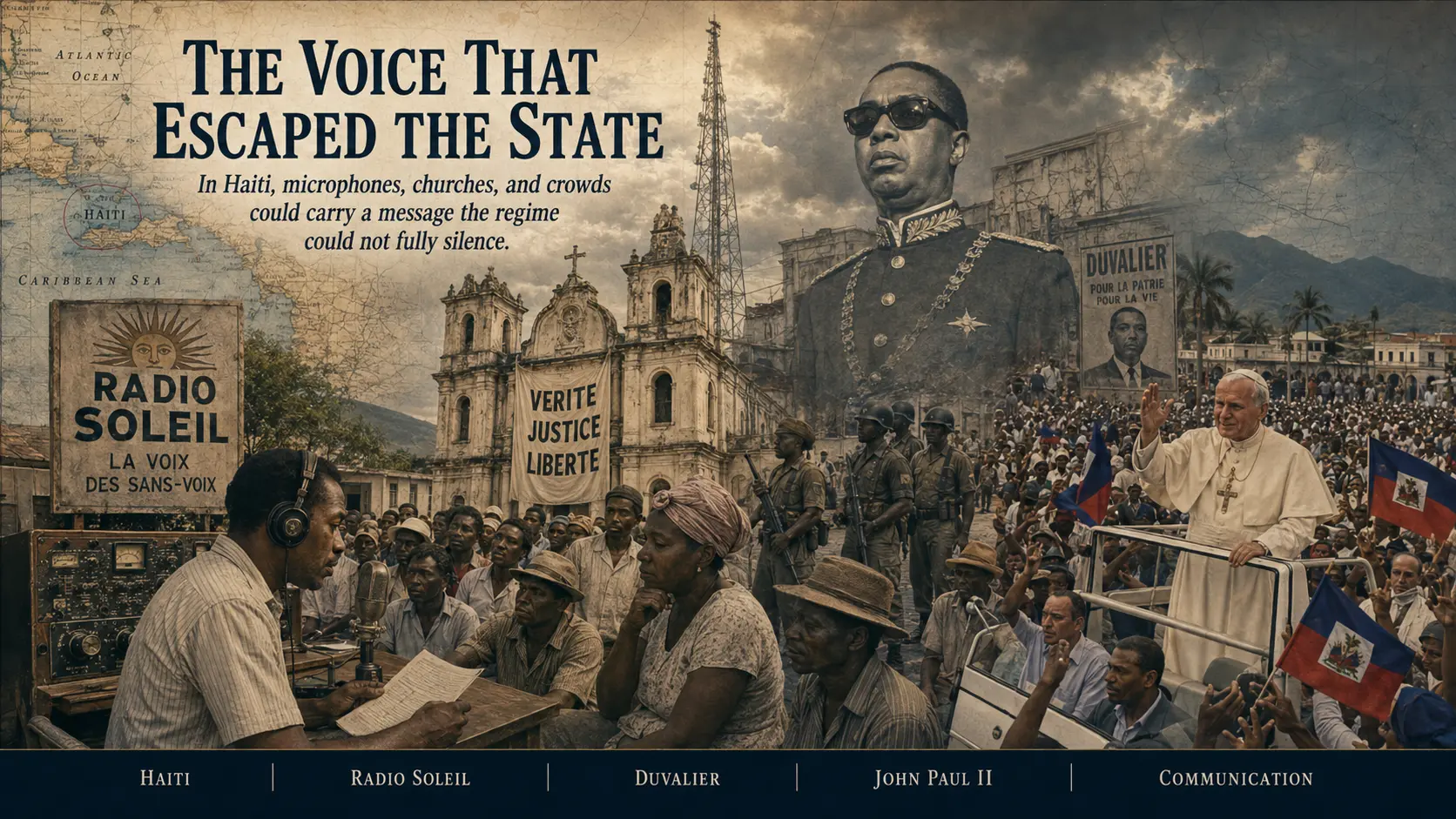
The younger Duvalier attempted to present a somewhat softer image abroad without dismantling the structure beneath it. Foreign aid mattered, development projects mattered and international recognition mattered. The regime wanted the advantages of appearing open without surrendering the mechanisms that kept it in power.
That opening had obvious limits.
On 28 November 1980, the government moved against independent journalists and opponents. Radio Haïti-Inter was silenced, journalists were arrested or driven into exile, and Jean Dominique left the country.
Closing the station solved one immediate problem and created another.
A government can close a transmitter. It is much harder to close the need for people to speak.
Radio Soleil existed inside a different institutional environment. It was connected to the Catholic Church, education, priests, local communities and organizations that the regime could pressure but could not destroy as casually as an independent newsroom.
Then, on 9 March 1983, Pope John Paul II arrived in Haiti.
His declaration that something had to change did not overthrow Jean-Claude Duvalier. Nothing changed on the political map that afternoon. Duvalier remained President for Life, the police remained, the ministries remained and the machinery of the dictatorship continued functioning.
But an authority the regime could not easily dismiss had publicly announced, inside Haiti, that the existing situation was unacceptable.
The Church now possessed more than theology.
It possessed legitimacy, and it already had microphones.
Radio Soleil became increasingly important as an educational and informational network. Schools, churches and local communities offered places where communication could continue spreading beyond the limits the government believed it controlled.
By 1984, unrest was moving into the streets. During 1985, the relationship between Radio Soleil and the government became openly confrontational. Father Hugo Triest and other Belgian priests were expelled, pressure increased on the Church itself, and Radio Soleil was eventually shut down as the regime attempted to recover control over a communication system it had once believed it could tolerate.
Then, on 7 February 1986, Jean-Claude Duvalier left Haiti.
It would be convenient to tell the story as dictatorship, resistance, democracy.
History was not remotely that polite.
The disappearance of the dictator did not repair the institutions his regime had damaged. Haiti entered years of political instability, military interference, coups, foreign interventions and recurring economic and institutional crises.
The man left. The structure he had weakened remained weak.
That is another form of movable power.
Sometimes power does not move when the government falls.
Sometimes the government falls because enough power has already moved somewhere else.
Haiti also demonstrates something much less comfortable about international power.
The great powers knew what the Duvalier regime was. They sent aid, funded development, criticized abuses and worried about instability. Yet Haiti controlled no indispensable maritime passage, no major industrial economy depended on a uniquely Haitian strategic resource, and Haiti possessed no military capacity capable of changing the global balance.
Its suffering could therefore become enormous without immediately becoming an existential problem for another major power.
Elsewhere around the Atlantic, the pattern looked very different. Angola attracted foreign troops and weapons because outside powers believed something important could be gained or lost there. Cuba brought the United States and Soviet Union close to nuclear war because the strategic stakes were obvious. When Argentina occupied the Falklands, Britain sent a fleet across the Atlantic because sovereignty, credibility and national power were directly involved.
When Haiti deteriorated, outside power arrived more often as aid: food, development money, doctors, teachers, NGOs and relief organizations.
Those things mattered enormously to the people receiving them. But the contrast reveals a brutal inequality in how international power moves.
The quantity of power attracted to suffering is not necessarily proportional to the suffering.
It often depends on what the people who possess the power believe they themselves stand to lose.
The geography is the weapon
Less than a year before our date, the South Atlantic supplied the clearest demonstration of all.
The Falkland Islands had been disputed for generations. Britain administered them, Argentina claimed sovereignty, and negotiations had occurred without resolving the contradiction.
Then, on 2 April 1982, Argentina invaded.
For a brief period, the physical reality changed completely. Argentine forces possessed the ground and the British administration was displaced. If sovereignty were simply the ability to stand somewhere with enough soldiers, the argument would have ended that morning.
It did not.
Britain assembled a task force, and suddenly all the geography between Britain and the Falklands became operational rather than decorative. Distance affected fuel, fuel affected aircraft range, range affected basing, and basing brought Ascension back into the story.
Britain possessed extraordinary military capabilities.
None of them could teleport.
Power still had to cross the map.
That is why the Black Buck missions were so revealing. Bombers and tankers had to perform an elaborate aerial choreography simply because the target was very far away. Whatever one concludes about the raids themselves, the logistical problem was undeniable.
The geography was the weapon.
Argentina could exploit distance simply by occupying territory thousands of kilometres from Britain. Britain could overcome that distance only by possessing the ships, aircraft, fuel, crews and intermediate access necessary to cross it.
On 14 June 1982, Argentine forces at Stanley surrendered and British physical control was restored.
The Argentine sovereignty claim did not disappear.
That gives us a remarkably clean demonstration of the problem. Before the invasion, Britain administered the islands while Argentina claimed them. During the occupation, Argentina possessed the ground while Britain continued claiming sovereignty and prepared the force necessary to reverse the situation. After the surrender, Britain again possessed the ground while Argentina continued its claim.
The islands had not moved.
Everything around them had.
Sovereignty, administration, physical control, international support, military force and the logistical ability to deliver that force were related to one another, but they were not the same thing.
The map alone could not show all of them at once.
26 April 1983
Now freeze the picture.
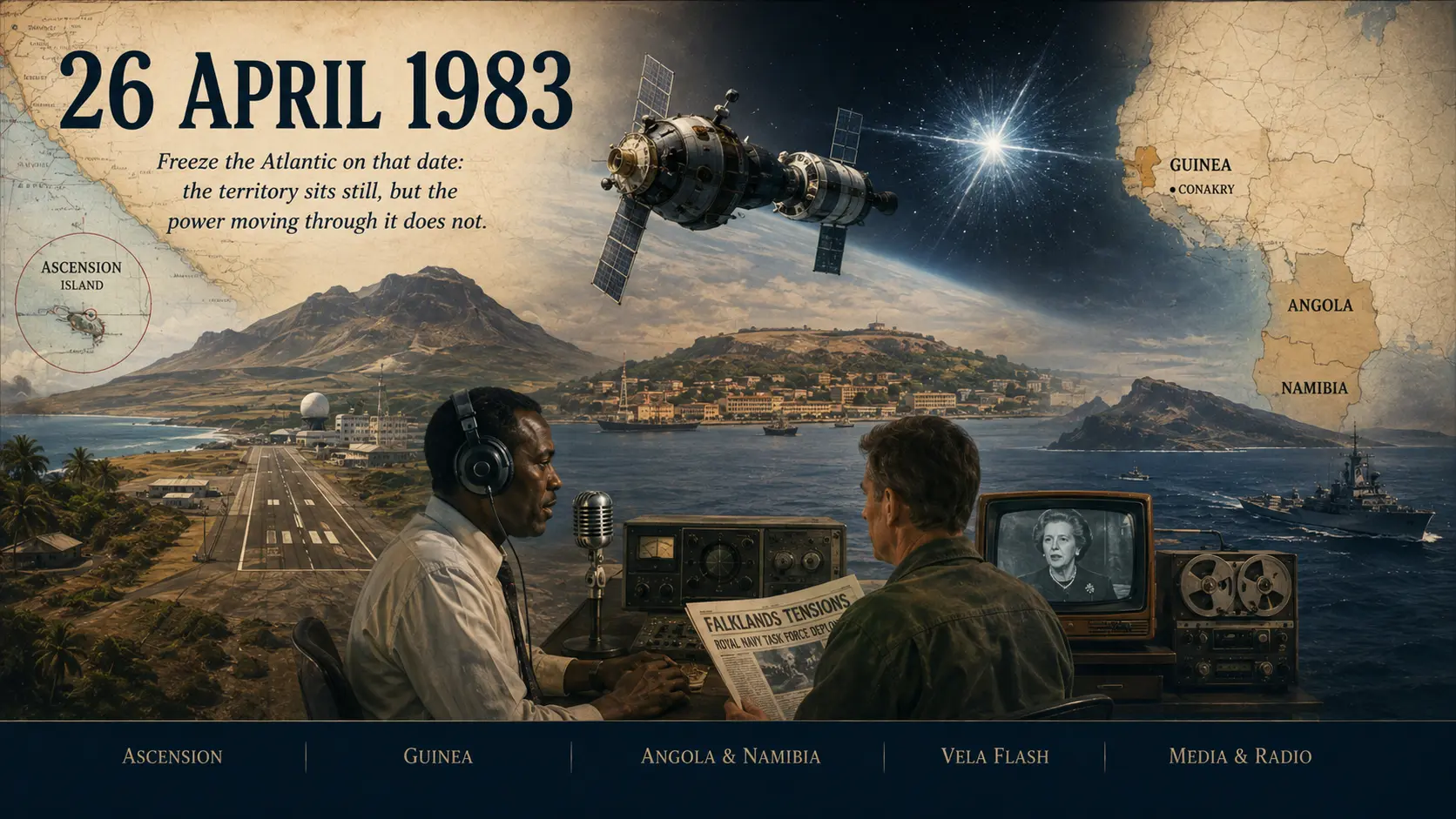
On 26 April 1983, the Falklands War has been over for less than a year, yet the sovereignty dispute that produced it remains unresolved. Ascension has returned to its quieter Atlantic existence, but the runway that connected Britain to the war is still there, along with the accumulated history of British sovereignty, American infrastructure and shared strategic use.
Farther east, Angola is independent but still trapped in a conflict capable of pulling Cuban, Soviet and South African power across its borders. Namibia still waits for the independence already envisaged by the United Nations, while Western Sahara remains caught between claims, occupation, armed resistance and an unfinished argument over self-determination.
Guinea has already demonstrated that something as simple as permission to use an airport can redraw the operational map of an ocean without moving a single frontier. The United States and Soviet Union remain nuclear adversaries but have already docked spacecraft in orbit. Somewhere over the far South Atlantic, a mysterious flash has shown that destructive power can appear without an acknowledged owner.
At the same time, governments are discovering that military power is no longer the only influence capable of crossing borders. Films escape censors, songs transform administrative decisions into public emotions, celebrities redirect cameras, churches protect microphones, and dictators discover that possessing the presidency does not guarantee control over everything a population says about them.
Almost none of this fits comfortably inside coloured borders.
The territory remains relatively still.
The power moving through it does not.
From our position decades later, we know what comes next. The Berlin Wall will open in 1989, Namibia will become independent in 1990, the Soviet Union will disappear in 1991, and South Africa will hold its first national election under universal adult suffrage in 1994.
From the future, those changes can look inevitable.
They were not.
On 26 April 1983, the institutions still look enormous, official and permanent. The flags are still flying and the borders are still printed in the atlases.
But some of the power sustaining those structures has already begun moving somewhere else.
Power often moves before the map knows how to show it.
And then there is Rust…
After all of this, asking whether the Scientists or the Bandits control Rust begins to feel like the wrong question.
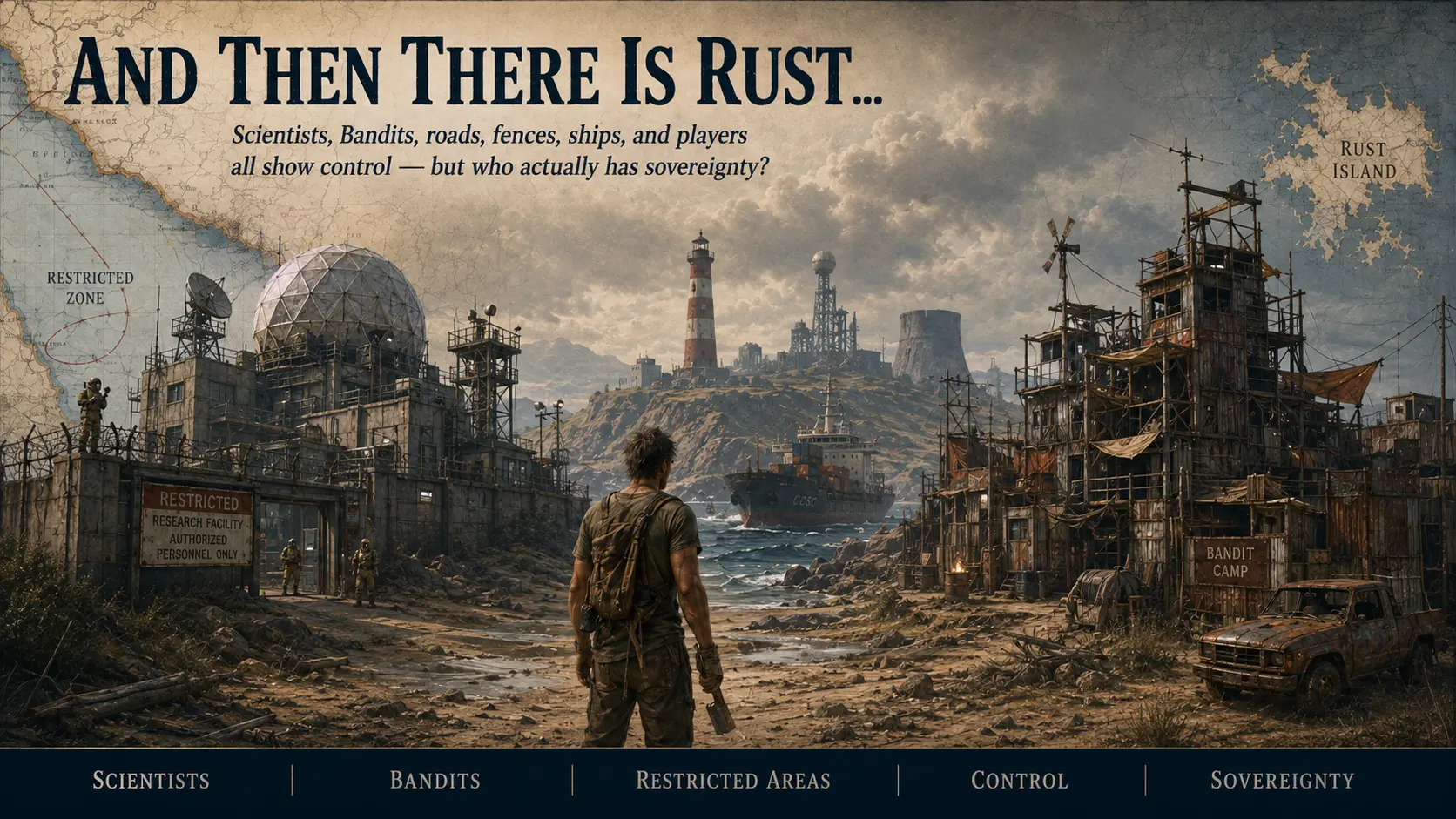
Scientists possess organized force. Bandits possess a settlement and enforce rules inside it. Players occupy land, roads exist, military infrastructure survives, aircraft appear, ships arrive and restricted areas are defended. Somebody can shoot you for crossing the wrong fence.
Those are all forms of control.
None automatically answers the larger question.
Who actually has sovereignty here?
At the Falklands, Britain and Argentina both had answers. At Western Sahara, several actors had answers. In Namibia, the administration on the ground and the international legal system could disagree over what that administration meant. At Ascension, sovereignty and operational use could belong to different actors at the same time.
On Rust, nobody even bothers explaining.
You wake up on the beach and the infrastructure is already there. Whatever governments, companies, militaries or institutions created it are either absent, hidden or irrelevant to the person standing beside the road with a rock.
The powers are already moving before the player even knows where the island is.
Perhaps sovereignty is not even the last question.
There is one form of movable power stranger than all the others: the ability of something to continue travelling after the person or institution that carried it has disappeared.
John F. Kennedy was killed in 1963 and became a political reference after Kennedy. Martin Luther King Jr. was killed in 1968, but the dream attached to him continued through movements, speeches and political arguments he would never live to see. John Lennon was killed in 1980, yet people continued singing the ideas he had compressed into songs.
The person can disappear. An office can change hands. A government can fall, a ship can stop moving, an empire can lose a colony and a censor can close a theatre.
Yet something associated with them can continue travelling anyway.
A promise can outlive the campaign that made it. A song can outlive the argument that produced it. A political idea can survive the government built around it. A story can move between generations that never met the people who began telling it.
Rust has now existed for more than twelve years. Millions of players have arrived and left, while the island itself has been erased and regenerated countless times. Roads have moved, monuments have appeared and disappeared, mechanics have been replaced, and entire generations of the game no longer exist except in screenshots, old videos and the memories of people who played them.
Some of the players who first woke naked on those beaches stopped playing years ago.
New players still wake there.
The island changes, the people change, and the people building the game keep changing it.
Yet people keep coming back.
Kennedy became a reference.
King’s dream survived King.
Lennon is still being sung.
And Rust is still being played.
References
Ascension Island, the Falklands and Black Buck
- U.S. Department of State, Office of the Historian — U.S. Support for the UK at Ascension — Foreign Relations of the United States, 1981–1988 — Contemporary documentation of British access to Wideawake Airfield, the U.S. presence and fuel stocks on Ascension, and the arrangements governing British use of American-operated facilities during the Falklands crisis.
- Royal Air Force Museum — British Military Aviation in 1982 — Chronology of RAF operations during the Falklands War, including Black Buck 1 and the Victor tanker relay supporting the Vulcan flight from Ascension.
- United Nations Security Council — Resolution 502 (1982) — Contemporary UN response to the Argentine invasion of the Falkland Islands, demanding the withdrawal of Argentine forces and a diplomatic settlement.
Conakry and the moving permission
- United Nations Security Council — Resolution 290 (1970) — UN response to the November 1970 military attack against Guinea and the Portuguese role in the operation.
- United Nations Archives — Guinea — Complaint against Portugal, 22 November 1970 — Archival record of Guinea’s complaint following the attack on Conakry.
- Central Intelligence Agency, Reading Room — Sub-Saharan Africa: A Growing Soviet Military Presence — Declassified assessment documenting Soviet Tu-95 maritime reconnaissance operations from Conakry and the loss of those landing rights in 1977.
Angola, Namibia and Western Sahara
- U.S. Department of State, Office of the Historian — The Angola Crisis, 1974–75 — Overview of the Portuguese withdrawal, the MPLA, FNLA and UNITA, and the involvement of the Soviet Union, Cuba, the United States, Zaire and South Africa in the Angolan conflict.
- United Nations Security Council — Resolution 435 (1978) — The UN plan for Namibia’s transition to independence and a central reference for the international legal position on South African administration of the territory.
- United Nations in Namibia — The UN’s Role in Namibian Independence — Historical overview of the long dispute over South African rule, SWAPO and the eventual implementation of Resolution 435.
- United Nations Peacekeeping — MINURSO — United Nations Mission for the Referendum in Western Sahara — Institutional background on the unresolved Western Sahara dispute between Morocco and the Polisario Front.
- United Nations Digital Library — Report concerning the legal and historical status of Western Sahara — Records Spain’s termination of its presence in the territory in February 1976 and Mauritania’s later withdrawal from its claim.
Cuba, détente, surveillance and the South Atlantic flash
- U.S. Department of State, Office of the Historian — The Cuban Missile Crisis, October 1962 — Soviet nuclear missiles in Cuba, American reconnaissance and the U.S. naval quarantine that brought the superpowers close to nuclear conflict.
- NASA — Apollo-Soyuz Test Project — Official history of the first joint American-Soviet space mission and the docking of Apollo and Soyuz on 17 July 1975.
- NASA — The Apollo-Soyuz Mission — Documentation and imagery of Thomas Stafford and Aleksei Leonov’s handshake in orbit.
- National Security Archive, George Washington University — The Vela Incident: South Atlantic Mystery Flash in September 1979 — Declassified records surrounding the 22 September 1979 double flash and the continuing debate over a possible nuclear test involving South Africa and Israel.
- Library of the Czech Academy of Sciences — 1983-039A — Kosmos 1457 — Launch record for Kosmos 1457 on 26 April 1983 from Baikonur and technical description of the Soviet photographic-reconnaissance satellite.
Celebrity as movable attention
- Historic Oregon Newspapers / Associated Press — Jayne Mansfield Missing During Bahamas Boating Trip — 8 February 1962 — Contemporary reporting of the boating accident and search for Mansfield, Mickey Hargitay and Jack Drury near Nassau.
- El Universal — Marilyn Monroe in Mexico, 1962 — Mexican archival account of Monroe’s visit and her contribution to the Instituto Nacional de Protección a la Infancia in the presence of First Lady Eva Sámano de López Mateos.
- Federal Bureau of Investigation — FBI Records: The Vault — Marilyn Monroe — Declassified FBI files and references concerning Monroe, illustrating official interest in her associations and activities.
- John F. Kennedy Presidential Library and Museum — Jacqueline Kennedy visits the Instituto Nacional de Protección a la Infancia — 30 June 1962 — White House photographic archive documenting Jacqueline Kennedy’s visit to the same Mexican child-protection institution during the presidential trip four months later.
Ships, songs and cultural power
- Bibliothèque nationale de France — Michel Sardou — “Le France” — Bibliographic and phonographic record dating the song to 1975.
- The Queen Mary — Ship History — Official history of the liner’s retirement from active service in 1967 and its preservation as an attraction in Long Beach, the contrast invoked in Sardou’s song.
- Bibliothèque nationale de France — Charles Aznavour — “Emmenez-moi” — Bibliographic record confirming the song’s original 1967 phonographic production.
Artists under political pressure
- Memórias Reveladas — Brazilian National Archives — Prisão de Caetano e Gil — Brazilian government archival account of the arrest of Caetano Veloso and Gilberto Gil following the hardening of military rule in December 1968.
- U.S. National Archives — Miriam Makeba — Biography and archival guide documenting Makeba’s anti-apartheid activism, cancellation of her South African passport and decades in exile.
- Center for Justice & Accountability — Víctor Jara — Account of Jara’s detention following the September 1973 Chilean coup and his killing while held at Chile Stadium.
- Memórias da Ditadura — Pra Frente, Brasil — History of Roberto Farias’s film, its public financing, censorship conflict and eventual uncut release in 1983.
Haiti — when control of the microphone became political power
- Duke University, David M. Rubenstein Rare Book & Manuscript Library — “Radio Haiti, You Are the Rain” — Repression and Remembrance on November 28 — Archival history of the Duvalier regime’s 28 November 1980 crackdown on Radio Haïti-Inter, the imprisonment and expulsion of journalists and Jean Dominique’s exile.
- The Vatican — John Paul II — Arrival in Port-au-Prince, 9 March 1983 — Official record of the Pope’s visit to Haiti and his public intervention in the political and social situation of the country.
- The Vatican — Benedict XVI recalling John Paul II’s 1983 Haiti visit — Vatican confirmation of the phrase that became associated with the visit: “Something must change here.”
- Human Rights Watch — Haiti — October 1985 — Contemporary human-rights report documenting growing conflict between the Duvalier government and the Catholic Church, including the expulsion of Father Hugo Triest of Radio Soleil.