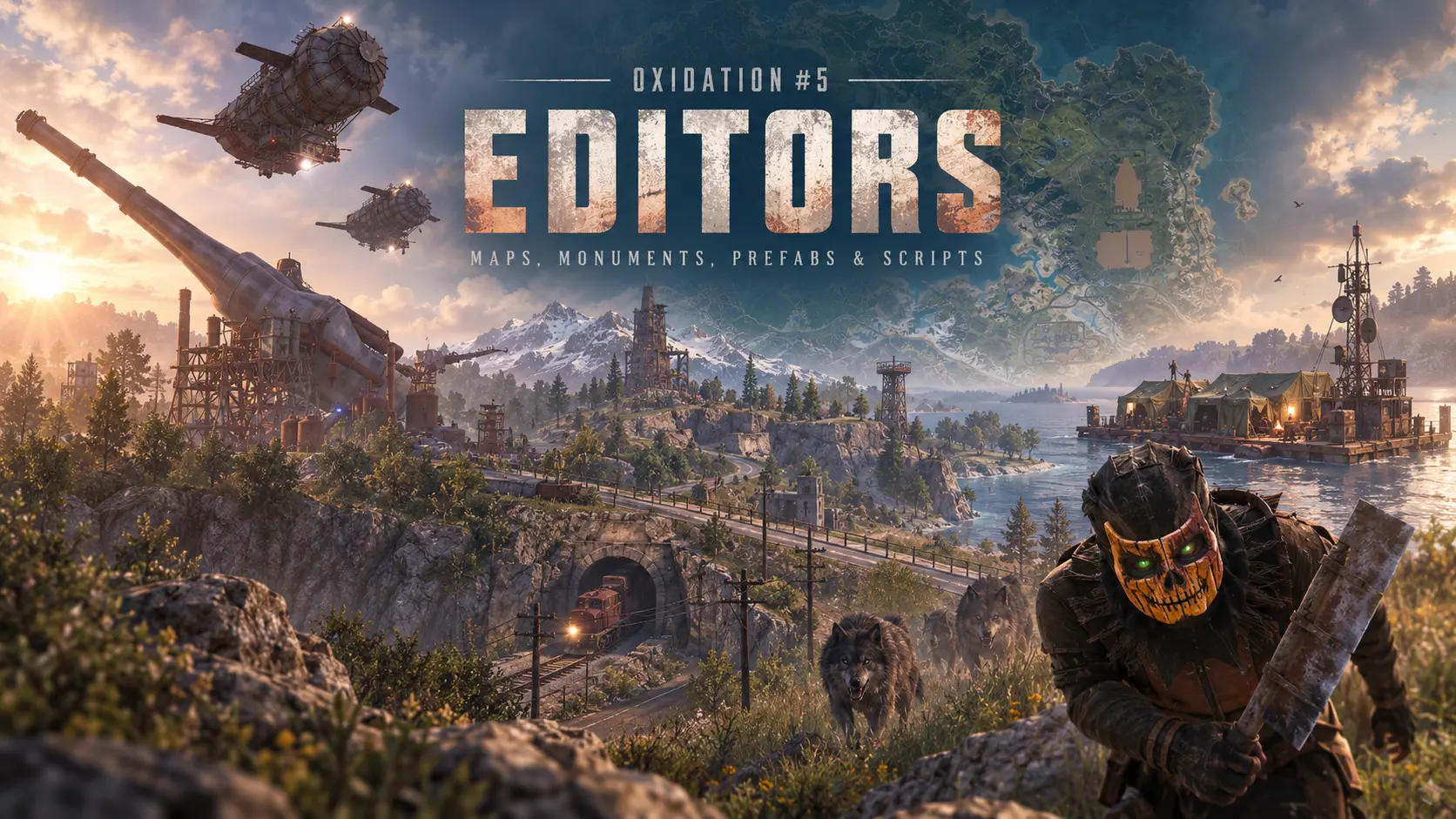
Oxidation #5 — Editors
Beyond Facepunch, another layer of Rust is built by its Editors: Engineers creating monuments and tiny prefabs, Cartographers reshaping entire islands, and Scripters turning familiar places into new experiences.
Facepunch builds Rust.
But the island you spawn on does not always belong entirely to Facepunch.
For years, people outside the studio have been reshaping it. They have built monuments that never existed in the official game, assembled entire landscapes from scratch, filled empty spaces with objects as small as a plate on a table, and written events that turn familiar locations into something completely different.
They are not all doing the same job.
Some build the places.
Some build the world around them.
Some make things happen once we get there.
For the sake of observation, three words describe those specialties rather well:
Engineers. Cartographers. Scripters.
The same person can obviously cross from one discipline to another. In practice, however, many Editors develop a preference — and often a reputation — for one particular kind of work.
What matters here is not how RustEdit works, how a plugin is installed or where a finished creation can be purchased.
What matters is what they made.
Engineers
Engineers work on the things that occupy the world.
Buildings. Monuments. Prefabs. Dungeons. Interiors. Industrial installations. Roadside scenery. Sometimes an object small enough to sit on a table.
The scale can be almost absurdly different.
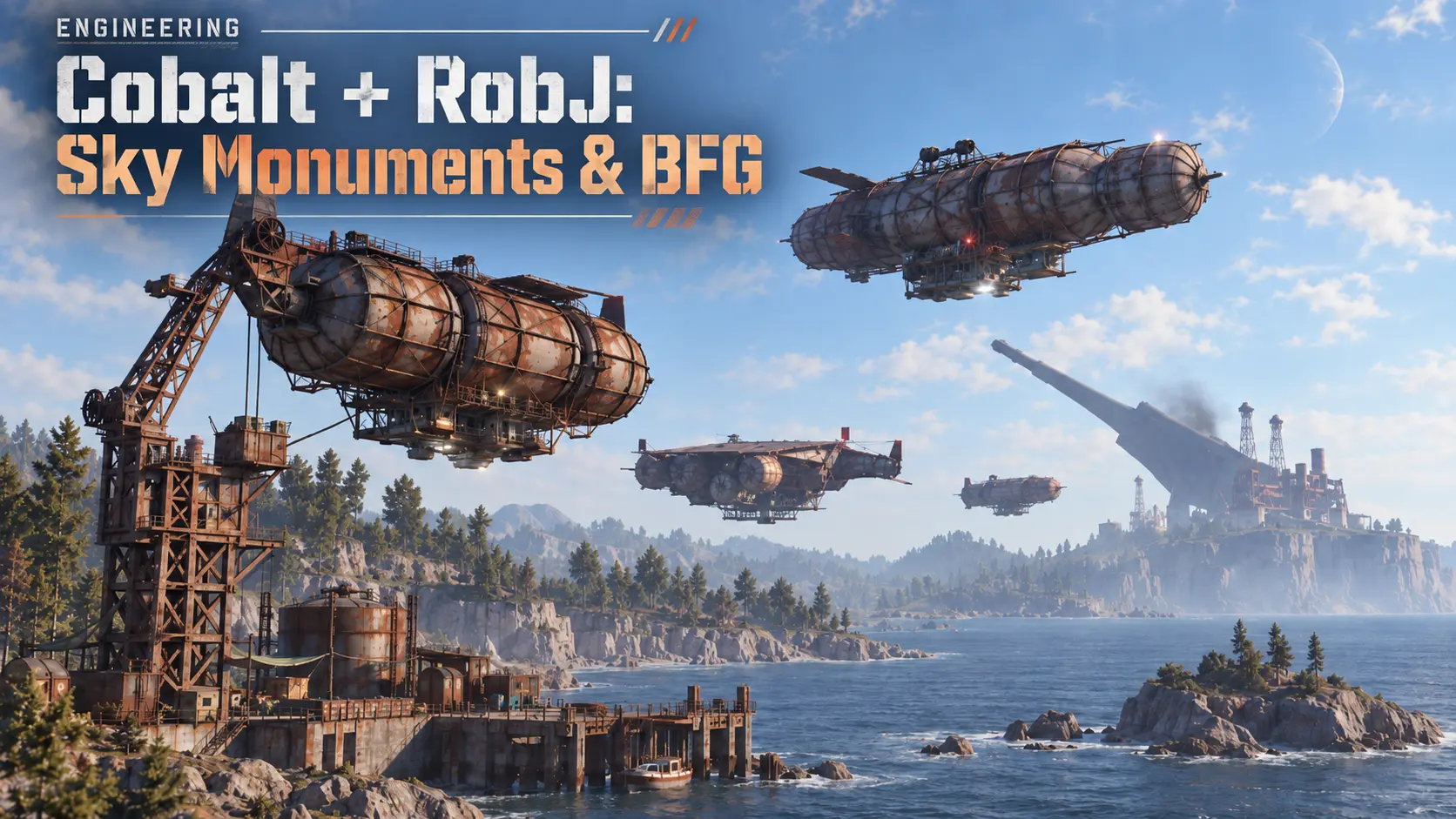
From Cobalt…
Some of the more spectacular early custom creations carried the Cobalt label.
A necessary distinction: Cobalt, here, refers to a label used by external Rust designers. It should not be confused with Cobalt Industries, the fictional company at the center of Rust’s own universe — even though several of those creations deliberately borrowed that vocabulary.
The Airship Sky Monuments took complete playable locations into the air. The package contains two airship sizes and several puzzle variants, including versions that require a Minicopter to complete. (Codefling)
And the people actually using them noticed what that changed. One mapmaker explained that he had built a whole fleet and that players loved it, adding that the monuments gave Minicopters and helicopters another reason to be used. Another customer simply reported:
“My players love it.” (Codefling)
The empty volume above a Rust island had become somewhere worth going.
At the opposite end of gravity — but certainly not ambition — sit the B.F.G. and Starlight Reactor.
Both are roughly 1,200-prefab constructions. The B.F.G. is an enormous defensive installation built around a three-stage loot puzzle. Starlight is an abandoned fusion complex with multiple cards, fuses and a deliberately oversized industrial setting. (Codefling)
One Starlight customer described it simply as:
“An awesome change of scenery for Rust.” (Codefling)
These are not little roadside replacements designed to disappear quietly into every procedural island.
They are statement pieces.
Some monuments adapt themselves to the island.
Others require the island to adapt to them.
The Cobalt-labelled projects demonstrated just how far that second approach could go.
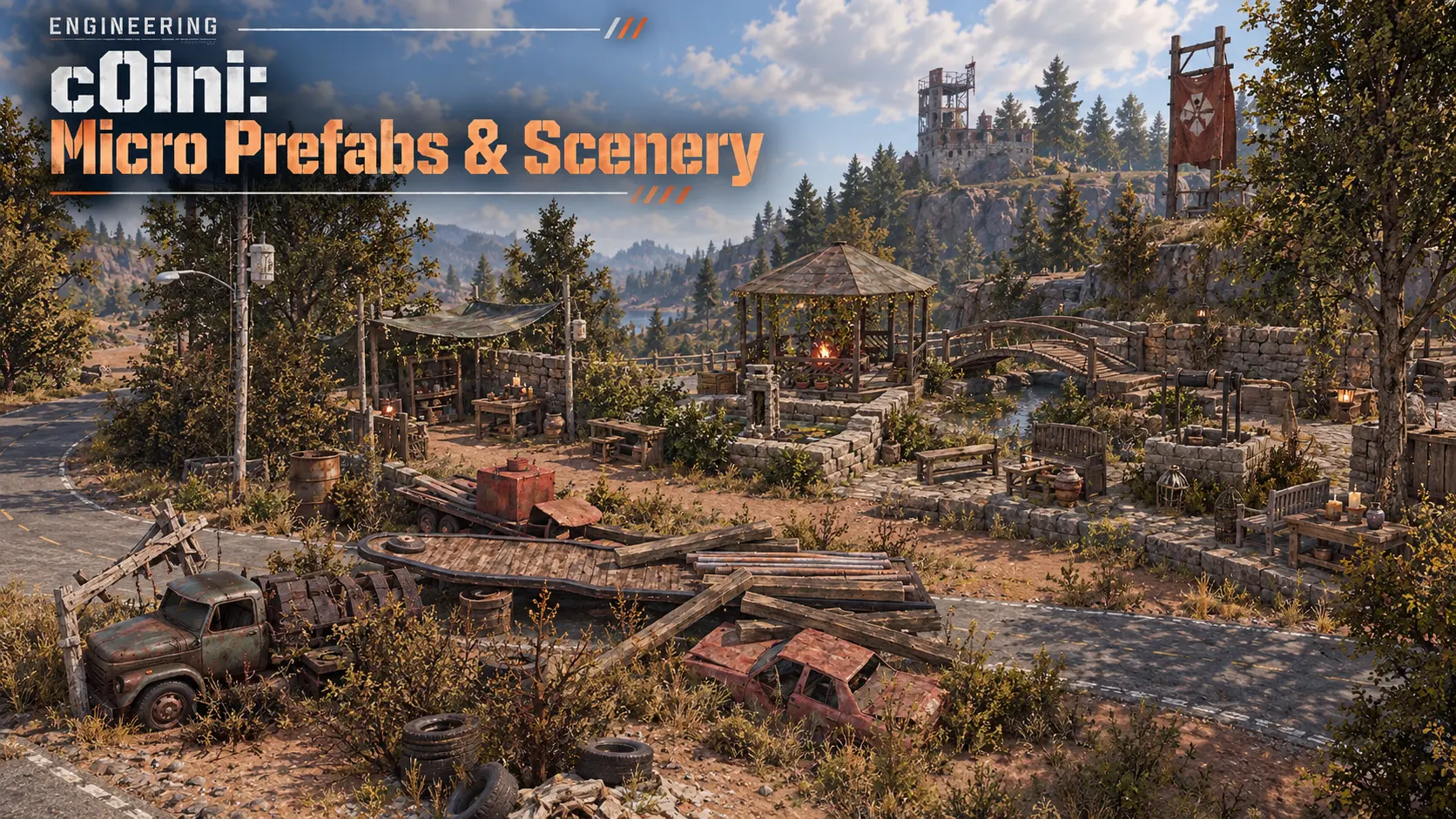
…to c0ini
At almost the opposite end of the scale is c0ini.
His work includes complete locations, but some of the most distinctive pieces are much smaller: reusable scenery and micro-prefabs representing ordinary objects and fragments of everyday life.
Tables. Chairs. Beds. Shelves. Carts. Crates. Kitchen utensils. Garden pieces. Appliances. Objects whose individual presence may barely be noticed.
His Medieval Interior Set contains 25 interior pieces. The later Medieval Set expands that approach to 81 prefabs covering furniture, trade objects, tableware, garden decorations and other small environmental details. (Codefling)
Then there are complete little scenes.
The Scenery and Scenes contains checkpoints, road and railway accidents, a helicopter crash, a wrecked caravan, hideouts and small dumps — compositions designed not necessarily to become the destination, but to fill the world around the destination. (Codefling)
A customer described exactly what this kind of work adds:
“Adds a lot of depth to a server.” (Codefling)
That is the important part.
A reactor announces itself from across the map.
A microwave does not.
But a believable environment needs both.
Small props make interiors look occupied. Environmental scenes interrupt otherwise anonymous stretches of terrain. Mundane objects can make a custom structure feel less like a shell assembled from game assets and more like a place somebody might actually have used.
And because they are prefabs, their final purpose does not necessarily belong to the person who first created them.
One Editor makes the piece.
Another decides what it eventually becomes.
Between c0ini’s smallest objects and Cobalt’s enormous installations lies almost the entire physical scale available to an Engineer.
From the object on the shelf to the structure on the horizon.
Cartographers
A monument creates a destination.
A Cartographer creates the territory connecting destinations.
The distinction becomes obvious after looking at enough custom work. A good monument designer is not automatically a good mapmaker, and the two jobs do not necessarily attract the same people.
Cartography operates at another scale.
Coastlines. Mountains. Valleys. Islands. Rivers. Roads. Railways. Biomes. Distances. Sightlines. Where monuments appear and what players encounter between them.
A custom map is not interesting merely because it contains impressive monuments.
The map itself has to be the creation.
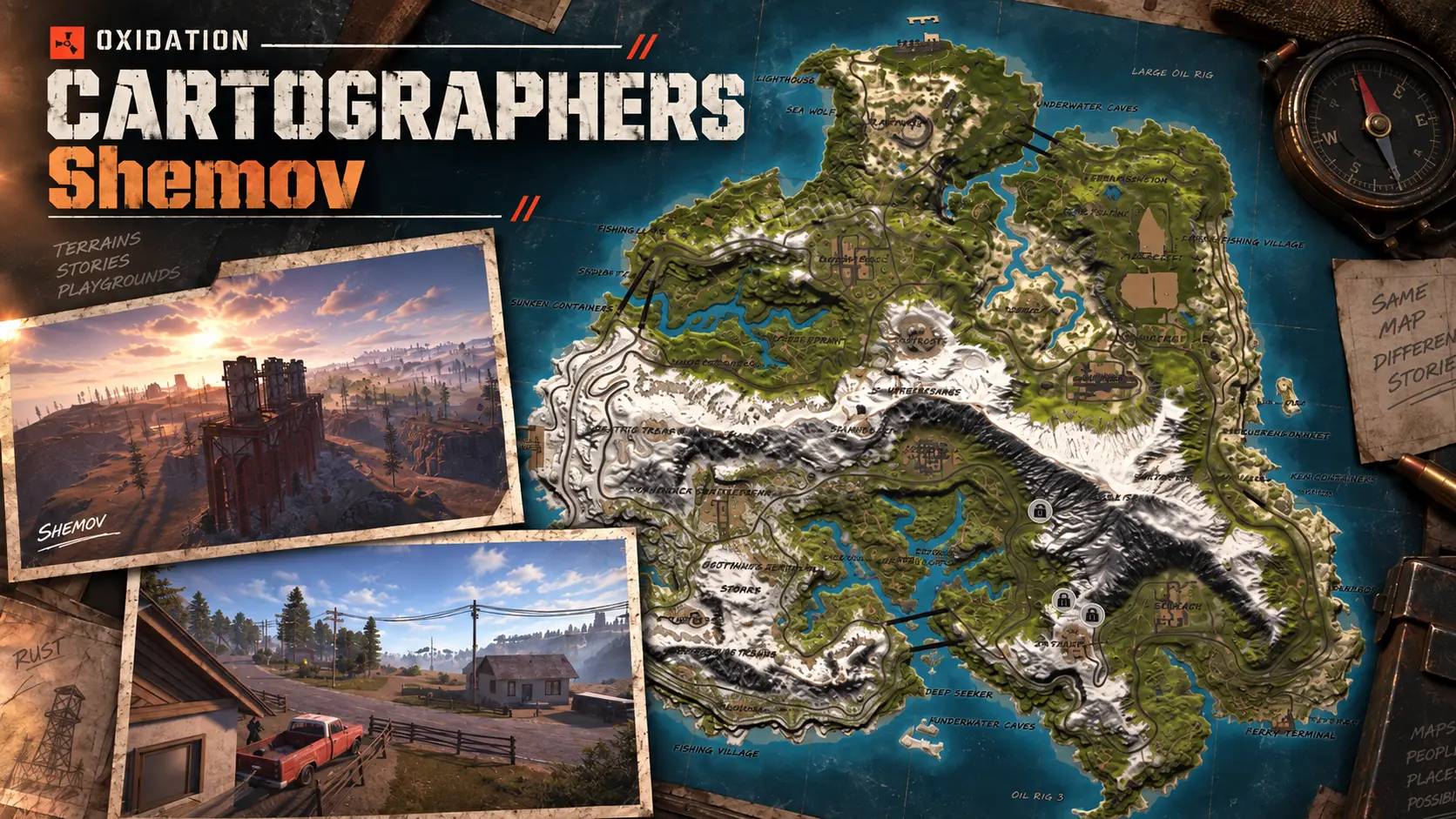
Shemov
Shemov’s work provides a useful example because its change of scale is visible.
His catalogue contains a long series of individual settlements, bunkers, build locations and monuments — contained destinations that can become pieces of somebody else’s world.
It also now contains complete maps, raid islands, arenas and much larger compositions designed around several different forms of Rust gameplay. His current Rusty Island, for example, is a size-4500 world with custom terrain, handcrafted rocks, road and rail systems, underground areas, build locations and dozens of vanilla and custom monuments. (Codefling)
This time, the reviews are especially useful because the customers are not merely praising the monuments inside the map.
They are talking about the cartography.
One called it an:
“Absolutely beautiful Map… Attention to detail was great.”
Another praised its landscapes and execution. And a player claiming 18,000 hours in Rust wrote:
“The best landscape I’ve seen in RUST.” (Codefling)
That is the distinction we were looking for.
Designing one location asks:
What should players find here?
Designing an entire map asks:
What should players find everywhere else?
The empty spaces become part of the work too.
A map that keeps changing
Custom maps also expose another relationship that is much more direct than ordinary game development.
The customer and the Editor can remain in contact after release.
A map page can carry its reviews, discussions, support requests and changelog together. Issues can be reported directly to the person maintaining the work, and corrections can then appear through subsequent releases.
Lost Horizons illustrates that continuing relationship particularly well. The map has gone through thirteen recorded versions, while customer feedback explicitly praises both the landscape and the author’s support. (Codefling)
The map does not necessarily become a frozen product when it is released.
It can remain a conversation between the people using it and the person maintaining it.
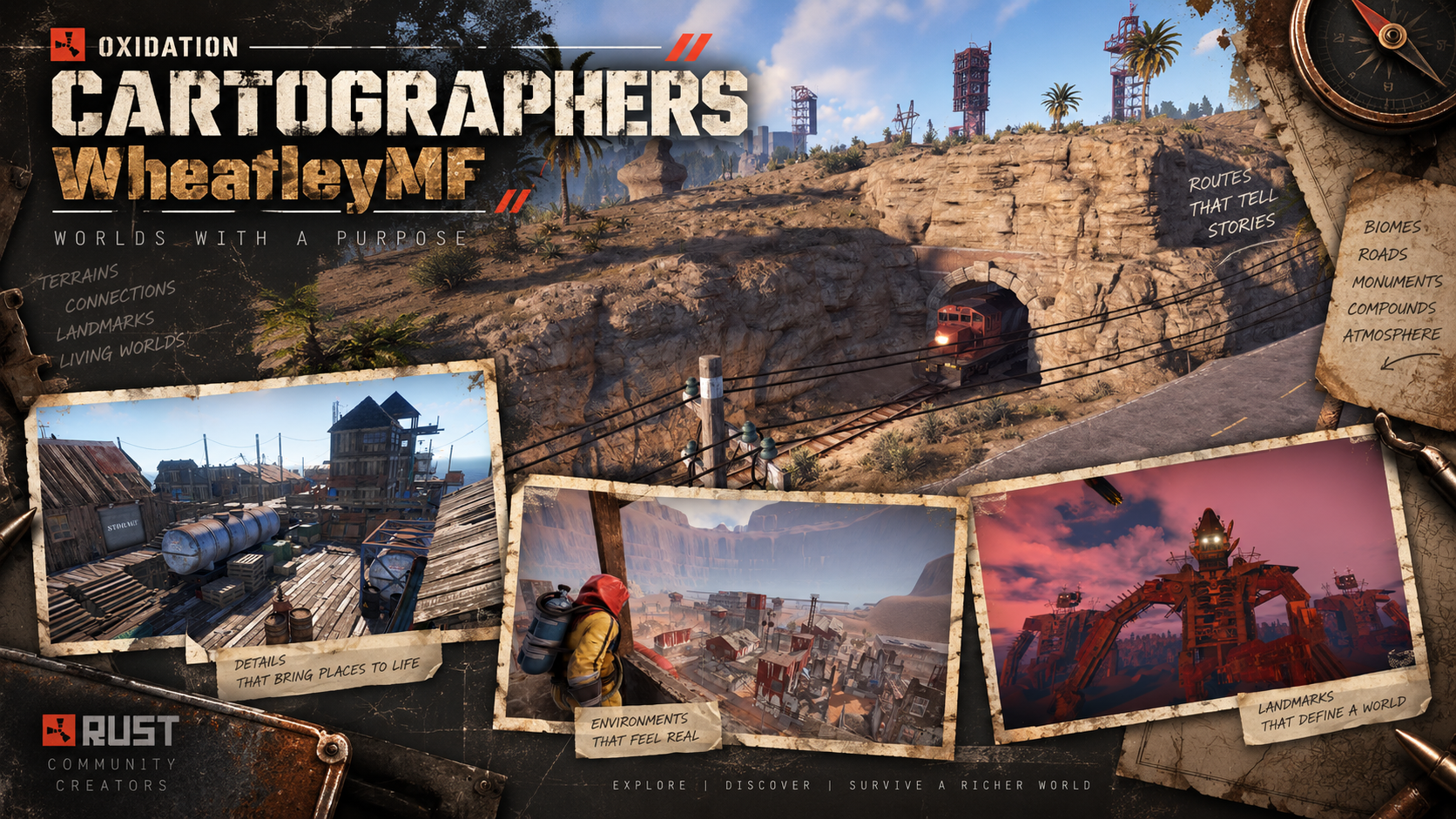
WheatleyMF
WheatleyMF provides almost the reverse trajectory.
Some of his earliest Rust work was also among his most ambitious.
Whole towns.
Oversized structures.
Giant robots.
Town36 was part of his Savage project and became one of the experiences through which he learned what custom Rust creation could — and could not — tolerate.
Wheatley later described it as his starting point. Town36 had initially been the reason he wanted to finish Savage. But the project exposed problems in the map layout and other issues as it grew.
Eventually he reached the opposite conclusion:
“When ‘Town 36’ was finished, it became the reason why I have decided to give up on this map.”
The monument that had motivated the map ultimately became the reason to abandon it.
That makes Town36 particularly interesting in hindsight. It was not simply an oversized city. It was an early experiment ambitious enough to teach its creator where the limits of his approach were.
And Wheatley did not respond by thinking small.
His Robots projects took the same impulse in another direction. In 2018, Facepunch put one of those giant machines at the top of Community Update 200 and called it:
“the most ridiculous custom build we’ve ever seen.”
Wheatley’s explanation was almost disarmingly simple: custom maps were good, but what if he made a scene with a giant robot instead? Facepunch summed up the result as Rust’s parts being pulled apart and reassembled. (Rust)
At the same time, Savage itself was experimenting with geography. Facepunch described its desert canyon and enclosing walls as constraining the action in a way unlike ordinary Rust maps. (Rust)
Later work could take a much more directly usable form.
Sailed Away reimagined the Fishing Village rather than trying to overwhelm the entire island. The question was no longer necessarily how enormous can this become?
It could simply be:
What if this familiar Rust location had been designed another way?
Then, in 2023, WheatleyMF and CollapsedOrange created Observer Island, a 4K custom map with custom mountains, road and train bridges, tunnels, sculpted cliffs, caves, underwater monuments and a deliberately unusual layout.
Facepunch went considerably further than merely showcasing it.
Observer Island ran on official Facepunch servers. (Rust)
For a time, players could therefore open Rust’s Official server list and enter a world whose terrain had been created by community Cartographers rather than Facepunch’s procedural generation.
That is quite a distance from building an oversized city while learning what the editor could withstand.
But the underlying question never really changed.
What else can these pieces become?
Scripters
Then there are places that can look exactly as Facepunch built them…
until something starts happening.
Scripters work on another layer of the world.
An Engineer can build the location.
A Cartographer can decide where it belongs.
A Scripter makes it happen.
That distinction matters because the programmer is not necessarily the person who originally imagined the concept. Custom Rust projects can bring together designers with an idea and programmers whose job is to turn that idea into something a server can actually execute.
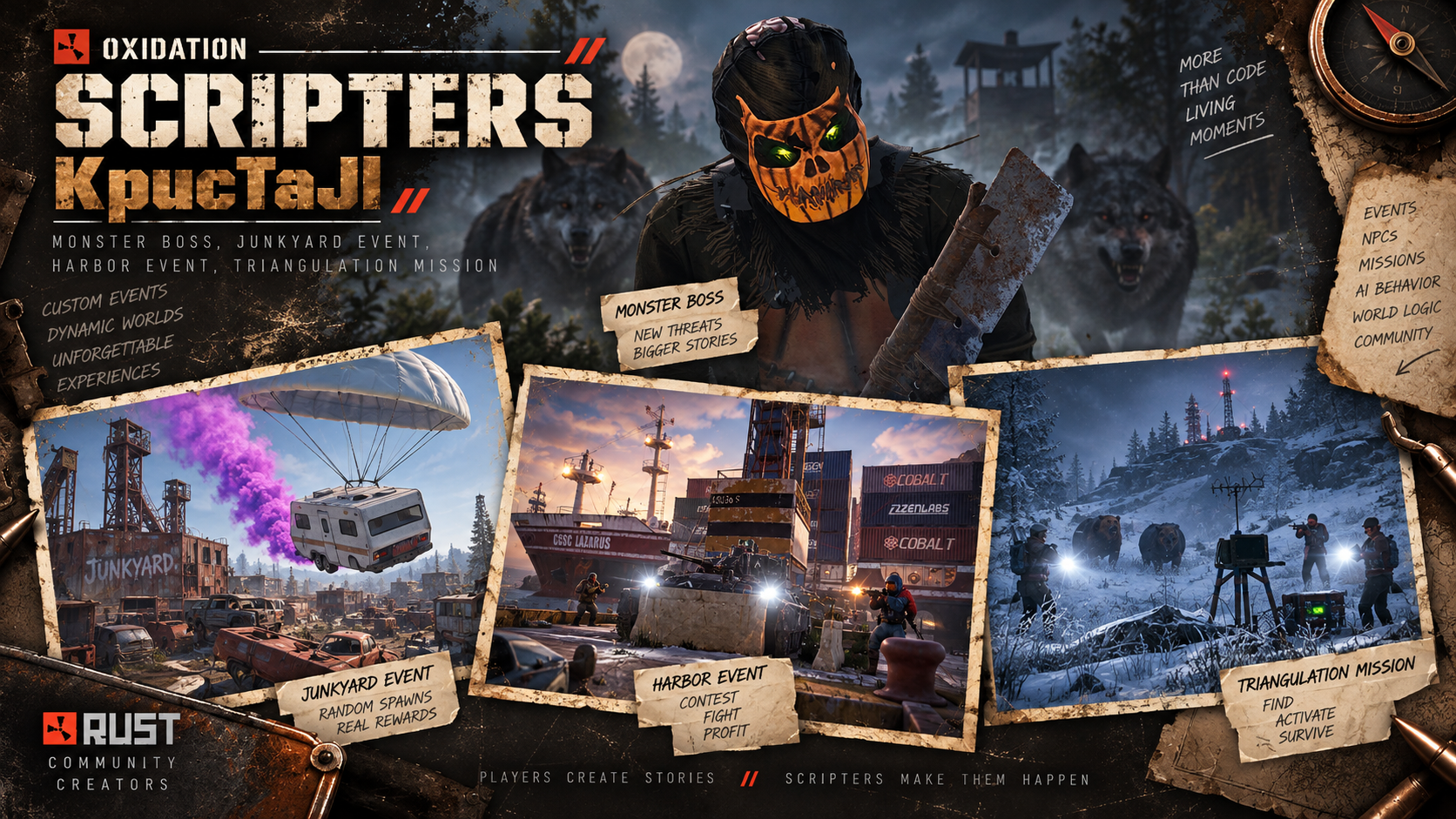
The Junkyard Event is a particularly clean example.
The Junkyard already exists.
So does its magnet crane.
So do the wrecked vehicles and the shredder.
KpucTaJl’s event takes those existing components and turns them into a scenario. NPC scavengers occupy the area. A required grenade is hidden inside one of the wrecked vehicles. Players have to fight through the location and use the Junkyard machinery itself to progress through the event. The plugin remains actively maintained years after its original release. (Codefling)
The Junkyard stops being merely somewhere to visit.
It becomes an activity.
The same idea goes further with the Harbor Event.
A cargo ship arrives. NPCs and an APC defend the area. The Harbor becomes a staged encounter, and its industrial machinery becomes part of an objective rather than simple scenery. The current release page records fifty versions and nineteen customer reviews averaging 5/5. (Codefling)
Again, what matters is what players noticed.
One server owner wrote after two months:
“players love it!”
Another described it as:
“Perfect balance too of tough and fun.”
And another reduced the entire appeal to one image:
“Where else can you see a whole tank guarding a cargo ship in the port.” (Codefling)
That is the Scripter’s contribution in one sentence.
The Harbor already existed.
The ship existed.
The Bradley existed.
Somebody found another game hiding between them.
Mad Mappers
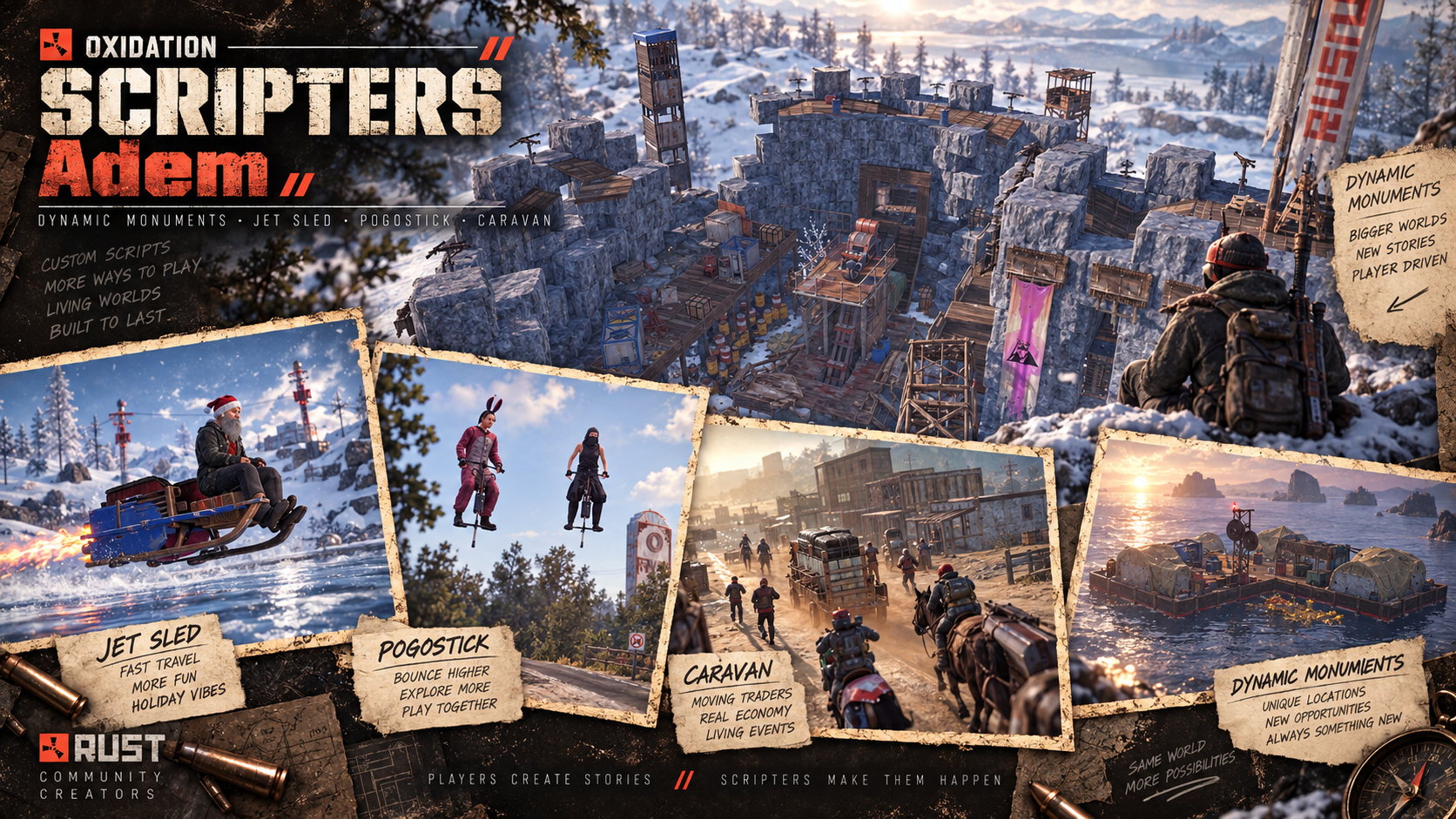
Eventually, these specialties start meeting one another. Like the collaboration between Gruber and many like Adem.
Mad Mappers is a particularly useful snapshot of what this scene has become.
Its current catalogue places complete maps by Shemov and others alongside monuments, scripted events and other server content produced by distinct authors. The individual names remain visible; the shared banner brings complementary specialties together. (Codefling)
That matters precisely because the talents remain different.
An Engineer does not need to become a great Cartographer.
A Cartographer does not need to become a programmer.
And the programmer implementing an event does not necessarily have to be the person who built the place or first imagined the scenario.
What began as individual specialties can become collaborative production.
An Engineer creates the place.
A Cartographer creates the world around it.
A Scripter makes it work.
The finished island can contain the work of several people who have never worked at Facepunch.
The workshop around the Editors
Editors do not work entirely in isolation.
Around RustEdit exists a large community support environment, with its Discord serving both newcomers and experienced users.
Questions are answered.
Problems are compared.
Work in progress is shown.
Techniques circulate.
Someone encountering RustEdit for the first time can ask people who have already made the same mistakes. Someone who has been editing for years can still encounter a strange enough problem to need another pair of eyes.
That exchange matters because much of the practical knowledge behind custom Rust content is maintained by the same community producing it.
The application provides an editor.
The community provides much of the workshop around it.
A lot more than a hobby corner
It would be easy to imagine all of this as a tiny niche living at the edge of Rust.
The visible numbers make that difficult.
uMod currently lists 1,419 Rust plugins. The catalogue includes everything from administration and building systems to events, vehicles, PvE and other gameplay modifications, alongside a considerable historical layer of older and unmaintained work. (uMod)
At the commercial end, Codefling currently reports about 3 million downloads, 12,000 customers served, roughly 170,900 files sold, and 3.7 million in processed payments. (Codefling)
Those figures are not a census of Rust editing.
They do not need to be.
Finished work also circulates through other marketplaces, individual sites, direct commissions and community channels. Those outlets are merely places where some of the work can be found.
The important part is much simpler.
There is a lot of it.
Before filling an empty server
For somebody discovering custom Rust for the first time, all of this can be dangerously tempting.
Maps. Monuments. Prefabs. Events. Scripts.
Every addition seems capable of making a server more interesting.
That does not mean every addition is a good investment.
For a server owner who knows nothing about RustEdit, a finished custom map can be a sensible first experiment. It provides an immediate change of scenery and lets the owner see whether players actually appreciate a custom environment before investing the time required to learn an entire new discipline.
Then watch what happens.
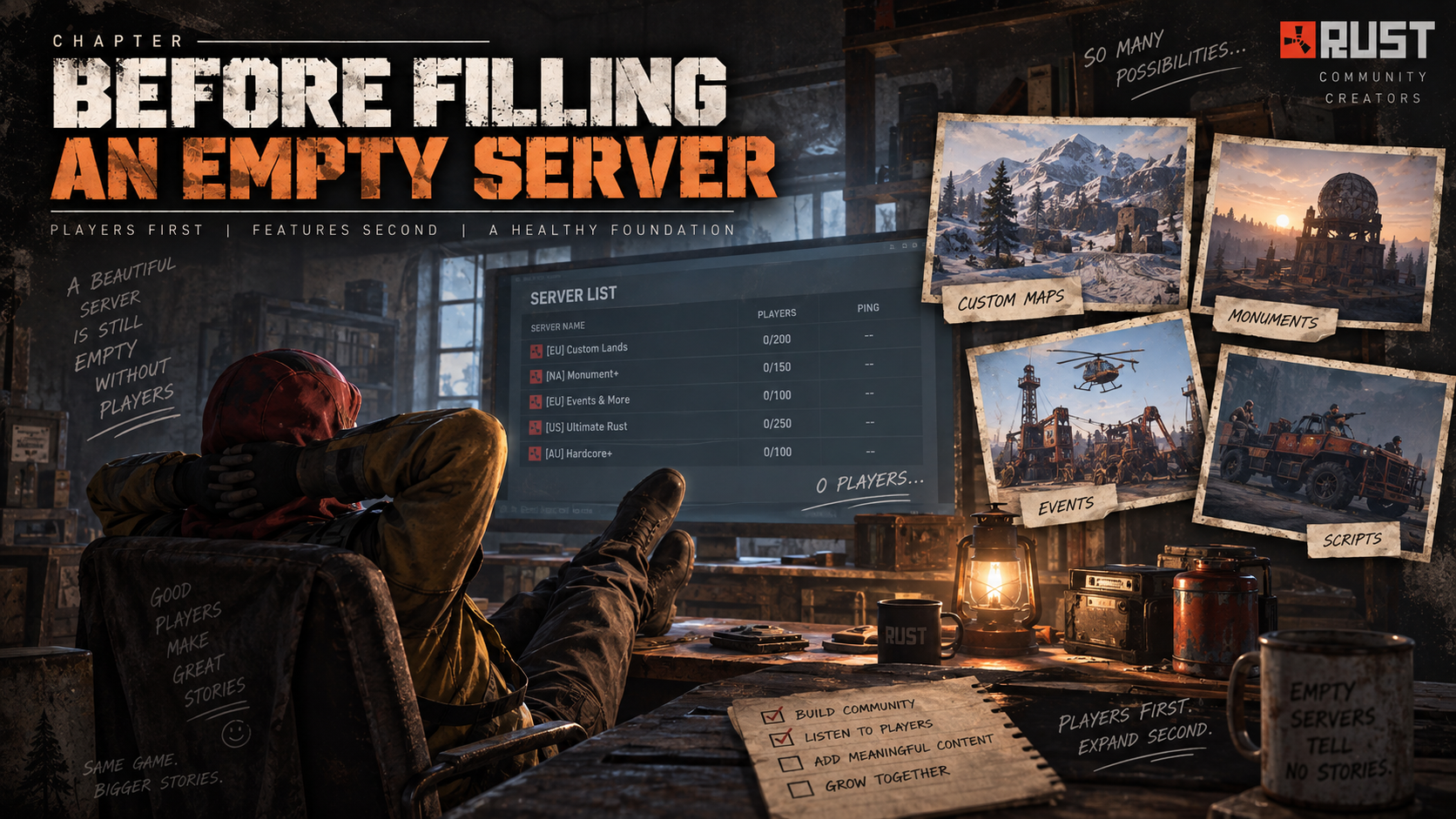
A server without an established player base does not become successful simply because more features have been added to it.
A beautifully decorated empty server is still empty.
Consolidate the player base first. Expand the world around it second.
Once people are actually playing, their response is a much better indication of what is worth adding next.
The other island
Facepunch still makes Rust.
That has never changed.
But custom servers have accumulated another body of development around it.
Someone can sculpt the terrain beneath your feet.
Someone else can build the structure on the horizon.
Another Editor can fill its rooms with objects small enough to overlook.
And somebody you will never see can write the event that begins when you walk through its door.
None of them needs to work at Facepunch.
That is what makes the Editors worth observing.
They do not merely suggest what Rust might become.
They build their version of it.
And once something has been built, another group becomes important.
The people who explain it.
The people who evaluate it.
The people who teach others about it.
The people who turn a session into a story and place Rust in front of an audience larger than any server could hold.
The Editors make things.
The Amplifiers make them travel.
References
- Airship Sky Monuments — Codefling; Cobalt Industries B.F.G. — Codefling; Starlight Reactor — Codefling; c0ini Medieval Set — Codefling; The Scenery and Scenes — Codefling; Rusty Island — Shemov / Codefling; Lost Horizons — Shemov / Codefling; Town36 — WheatleyMF; Robots — WheatleyMF; Community Update 198 — Facepunch; Community Update 200 — Facepunch; Observer Island / Coupling the Rails — Facepunch; Junkyard Event — Codefling; Harbor Event — Codefling; Mad Mappers — Codefling; uMod — Rust; RustEdit Discord.