Landmarks #1 — The January Rust Boom
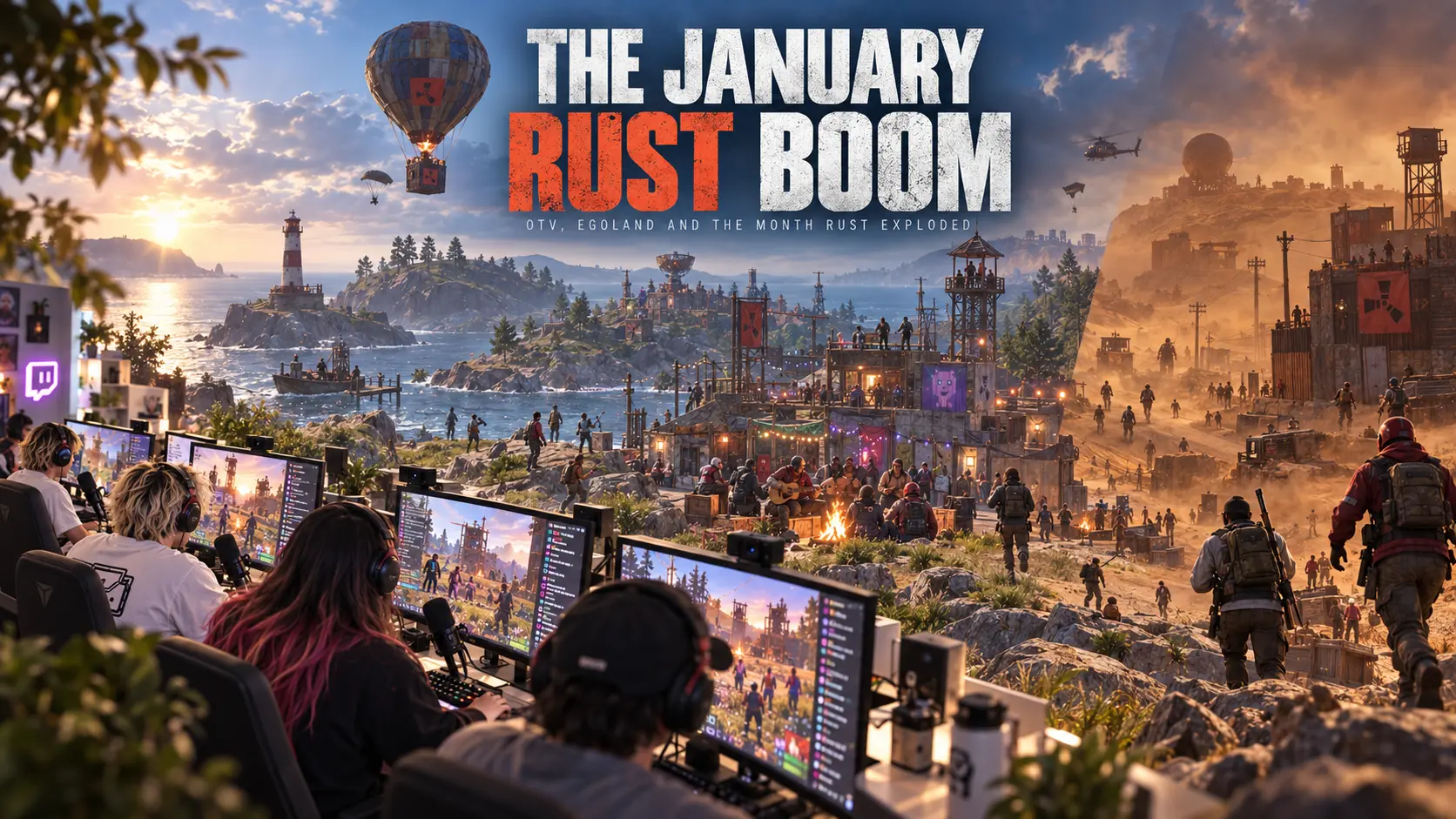
January 2021 changed the scale of Rust. OTV, Egoland and a massive influx of streamers brought millions of eyes to the game, while revealing that Rust could support far more than one way to play.
On December 26, 2020, a group of streamers entered a private Rust server.
They brought friendships, rivalries, enormous audiences and very different ideas about what they were going to do there. Within days, their island had become a shared neighbourhood, an improvised television series and a remarkably public argument about how Rust should be played.
Then another island opened.
On January 3, Egoland gathered creators from Spain and Latin America around a separate Rust server. The two events developed independently, spoke to different audiences and negotiated their own rules. Their activity converged inside the same game category, where established Rust creators were suddenly meeting people whose audiences had barely encountered the game.
In November 2020, Rust averaged approximately 8,800 viewers on Twitch. January reached 256,400, with a peak of roughly 1.4 million. A seven-year-old survival game had entered the audience territory occupied by the largest games on the planet. (SullyGnome: November 2020, January 2021)
The most interesting question is how that ascent happened.
The answer runs through the people on those islands, the audiences watching them and the extraordinary amount of attention circulating between the two.
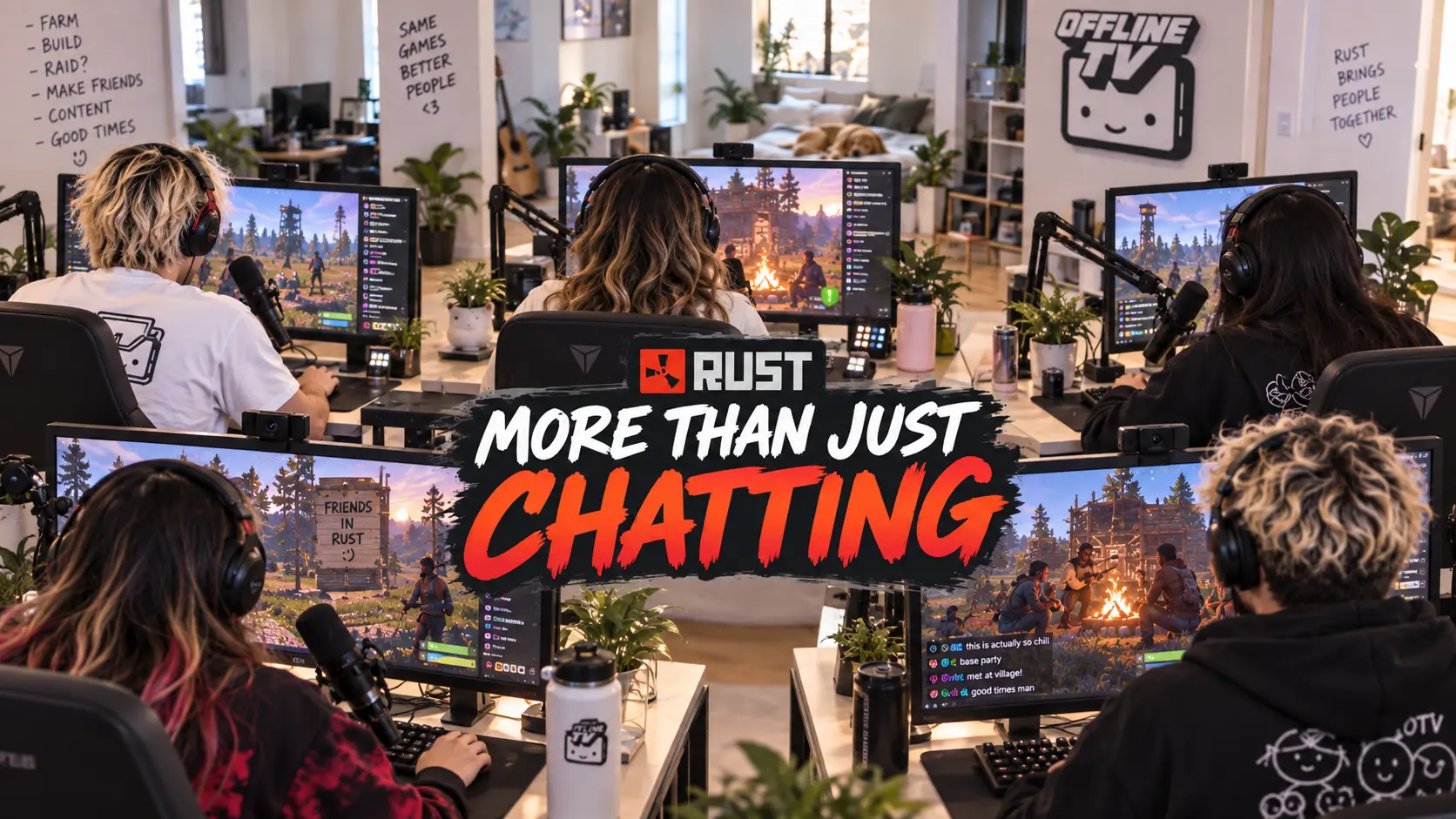
More Than Just Chatting
OfflineTV already knew how to turn shared games into social entertainment. Minecraft had given them long periods where playing, building and simply talking could coexist, while Among Us turned their existing friendships into a social game of lies, accusations and laughter. Rust was different: it demanded far more attention from the game itself.
The expanding OTV & Friends circle also contained considerable competitive experience. xQc came from professional Overwatch. Shroud had played professional Counter-Strike: Global Offensive. Scarra, Voyboy and Shiphtur had competed in League of Legends. Myth had built his reputation around Fortnite.
Alongside them, Pokimane, LilyPichu, Disguised Toast, Sykkuno, Ludwig, Ash and many others brought their own gaming habits and ways of entertaining an audience. OfflineTV supplied the social nucleus; the gathering quickly extended far beyond its membership.
These participants already knew how to make shared play interesting. Rust gave that ability a demanding environment.
A house required resources. A shop needed stock. An expedition required equipment and some understanding of where everyone was going. Hunger, radiation, animals and other players continued to exist during conversations. A friendly evening could become a rescue operation because somebody had fallen off the wrong structure.
Even the social scenes remained connected to the game.
That connection would prove essential. The participants could invent their own reasons for gathering, but Rust kept supplying things that had to be done.
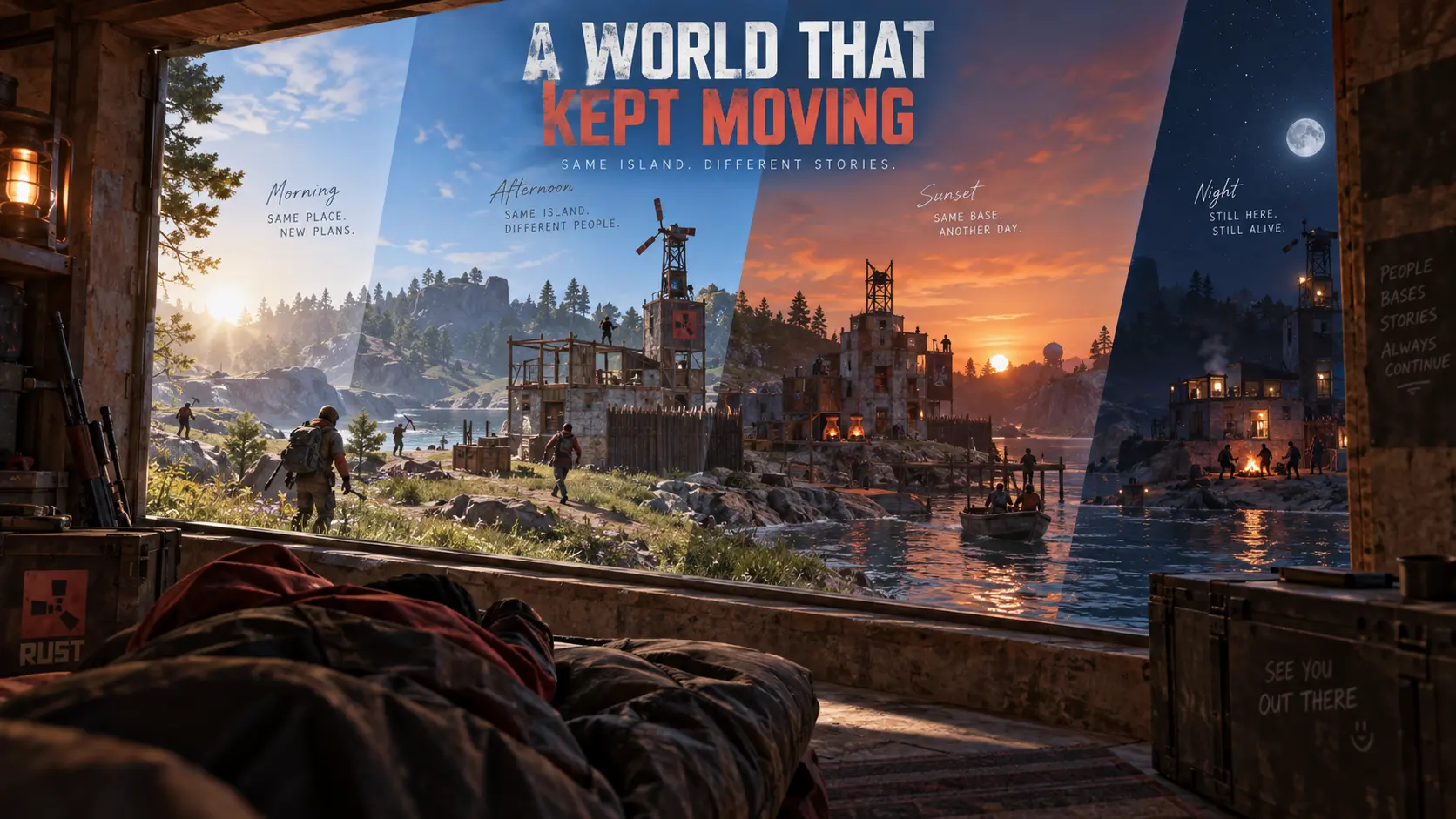
A World That Kept Moving
The island existed while its inhabitants slept.
Neighbours expanded their homes. Other groups acquired weapons. Resources changed hands. A conversation became an agreement, then a disagreement, then a clip that reached another audience before the person involved had returned to the server.
Each broadcast resumed inside a world that had accumulated more history.
This gave the experiment a different rhythm from a succession of matches. Logging in meant discovering what had happened during an absence. Viewers also returned with unfinished business: an expedition to follow, a confrontation to anticipate or a newcomer whose progress had become part of their daily entertainment.
The timing helped.
By the winter of 2020–2021, many people had spent months working, studying and socialising online. Gaming and livestreaming had already expanded during the pandemic. Nielsen reported in 2020 that 46 percent of American gamers surveyed were playing more because of COVID-19. (Nielsen)
Rust arrived within that culture as a persistent place. It had homes, neighbours, businesses, roads and journeys. People physically separated from one another could still have a destination in common.
Long sessions helped keep the island populated, but their duration alone explains little. Ten or eleven hours online could already resemble an ordinary working day for a major streamer. What mattered was the ability to keep the same world interesting over successive days.
The participants kept the interest alive. Rust provided a framework rich enough for their social life to remain attached to the game.
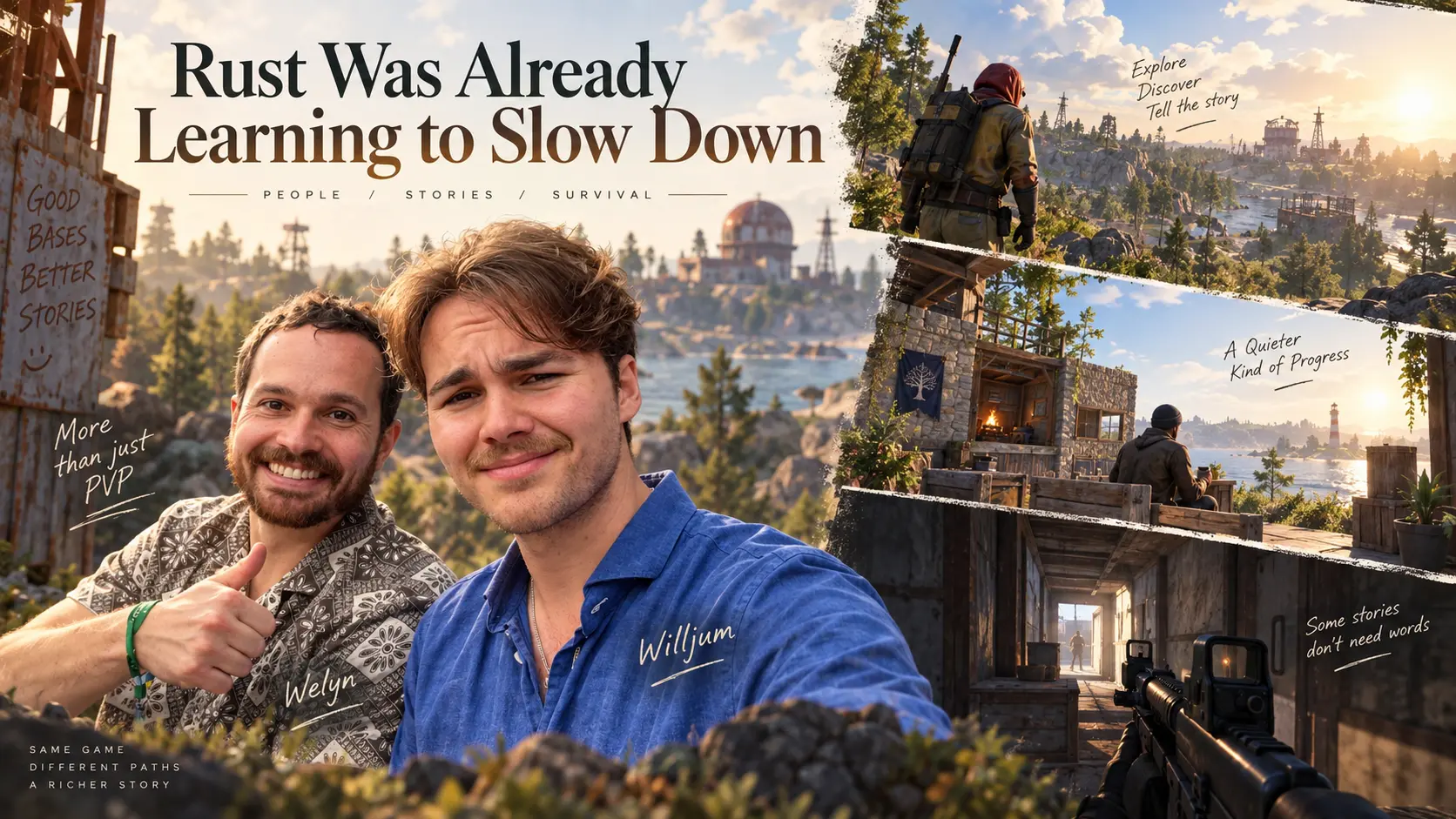
Rust Was Already Learning to Slow Down
When OTV arrived, Rust was already learning that being entertaining did not require every encounter to end in a fight.
Welyn had demonstrated this for years.
He was perfectly capable of playing Rust at a high level, but combat was rarely the entire point of his videos. A raid could become revenge. A neighbor could become a character. A strange encounter could carry an episode. PvP remained part of Rust, but Welyn increasingly used it as one ingredient in a larger story.
Facepunch had noticed. His work appeared repeatedly in the Community Updates long before OTV, alongside other creators who were turning ordinary wipes into something worth following.
Willjum represented another direction.
He was still a very young creator when the first OTV wave arrived, and his style was already unusually quiet. He could farm alone for hours, choose an anonymous corner of the map, build a base simply because he liked the design, and allow a wipe to develop around whatever happened nearby.
There was very little need to announce dominance.
The interesting part was often simply watching somebody live in Rust.
That did not make Willjum harmless. As his mechanical skill developed, he became perfectly capable of competing with experienced players. The difference was that becoming stronger never required abandoning the relaxed identity that had attracted his audience in the first place.
AloneinTokyo pushed that idea even further.
For some players, even narration could become unnecessary.
He remained largely anonymous, rarely relied on voice, and allowed the game itself to explain what was happening. Farming, building, defending, watching another group from a distance, preparing for an attack, surviving it — the sequence of decisions became the narrative.
The player did not need to step in front of the game to tell the audience what to feel.
Rust could speak for itself.
That anonymity also changed the relationship between creator and viewer. There was less personality to follow in the conventional streamer sense. The attraction came from observation: understanding what the player had noticed, anticipating the next decision and watching an apparently ordinary solo existence become increasingly complicated.
Neither Willjum nor AloneinTokyo was part of the original OTV event in January 2021.
That matters.
They were not examples produced by the phenomenon. They were references outside it — evidence that Rust audiences were already comfortable watching very different kinds of play before hundreds of thousands of new spectators arrived through OTV and Egoland.
For people already following Rust creators, the idea that farming, building, conversation, observation or simply surviving could carry an audience was not particularly radical.
The scale was new.
The principle was not.
Welyn could turn Rust into a story.
Willjum could turn it into a place worth inhabiting.
AloneinTokyo could simply let the game tell the story.
And players such as hJune showed yet another possibility. A highly competitive player could enter a social environment without needing to prove his ability by dismantling everyone around him. Mechanical mastery remained useful, but it could be redirected toward protection, cooperation, spectacle or simply participation.
This helps explain Garry Newman’s reaction when arguments erupted over how people were supposed to play on the OTV server.
When somebody complained that the streamers were not really playing Rust, Garry replied:
“That might be Rust, but that’s not what they’re trying to do.”
His point was practical. The server existed to create fun, watchable content. Its rules reflected that objective.
OTV therefore did not suddenly invent a softer or more social version of Rust. Several of Rust’s own creators had already spent years demonstrating that an audience could remain interested while players farmed, built, talked, explored, created rivalries and occasionally fought — and, in AloneinTokyo’s case, even while the creator himself almost disappeared behind the game.
What OTV changed was the scale.
Instead of one creator shaping a wipe into a story, an entire server could become the story.
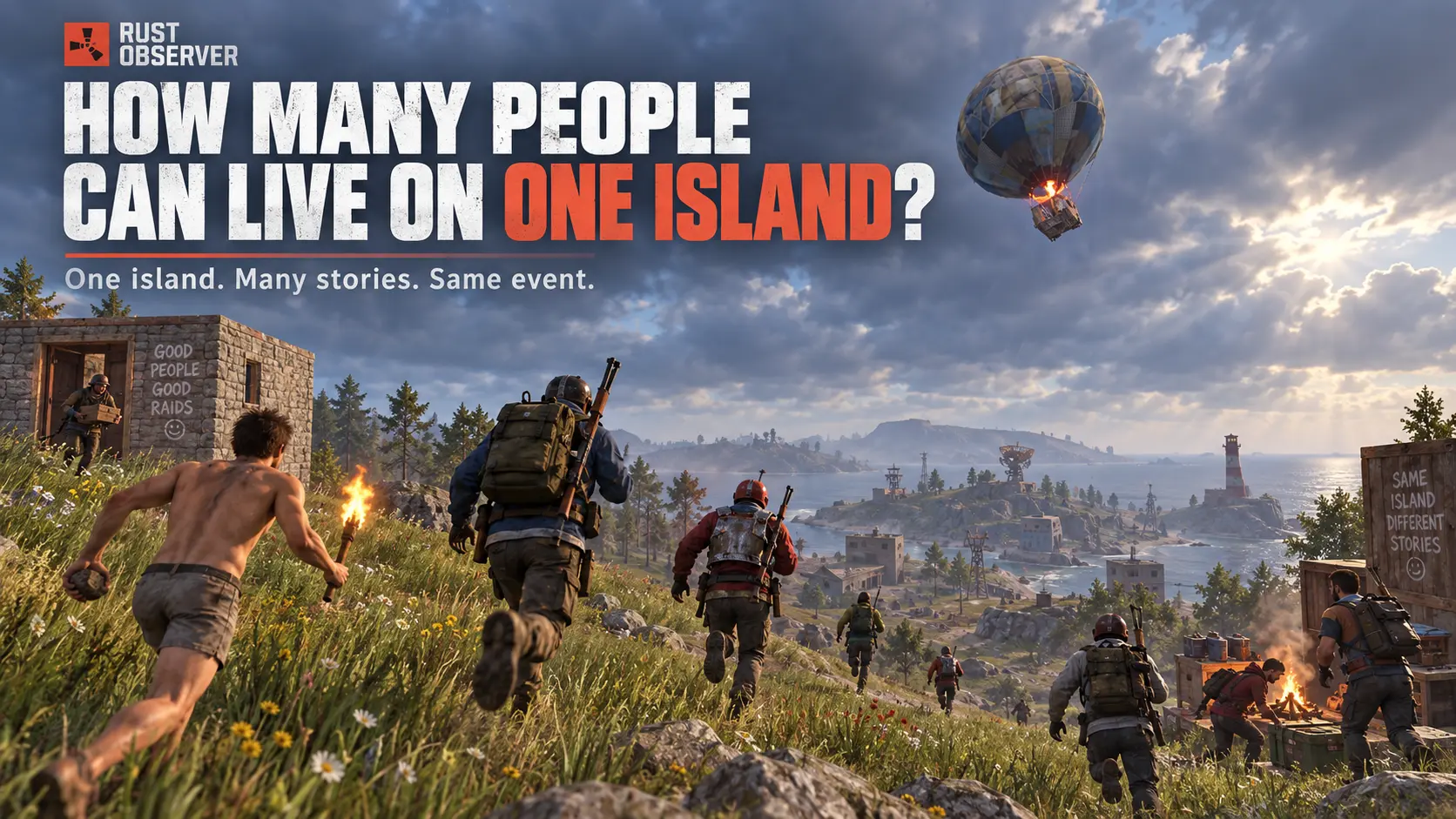
How Many People Can Live on One Island?
The scale of the gathering became part of its appeal.
By January 10, public attempts to track the OTV line-ups already ran to dozens of names in one environment and well over a hundred in the larger roster. Invitations and movements between servers made those lists difficult to maintain. (Gamer Journalist’s contemporary line-ups)
Those were participant lists, rather than a count of everyone connected at once. Their importance lies in the number of independent perspectives sharing the event.
Welyn could be taking newcomers toward a monument while another group negotiated a dispute, somebody worked on a shop and several experienced players prepared for a fight. Each activity occupied the same geography. Each could intersect with the others.
Every broadcast supplied a different entrance.
A viewer arriving through Ash encountered the island through discovery and conversation. Another following a competitive Rust creator saw its resources, routes and vulnerabilities. Both might eventually watch the same encounter from opposite sides.
An ordinary television production chooses which camera to show. Here, the audience could move between cameras.
The island supported houses, groups, solo players, businesses and expeditions while allowing their inhabitants to pursue different objectives. Its social density came from that coexistence. A journey across the map could cross several other broadcasts without anybody having scheduled a collaboration.
Rust’s capacity to hold a large population was already familiar to its players. These events made the storytelling potential of that population unusually visible.
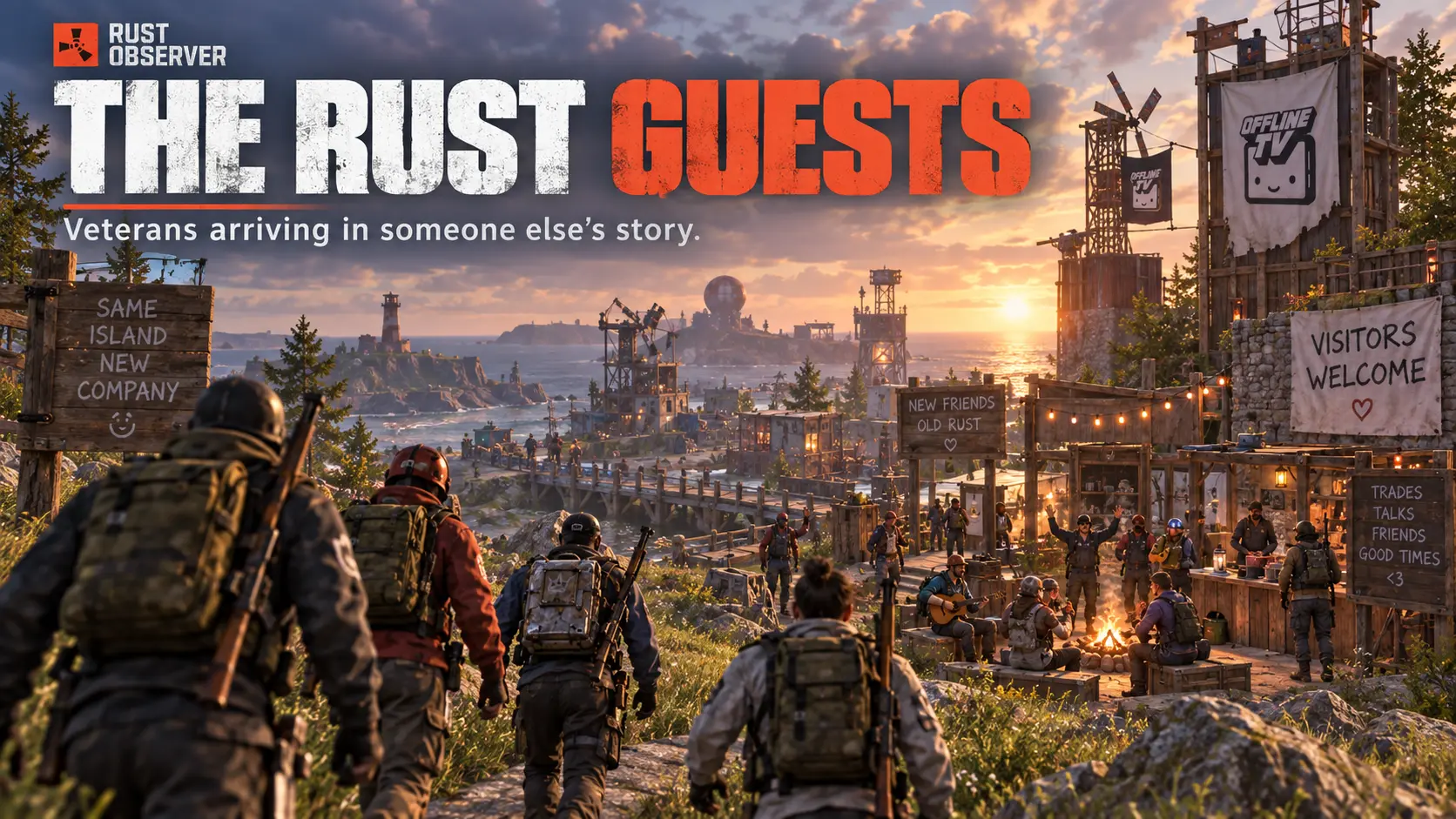
The Rust Guests
Established Rust creators arrived as invited participants in an environment whose social rules were still taking shape.
Welyn and hJune appeared within the more socially oriented circle. Blooprint, CoconutB, Ser Winter, ZChum, Stimpee, Enardo, Hutnik, ShackyHD, BaseTradeTV and Swales94 were among the Rust names documented across the expanding server population. (January 2021 participant lists)
They brought different forms of experience. Combat specialists understood progression, positioning and the consequences of leaving a base poorly defended. Storytellers knew how to extend an encounter. Explorers could turn an unfamiliar monument into an expedition that everyone understood well enough to enjoy.
Their position resembled that of guests entering an established social circle. Familiar Rust behaviour now required an additional judgment: how would these particular people receive it?
Experienced players could adapt, explain, negotiate or test the boundaries. Those who enjoyed PvP still looked for opportunities to fight. The meaning of a fight depended heavily on the expectations surrounding it.
Welyn worked naturally as a bridge between experienced Rust players and newcomers.
With Ash and others, teaching became part of the entertainment. Navigation, monuments, puzzles and survival supplied practical objectives. Mistakes created comedy. A trip to the Dome or Military Tunnels could be interesting because the participants were discovering how the place worked.
Welyn also had the credibility to keep experienced players comfortable within that slower pace. His knowledge gave an expedition direction without requiring everyone to become competitive.
Ash’s growing independence gave viewers another story to follow. Early uncertainty gradually became familiarity. Her friendly manner often encouraged others to treat her as harmless, even when she was standing suspiciously close to the latest complication.
These relationships made game knowledge socially useful. The newcomer gained confidence, the veteran acquired a new audience, and the lesson itself became something worth watching.
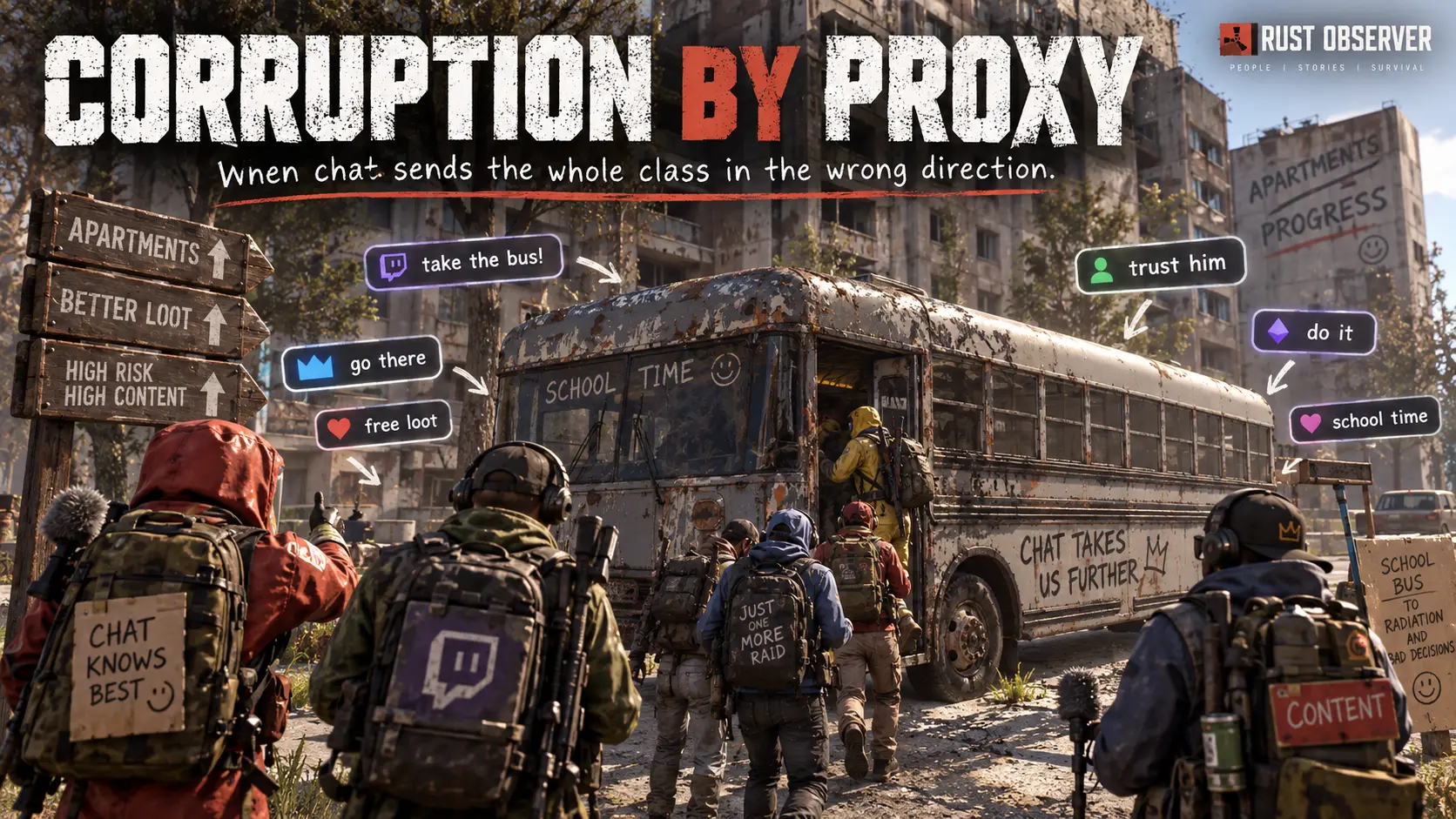
Corruption by Proxy
Another population of Rust veterans entered through Twitch chat.
Viewers recognised valuable components, weak walls, dangerous routes and profitable opportunities. They could advise Myth, Ash, Pokimane or another newcomer on what to collect, where to recycle and which doorway urgently needed attention.
They also supplied judgments.
A neighbour looked suspicious. A stranger was carrying something worth taking. Somebody should retaliate. Somebody should attack first. An exposed weakness was an invitation.
Every suggestion carried a fragment of the Rust those viewers already knew.
The streamer was therefore learning two things simultaneously: the social environment being built with friends, and the habits of players accustomed to much less forgiving servers.
This was corruption by proxy.
The audience could import suspicion, opportunism and competitive expectations without obtaining an invitation to the island. It happened suggestion by suggestion, reinforced by reactions whenever the streamer followed the advice.
The influence also travelled in the other direction. Established Rust viewers watched experienced players negotiate, teach or spend an evening doing something that contributed little to competitive progression. Familiar creators became guides to unfamiliar ways of enjoying the game.
The exchange made the event more interesting and its social boundaries harder to maintain.
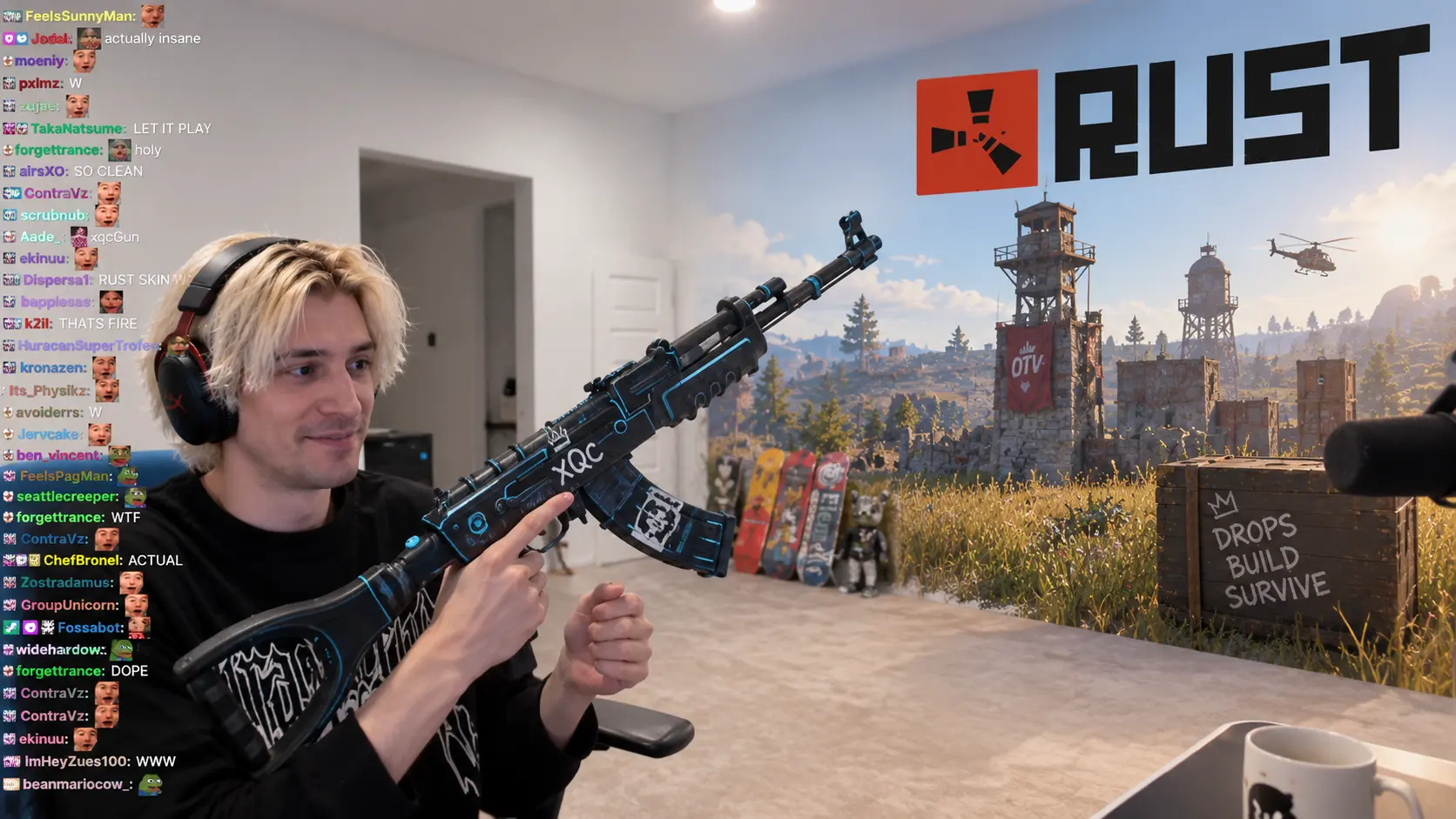
xQc and Competitive Gravity
xQc gave those tensions an enormous stage.
His public identity remained closely associated with confrontation, immediate reaction and competitive pressure. Other former professional players were present, but xQc’s broadcasts gave contests and disagreements a particularly intense rhythm.
Rust complicates that competitive instinct.
The person behind the rifle can talk. An opponent can negotiate, become a neighbour or return tomorrow as an ally. The conversation following a confrontation may eventually matter more than the loot involved.
That produces two different reasons to keep watching:
I want my player to win.
I want to see what happens to my player.
Both existed on the OTV servers, often within the same audience.
LilyPichu, Ash or Disguised Toast could produce an excellent evening through a failed expedition, an improvised business or a situation that became progressively more ridiculous. A disaster might create several days of entertainment.
Competitive success remained valuable. It simply operated alongside other rewards.
As communities mixed, the same encounter could be interpreted as skilled play, excessive aggression, a successful joke or a violation of the atmosphere everyone had been trying to create. Clips carried those interpretations across audiences that had seen different portions of the story.
xQc amplified a tension already present in the arrangement: Rust offered competitive opportunities faster than the participants could agree on when taking them was appropriate.
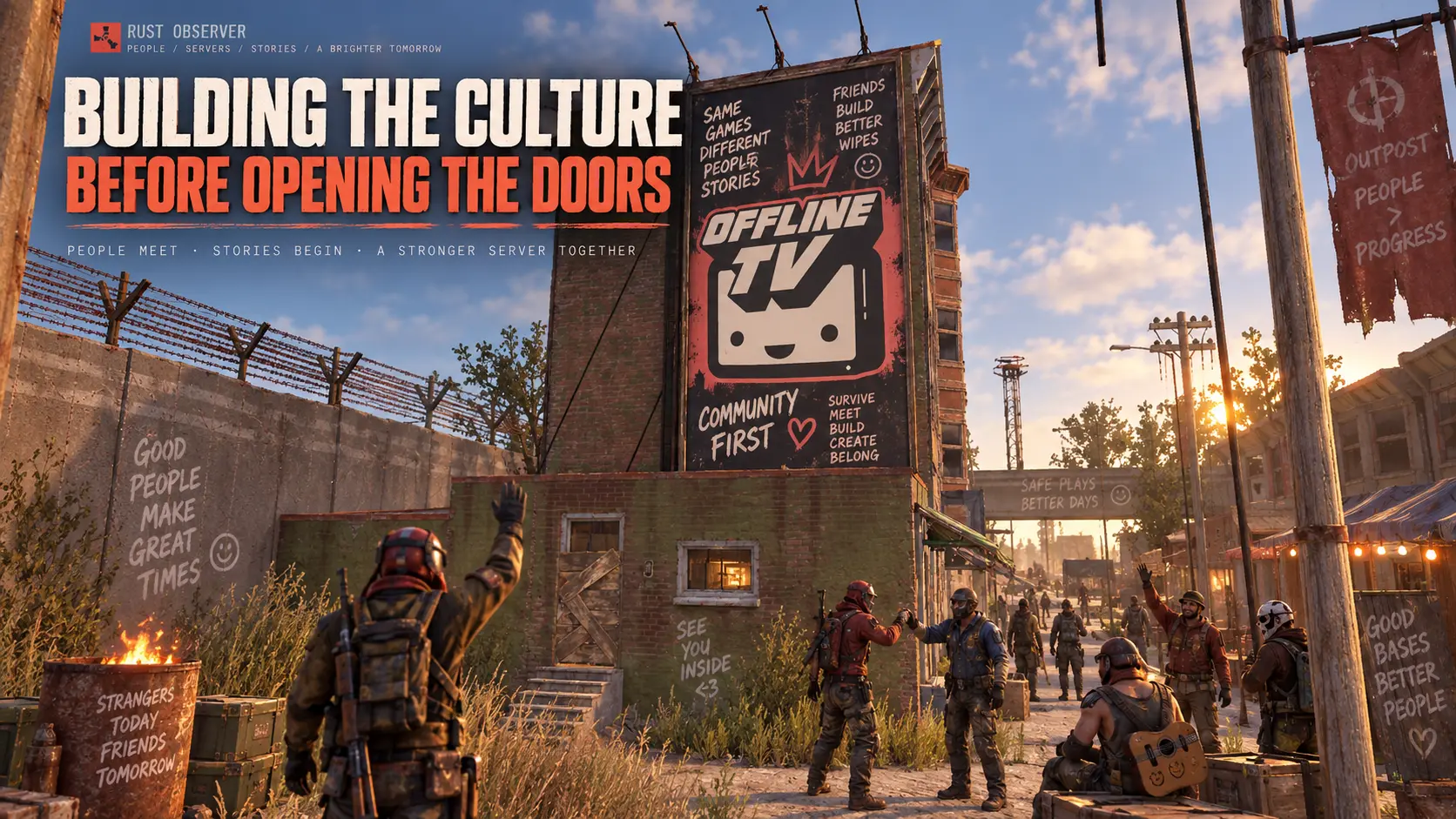
Building the Culture Before Opening the Doors
A small group can establish shared habits gradually.
Friends learn a game together, discover what they enjoy and develop a sense of which behaviours belong in their particular world. Invitations then introduce newcomers to something that already has a recognisable character.
The OTV Rust server expanded while that process was still underway.
Experienced players progressed quickly. New participants brought different expectations. Growing audiences scrutinised interactions that would have passed without comment on an ordinary server.
The game’s progression and the group’s social development moved at different speeds.
By January 1, Abe had announced a reorganisation for January 7. A new environment would have fewer participants, stricter rules and a stronger roleplay focus; the existing server would remain available for freer PvP and raiding. He also clarified that the decision involved more than xQc alone. (Abe’s announcement, reported by Dexerto)
The split gave participants somewhere better suited to their intentions.
It also changed the shared story.
Accidental encounters between incompatible playstyles had produced some of the event’s most unpredictable scenes. Separating those styles reduced the need for constant negotiation, while also reducing the number of occasions when everyone’s stories could collide.
The effect resembled sandpaper: removing the splinters also smoothed some of the texture.
For OTV, the original gathering became more fragmented. Across Rust, viewers gained additional routes toward the forms of play they preferred. Social interaction, exploration and competitive PvP could each lead them toward different creators.
The shared story divided; the audience acquired more places to go.
Ser Winter
Ser Winter’s removal exposed the difficulty of negotiating those boundaries.
Within Rust, he already had a reputation for storytelling and fair play. Viewers familiar with his work brought that history to the incident. Other spectators encountered an experienced player whose actions appeared incompatible with the social expectations surrounding the server.
The disagreement involved two readings of the same behaviour.
A familiar Rust encounter could look entirely different when the participants were also expected to preserve an ongoing social production. Experience made an action easier to perform; it did not guarantee agreement about whether the action belonged there.
Ser Winter was banned on January 9, two days after the major reorganisation. His public response accepted the decision as “completely fair and fine” and said that he had already intended to stop returning after that day. (Ser Winter’s statement, reproduced contemporaneously)
His departure illustrates the growing cost of negotiating social permission around Rust behaviour. Turning it into the cause of the event’s subsequent trajectory would give one incident far more explanatory power than it deserves.
A month later, Facepunch included his dedicated Ser Winter AR in the February Twitch Drops programme. (Ser Winter AR)
He lost his place in OTV, but not his place in Rust.
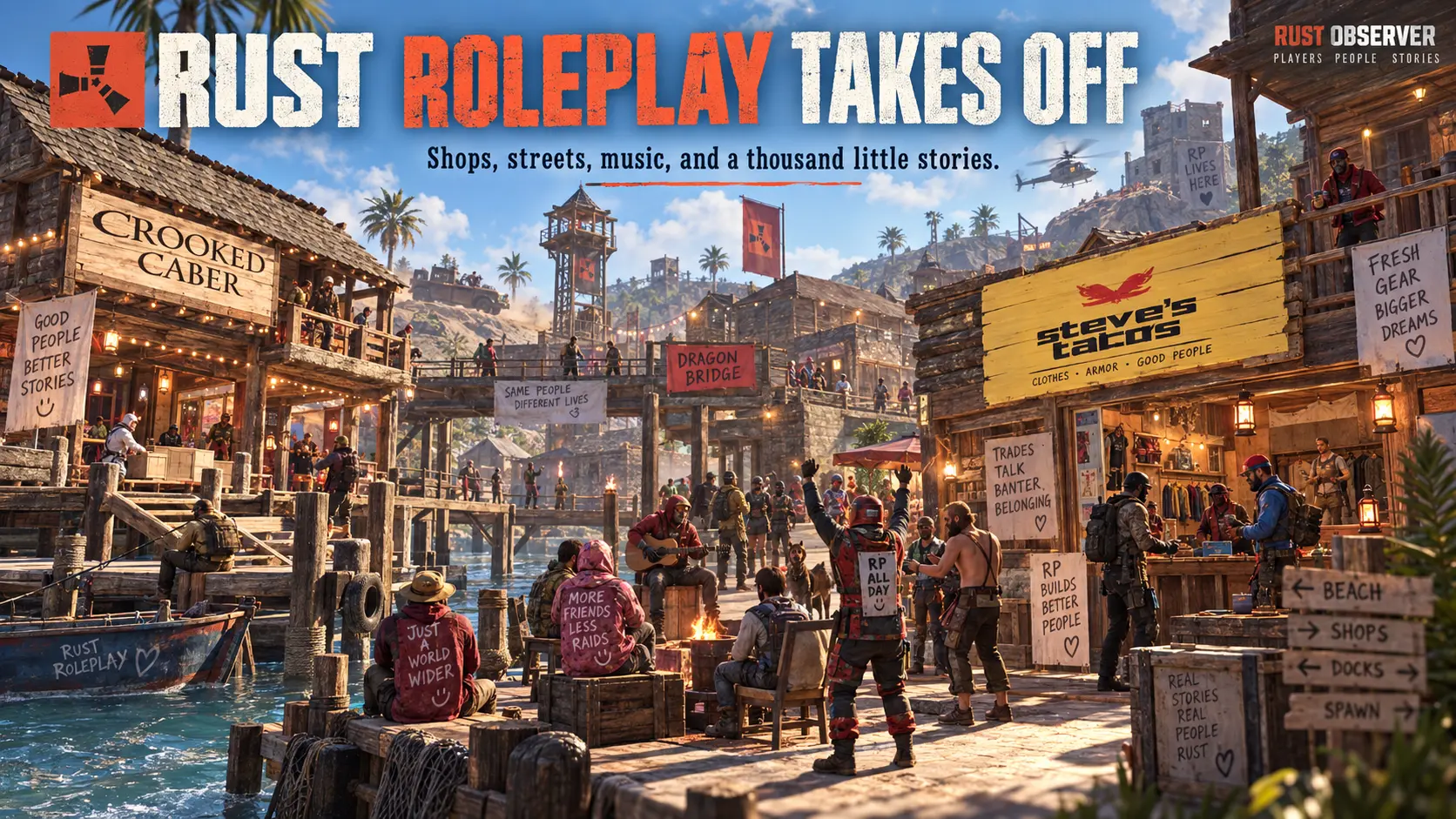
Rust Roleplay Takes Off
On January 21, Facepunch wrote:
“Rust Roleplay has taken off thanks to OTV & Friends.”
The same Community Update featured Holmzy’s House of Horror, which had trapped LilyPichu and Jacksepticeye, alongside other creations from the wider Rust community. (Community Update 230)
Roleplay already had a history in Rust. January gave its possibilities an extraordinary public demonstration.
Later that month, game lead Maurino “Helk” Berry described that variety as something already built into Rust. There was core PvP, he explained, but also roleplay, within a game deliberately designed with few restrictions and left largely to its players. Different additions — farming, vehicles, electricity, instruments and combat — naturally appealed to different creators. OTV had not discovered a loophole in what Rust was supposed to be; it had exposed, at enormous scale, how many different things the same island could support.
The social objectives remained connected to the island’s systems. Construction required gathering. Commerce required goods. Travel involved danger. An event occupied a place that had to be built, supplied and sometimes defended.
Weapons could protect a gathering, interrupt it or become part of its performance. A monument could provide loot, a lesson or the setting for a disastrous outing.
The difference often lay in intention.
Participants could pursue resources because they wanted to organise something with their neighbours. They could fight because a rivalry had become entertaining. They could enter a dangerous area because watching their friends attempt it was worth the risk.
That range of purposes helped Rust remain a game throughout the social experiment. The island continued to give its inhabitants reasons to act.
Meanwhile, Egoland
Egoland opened on January 3, 2021, organised around aLexBY11 and Rubius.
Contemporary coverage counted 76 participants, with approximately sixty taking part at the opening. Their combined broadcasts attracted more than one million viewers that first evening. Auronplay, TheGrefg, Ibai and other major personalities brought enormous audiences into the event immediately. (MeriStation’s launch coverage, El País on Egoland’s participants)
Egoland belonged to an independent Spanish-speaking creator network, with participants and audiences across Spain and Latin America.
Its scale also demonstrates how separate large media worlds can remain. Following Rust closely through English-language creators did not guarantee that a viewer would understand the size or importance of what was happening elsewhere.
Egoland organised much of its activity around Rust’s ordinary pressures: survival, resources, teams, rivalries, alliances and raids governed by agreed restrictions. Social performances grew within those relationships.
OTV devoted considerable effort to preserving the atmosphere of an existing circle inside Rust. Egoland built more of its event around the game’s progression and conflicts.
These were tendencies, with plenty of overlap. Both gatherings produced friendships, arguments, comedy and improvised performances. Both needed rules. Both depended on participants making their shared world worth following.
Their media output, however, reveals a particularly useful distinction.

A Media Machine
Egoland turned its streams into a continuous supply of publications.
Long sessions produced edited episodes, highlights, summaries, compilations and clips. A small encounter could appear from several perspectives. A longer relationship could become a recurring series. Titles and thumbnails gave individual moments another opportunity to find an audience after the livestream had ended.
YouTube’s own account describes more than 70 creators sharing the server for almost thirty days. Alongside survival and conflict, the participants produced entertainment such as Rust Dates and a gladiator tournament.
The platform reported more than 280 million Egoland views during its first 30 days. It also measured a rise of more than 270 percent in average daily views of Rust videos worldwide, from January 3 onward compared with the daily average in January 2020. (YouTube’s Egoland analysis)
That publishing system gave the event reach beyond the people available to watch live.
A viewer could follow a favourite creator’s edited episodes, encounter an isolated joke or discover Rust through an explanation of what Egoland was. The same month supplied material for several forms of viewing.
OTV also generated enormous quantities of clips and videos. Its most visible circulation centred on famous personalities, overlapping fandoms and moments spreading between communities. Egoland made the capacity for sustained, large-scale publishing especially clear.
They were two media machines operating on the same game at the same time.
The Numbers Go Vertical
December already contains the beginning of the ascent.
Rust’s average Twitch audience rose from 8,800 in November to 25,900 in December. The monthly peak reached 330,400. The large January Drops campaign was still ahead. (SullyGnome: November, December)
On January 3, Egoland opened and the wider Rust category passed one million concurrent viewers. By January 4, PC Gamer was covering the gathering as a major Twitch event. (PC Gamer)
January 7 brought the force wipe and the large Drops campaign. Facepunch anticipated heavy demand and added 13 official servers pre-emptively. (January Update)
The commercial movement followed quickly. Rust placed fourth in Steam’s global weekly revenue ranking for the week ending January 3, then reached first place in the rankings ending January 10, 17 and 24. During those three weeks, it ranked above both Cyberpunk 2077 and the Valve Index VR Kit. (January 3, January 10, January 17, January 24)
Garry Newman also reported more than $1 million in Steam revenue on two separate days during the surge. (GameSpot)
The monthly totals show the scale of the convergence:
| Month | Average Twitch viewers | Twitch peak | Hours watched | Average Steam players | Steam peak |
|---|---|---|---|---|---|
| November 2020 | 8,800 | 50,100 | 6.3 million | 55,408 | 101,365 |
| December 2020 | 25,900 | 330,400 | 19.2 million | 61,172 | 97,445 |
| January 2021 | 256,400 | 1.4 million | 190.5 million | 142,117 | 244,394 |
| February 2021 | 66,100 | 346,500 | 44.3 million | 117,742 | 224,276 |
Twitch figures come from SullyGnome’s monthly records; Steam player figures come from SteamCharts. (January Twitch figures, February Twitch figures, SteamCharts)
From December to January, average Twitch viewership and hours watched both multiplied by almost ten. Average concurrent players on Steam multiplied by 2.32.
Facepunch’s January review described its player base doubling within four days and explicitly credited Twitch and YouTube creators, “particularly OfflineTV and Egoland.” It also recorded 48 million game launches and 32,000 servers online. (Facepunch’s January review)
For a few weeks, Rust operated at a scale usually associated with major launches and the largest competitive games.
Its January spectacle was organised around a very different centre. Instead of following a championship bracket, audiences followed a network of people sharing persistent worlds.
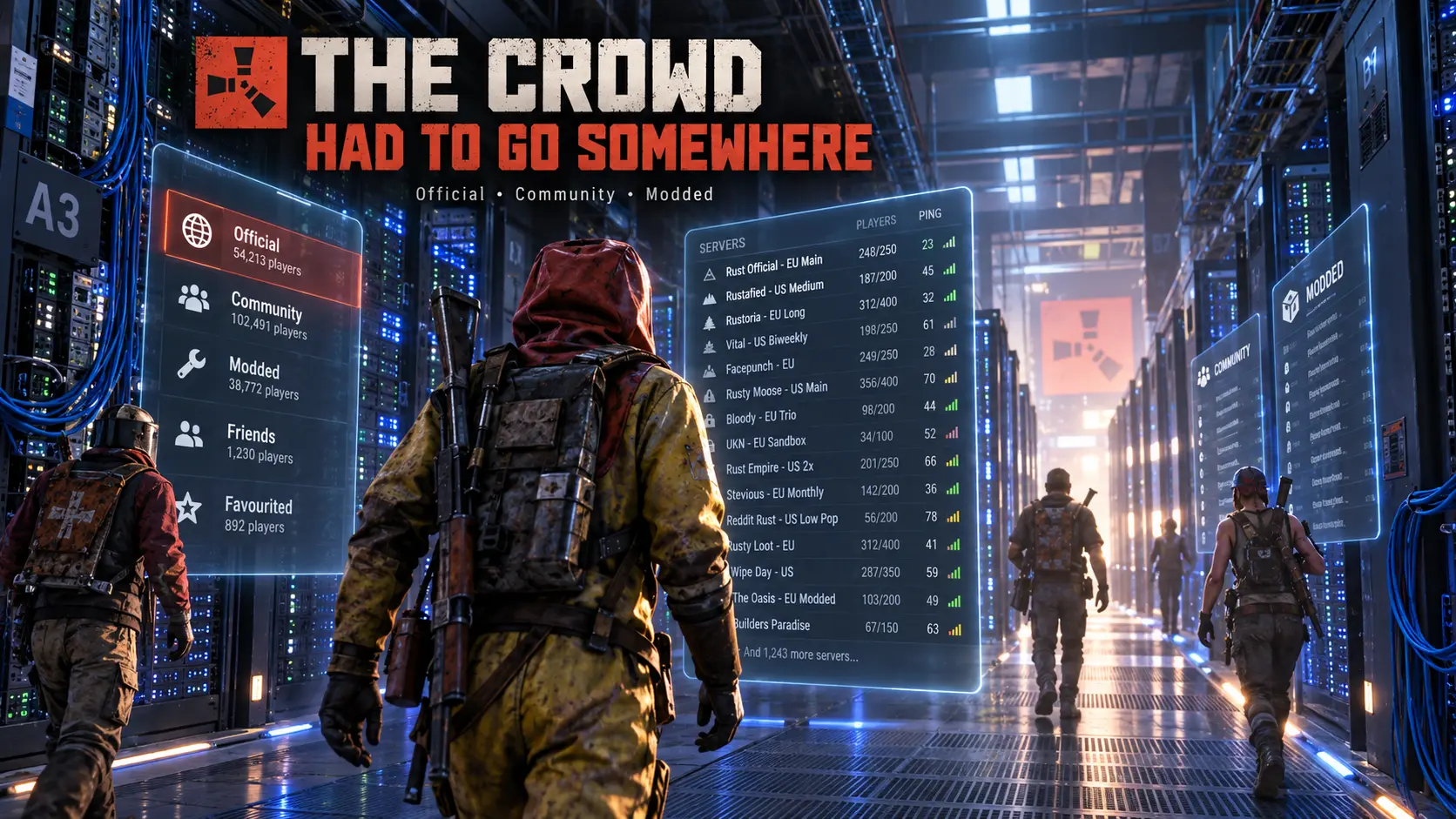
The Crowd Had to Go Somewhere
Hundreds of thousands of additional players could watch OTV and Egoland.
They could not play there.
Once somebody bought Rust, the next destination was the server browser — an existing network of official, community and modded servers with their own populations, rules and expectations.
The January boom therefore reached far beyond the private islands that had created so much of the attention.
Facepunch had already anticipated additional demand by adding 13 official servers for the January 7 update. By the end of the month, it recorded approximately 32,000 servers online. That growth exposed infrastructure which had never been designed for such scale. Facepunch acknowledged that the server browser was struggling with the number of listings, leaving some servers invisible to players and frustrating their owners. The surge also increased pressure on anticheat and moderation, with 31,000 banned accounts and 1.2 million in-game bug, feedback and cheat reports recorded during January.
For individual community administrators, the consequences were more immediate.
Brave New Rust offers a small but unusually well documented example.
On January 17, the returning community server divided parts of its map between PvE and PvP. The intention was simple: new players could build and learn in relative safety while experienced players still had most of the map available for ordinary Rust.
Five days later, the experiment was abandoned.
The administrator reported that griefers were exploiting the PvE area and targeting the newcomers it was supposed to protect. The server returned to vanilla rules while alternatives were considered: a protected compound where beginners could learn, or eventually an entirely separate PvE/RP server.
By February, Brave New Rust described itself as growing every day. That growth also brought more work. Its moderators had already dealt with hate speech and cheating, while the community adjusted its wipe schedule, organised events and tried to establish rules around its new population.
Brave New Rust was only one server, and its experience cannot describe all 32,000.
It does show what the January numbers could mean once they reached an ordinary community.
Players arriving from OTV or Egoland had watched carefully managed environments where rules, invitations and administration helped determine the experience. The public server browser offered something much less predictable. Some newcomers found PvP. Others searched for PvE or roleplay communities. Some encountered experienced players willing to teach them. Others became easy targets.
Server owners, meanwhile, had to decide which of those new players they wanted to keep — and how much they were prepared to change their servers to accommodate them.
The January boom had moved beyond Twitch.
It was now logging in.
January 7 also gave the new audience an unusually complete introduction to one of Rust’s oldest rituals.
The monthly map wipe itself was familiar territory for established players, but this one went further. Following the introduction of the Tech Tree, Facepunch forced a blueprint wipe across every Rust server for the first time in years.
The timing was remarkable. OTV had already shut down its original server and was preparing its reorganised servers for January 7, including a more roleplay-oriented environment. When the new island opened, everyone started again under the same conditions imposed across Rust: new map, new progression, and no accumulated blueprints.
For millions of viewers discovering Rust through carefully organised private servers, the game had just demonstrated one of its less negotiable traditions.
Even OTV had to wipe.
Beyond the Rust Audience
The coverage spread with the numbers.
PC Gamer followed the Twitch records. GameSpot covered the revenue. El País explained Egoland and its participants. La Vanguardia followed the event as a story within the wider streaming landscape. YouTube’s Culture and Trends team eventually examined its global effect on Rust videos. (PC Gamer, El País, La Vanguardia)
Rust had become a subject for people explaining online entertainment to audiences who might never play it.
That expansion followed the creators’ existing relationships with their viewers. Someone arrived for Pokimane, Rubius or Sykkuno and gradually learned what a monument was, why a locked door mattered or why everybody suddenly wanted scrap.
The game acquired meaning through a familiar person.
Veteran creators benefited from the same process. Welyn could become the person who helped a favourite streamer survive. hJune could become a trusted source of expertise. Blooprint could offer a more competitive destination to viewers interested in what experienced Rust players did with the same systems.
Attention moved from the person who introduced the game toward other people who made it interesting.
Drops Follow the Crowd
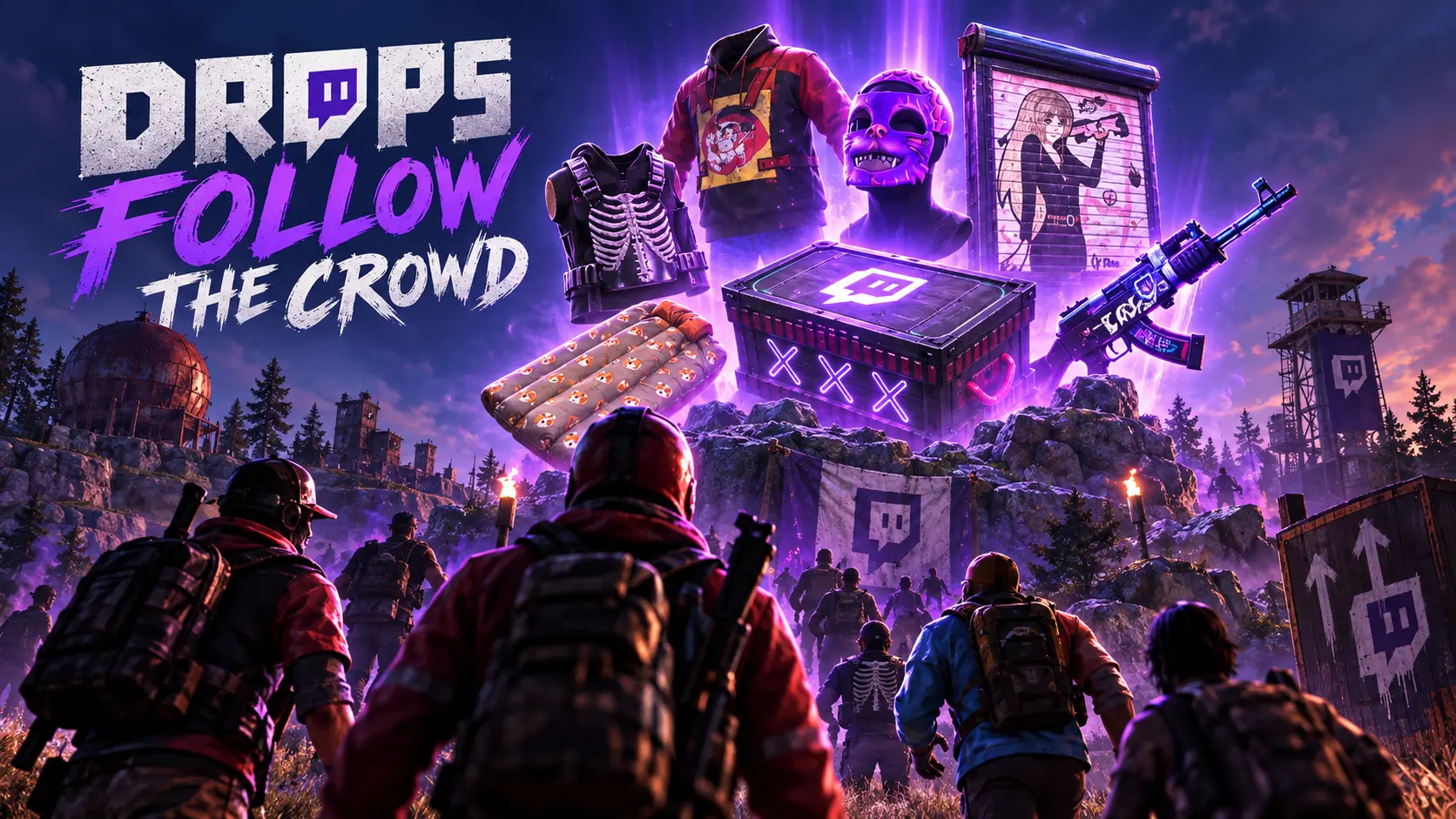
Facepunch had tested Twitch Drops in November 2020. By the time the major campaign opened on January 7, the audience surge was already underway.
The January programme combined general rewards with dedicated items for Auronplay, Jacksepticeye, LilyPichu, Ludwig, Myth, Pokimane, Shroud, Sykkuno and xQc. Watching Rust now offered something viewers could eventually use inside the game. (January Update)
Facepunch counted 9.1 million Drops earned and 5.5 million claimed during January. (January review)
The subsequent campaigns made the circulation especially visible.
On February 4, the programme highlighted established Rust creators including Welyn, hJune, CoconutB and Hutnik. Ser Winter followed in February, while Blooprint and Swales appeared in the March campaign. (February campaign, March campaign)
During his dedicated Drop period, Welyn reached 76,790 concurrent Twitch viewers on February 6. The date links his record directly to this phase of the event: the initial convergence had already happened, and the rewards were concentrating attention on creators within Rust. (SullyGnome’s Welyn record)
The sequence matters. Creators attracted the crowd; Drops supplied an additional reason to remain and an incentive to visit particular channels.
An item could also carry the event back into the game. It became a usable souvenir of a creator, a week of broadcasts or the moment a viewer discovered Rust.
Humans, Rules and Wipes
Egoland’s first season was scheduled to close on February 3, one day before Rust’s next monthly force wipe. The announcement arrived after disagreements between participants and growing pressure around the administration of the event. (MeriStation’s contemporary report)
The calendar supplied a convenient boundary to an experience already being negotiated by its organisers.
A wipe resets territory and possessions. In a creator event, it can also provide a break in the social obligations accumulated around them. Alliances, grudges, protection arrangements and expectations about who should help whom can all become easier to reconsider when the previous world has ended.
That is part of what makes wipes useful as a rhythm for Rust events. A season can have a beginning, an escalation and a conclusion without requiring its participants to inhabit the same island indefinitely. The broader relationship between resets and Rust’s social life is explored in Baby Wipes.
The important distinction is between ending a particular gathering and ending the interest it generated.
February’s figures show how differently those two things could move.
What Remained After January
Average Twitch viewership fell from 256,400 in January to 66,100 in February, a decline of roughly 74 percent.
Average Steam players fell from 142,117 to 117,742, approximately 17 percent. February still averaged about 93 percent more concurrent players than December. (SullyGnome: February, SteamCharts)
The spectacle contracted much faster than the game population.
Those figures describe the immediate aftermath. They show a substantial population still playing after the most exceptional concentration of broadcasts had passed.
The paths taken by individual viewers naturally diverged. Following an invitation-only server could lead someone toward social communities, ordinary survival servers, competitive Rust or continued viewing without playing.
Buying the game supplied the systems seen on stream. Finding the right server supplied much of the surrounding experience.
That distinction helps explain the range of Rust that became visible during the boom. An audience could discover the game through social play and eventually prefer exploration, building or PvP. Established players could also find creators whose habits were closer to their own than the first major streamer they had watched.
The attention had acquired several destinations.
Different Returns
OTV’s later 2021 experiments returned to the problem of building a shared culture.
A more vanilla-oriented approach allowed experienced players to establish Rust’s competitive rhythm quickly. By then, participants already understood far more of the game. Reopening a server also meant bringing back knowledge and expectations that had taken days to develop during the original experiment.
Abe’s subsequent Wild West reset narrowed the population, changed the rules and encouraged a more gradual return.
Seen through the experience of January, that was a change of method as much as a change of scenery. A smaller nucleus had more opportunity to establish how the new society should work before progression and invitations carried it elsewhere.
The longer continuity took different forms.
Egoland returned under its own identity with Egoland 2 in January 2022. OTV’s relationship with Rust also continued through individual participants, collaborations and later events. (Egoland 2 coverage)
In April 2022, an official Rust Twitch Rivals event placed teams led by Disguised Toast and aLexBY11 opposite one another. Facepunch named participants including hJune, xQc, Welyn, BaboAbe and Sykkuno. (Zipline & Rail Update)
Those names show a continuing relationship between the networks brought together around the game.
The original private servers could change or disappear while their participants remained connected to Rust and to one another.
A Reciprocal Relationship
Facepunch already had years of experience showcasing community videos, maps, tools, streamers and charity events.
January expanded the scale of an existing relationship.
Creators brought audiences and supplied the daily material that kept those audiences interested. Facepunch provided the game, official visibility, additional capacity and rewards that encouraged viewers to circulate between channels.
Rust became both the subject of the entertainment and the environment used to produce it.
Nobody necessarily works for the other; they make each other more visible.
The benefits could also cross playstyles. Welyn introduced exploration and storytelling. hJune brought technical and competitive knowledge into social encounters. Blooprint provided a route toward combat-focused Rust. Ser Winter’s continued inclusion showed that a disagreement inside one private community did not determine a creator’s place in the wider game.
The boom brought those forms of Rust into contact without making their audiences identical.
Its significance lies partly in that variety. People could arrive for the same event and leave with entirely different reasons to keep watching or playing.
Then the Servers Burned
The January boom had placed extraordinary pressure on Rust’s server ecosystem.
Two months later, part of that ecosystem literally caught fire.
On March 10, 2021, a major fire destroyed the SBG2 building at OVH’s Strasbourg datacenter. Twenty-five Facepunch European servers went offline, and the affected player progression could not be restored. Facepunch later acknowledged that the relevant backups had been stored in the same facility and changed its backup strategy as a result.
The impact extended beyond the official network.
Community hosts using infrastructure in the same complex were also affected. Rust Observer‘s own network, then running 18 custom servers through Shockbyte, became unreachable following the fire.
Facepunch managed to bring replacement servers online remarkably quickly, but communities did not all recover at the same speed. For European players and server owners who had just experienced Rust’s largest wave of attention in years, the incident was an abrupt reminder that the game’s enormous online world still depended on very physical machines in very physical buildings.
January had shown how quickly Rust could grow.
March showed how quickly part of that world could disappear. The web had made communities appear almost weightless. Strasbourg was a reminder that they still depended on buildings, power, cables, backups — and people.
What the Boom Left Behind
OTV & Friends supplied a social nucleus and a remarkable concentration of famous perspectives. Rust creators connected that gathering to years of accumulated knowledge. Twitch chats carried established player habits into the experiment. Egoland mobilised a vast Spanish-speaking network and generated hundreds of millions of YouTube views. Drops prolonged and redirected attention. Facepunch supported and amplified the activity.
Together, these relationships produced the January ascent.
The records capture its scale: a monthly Twitch audience almost ten times December’s, a Steam population that more than doubled, three consecutive weeks at the top of Steam’s revenue ranking and a much larger player population still present in February.
The process behind those records is what makes the month distinctive.
Dozens of independent personalities could build, trade, explore, fight and perform within shared worlds. Their audiences followed different lives unfolding in the same geography. A lesson became an expedition. An expedition became a disaster. A disaster became a clip that brought somebody else to the island.
The participants gave viewers reasons to return.
Rust gave them somewhere to return to.
References & Useful Links
- Facepunch — January Update, January 7, 2021 — the major Twitch Drops campaign, dedicated creator Drops, blueprint wipe and the addition of 13 official servers in anticipation of the surge. January Update
- Facepunch — January 2021 Review / Softcore Gamemode Update — Facepunch’s own assessment of the boom: the player base doubling within four days, OfflineTV and Egoland, 244,000 concurrent players, 1.373 million Twitch viewers and 9.1 million Drops earned. Softcore Gamemode Update
- Facepunch — Community Update 230, January 21, 2021 — contemporary acknowledgement that “Rust Roleplay has taken off thanks to OTV & Friends.” Community Update 230
- SullyGnome — Rust, January 2021 — Twitch audience statistics for the peak month: 256,400 average viewers, 190.5 million hours watched and a peak of roughly 1.4 million viewers. Rust Twitch statistics — January 2021
- SteamCharts — Rust — historical Steam player counts used to compare the population before, during and immediately after the January surge. Rust — Steam Charts
- SteamDB — Weekly Global Top Sellers, January 10, 2021 — Rust reaches first place in Steam’s worldwide revenue ranking during the boom. Steam Weekly Global Top Sellers — January 10, 2021
- YouTube Culture & Trends — Egoland — YouTube’s retrospective on more than 70 Spanish-speaking creators, 280 million views in the first 30 days and the worldwide increase in Rust video viewing. Spanish-speaking gamers rallied together for a big event called Egoland
- MeriStation — Egoland launch coverage — contemporary Spanish coverage of the January 3 event and its major participants. Egoland, el servidor de Rust con los grandes streamers españoles
- El País / Verne — Egoland — contemporary account of the alliances, rivalries and more than 70 creators involved in the Spanish-speaking event. Egoland: más de 70 streamers juegan a sobrevivir entre alianzas y traiciones
- PC Gamer — Rust passes one million Twitch viewers — contemporary coverage of the category’s extraordinary rise during the first days of January. Rust tops a million peak viewers on Twitch
- Gamer Journalist — OfflineTV server line-ups — a contemporary attempt to document the rapidly expanding participant lists across The Badlands and The Divide. Rust Lineups for OfflineTV’s The Badlands and The Divide Servers
- Dexerto — OfflineTV server split — contemporary coverage of BaboAbe’s decision to separate the more roleplay-oriented environment from freer PvP and raiding. OfflineTV Rust server to be split up amidst xQc crew PVP drama
- Dexerto — Garry Newman on OTV playstyles — Garry’s response to complaints that the streamers were not playing Rust “properly,” including his distinction between ordinary Rust and the kind of watchable content the OTV server was trying to create. Rust dev mocks streamers who’ve been banned from OTV server
- Facepunch — Community Update 150: Welyn — Solo Adventure — an early example of Facepunch highlighting Welyn’s ability to turn skilled solo Rust into concise, entertaining storytelling. Community Update 150
- Facepunch — Community Update 198: Welyn — One Life — another pre-OTV example of Rust gameplay organised around a self-imposed narrative objective. Community Update 198
- Willjum — The True Rust Experience: A Solo Movie, December 2020 — a useful snapshot of Willjum’s emerging solo identity immediately before the January boom. The True Rust Experience.. A Solo Movie
- aloneintokyo — Rust Solo Survival, 2020 — examples of the anonymous, gameplay-led solo format already attracting an audience before OTV and Egoland. MY WIPE DAY on the HARDEST SERVER | Rust Solo Survival
- GameSpot — Garry Newman’s January revenue figures — contemporary reporting of Facepunch earning more than $1 million on Steam on two separate days during the surge. Rust Developer Made More Than $1 Million In A Day Twice This Week
- The Loadout — Interview with Rust game lead Maurino “Helk” Berry, January 27, 2021 — a contemporary account from Facepunch of the unexpected OTV and Egoland explosion, the team’s “delight and disbelief” at passing one million Twitch viewers, Rust’s different playstyles, the purpose of Twitch Drops and the community stories Facepunch was watching unfold during the event. Rust’s meteoric rise on Twitch left its developers in a state of “delight and disbelief”