Oxidation #6 — The Goods
Oxidation Oxidation #1 — Changing Course (1) Oxidation #2 — Pimp My Ride (2) Oxidation #3 — Talented Ego (3) Oxidation #4 — Legacy Please! (4) Oxidation #5 — Editors (5) Oxidation #6 — The Goods (6) Oxidation #7 — Resonance (7) By the time we spawn on the beach on April 26, 1983, merchandise…
By the time we spawn on the beach on April 26, 1983, merchandise is already everywhere.
Pac-Man has escaped the arcade. Contemporary advertising has him on watches, shoes, plush toys, cereal and almost anything else capable of carrying a yellow circle with a mouth. By 1983, his own official history remembers the character being described in the United States as the “Mickey Mouse of the 80s.” (PAC-MAN Official Site)
Masters of the Universe has taken another route. Mattel launched the original toy line in 1982, establishing He-Man, Skeletor, Battle Cat and the physical world of Eternia before the animated series reached television. We remember that the series has not yet aired when we spawn on the beach; He-Man and the Masters of the Universe will arrive later in 1983 and expand a world the toys have already begun to define. (Mattel Creations)
The merchandise industry does not need Rust to invent anything.
Rust first needs to become something recognizable enough to merchandise.
Becoming Rust
That takes time.
Legacy gives way to Experimental. Characters change. Weapons are replaced. Interfaces disappear. Building pieces, environments and monuments go through multiple generations. The visual identity players recognize today accumulates gradually while Facepunch keeps rebuilding the game around it.
Minecraft had a much easier problem to solve. Its visual language established itself early. New blocks, creatures and environments accumulated, but the underlying colours, textures and silhouettes remained recognizable.
Among Us needs even less. Put a crewmate on a product and nearly everything else can disappear. No map, vent or secret passage is required. The character carries the identity by itself.
Rust spends years acquiring that kind of visual shorthand.
And while that happens, Facepunch is overwhelmingly occupied with developing Rust.
Fortunately, the commercial world around games has changed dramatically since 1983.
The Store Was Already Open
When Rust appears in 2013, the infrastructure for fan-made merchandise is already waiting.
Etsy has existed since 2005. Redbubble began in 2006. TeePublic dates to 2013. All three give independent creators access to buyers without requiring them to build a conventional manufacturing and retail operation first. Redbubble can even take an uploaded design and handle the printing and shipping itself. (Etsy, Inc.)
That changes the relationship between a game and its merchandise.
In 1983, turning a successful character into a line of physical products generally required companies capable of manufacturing and distributing them.
By 2013, a Rust player can look at something on the screen and think:
I want this from Rust.
Somewhere else, a creator can answer:
Hold my beer.
Etsy illustrates that exchange particularly well. Furnaces, Eokas, turrets, lamps, signs and miniature props can exist because a small workshop does not need to sell fifty thousand of them. TeePublic and Redbubble make the lighter end even easier: shirts, stickers, posters and fan-designed references can reach a tiny audience and still be worth producing.
This also shapes what fans tend to make.
Small shops are very good at decorations, miniatures, prints and custom props.
A reliable backpack, pair of boots or chair requires something else.
Welyn Gives It a Push
Welyn’s contribution begins very simply.
He wants a physical version of his own character for himself and his fans.
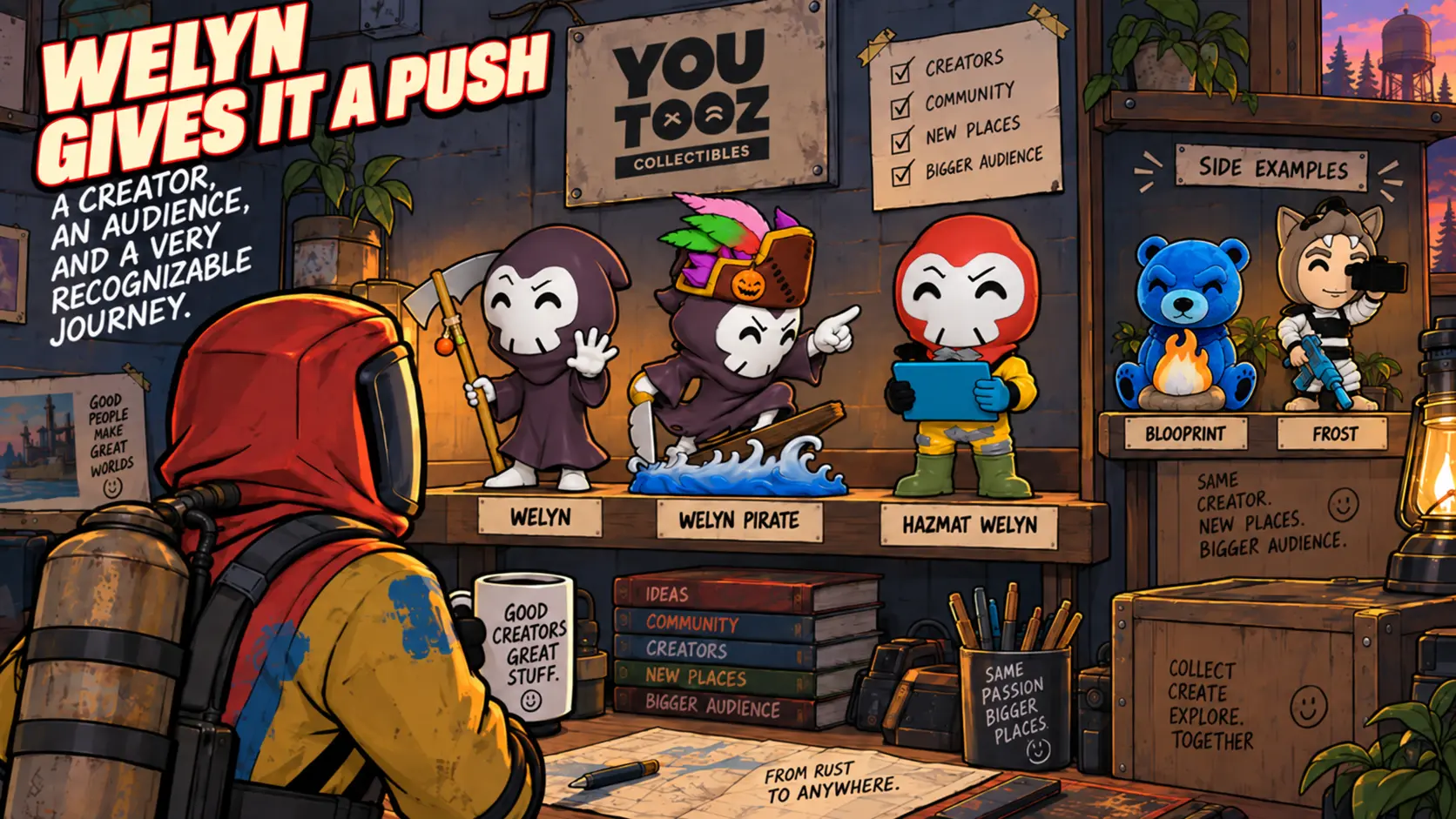
In March 2020, Youtooz releases the first Welyn collectible: his Grim Reaper character, packaged around the imagery his audience already associates with him. The product belongs to Welyn. Youtooz’s own description identifies him primarily through the Rust videos that had built much of his audience. (Youtooz)
The idea proves portable almost immediately.
On December 11, 2020, Youtooz releases a second Welyn figure, this time as an official Welyn × Sea of Thieves × Youtooz collaboration. The same creator identity has moved into another game’s merchandise without ceasing to be Welyn. (Youtooz)
Rust eventually completes the loop.
In July 2022, Hazmat Welyn places the creator directly inside an official Rust collectible. Welyn’s identity and Rust’s Hazmat are deliberately combined into a single physical product. (Youtooz)
Then in November 2025, the Welyn Reaper Plush appears directly inside Youtooz’s Rust collection. The character that began as Welyn’s own physical merchandise has now become part of the physical Rust catalogue. (Youtooz)
That progression is what matters.
Welyn starts by giving his own audience something they can own. Sea of Thieves demonstrates that the creator himself can move into another licensed product line. Rust eventually does the same thing with one of its best-known creators.
And the formula spreads.
Frost receives an official Youtooz collaboration with Rust in 2022. Blooprint gets his own plush in 2023. Epic Desk’s initial Rust partnership explicitly specializes in limited-edition campaigns for content creators and invites Rust creators to bring their own ideas to the program. (Youtooz)
The parallel with streaming is hard to miss.
OTV would later accelerate the rush toward Rust.
Welyn helped accelerate the rush toward physical things around Rust.
Neither phenomenon began with them. Both showed how quickly an existing audience could move once somebody gave it a reason.
For Fans, By Fans
Facepunch tested another route in 2020.
For Fans By Fans allowed community artwork to move into an official merchandise catalogue. Fan submissions could be selected, licensed and turned into real products without Facepunch having to build its own manufacturing operation.
The idea was more interesting than the Rust catalogue that ultimately came from it.
Posters, stickers, mugs, hats and desk accessories were already easy to find elsewhere — often with more variety, better presentation or more specialized products. When FFBF later changed ownership and eventually closed its storefront, Rust merchandise did not disappear with it.
By then, other manufacturers and creator platforms were already filling the same space.
The channel disappeared. The demand did not.
From a Furnace to a Factory
Lootroom does not enter Rust as a large merchandise company looking for another licence.
It grows from Rust.
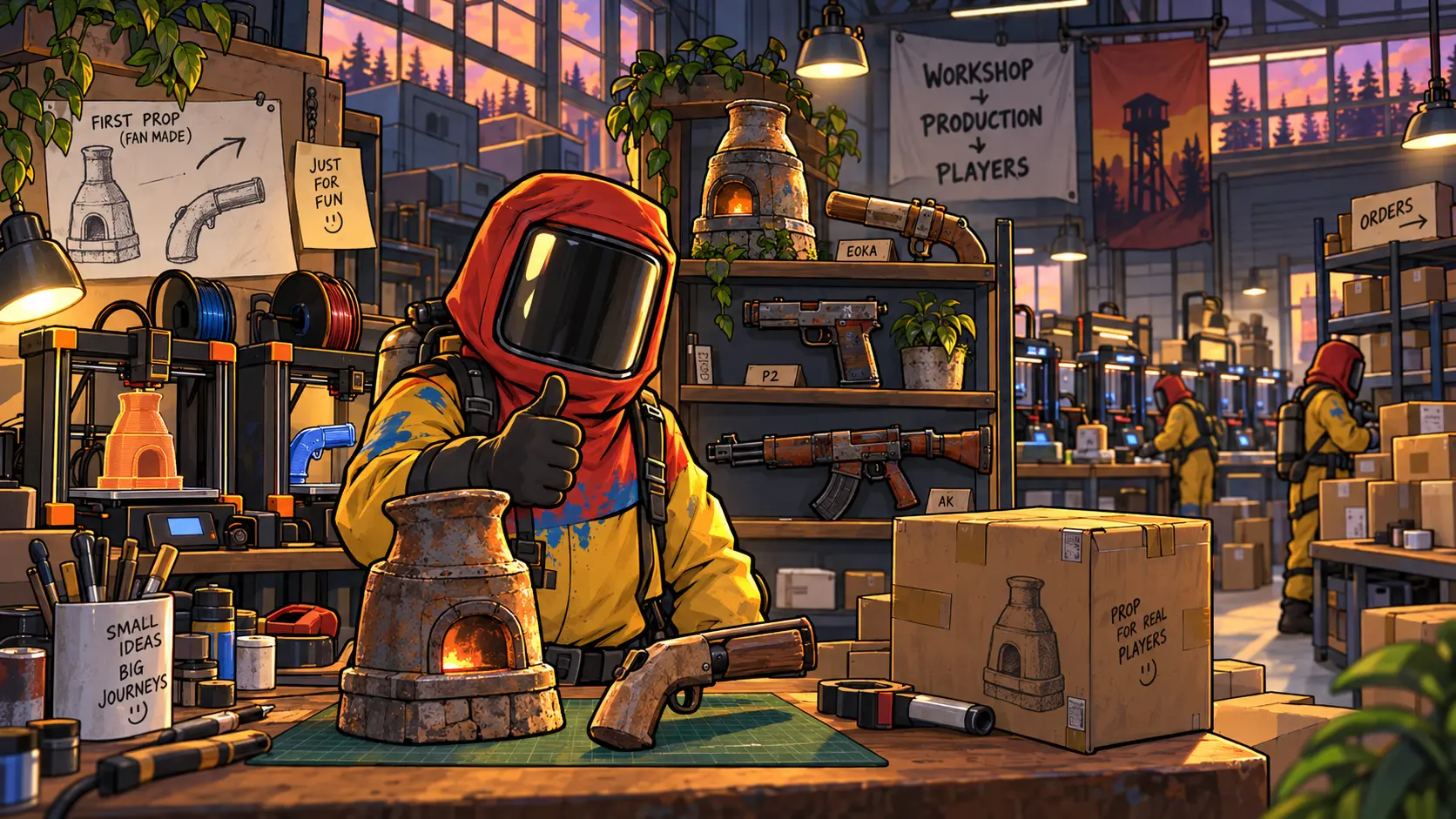
Their history, as published by Facepunch, starts in mid-2018 with a joke during a wipe about furnaces always needing to run. That becomes a small real-world furnace for the desk. Photos attract attention. Purchase requests arrive. A small store follows.
The furnace is joined by an Eoka and a P2. Repeated requests eventually push Lootroom toward something much larger: the default Rust AK, added in May 2020. The size of the new prop even forces them to change parts of their production and packaging process. (Rust)
Demand keeps pushing the catalogue.
Lootroom says it builds internal lists of the most requested items and gradually works through them. In September 2021, a limited Blooprint SAR produces what the company describes as overwhelming demand. By September 2022, Lootroom GmbH exists in Germany and more than twenty printers are running almost continuously. (Rust)
Facepunch still has not built this company.
Rust players have.
Then, in July 2024, Facepunch announces that it has been watching Lootroom from the sidelines and finally makes the relationship official. Lootroom becomes a licensed partner, with Facepunch supplying in-game assets to help improve the accuracy of future products. (Rust)
That order is important.
Demand creates the props.
The props create the business.
The successful business becomes the official partner.
Today, that same ecosystem can produce a full-size physical version of a creator’s weapon skin, like the xQc AK, while Lootroom also sells STL files allowing customers to print certain Rust objects themselves.
The maker has become a manufacturer without losing the original idea:
somebody sees something in Rust and wants it on the desk.
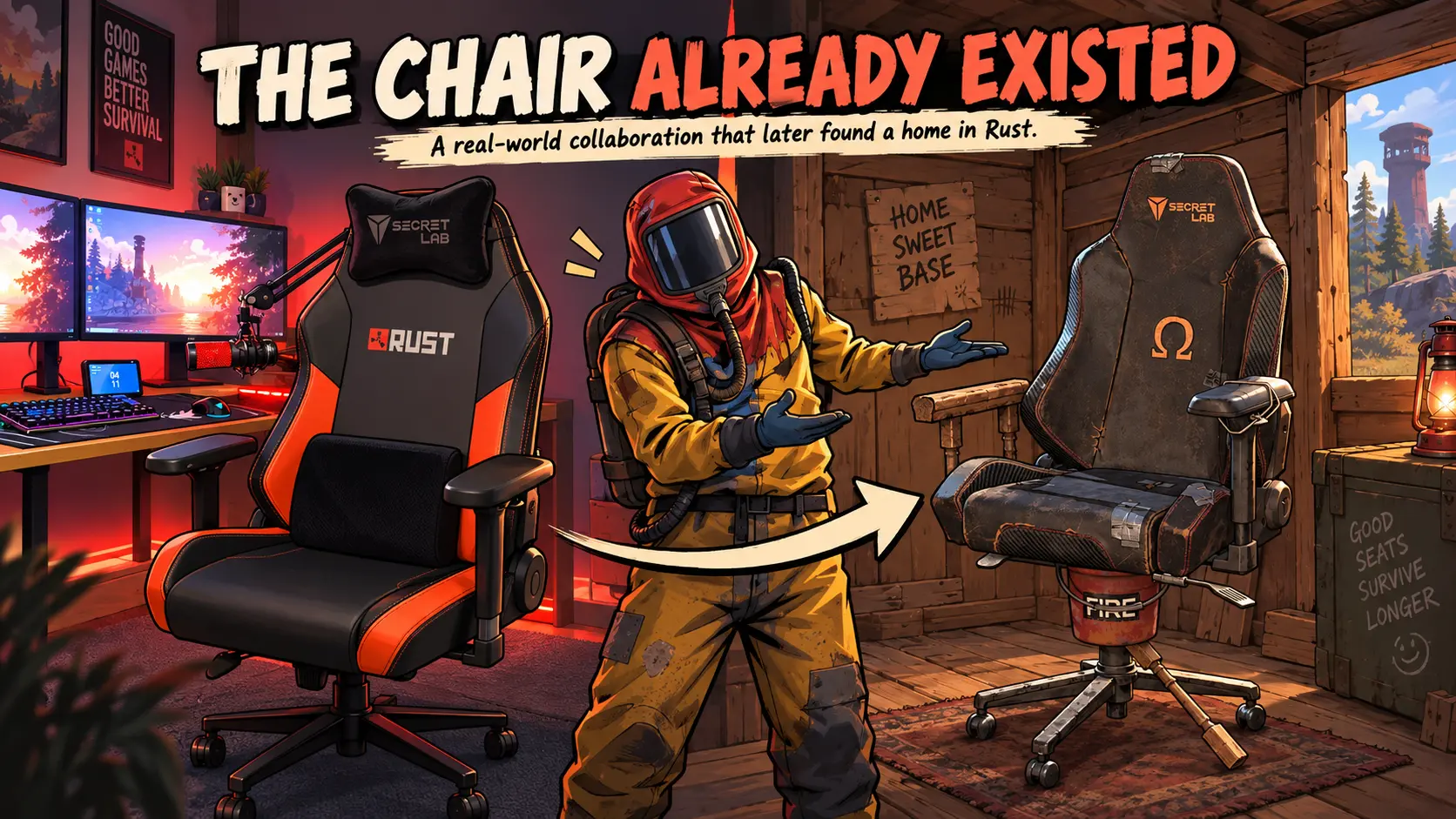
The Chair Already Existed
Secretlab represents almost the opposite commercial path.
Secretlab already makes gaming chairs.
Rust becomes an edition of the company’s existing OMEGA 2020 and TITAN 2020 platforms. The underlying product, engineering and features belong to Secretlab; the collaboration supplies the Rust design and official licence. Secretlab was doing the same thing with other games, teams and entertainment properties on the same chair generation. (Secretlab Blog)
The Rust edition adds one particularly clever feature.
Buying the real chair also unlocks an exclusive Secretlab chair inside Rust. Secretlab describes it as the first branded cosmetic introduced into the game. (Secretlab Blog)
The physical product has crossed the screen.
And once it arrives there, Rust treats it like Rust.
The chair is craftable. The person with access can manufacture it using ordinary game materials, and the resulting chairs can circulate among other players. (Facepunch Wiki)
That immediately changes the scale of the promotion. The chair is no longer visible only to somebody who spent real money on Secretlab furniture. A buyer can craft one for a friend, a clanmate or another player on the server.
Players immediately start treating it as furniture rather than advertising. Requests appear for it to rotate or rock like the real chair.
Those features never arrive, but the reaction says enough.
Once the product enters Rust, players expect it to behave like part of Rust.
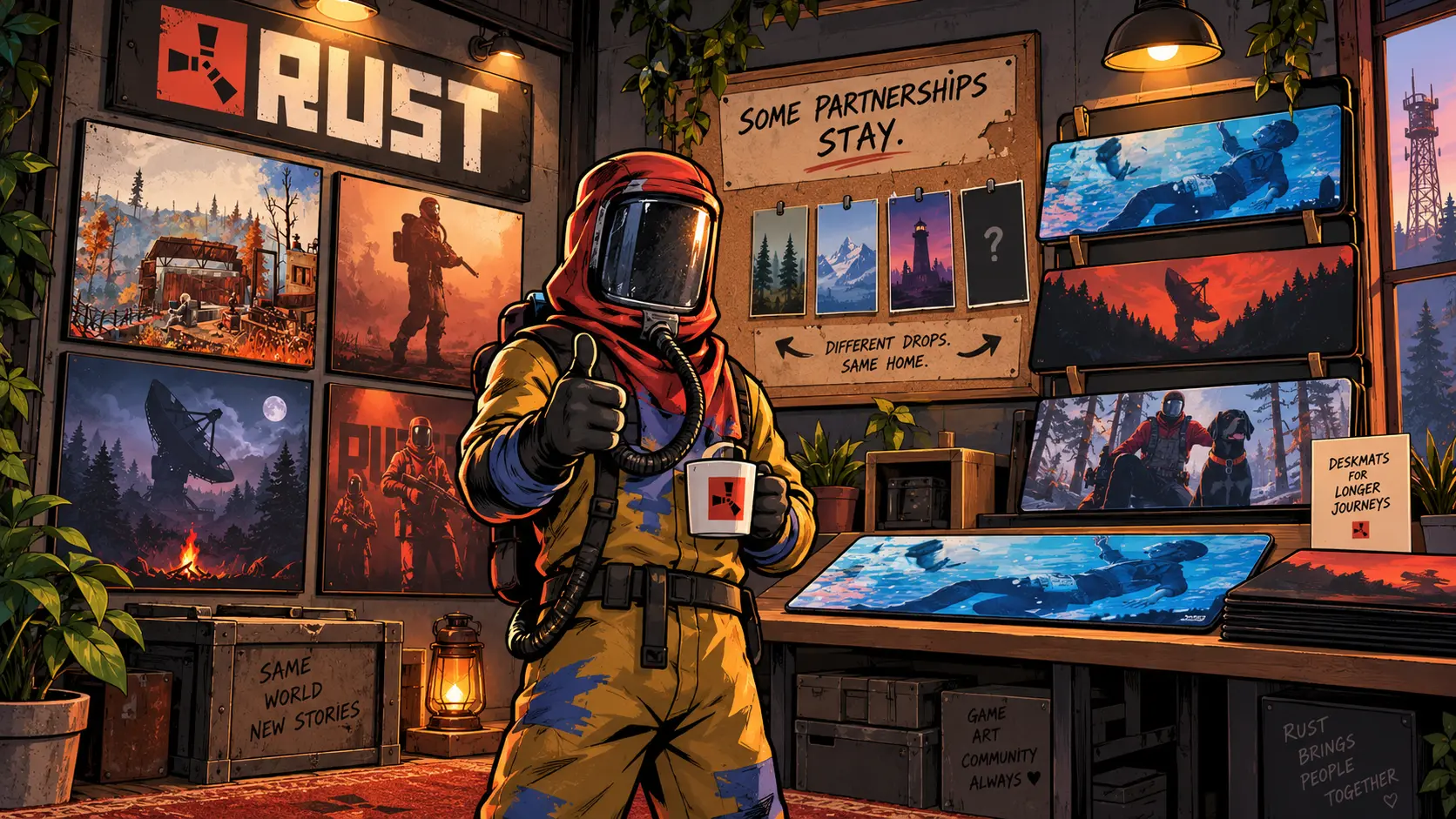
Some Partnerships Stay
Secretlab is tied to a particular generation of product, and the Rust edition eventually leaves the active range.
Other partnerships work on a much longer clock.
Displate still operates an official Rust brand shop, currently carrying dozens of licensed metal artworks. Rust fits naturally into its existing product: the company already makes metal posters, and licensed Rust art simply remains another active collection as long as the relationship and demand continue. (Displate)
Epic Desk has remained with Rust for four years as well.
Its current Rust catalogue still contains roughly two dozen officially licensed mats. The underlying Rust collection stays active, while creator and partner drops rotate through it. Epic Desk explicitly distinguishes those limited campaigns from its core designs, which remain in rotation. (Epic Desk)
That creates an interesting structure.
Rust provides the permanent umbrella.
Individual creators come and go beneath it.
The creator campaign can be temporary without making the Rust partnership temporary.
When the Fan Cannot Make the Real Thing
The physical products that attract the most attention reveal another pattern.
Many of them are useful.
Boots.
A backpack.
A chair.
A deskmat.
These already make sense as objects before the Rust branding is added.
A maker can print a miniature furnace or reproduce an Eoka for display. Building footwear people can actually wear, a durable backpack that can carry a laptop, or furniture expected to survive years of use requires a very different level of manufacturing.
That is where industrial partners become useful.
CAN.BE’s Rust Large Backpack is a particularly direct example. It is presented as a real-world version of the in-game backpack, but it is also designed as an actual 25.5-litre bag with a padded laptop compartment, water-resistant material, multiple storage compartments and a warranty. (can.be)
The fan-market version of the idea might be a miniature backpack sitting on a shelf.
The manufacturer can make the backpack.
And there is one particularly strange pair of boots sitting nearby.
Wellipets gets only a cameo here because its story already has an article of its own.
The original Frog Wellington was simply a real product from 1983. Rust later carried an altered version of that boot into its own history. Decades afterward, Facepunch and Wellipets finally turned that old visual connection into an official physical collaboration.
The whole strange round trip is already told in Frog Boots: The Wellipets Connection. (Rust.Observer)
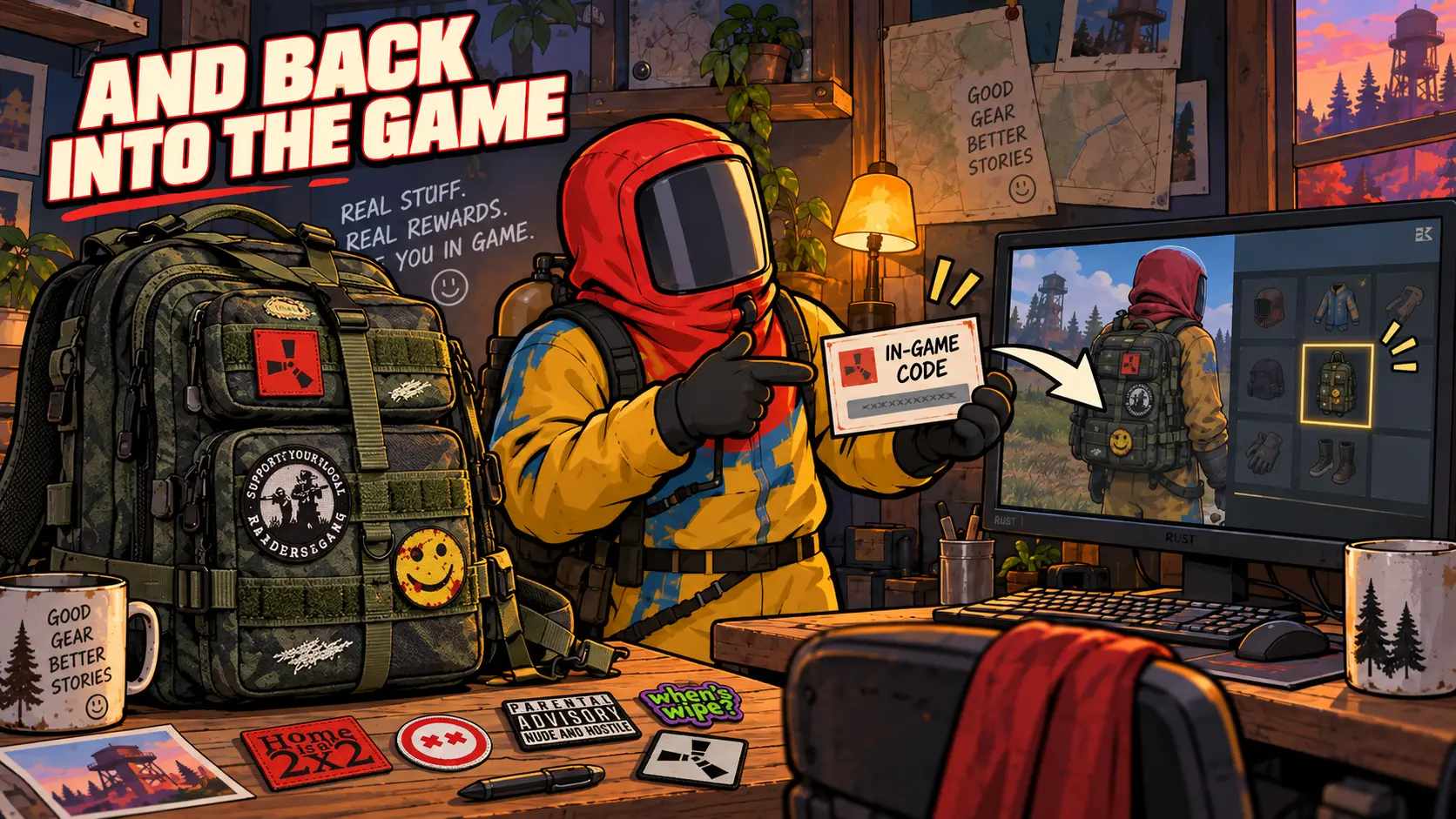
And Back Into the Game
Physical merchandise and virtual cosmetics are different markets.
Twitch Drops, streamer skins and charity cosmetics belong primarily to the virtual side of Rust. Their designs can represent creators, events, fundraising campaigns or moments that exist only inside the game.
The Goods is interested in the physical object.
But the two worlds increasingly meet.
Secretlab established an early version of the bridge: buy the real chair, receive access to the virtual chair.
Youtooz later uses the same idea with Rust plush products. The Hazmat Plush, Scientist Plush and Heavy Scientist Plush have been sold with complimentary in-game decorative items attached to the physical purchase. (Youtooz)
CAN.BE pushes the same mechanism into the backpack. Each physical Large Backpack includes a code for complementary digital Rust items, with Facepunch describing them as weapon charms designed to connect the tangible product with the game. (can.be)
The relationship has therefore become repeatable:
buy something from Rust in the real world, and part of that purchase follows you back onto the island.
That is different from a Twitch Drop.
The virtual item is not the product.
It is the receipt that crosses the screen.
More Than Things on a Shelf
Rust’s commercial reach also extends into products that are difficult to call props at all.
Dark Horse’s The Art of Rust, published in January 2026, turns the development of Rust itself into a physical object: 184 pages of concept art, environments, costumes, weapons, props and vehicles. (PenguinRandomhouse.com)
Shockbyte goes farther from conventional merchandise.
It sells a service: Rust server hosting. Its official partnership with Rust includes an exclusive Tool Cupboard skin for eligible server customers. The purchase happens entirely outside the game, but part of its value returns to the customer as a Rust cosmetic. (Rust)
Beyond that sits another economy built around Steam inventories, skin trading and outside services. Some of those services become arcades or casinos; others simply use the value of Rust items as the basis for an external marketplace.
Those branches are larger subjects of their own.
They are useful here mainly because they show how far something can travel once Rust gives it recognizable value.
Get Out of the Way
Facepunch’s approach helps explain why the physical Rust ecosystem looks so decentralized.
Its current merchandise page tells creators who believe they can make good Rust or Garry’s Mod merchandise to “go for it.” Anyone wanting an official partnership can contact the studio separately. (facepunch)
The Fan Content Guidelines are equally revealing.
For physical goods, Facepunch says it is generally comfortable with the practice and does not want to “get in the way where it doesn’t make sense.” The copyright and trademarks remain Facepunch property, and unofficial products cannot pretend to be official or endorsed. (facepunch)
That places the everyday barrier remarkably low.
A fan making a few Rust-inspired objects does not need Facepunch acting as a certification office.
Facepunch does not need to investigate every furnace, poster or sticker.
The creator gets room to experiment.
Facepunch keeps ownership of Rust.
The larger conversation begins when somebody wants the official label, access to original assets or a formal commercial relationship.
That is exactly the path Lootroom eventually takes.
FFBF demonstrates another version of it.
Epic Desk and Displate represent long-running licensed versions.
Secretlab uses Rust for a particular product campaign.
CAN.BE takes an object from the game and manufactures a practical real-world version.
Different companies can fill different gaps because Facepunch does not need to build the entire machine itself.
The Goods
That may be the biggest difference between April 1983 and the world Rust eventually enters.
Pac-Man and Masters of the Universe grew in an era when the companies behind a successful property needed manufacturers, retailers, advertising and distribution networks to put the products in front of fans.
When Rust arrives thirty years later, much of that machinery is already available to everybody.
Fans can draw.
Small shops can print.
Makers can build.
Creators can test their audiences directly.
Established manufacturers can step in when an idea needs footwear, furniture, books or durable equipment.
And Facepunch can watch what emerges.
Sometimes it licences the result.
Sometimes it provides the original assets.
Sometimes it opens an official route for fan designs.
Sometimes a company that already exists simply gives Rust a turn on its product.
And sometimes there is no reason for Facepunch to do anything at all.
That helps explain why Rust can have a surprisingly large physical culture without a single central catalogue trying to supply all of it.
Players had already spent years answering the important question themselves:
I want that from Rust.
Somebody, somewhere, usually answered:
Hold my beer.