Oxidation #3 — Talented Ego
Rust is built from thousands of personal decisions. Talented Ego follows the developers, artists and designers whose judgment, persistence and individual fingerprints became part of the game.
There’s a piece of me in this — but it isn’t me.
On September 12, 2023, Unity announced a new Runtime Fee.
Garry Newman reacted almost immediately on X.
His first question was blunt:
“Unity want us to start paying them $200k a month?”
Then he did the math.
His first estimate was wrong. Under the announced formula, he calculated that Rust would instead have generated roughly $410,000 in additional fees over its lifetime — significant money, but nowhere near what he had first imagined. What bothered him remained. Unity had introduced a new way to charge projects already built around its engine, and suddenly questions about installs, tracking and unilateral changes mattered much more than the amount itself. (Kotaku)
For a brief moment, we were watching a person think in public.
Later that same day, Alistair McFarlane had gone one step further and called Unity directly. His report on X was remarkably repetitive:
“1 – They don’t know yet
2 – They don’t know yet
3 – They don’t know yet…”
Six questions. Six variations of the same answer.
The following day, Garry moved from X to his own website.
The title left little ambiguity:
Unity can get fucked
But underneath the title was the part that mattered.
“the cost isn’t a big issue to us.”
Facepunch had spent ten years building Rust with Unity and paying for the engine. Garry’s complaint was that the relationship itself had changed without warning, consultation or agreement.
His conclusion was shorter still:
“The trust is gone.” (Garry)
There was no corporate communiqué waiting behind Garry Newman. The public response remained under his own name.
Garry had reacted for himself.
He just happened to be the boss.
And that changes the weight of a personal reaction.
Garry can misunderstand an announcement. He can become angry. He can make a calculation, discover that it is wrong and correct it. Those are perfectly ordinary human behaviours.
His name, however, carries Facepunch with it.
Employees, products, business relationships and years of work sit behind the same person who can open X and react to something irritating.
Fortunately for him, he was nowhere near alone.
Necrosoft Games director Brandon Sheffield arrived at essentially the same issue:
“Unity is quite simply not a company to be trusted.”
Rami Ismail asked:
“There is no way Unity talked to a single developer before launching this.”
And The Falconeer developer Tomas Sala, already years into another Unity project, described being unable to simply turn around:
“I have no options, cannot go back, can only bend and pay up.” (Ars Technica)
Different people.
Different projects.
Different businesses.
Very similar concern.
Garry’s reaction was personal. It was not unique.
The unity against Unity was already palpable.
Ten days later, Unity itself acknowledged the communication failure. Marc Whitten opened the company’s response with an apology, saying Unity should have spoken with more developers and incorporated more feedback before announcing the Runtime Fee. He also acknowledged that the company would have to work to earn trust. (Unity)
Garry’s instinct happened to be well placed.
Lucky him.
Because that is one of the uncomfortable realities of putting talented people in positions of responsibility:
the more responsibility you carry, the more expensive your personal judgment can become.
And that brings us to two words that are usually treated very differently.
Talent and Ego
For this article, we can keep the definitions simple.
Talent is what other people recognize in us.
Ego is what we recognize in ourselves.
Talent is the ability somebody else notices: the artist who can create a convincing industrial structure, the programmer who repeatedly solves problems nobody else has solved yet, the sound designer whose work develops a recognizable identity.
Ego is the internal side of that equation: judgment, confidence, expectations, self-assessment, the feeling that an idea is worth pursuing or that a problem can be solved.
Neither one requires arrogance.
Someone can be talented without believing they are the best person in the room.
Someone can have a strong ego without needing to dominate it.
What makes development interesting is what happens when the two meet.
A talented person eventually has reasons to trust their abilities.
An experienced person accumulates reasons to trust their judgment.
Then a project gives both of them something capable of proving them wrong.
That is where Talented Ego begins.
A piece of me
Every developer who spends enough time on a project leaves something personal behind.
An artist chooses a shape.
A concept artist establishes a visual language.
An environment artist gives a location its proportions, routes and atmosphere.
A programmer decides how something behaves.
A sound designer decides what an object should sound like when it happens twenty metres away, then two hundred metres away.
Each contribution begins somewhere inside a person.
There’s a piece of me in this.
That does not make the whole thing mine.
It simply means that something I knew how to do became part of it.
The distinction becomes especially interesting with work that turns into behaviour.
A train starts moving.
The script becomes movement.
A procedural system places a road through the landscape.
The work becomes geography.
A weapon fires somewhere beyond the next hill.
The sound becomes information.
Rust players provide a particularly good demonstration of that last one.
After enough hours, experienced players stop hearing generic gunfire.
They hear weapons.
A Double Barrel somewhere nearby means one thing.
A P2 may mean another.
Then an AK starts firing in the distance and somebody immediately changes direction.
A fight may be happening.
A raid may be underway.
Something worth investigating has announced itself through sound.
Watch experienced Rust content creators and the identification can be almost instantaneous.
The player hears:
AK.
The designer’s work has become a word in a language the player learned simply by living in Rust long enough.
Good work eventually becomes ordinary behaviour we rely on.
And Rust has accumulated thirteen years of it.
You already know the team
If you have played Rust long enough, you already know a surprising amount about the people who built it.
You may simply know them through their results.
You have heard their work.
Walked through it.
Worn it.
Driven it.
Shot it.
Broken it.
And occasionally discovered it again after somebody fixed it.
Garry and Helk are easy names to recognize because they have occupied very public positions throughout Rust’s history.
The quieter names are where things become particularly interesting.
In 2017, Garry added a public team list to the Facepunch website for a very practical reason. His name had become a catch-all whenever players wanted to address development work. The team page gave them actual people instead. (Rust)
The Devblogs provide something even more useful.
For years, individual developers have written sections under their own names. They describe what they built, what took longer than expected, what they want to try next, what another developer handed them, what they dislike about their previous work and occasionally what failed.
The commit history adds another layer.
Together, those records let the team introduce itself through its work.
The easiest way to meet the Rust team is to follow their fingerprints through the game.
What follows is therefore neither a ranking nor an attempt to assign sole ownership of Rust’s features.
Large pieces of Rust almost always carry several fingerprints.
These are simply moments where the public record makes one of them particularly easy to see.
Following the fingerprints
2014 — André Straubmeier: building around Unity’s assumptions
Very early in the Experimental rebuild, André Straubmeier repeatedly found himself working where Rust’s needs departed from what Unity already provided.
AI made the problem particularly obvious.
Legacy had used Unity’s built-in navigation system, but its navmesh for the island occupied roughly 400 MB. The new Rust island was procedurally generated, so a navigation mesh could no longer simply be baked in advance. It had to become dynamic.
That problem landed with André. (Rust)
Trees produced another version of the same challenge. André and Petur developed their own billboard work while the team also pushed terrain rendering and blending beyond Unity’s standard solutions. (Rust)
A recognizable fingerprint appears remarkably early:
when Rust’s needs moved beyond the assumptions of the engine, André kept working on the missing piece.
It is a pattern that will appear again.
2015 — Alex Rehberg: turning a weak point into a signature
Alex Rehberg gives us something unusually personal because he tells us exactly how he judged his previous work.
While rebuilding Rust’s gunshots, he wrote:
“I felt like this was one of my weak points before.”
So he returned to it.
Recorded gunshots alone lacked the character he wanted, and he began layering other sounds into them. Nail guns. Cracking whips. Truck air brakes. Staplers.
Techniques he had learned while working on explosions became useful for firearms. Silenced weapons followed. Later work continued refining weapon audio and distance. (Rust)
Years later, experienced players can recognize those weapons through sound quickly enough to make gameplay decisions from them.
The fingerprint begins with Alex identifying something in his own work that could be better.
Then doing it again.
He heard a weakness and returned until the sound had character.
That is ego in a much more useful sense than vanity.
Self-recognition can include recognizing what needs improvement.
2016 — Helk: changing his mind in public
The XP system had every reason to feel encouraging before release.
Helk later described its early feedback as so positive that he was “on Cloud 9.”
Then thousands of players got hold of it.
Complaints that initially looked like a vocal minority spread through Reddit, other channels and eventually the game itself. Helk went back to play the later progression players were complaining about and found an important gap in the testing: relatively few testers had actually pushed far enough into the system to encounter the problem.
His response was straightforward:
“If that doesn’t work we’ll try something else until it does.” (Rust)
A few months later, XP was gone.
When Components arrived, Helk was equally direct about the reason. XP had changed the feeling of Rust in ways the team no longer wanted. Progression had begun dominating the sandbox rather than supporting it. (Rust)
Months of personal investment did not disappear.
They became experience with the problem.
Helk was willing to be enthusiastic about his own idea, discover what he had missed, and continue working from there.
The accomplishment here is not simply Components.
It is the ability to move past the investment already made.
2017 — Damian Lazarski and Vincent Mayeur: passing a giant place between two people
Launch Site gives collaboration a physical scale.
During the final stretch of what was still being called the Rocket Factory, Damian Lazarski was completing collision models, LODs, optimization, graphical polish and the remaining loose ends around the factory.
Vincent Mayeur was simultaneously finishing his own section of the site and preparing the entire level for release. (Rust)
Then the work came together.
Vincent’s release note opened with:
“After a good three months of work, Damian and I are happy to release the Launch Site monument…”
At the time, it contained the largest man-made structures in Rust. (Rust)
Its scale makes the contribution unusually easy to experience.
Standing inside Launch Site means standing inside work Damian and Vincent passed between themselves until both were ready to put their names beside it.
One place.
More than one ego.
One result.
2018 — Diogo Teixeira and Damian Lazarski: opening a new part of the world
By 2018, Rust wanted to do much more with the ocean.
For Diogo Teixeira, that meant making the underside of water behave like an actual part of the rendering system rather than a placeholder.
Visibility, reflection, refraction, lighting and the water surface itself became real development problems because players were finally being expected to spend meaningful time underneath it. (Rust)
Damian was already waiting on the other side of that work.
He built six underwater rock formations to give players actual places to explore on the ocean floor, complete with loot locations, while openly describing the first art pass as quick work that would receive more polish later. (Rust)
This is a particularly clean example of one talent making room for another.
Diogo makes the space usable. Damian gives the space somewhere to go.
A technical problem becomes an artistic opportunity.
2019 — Diogo Teixeira: making room for everyone else
Some accomplishments are measured by what they give back to everybody around them.
In 2019, Diogo extended Rust’s mesh optimization work across monument geometry.
An earlier pass had already recovered roughly 700 MB of memory.
This one recovered another 600 MB.
That additional headroom allowed another gigabyte of textures into the streaming pool while the team prepared for the much larger rendering work then expected from HDRP. (Rust)
Nothing about the artistic ambition of Rust became smaller.
Diogo simply found more room for it.
His fingerprint appears in the space he recovered for everybody else’s work.
And the project that was supposed to benefit from all that preparation was about to become much harder than expected.
2020 — Bill Borman and the modular car team: several pieces of several people
Modular cars had existed in concepts for five years before they finally became something players could drive.
Bill Borman had joined the Rust team with previous experience programming vehicles — including modular ones — and that experience put the project on his desk. Contemporary development coverage traces Bill building the modular entity framework, engines, seating, storage, mass, driving controls and fuel behaviour as the system developed. (Rustafied)
By release, the work had become much larger than one programmer.
Helk supplied specifications.
Thai created new 3D models for the modules.
Alex Rehberg handled audio.
Howie worked on art and icons.
Petur contributed effects.
André repeatedly reviewed the code.
When the vehicle branch finally merged into Main in June 2020, it contained almost 2,500 new or changed files. (Rust)
This is perhaps the cleanest example in the timeline of several personal specialties converging on one object.
Bill’s experience makes the system possible.
Thai gives it physical form.
Alex gives it sound.
Howie gives it visual language.
Petur gives it effects.
André tests the code through another experienced pair of eyes.
Then the player presses the accelerator.
One car becomes several pieces of several people.
2021 — The HDRP team: carrying the work home
Then came the kind of problem that reveals the personality of an entire group.
In May 2019, Facepunch had begun what it later called a “mammoth task”: moving Rust toward Unity’s High Definition Render Pipeline.
Months went into converting assets.
Testing followed.
Profiling followed.
The expected performance improvement never arrived.
HDRP was actually performing worse. (Rust)
At that point the team had a problem much larger than a renderer.
A huge amount of work was attached to a destination that no longer made sense.
They could abandon the route without abandoning the work.
So they turned around.
Months more went into bringing the updated assets back into Rust’s existing rendering pipeline. Rocks, foliage, trees, world objects and monuments were adapted again.
By May 2021, Facepunch described the resulting World Revamp as the culmination of work by several people carried out on and off over roughly two years. The company explicitly said it had refused to waste the visual work produced during the abandoned HDRP transition and instead ported it back into the game. (Rust)
The surrounding development record gives individual faces to parts of that enormous effort. Diogo’s rendering and memory work had already been aimed toward HDRP. Petur appears immediately afterward bringing Hapis into the new visual world. Damian, Vincent and André had repeatedly been working across environments, vegetation, monuments and procedural integration during the same broader evolution of Rust’s world. Facepunch presents the final backport itself as collective work rather than assigning every asset to one person. (Rust)
That collective credit matters.
This is one of the clearest places where the ego of the team becomes visible through what they did.
The destination failed.
They carried the work home.
Their achievement was not making HDRP work.
It was making sure two years of work still mattered when HDRP did not.
2022 — André Straubmeier, Jarryd Campi and Bill Borman: experience starts connecting itself
Eight years after André was solving problems created by the first procedural island, his name appears beside another generated network.
Rust’s first above-ground railway.
The initial release was deliberately presented as a proof of concept. The world-generation problem came first; driveable trains would follow. (Rust)
In the same update, Jarryd Campi turned another piece of infrastructure already crossing the island — powerlines — into a procedural zipline network.
Then Bill Borman picked up the railway from the gameplay side.
Work carts arrived.
Rail sidings followed.
Trainyard gained unloading infrastructure and resource wagons that could be physically moved through the network. By November, Bill was putting a functioning Caboose into the world. (Rust)
Seen through the people instead of the release names, the progression becomes more interesting.
André gives the world somewhere for rails to go.
Jarryd finds a new use for infrastructure already crossing that world.
Bill makes the railway do things.
Different specialties keep meeting inside the same island.
2023 — Ian Henderson: from hiding in the shelter to bringing it back to life
Ian Henderson may give us the most literal piece of me in this entire timeline.
He introduced himself publicly as Rust’s new Gameplay Programmer while implementing the returning Legacy Wooden Shelter.
Then he explained why the assignment meant something to him.
Ian remembered cowering in that same kind of shelter as a Rust player in 2013.
Ten years later, Vincent had produced a new model of it.
Ian was now:
“bringing Vincent’s awesome model to life.” (Rust)
That small paragraph compresses an enormous amount of Rust history.
A player remembers an object.
He eventually joins the team.
Another developer rebuilds it.
Ian gives it behaviour.
New players use it.
Ian’s memory of Rust becomes part of somebody else’s first memory of Rust.
There may be no better example of a piece of the player becoming a piece of the game.
2024 — Vincent Mayeur: returning to an old piece of Rust
A year later, Vincent reached even further backward.
Radtown returned from Legacy.
The challenge was not simply to build another monument. Vincent took an old collection of blocky garage-like structures and translated it through another decade of Rust development while preserving the proportions and purpose of the original spaces.
Routes opened.
Cover changed.
Movement improved.
The recognizable shape survived. (Rust)
Vincent had spent years creating new places for Rust.
Here he was applying that accumulated experience to one of Rust’s oldest places.
The old Rust passed through the hands of somebody who had spent years helping build the newer one.
That is another way a fingerprint can change over time.
The hand is familiar.
The experience behind it has grown.
2025 — Grigler: making thousands of things cooperate
Grigler’s projectile work provides a wonderfully measurable example of technical talent.
Previously, each bullet or thrown weapon performed its physics queries one after another.
One projectile.
Then the next.
Then the next.
That worked until enough projectiles were active in a dense fight.
Grigler rewrote the system so the queries could be collected together and processed as a batch across the available job threads.
Facepunch’s benchmarks found the batched projectiles were generally at least twice as fast to compute as the older serial approach. (Rust)
The player still pulls the trigger exactly as before.
Grigler’s accomplishment is in what happens afterward.
He looked at thousands of repeated individual operations and found a way to make them work together.
His fingerprint is the extra room Rust gains when everything becomes busy at once.
2026 — Many fingerprints arrive in the same boat
The Naval Update gives us a useful picture of what thirteen years of this process eventually looks like.
Adam W presents player-made boats.
Flavien opens the Deep Sea itself.
Petur fills it with semi-procedural tropical islands.
Octo builds Ghost Ships.
Ian Henderson introduces PT Boats, scientist vessels and an updated RHIB.
Maverick changes how scientists behave at sea and on Oil Rigs.
Martyn Chapman adds naval missions while improving the internal tools used to build them. (Rust)
Each contribution remains identifiable in the development record.
Then the player sails into all of them at once.
The boat is interacting with the environment.
The environment is supporting encounters.
AI occupies the encounters.
Missions direct people into them.
Networking and performance work keep everything moving.
One situation becomes the work of several people.
That makes 2026 a fitting place to leave the timeline.
Not because Naval is the greatest achievement in Rust’s history.
Because after thirteen years, it shows the same process still operating:
a piece of me becomes a piece of Rust.
What the fingerprints reveal
Looking back across these examples, the most revealing details are often the verbs.
Alex revisited something he considered a weakness.
Helk changed his mind after an idea met the players.
Damian and Vincent passed work between each other until Launch Site was ready.
Diogo made room for other people’s work.
Bill turned experience from previous projects into a Rust system.
The HDRP group carried work back when its original destination disappeared.
Ian brought to life an object another developer had rebuilt.
Those actions tell us more than a list of job titles.
They show different ways of approaching work: persistence, confidence, curiosity, self-criticism, specialization, adaptation and the willingness to trust somebody else with a piece you started.
That is where personality enters the development record.
Not through gossip.
Through behaviour.
The person inside the Devblog
Rust leaves an unusually useful trail for this kind of observation.
Its Devblogs have spent years allowing developers to speak in the first person.
I worked on this.
I finally finished that.
I wasn’t happy with this.
I’m going to try this next.
We thought this would work.
It didn’t.
Here’s what we’re doing instead.
That distinction matters.
A developer saying what they are working on is not always Facepunch announcing the future of Rust.
Sometimes it is simply somebody telling us what is currently on their desk.
Then other people enter the process.
A colleague reviews the code.
An artist receives a blockout.
A programmer receives a model.
Players discover an exploit.
Performance exposes a cost nobody saw during development.
A new Unity version behaves differently.
Twenty thousand players answer a question two hundred testers did not.
Rust answers back.
The original idea starts moving through other hands.
We can describe that cycle quite simply:
personal intention → work → exposure → reaction → correction → integration
By the time something becomes Rust, its first author may still be recognizable inside it, but the project has transformed the contribution.
That is why:
There’s a piece of me in this
works much better than:
This is mine.
Public work, private people
There is another useful boundary here.
Facepunch gives us a great deal of access to the work.
The public team page gives names.
Devblogs attach those names to tasks.
The Commit Log provides an enormous stream of technical activity.
Personal portfolios sometimes explain exactly what an artist contributed to a monument or asset.
That is enough to find personality without pretending we know the private person.
Facepunch shows us their work.
So we analyze their work.
A developer publicly saying that something was a weak point tells us something about how they judge their own craft.
Somebody spending months rebuilding an environment tells us something about persistence.
Changing course after an experiment fails tells us something about judgment.
A programmer remembering the shelter they once hid inside as a player tells us something about their relationship with the game.
Their friendships, arguments, marriages, family lives and office politics belong somewhere else unless they themselves deliberately bring those things into the public development story.
The fingerprints are already enough.
The other side of Pimp My Ride
Some of the events in this article will sound familiar.
That is intentional.
Pimp My Ride followed the machinery.
Unity.
Networking.
AI middleware.
HDRP.
Rendering pipelines.
The recurring question was:
Who controls this part, and can it be made to do what Rust needs?
Talented Ego moves the machinery into the background.
The same HDRP story now reveals something different.
The interesting part is no longer that Facepunch abandoned one rendering pipeline and backported its work into another.
It is that people spent years working toward one destination, discovered that the destination was wrong, and still found a way for their work to survive.
The procedural world tells the same double story.
Technically, it is a collection of systems.
Humanly, André keeps appearing whenever Rust asks its generated world to solve another problem.
The railway can be described as procgen and vehicle code.
Or it can show André, Jarryd and Bill approaching different pieces of the same world from three directions.
The code has its history.
The people have another.
Sometimes both histories pass through exactly the same event.
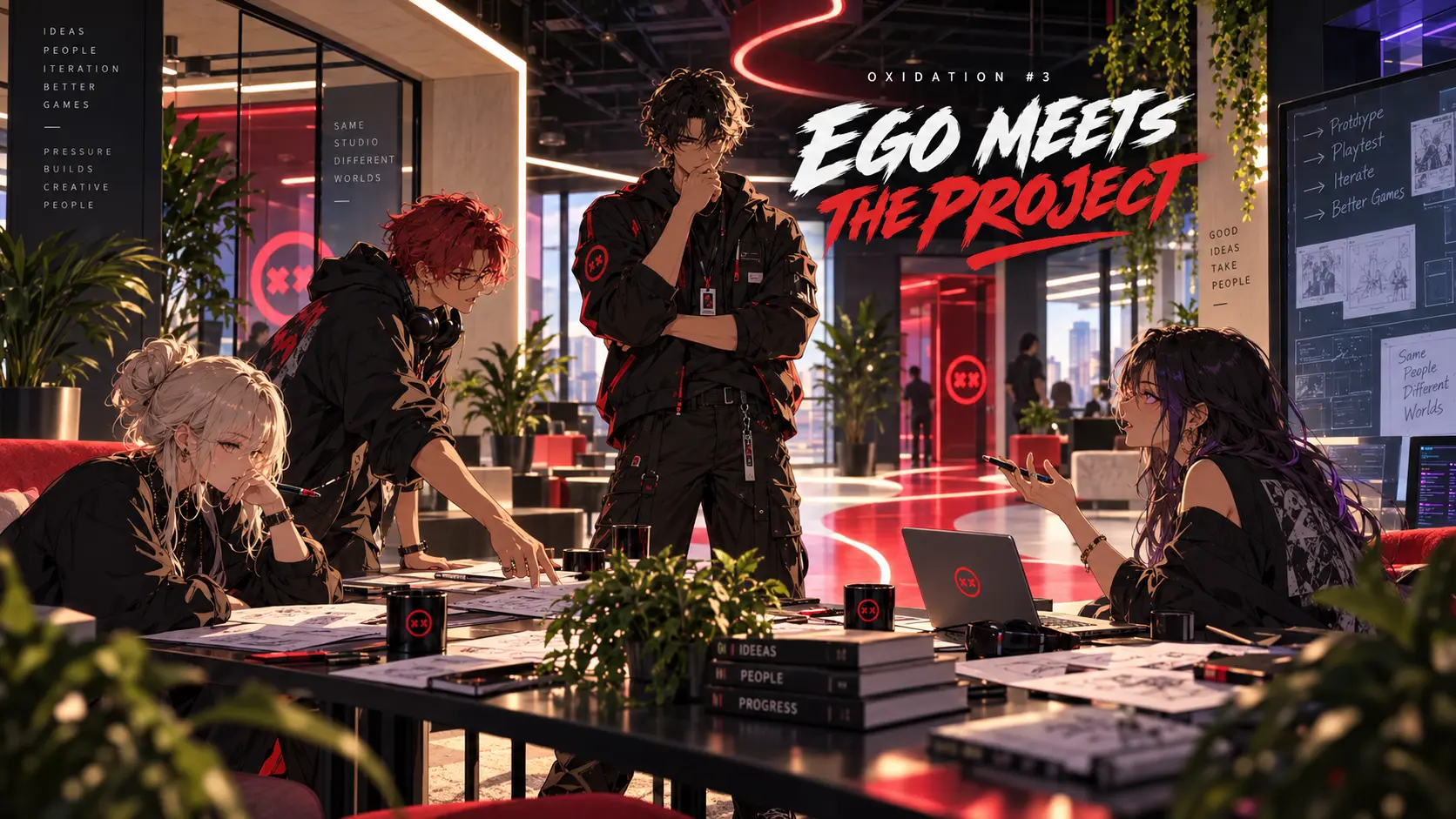
Ego meets the project
Every fingerprint begins with some form of personal judgment.
I think this can work.
I can solve this.
This needs to change.
I can make this better.
That is ego without the insult usually attached to the word.
The project then tests it.
Sometimes confidence produces a system that survives for years.
Sometimes it produces XP.
Both outcomes are useful.
The interesting person is not the one whose judgment is always correct.
Nobody qualifies.
The interesting part is what happens next.
Do they defend the work because it is theirs?
Do they revisit it?
Do they improve it?
Do they let someone else reshape it?
Do they carry the useful pieces into another solution?
Do they accept that two years of effort arrived at the wrong destination and begin the trip back?
Rust’s history provides examples of all the productive answers.
And this is where the title stops sounding contradictory.
A talented ego is capable of saying:
I know what I can do.
It can also say:
I was wrong about this.
Or:
You can make this piece better than I can.
Or:
The plan failed. The work still has value.
Those sentences require confidence too.
Back to Garry
Which brings us back to September 2023.
Garry’s Unity reaction appeared dramatic because his position made his ego unusually visible.
He could react as an individual.
He could not stop being Garry Newman of Facepunch while doing it.
That is the cost of authority.
But the rest of this article contains quieter versions of the same relationship between personal judgment and responsibility.
Alex’s judgment eventually affects what players hear.
Vincent’s judgment becomes somewhere they stand.
Diogo’s judgment affects how much of everybody else’s work can fit into memory.
André’s judgment helps determine how the island assembles itself.
Bill’s judgment turns vehicles into behaviour.
Helk’s judgment can push an entire progression system into the game — and another judgment can remove it.
A whole group can decide that an abandoned technological route will not be allowed to erase years of work.
Authority makes some egos louder.
Work makes others durable.
A piece of Rust
Talent is what other people recognize in us.
Ego is what we recognize in ourselves.
Development repeatedly tests both.
Sometimes a person gets to spend months staring at something before finally watching players touch it for the first time.
Sometimes the satisfaction comes years later, when the thing still works.
Sometimes another developer picks it up.
Sometimes players use it in a way nobody imagined.
Sometimes the whole idea disappears while parts of the work quietly survive inside something better.
Then the player takes over.
The carefully built gunshot becomes:
AK.
The procedural road becomes:
the way home.
Three months of environment work becomes:
Launch Site.
A model becomes:
a shelter.
Code becomes:
a moving train.
Several departments become:
a car.
Two years spent walking toward HDRP become:
the world Rust actually kept.
At that point, the original contribution has become larger than the person who started it.
Which may be the healthiest possible destination for ego inside a project this old.
There’s a piece of me in this —
but it isn’t me.
After thirteen years, Rust is what happens when enough people can say that at the same time.
Sources and references
For the Unity opening, the primary source is Garry Newman’s September 13, 2023 personal post, Unity can get fucked, particularly his distinction between the financial cost and the loss of trust. Garry Newman — Unity can get fucked Contemporary coverage preserves his September 12 X reaction, including the initial $200k/month interpretation and subsequent calculation of approximately $410,000 over Rust’s lifetime. Kotaku — Developers react to the Unity Runtime Fee
Rami Ismail’s reaction and the broader immediate developer response are documented by The Guardian. The Guardian — Game developers furious as Unity announces new fees Brandon Sheffield and Tomas Sala’s statements are preserved in Ars Technica’s report, while Sheffield’s original The Death of Unity provides his full argument. Ars Technica — Unity per-install pricing backlash Brandon Sheffield — The Death of Unity Unity’s September 22 response is Marc Whitten’s official open letter. Unity — An open letter to our community
Alistair McFarlane’s September 12, 2023 X post concerning his call with Unity is preserved in the contemporary Rust Discord material collected for this project.
For the team presentation and public development record, Devblog 161 contains Garry’s explanation of the new Team List and his observation that his name had been used as a catch-all for the team. Facepunch — Devblog 161
For André Straubmeier’s early dynamic navigation work, Friday Devblog 16 explains why Rust’s procedural world could not rely on the baked Unity navmesh used by Legacy. Facepunch — Friday Devblog 16 His and Petur’s billboard work is documented in Friday Devblog 19. Facepunch — Friday Devblog 19
For Alex Rehberg and gunshot audio, Devblog 78 contains his description of gunshots as one of his previous weak points and explains the unusual recordings layered into the redesigned sounds. Facepunch — Devblog 78
For Helk, XP and Components, Devblog 121 contains the “Cloud 9” account, his reassessment after wider player exposure and “we’ll try something else until it does.” Facepunch — Devblog 121 Devblog 134 documents the replacement of XP by Components and Helk’s explanation of why XP had taken Rust in the wrong direction. Facepunch — Devblog 134
For Launch Site, Devblog 166 documents the final parallel work by Vincent Mayeur and Damian Lazarski, while Devblog 167 contains Vincent’s release statement after roughly three months of work. Facepunch — Devblog 166 Facepunch — Devblog 167
For underwater rendering and environments, the 2018 Compound Update contains Diogo Teixeira’s underwater rendering work and Damian Lazarski’s six underwater rock formations. Facepunch — The Compound Update
For Diogo’s 2019 optimization work, the Instrument Update records an additional 600 MB reduction in monument mesh memory after an earlier approximately 700 MB saving, along with expanded texture-streaming capacity and the connection to forthcoming HDRP work. Facepunch — The Instrument Update
For Modular Vehicles, Facepunch’s July 2020 release explicitly credits Helk, Thai, Alex Rehberg, Howie, Petur and André alongside the programmer leading implementation, and records almost 2,500 new or changed files at branch merge. Facepunch — Modular Vehicles Update Contemporary Rustafied development coverage identifies Bill Borman as the programmer driving the modular vehicle branch during development. (Rustafied)
For HDRP and the World Revamp, the April 2021 Gestures Update describes the 2019 HDRP attempt as a “mammoth task,” explains the unsatisfactory profiling results and documents the subsequent backport. Facepunch — Gestures Update The May 2021 World Revamp explicitly describes the release as the culmination of work by several people across roughly two years and states that the HDRP visual work was ported back rather than discarded. Facepunch — World Revamp
For rails and ziplines, the April 2022 Zipline & Rail Update directly credits André Straubmeier with the procedural rail network and Jarryd Campi with the powerline ziplines. Facepunch — Zipline & Rail Update Bill Borman’s Trainyard unloading work is documented in August, and his Caboose in November. Facepunch — Trainyard Unloading Facepunch — Prototype 17
For Ian Henderson and the Wooden Shelter, 10 Years of Rust contains Ian’s own introduction, his memory of using the shelter in 2013 and his description of “bringing Vincent’s awesome model to life.” Facepunch — 10 Years of Rust
For Vincent Mayeur and Radtown, World Update 2.0 documents his modernization of the Legacy monument while retaining its original proportions and purposes. Facepunch — World Update 2.0
For Grigler’s projectile work, Harder Core documents the rewrite from serial projectile updates to parallel batched processing and reports benchmark results generally at least twice as fast to compute. Facepunch — Harder Core
Finally, the 2026 Naval Update directly credits Adam W, Flavien, Petur, octo, Ian Henderson, Maverick and Martyn Chapman across player-made boats, the Deep Sea, islands, Ghost Ships, scientist boats, AI and missions. Facepunch — Naval Update