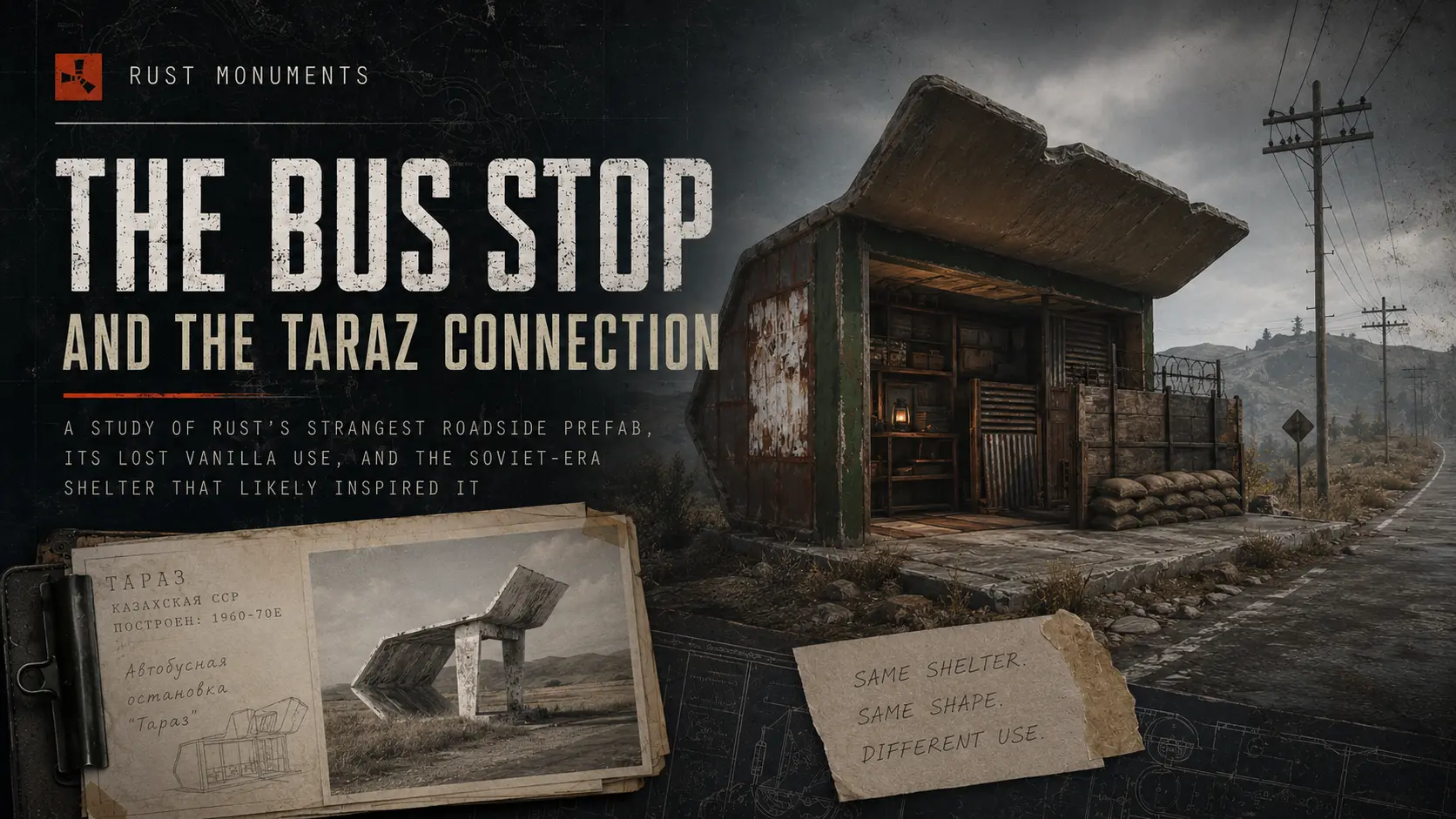
Props #1 — The Bus Stop and the Taraz connection
Rust’s Bus Stop traces back to Soviet roadside architecture near Taraz, Kazakhstan, revealing how a useless prefab became player folklore.
Rust’s Bus Stop and the Soviet Roadside Monument
Some Rust monuments are important because of what Facepunch placed inside them.
Launch Site has height, radiation, Bradley, puzzles, elite crates, and the visual authority of a forbidden military-space complex. Oil Rig has scientists, locked crates, boats, counters, and server-wide tension. Lighthouse has shoreline identity, early-wipe usefulness, and just enough loot to matter.
And then there is the Bus Stop.
The Bus Stop is almost nothing.
A roadside shelter. A roof. A bench. Dirty panels. A concrete pad. A small sign of public infrastructure from a world where people apparently still waited for something to arrive.
It does not offer a puzzle. It does not define progression. It does not give players a reliable loot loop. It does not make anyone open the map and say, “We need to control Bus Stop.”
As a vanilla monument, it may be one of the least profitable objects in the game.
That is exactly why it is interesting.
Barely a Monument
Calling the Bus Stop a monument already feels generous.
It is closer to a roadside prefab, repeated across procedural maps as part of Rust’s road language. It appears near roads, junctions, monument access routes, and the connective spaces around the larger pieces of the island.
It is not a destination.
It is a trace.
The Bus Stop tells the player that the island was once organized around roads, movement, waiting, arrival, and public infrastructure. Someone was supposed to stand there. Someone was supposed to sit there. Something was supposed to arrive.
But in Rust, no bus is coming.
That makes the object strangely perfect. It is not useful in the mechanical sense, but it makes the world feel inhabited before the player arrived. It is a fragment of ordinary life with its function removed.
Then players found a new function for it.
Players Made It Useful
Rust players are professionally allergic to useless objects.
Give them a rock, a cliff, a cave, a broken wall, a roof, a weird gap, or a stupid shelter beside a road, and someone will eventually ask the only question that matters:
Can I abuse this?
For a long time, the answer was yes.
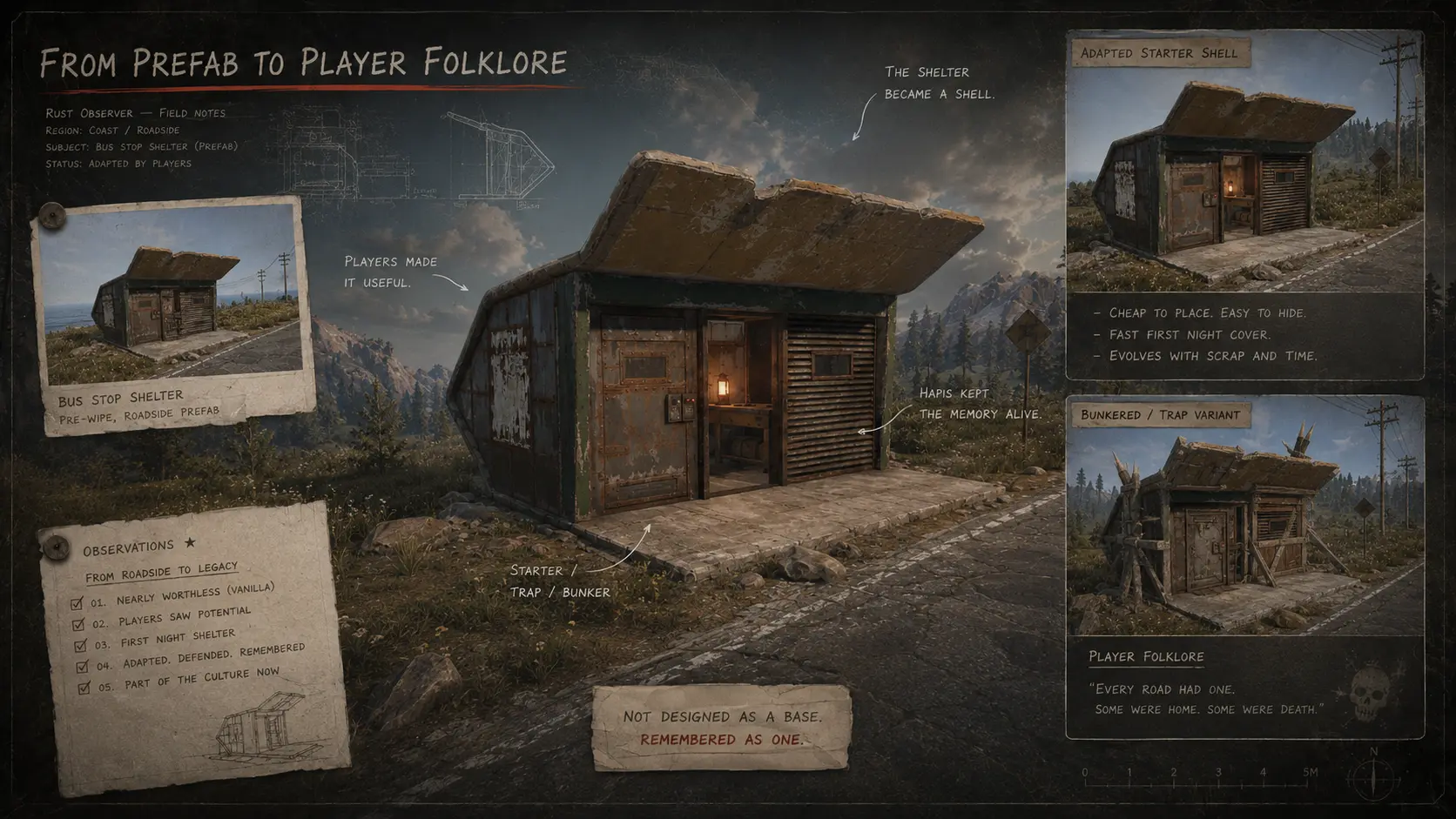
The Bus Stop became one of those small player-made traditions that made Rust feel alive. It was never powerful because of official monument design. It became powerful because players could wrap a base around it.
A Bus Stop base was not just a normal starter with a funny shape. It was adaptation. The player did not place a house and decorate it later. The player found a piece of the world and turned it into architecture.
That is very Rust.
The shelter became a wall.
The roof became cover.
The concrete pad became a footprint.
The useless roadside object became a home, a trap, a bunker, or a ridiculous little vault.
It was not always balanced. It was not always beautiful. It was probably not always healthy for the road system.
But it was memorable.
And Rust survives on memorable things.
Before Taraz: Facepunch Already Knew Players Were Building Around It
Before Rust’s Bus Stop took on its current Soviet roadside identity, it was something much simpler.
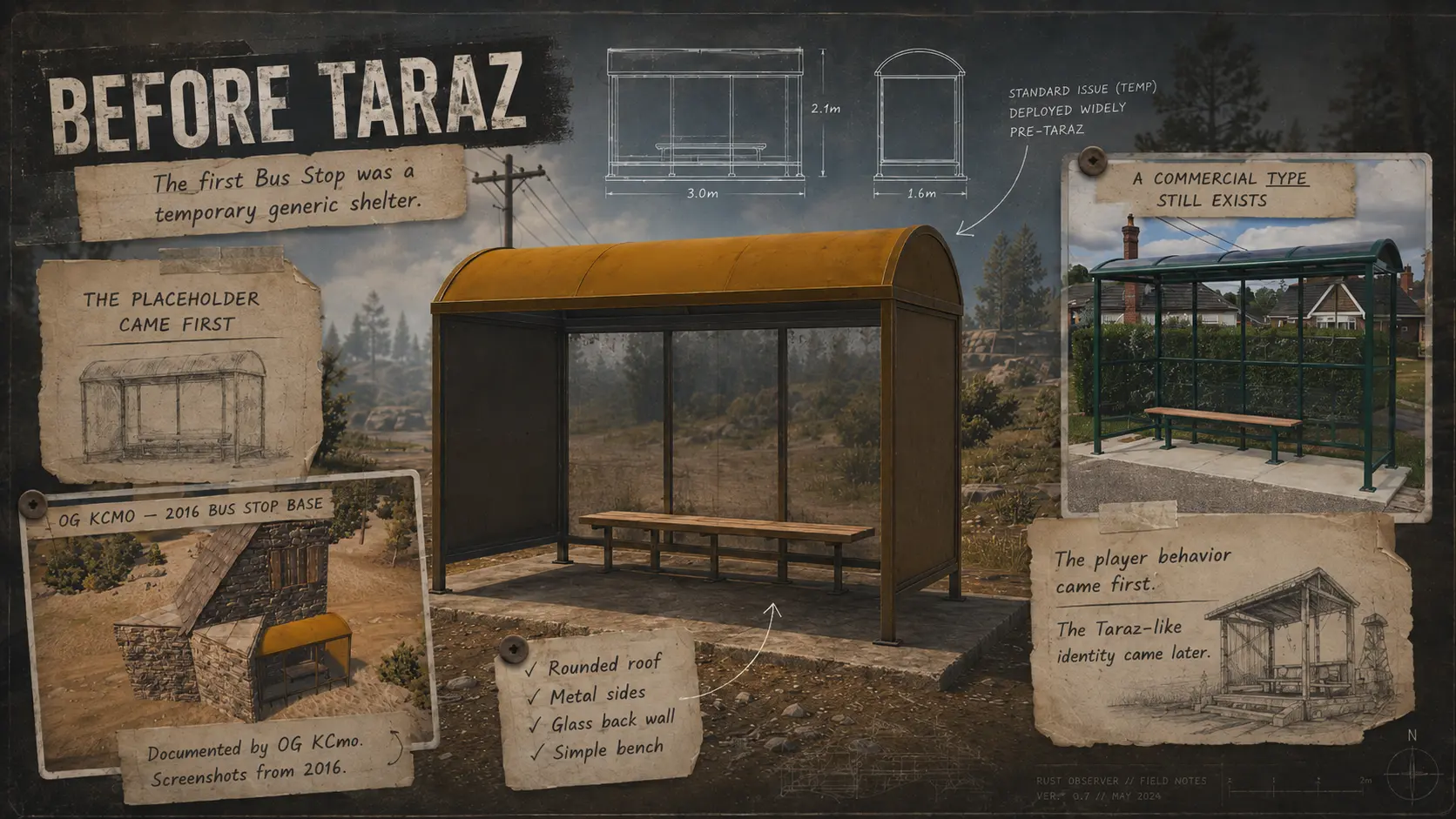
The first Bus Stop was a temporary, generic roadside shelter: a practical placeholder rather than an architectural statement. It used a rounded barrel roof, a light metal frame, solid metal side panels, an open front, a glazed rear wall, and a simple bench. In other words, it looked much closer to a standard commercial bus shelter than to the sculptural, Taraz-like form that would later replace it.
That detail matters, because it changes the order of the story.
Players were already building around the Bus Stop before the current model existed.
Screenshots and surviving footage from 2016, including material documented by OG KCmo, show the older shelter integrated directly into roadside player builds. At the time, building along or across roads was still possible, which meant the Bus Stop could be absorbed into small starter bases, improvised compounds, and compact roadside traps. The shelter was not yet visually remarkable, but it had already become usable architecture.
So the player behavior came first.
Facepunch itself later acknowledged that culture. In a 2016 community feature, the studio highlighted a Bus Stop base built by players, describing it as a snug roadside hovel built up and over the shelters found along Rust’s roads. The important point is not that the Bus Stop had become a major monument. It had not. The important point is that players had already identified it as something worth claiming, enclosing, and reusing.
Devblog 120 makes that history even clearer in hindsight.
When Facepunch introduced the current Bus Stop model, they explained that it was replacing the earlier temporary version. But they also made a revealing design note: the new model had been kept close to Rust’s building-block grid because some players liked building around it.
That sentence changes how the object should be read.
The current Bus Stop was not simply a new roadside prop. It was a replacement designed with inherited player behavior in mind. Facepunch did not invent the Bus Stop base with the Taraz-like model. They inherited an existing player habit, recognized it, and preserved it in the geometry of the new shelter.
This gives the Bus Stop two distinct histories layered on top of one another.
The first is functional: a generic roadside shelter that players turned into a buildable object during an earlier phase of Rust’s road system.
The second is architectural: the replacement model gave that same roadside object a far stronger visual identity, one that now connects convincingly to the Soviet bus-stop tradition and, more specifically, to the shelter near Taraz, Kazakhstan.
In that sense, Taraz did not create the Bus Stop base.
Taraz gave the Bus Stop base a face.
The Road Killed the Bus Stop Base
The Bus Stop did not become difficult to use because the shape was bad.
It became difficult because of where vanilla Rust places it.
On normal procedural maps, Bus Stops are tied to the road system. They sit near road layouts, monument entrance roads, and roadside logic. That places them inside or very close to no-building space. At intersections, the problem can become worse because road buffers and roadside restrictions overlap.
The result is simple:
The prefab still has potential.
The player still has ideas.
The build system still exists.
But the zoning says no.
Facepunch’s January 2020 road changes made sense from a design perspective. Roads are circulation. Roads connect monuments, vehicles, travel routes, junkpiles, and the rhythm of the island. If players can build too aggressively into that system, they can block movement, create exploits, interfere with spawns, and turn neutral infrastructure into private territory.
So yes, the restriction makes sense.
But design can make sense and still feel brutal.
For Bus Stop lovers, the change did not only remove a building trick. It removed a small piece of Rust folklore.
Hapis and the Last Survivors
There are still exceptions.
On Hapis, and on specific custom maps, the older relationship between the Bus Stop and player building can still survive. That is one reason the Bus Stop never fully disappeared from Rust culture. Even after normal procedural maps made it harder to use, players kept looking for the last buildable examples.
PrinceVidz turned that idea into a Rust story with “The Last BUS STOP Base in Rust (i found it),” framing the Hapis version almost like a last surviving specimen.
The joke works because everyone who understands Bus Stop bases understands the loss behind it.
This is not just a build spot.
It is a creature from an older Rust.
Hapis itself now belongs more to Rust’s historical map culture than to the normal procedural experience. Facepunch brought Hapis back for Rust’s 10-year celebration, then later retired Hapis and Observer Island from Facepunch servers while still allowing server owners to host them.
That makes Hapis Bus Stops feel even more like fossils: old map logic preserving old player behavior.
A Worker Shuttle, Not Public Transit
The Bus Stop also tells us something through placement.
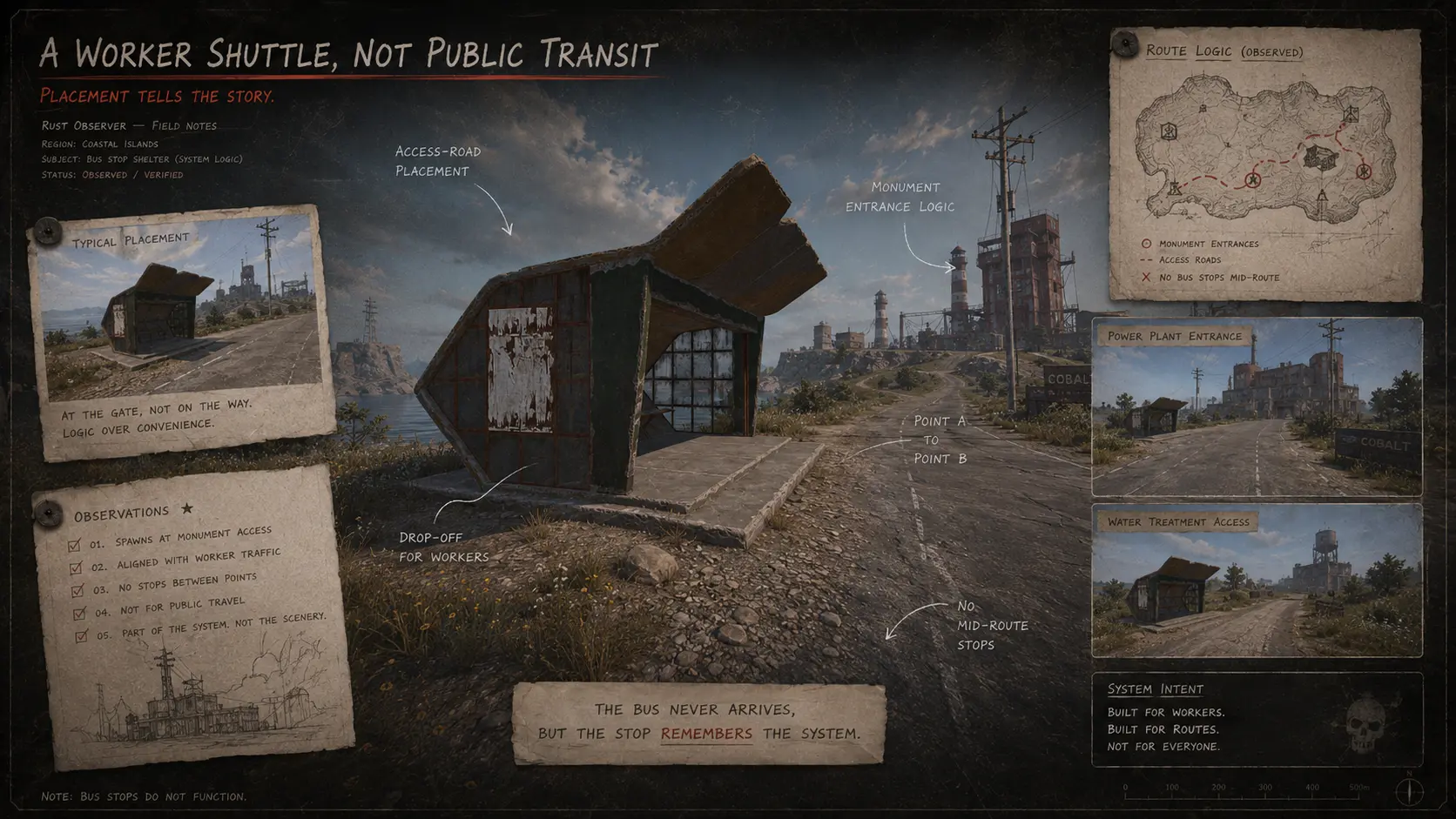
On Rust’s procedural roads, the shelters do not read like a normal civilian bus network. They are not evenly spaced along long stretches of road. They are not placed as neighbourhood stops, scenic pauses, or public transport stations between settlements.
They appear most clearly near the road entrances to monuments.
That changes the interpretation.
Rust’s Bus Stop does not feel like the remains of ordinary civilian transit. It feels more like a worker shuttle system: point-to-point movement between controlled sites. A small transport network for scientists, technicians, guards, maintenance crews, and industrial workers moving from one concrete facility to another.
No pause between destinations.
No public route culture.
No village-to-village rhythm.
Just controlled movement.
That makes the prefab fit the island even better. A folded concrete shelter beside a monument entrance is not decorative nostalgia. It is practical infrastructure for a working island: a place where personnel once waited before entering a launch site, power plant, treatment facility, harbor, airfield, or research complex.
The bus never arrives in Rust because the system that needed it is gone.
But the placement still remembers the route.
From Player Habit to Architectural Identity
This is why the Taraz connection should not be treated as the beginning of the Bus Stop’s story.
The Bus Stop was already part of Rust’s player culture before it became visually memorable. Its first version belonged to the world of ordinary roadside furniture: useful, generic, replaceable. It had a roof, panels, a bench, and just enough structure for players to notice its possibilities.
The replacement changed the object’s meaning.
Where the temporary shelter looked like a piece of modern street infrastructure, the current Bus Stop looks like a relic. Its folded canopy, raised front wing, descending rear mass, heavy concrete logic, and sculptural side profile push it out of the category of simple street furniture and into the world of Soviet roadside architecture.
That is where Taraz matters.
The shelter near Taraz, Kazakhstan, does not explain why players built Bus Stop bases. That behavior was already there. What Taraz explains is why the current Bus Stop feels different: heavier, stranger, older, more deliberate, and more architectural than the temporary object it replaced.
The old Bus Stop was a place players could use.
The new Bus Stop became a place players could remember.
The Real-World Inspiration: Taraz, Kazakhstan
Rust’s Bus Stop has one of the clearest real-world visual references in the game.
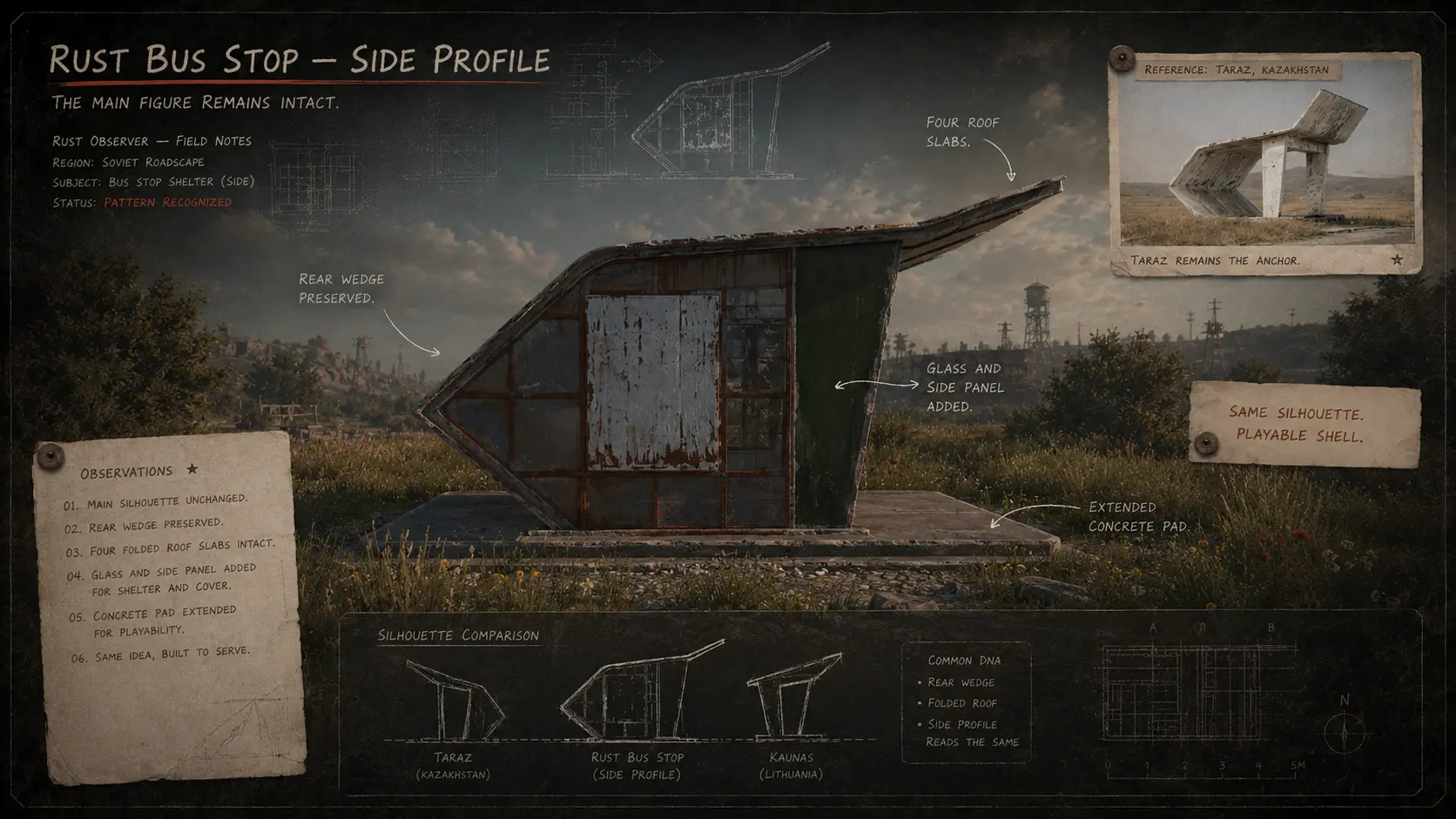
We strongly identify the famous Soviet-era shelter near Taraz, Kazakhstan, photographed by Christopher Herwig, as the main visual inspiration for Rust’s Bus Stop.
The comparison is not based on a vague resemblance.
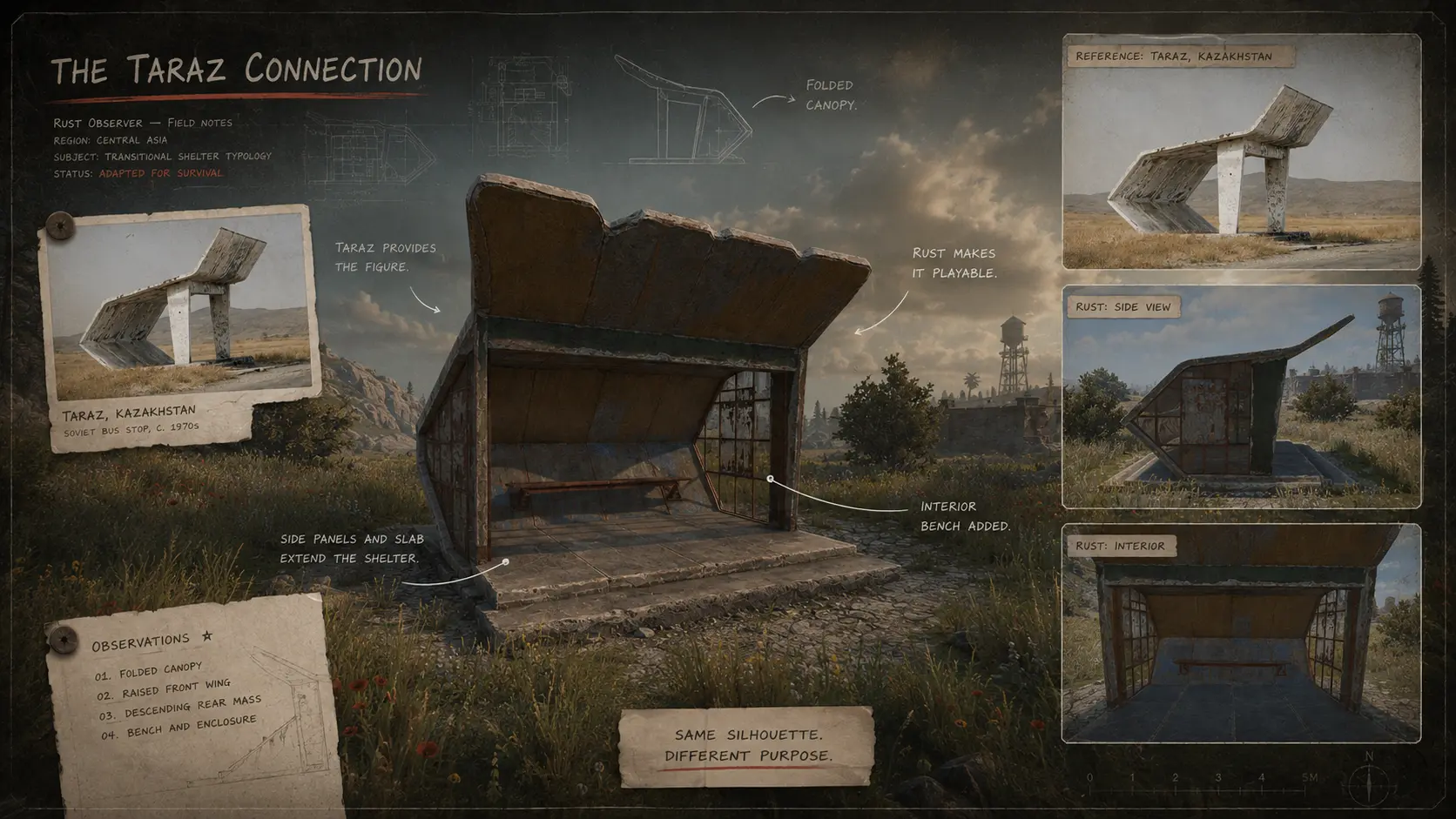
The raised wing-like roof, the folded roadside profile, the two-support structure, the rear mass dropping toward the ground, the open shelter logic, the concrete base, the parallel roof bands, and the weathered surface pattern all point in the same direction.
The Taraz shelter looks complex at first, but its geometry is simple: repeated roof bands folded through opposite angles. The front rises. The rear falls. The final rear segment returns toward the ground. The result is a roadside sculpture made from a very readable mathematical gesture.
Rust keeps that gesture.
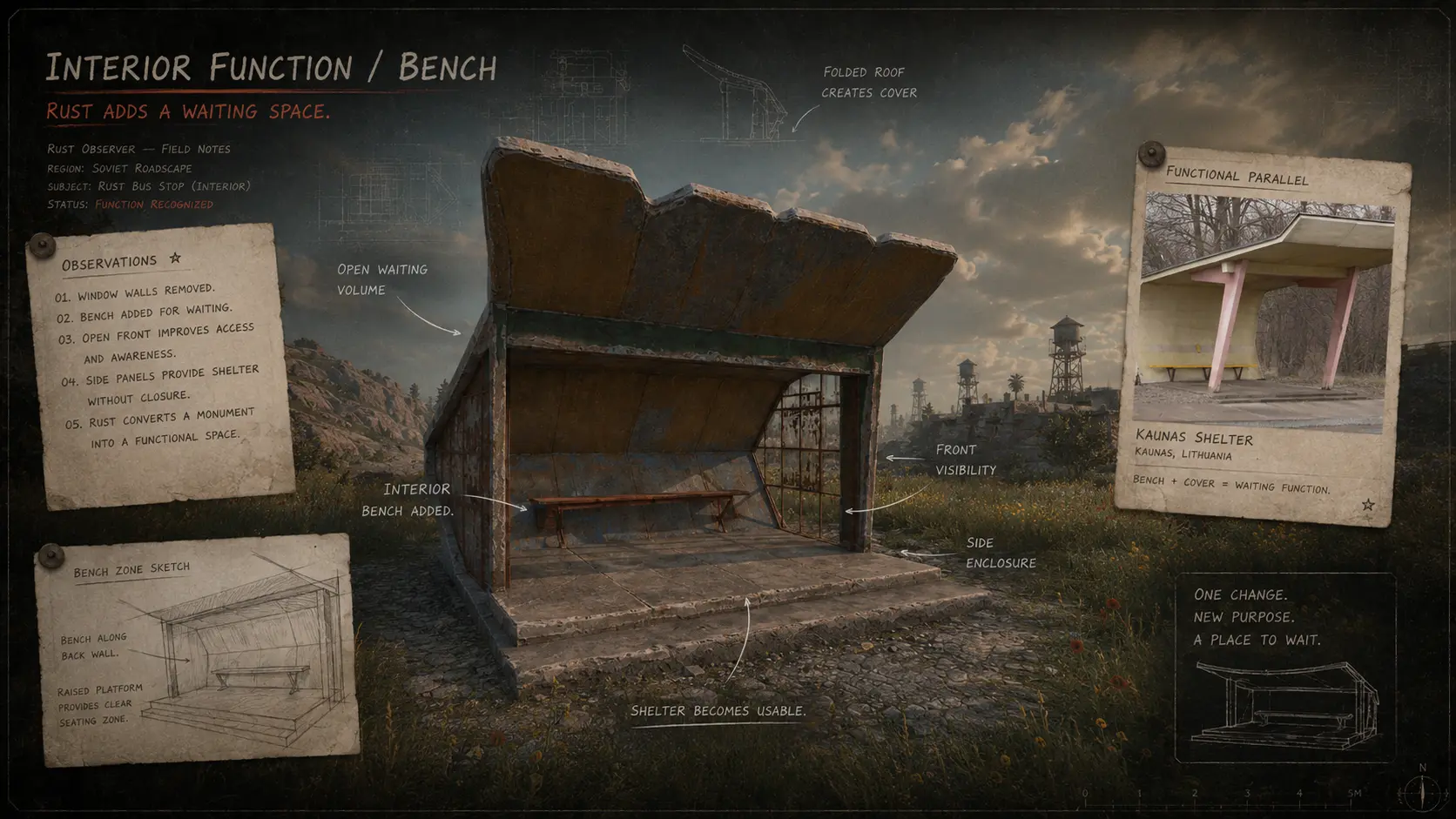
The proportions change because the object has been adapted into a playable prefab. The slab is extended into a usable floor area. The shelter is enclosed with side panels. A bench is added. The glass and metal framing make the object more readable as a bus stop in-game.
But the main figure remains intact.
Taraz gives Rust’s Bus Stop its identity.
Not a Copy: A Playable Hybrid
Rust’s version is not a one-to-one museum replica.
It is a playable hybrid.
The main structure comes from Taraz: the folded canopy, the dramatic roof angle, the rear descent, the two-support composition, the exposed weathering, and the sculptural roadside silhouette.
The functional details come from the broader Soviet bus-stop family.
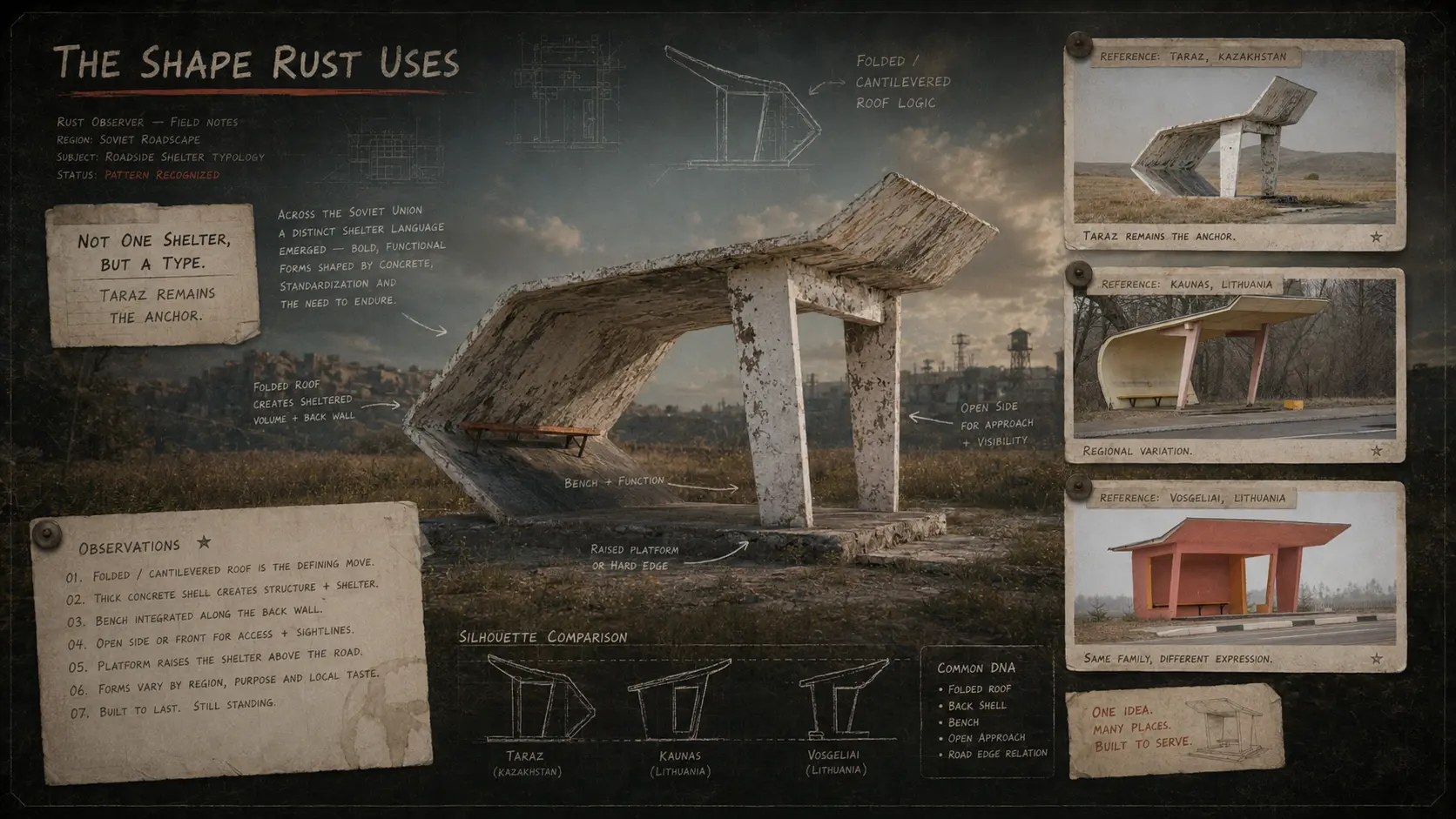
The bench, for example, is not part of the Taraz shelter in the reference photograph, but it appears in other Soviet-era examples, including the Kaunas shelter in Lithuania photographed by Herwig. That comparison matters because it explains how Facepunch converted the Taraz figure into a clearer game object. Taraz provides the sculptural identity. Kaunas and similar shelters provide the ordinary function: a place to sit, wait, and hide from the road.
The side panels and dirty windows are also a Rust translation. They add enclosure, visual cover, decay, and gameplay readability. They turn the open roadside sculpture into a compact shelter the player immediately understands.
That is the logic of the prefab.
Rust does not need Taraz to be copied bolt-for-bolt. It preserves the recognizable figure, then rebuilds it as a small usable object inside the game.
Why Soviet Bus Stops Became Roadside Monuments
Taraz is the visual anchor for Rust’s Bus Stop, but it belongs to a much larger phenomenon.
Across the former Soviet Union, bus stops became a distinct roadside architectural typology. They appeared from the Baltic republics to Central Asia, from the Caucasus to Siberia, along village roads, regional highways, collective-farm routes, industrial corridors, resort towns, mountain passes, and open countryside.
Some were built in concrete. Others used metal, stone, wood, ceramic tile, mosaic, or local materials. Some were plain. Others were wildly sculptural.
That variety is the point.
These structures were often treated as minor architectural forms: small public objects attached to roads, villages, collective farms, regional routes, or local transport systems. They were not grand state buildings. They were not ministries, metro stations, palaces of culture, or official monuments.
Because they were small, they had room to breathe.
Major Soviet architecture could be centralized, ideological, standardized, and heavily supervised. Bus stops were different. They were too ordinary to carry the full weight of official architecture, but too public to be meaningless. Local road departments, regional architects, artists, builders, collective farms, and communities could turn a basic shelter into something more personal.
The result was a huge roadside gallery of folded concrete, painted panels, mosaics, timber shelters, geometric canopies, local symbols, animals, flowers, rockets, folk motifs, and space-age experiments.
Some worked well as shelters. Others barely protected anyone from wind, snow, rain, or sun. Function was not always the whole point.
That is what makes them strange.
A bus stop should be one of the simplest objects in a landscape: a roof, a bench, a sign, a place to wait. But across the Soviet world, many of them became miniature monuments. They marked the road. They gave villages and regions a small architectural signature. They brought art into everyday movement, not inside a museum, but beside the road.
They are wonderful because they are too ambitious for their function.
Infrastructure Became Display
The Soviet bus stop belongs to a larger culture of visibility.
Across the Soviet Union and the wider Soviet-influenced world, power was not expressed only through soldiers, parades, flags, uniforms, and monumental government buildings. It was also expressed through the everyday environment: public squares, murals, mosaics, schools, workers’ clubs, factories, parks, road infrastructure, signage, and small architectural forms.
The goal was not only to build useful things.
It was to make the system visible.
In Soviet public space, the state did not only administer the landscape. It wrote itself into it. Names, slogans, institutions, and functions could be placed directly onto buildings at architectural scale. A cinema, factory, palace of culture, stadium, or workers’ club did not always need a modest sign at street level. Its identity could sit above the façade in enormous letters, becoming part of the skyline itself.
Even in abandoned places like Pripyat, that visual grammar remains. The people are gone. The institutions are gone. The signs no longer guide daily life. But the buildings still announce what they were, and the scale of the lettering still carries the old idea: public space was meant to make the system visible.
The bus stop is the smallest version of that logic.
It is not a palace of culture. It is not a parade square. It is not a monumental factory façade. It is only a shelter beside a road. But even there, infrastructure could become display. A roof, a bench, a wall, or a painted panel could carry local identity, public art, regional style, and state presence.
That is why Soviet bus stops feel strange and wonderful at the same time.
They are ordinary objects carrying an extraordinary amount of visual ambition.
Rust’s Bus Stop inherits that contradiction. It is small, almost useless, and easy to ignore. But its shape comes from a world where even the roadside could become a stage for public architecture.
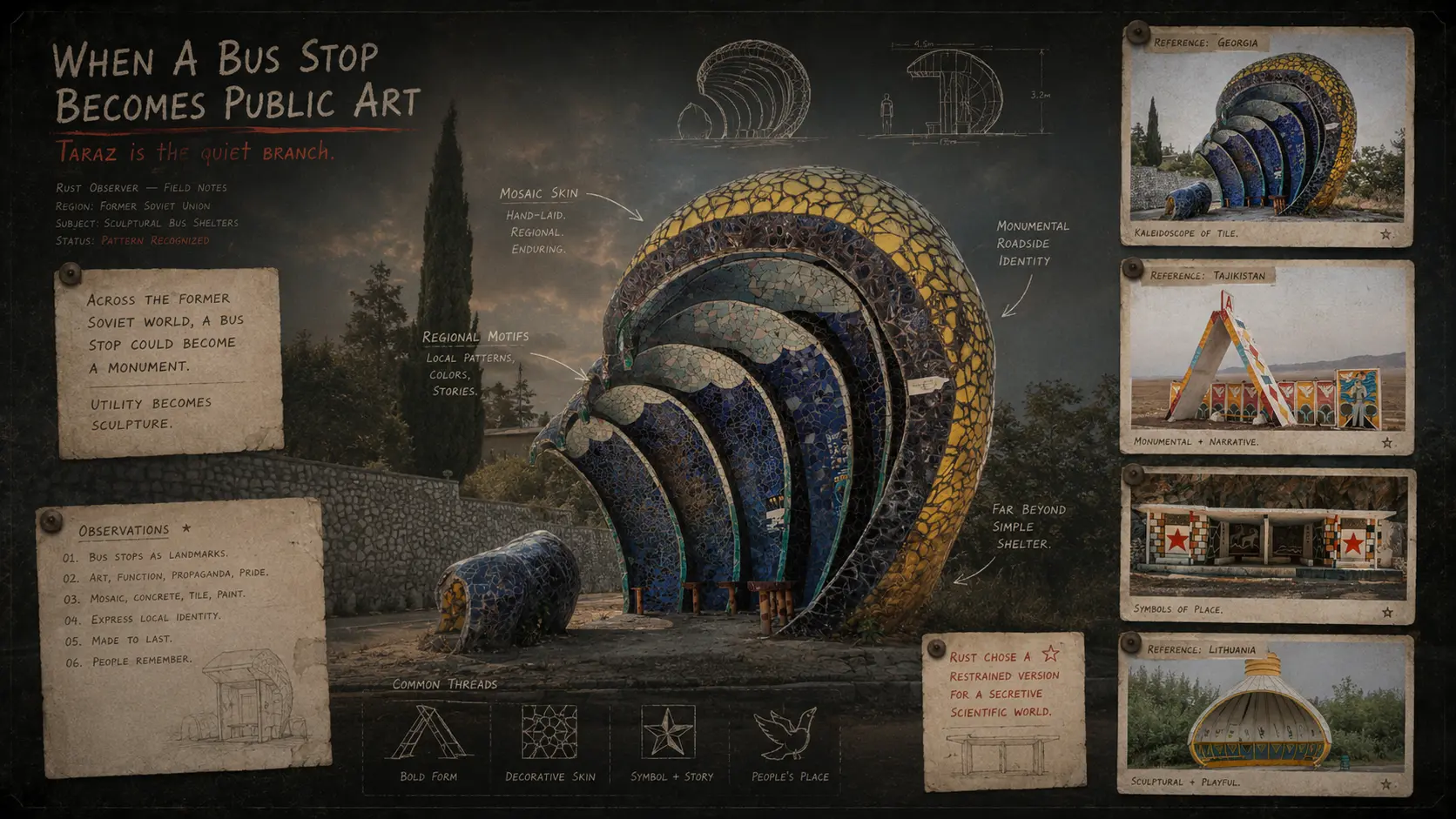
Why This Sad Bus Stop?
The shelters closest to Rust are not the most spectacular Soviet bus stops.
That is probably the point.
Across the former USSR, many roadside shelters became colourful, joyful, absurd, and almost theatrical: mosaics, shells, animals, folk patterns, space-age capsules, and small public artworks placed beside ordinary roads. Those examples explain why Soviet bus stops became famous, but they would not fit Rust’s island very well.
Rust is not a tourist road.
It is a secretive scientific and military landscape. Its concrete, roads, labs, launch infrastructure, and industrial ruins need to feel controlled, practical, damaged, and believable. A wildly decorative mosaic shelter would be historically valid, but visually too loud. It would pull the island toward public art, folklore, or roadside tourism.
The Taraz shelter works because it is quieter.
It is sculptural, but not playful. It is strange, but not cheerful. It has Soviet ambition without becoming decorative excess. Its folded form feels engineered, almost aerodynamic, and its damaged white surface already looks like something forgotten by a larger system.
That makes it ideal for Rust.
Facepunch did not choose the most beautiful Soviet bus stop. They chose the one that could survive inside Rust.
Taraz gives the Bus Stop enough real-world identity to matter, but enough restraint to feel like infrastructure.
A Folded Concrete Shelter for a Concrete Island
On Rust’s island, concrete makes sense.
If the island once supported a small internal transport system for scientists, technicians, guards, and industrial workers, then its bus stops would not need to be joyful roadside artworks. They would need to be durable, cheap, repeatable, and easy to place beside service roads.
A folded concrete shelter is perfect for that world.
It belongs to the same material language as the rest of the island: slabs, pads, foundations, roads, tunnels, laboratories, launch infrastructure, and industrial buildings. It feels like something designed by the same system that poured the concrete elsewhere.
That is why the sad version works better than the spectacular one.
The island does not need a mosaic shell or a colourful folk monument. It needs a practical public object with just enough ambition to reveal where it came from. A roof. A bench. A slab. A place for scientists to wait between concrete buildings, under concrete shelter, on a concrete island built for work that was never meant to be fully public.
Herwig Made the Pattern Visible
Christopher Herwig did not create the beauty of Soviet bus stops.
He made it visible.
For people living across the former Soviet republics, these shelters were not exotic discoveries. They were part of the road: familiar, aging, useful, embarrassing, repainted, abandoned, or taken for granted. A local resident might pass the same sculptural shelter every day without thinking of it as architecture.
Herwig changed the frame.
By photographing these objects as a collection, he made the pattern visible. What looked like isolated roadside oddities became a vast architectural phenomenon spread across the former USSR. The bus stop was no longer just a place to wait. It became evidence of local creativity, public infrastructure, regional identity, and artistic freedom surviving inside a system usually remembered for control and standardization.
That is also part of the chain that leads to Rust.
The real shelter stood beside the road first. Herwig made it legible to the outside world. Facepunch transformed that visual archive into a playable ruin. Players then turned the ruin into folklore.
Soviet Kazakhstan and the Launch Site Question
The Taraz shelter matters because Soviet Kazakhstan was not a decorative edge of the USSR.
It was one of the places where the Soviet project became physical.
For this article, the full national history of Kazakhstan is not the subject. The important point is that, during the twentieth century, the Kazakh SSR carried several faces of Soviet power at once: roads, planned settlements, industrial regions, agricultural campaigns, military test ranges, nuclear secrecy, missile systems, and space mythology.
Baikonur is the clearest link.
Built on the Kazakh steppe, Baikonur began as a Soviet missile test range before becoming the most famous launch site in the world. It is the kind of place that makes Rust’s Launch Site feel less random: a massive strategic installation, Soviet/Russian-coded, placed in a landscape that also contains roads, public infrastructure, concrete structures, and ordinary signs of civilian life.
The same republic also held darker strategic layers. Semipalatinsk was the Soviet Union’s primary nuclear test site. Sary-Shagan was tied to anti-ballistic missile and anti-satellite testing.
These are not Bus Stop subjects, and they should not take over this article. But they explain why Soviet Kazakhstan matters as a reference field.
It was a territory where the ordinary and the strategic coexisted.
A roadside shelter near Taraz belongs to the everyday side of that world. It is not a missile base. It is not a launchpad. It is not a secret test range. It is a place to wait beside the road.
But that is exactly why it matters.
The Bus Stop shows the smallest visible layer of the same system. If Baikonur was the cosmic face of Soviet Kazakhstan, the bus stop was its public roadside face: transport, art, concrete, local identity, and state visibility compressed into a useful object.
This is the bridge to Rust.
Rust’s Bus Stop is not secretly about Baikonur. Launch Site will carry that discussion more directly. But both belong to the same visual problem:
Why does this island contain Soviet/Russian-coded infrastructure at all?
The answer is not that every object copies the Soviet Union.
The answer is that Rust uses the visual language of systems that wanted to organize, occupy, display, and control space. The Bus Stop shows that language at the smallest scale. Launch Site shows it at the largest.
Editor’s note: We will return to Baikonur, Soviet Kazakhstan, and the strategic landscape of the steppe in the Launch Site article.
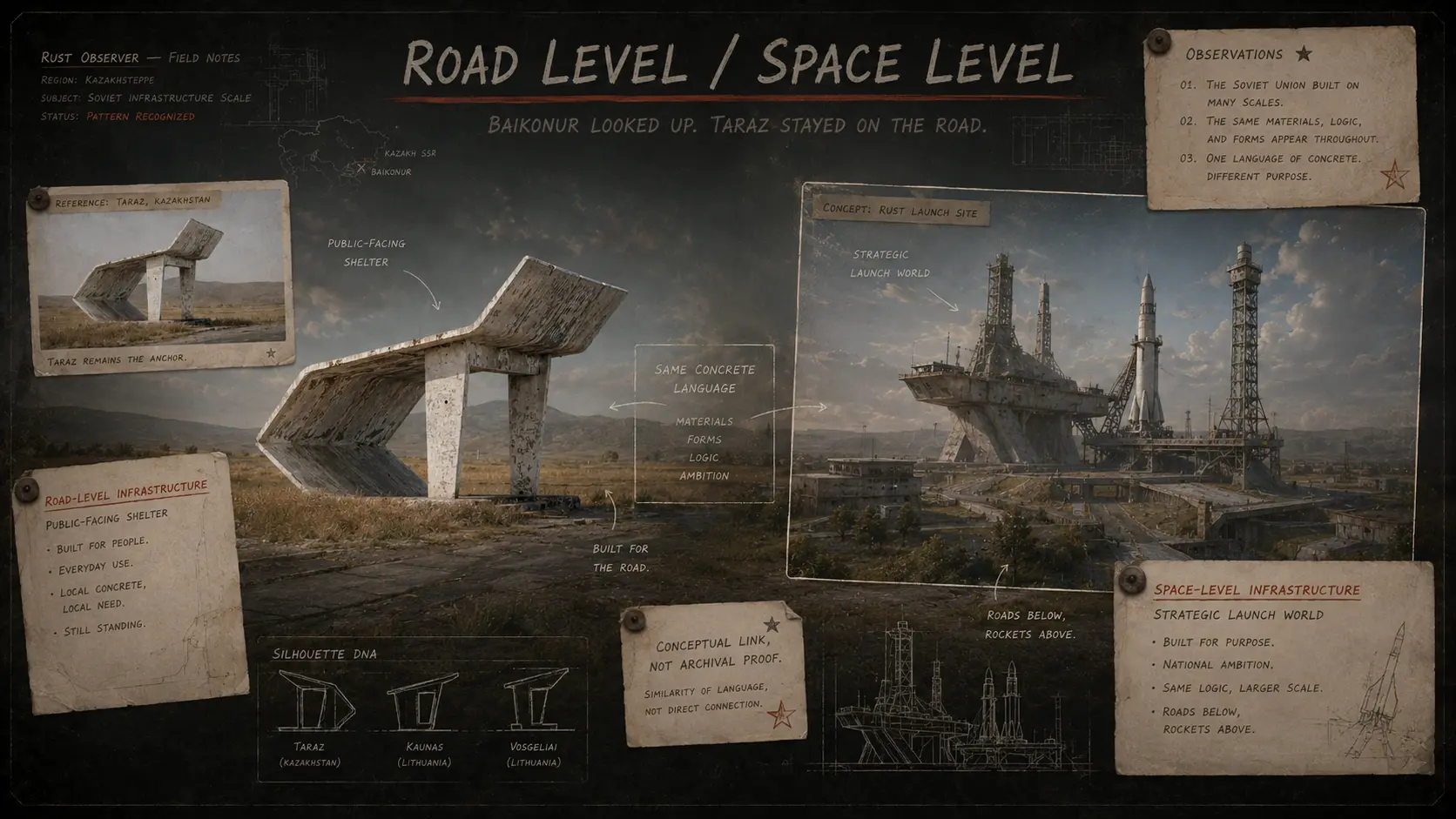
A What If Bridge: Imported Memory
There is one speculative reading worth keeping on the table.
If Rust’s Launch Site represents a hidden Cold War infrastructure project, then its Soviet visual language does not need to be accidental. By the mid-1970s, the United States already knew about Baikonur, and Apollo-Soyuz had opened a rare public channel between American and Soviet space programs. A remote island, outside the normal field of cameras and public diplomacy, becomes an ideal What If setting: Soviet launch expertise, Western instrumentation, British and German engineering, and a project too sensitive to display openly.
In that reading, the Bus Stop is not random decoration.
It is imported memory.
A specialist who came from the Soviet space or military-engineering world would not bring only technical knowledge. He would bring the visual habits of the system that trained him: roads, slabs, public shelters, monumental small architecture, and the belief that even ordinary infrastructure should carry identity.
Baikonur gives us the engineer.
Taraz gives us the memory.
Rust gives us the island.
This is not confirmed lore. It is a speculative bridge between two observations: Rust’s Launch Site feels Soviet/Russian-coded, and Rust’s Bus Stop strongly carries the visual identity of a Soviet roadside shelter from Kazakhstan.
Launch Site would be the secret project.
Bus Stop would be the cultural fingerprint.
The Bench That Cannot Be Used
One detail is almost ironic: Rust’s Bus Stop includes the bench, but not the act of sitting.
The bench completes the visual language of the roadside shelter. It tells the player what the object was for. It transforms the sculptural Taraz form into something immediately legible: an actual bus stop.
But the player cannot sit.
That missing interaction is small, but it says a lot. The object remembers its function visually, but not socially. It looks like a place designed for waiting, yet no one can truly wait there. It is a prop of public life after public life has disappeared.
That is very Rust.
The world is full of objects that still carry their old meaning, even after the systems that made them useful are gone.
Why Fans Still Care
The Bus Stop is not important because of loot.
It is important because players attached meaning to it.
For some players, it is a nostalgic build spot. For others, it is a trap-base shell, a road ambush point, a weird starter, or a reminder of older Rust geometry. For creators like PrinceVidz, it becomes story material: a small abandoned prefab with enough history to carry an entire video premise.
That is the difference between content and culture.
Content is what the developer places.
Culture is what players remember.
The Bus Stop was never one of Rust’s great monuments. It was barely a monument at all. But because it was strange, buildable, abusable, recognizable, and tied to real-world architecture, players made it bigger than its loot table.
It became a monument because players treated it like one.
Why It Still Matters
The Bus Stop remains useless in the traditional vanilla sense.
That is not really an insult. It is useless in the loot sense. It is useless in the puzzle sense. It is useless in the progression sense. It does not compete with Gas Station, Supermarket, Mining Outpost, Lighthouse, or any serious monument.
But it is useful as world language.
It tells us that roads mattered. It gives the map a mundane human detail. It creates cover. It creates memory. It gives players a place to hide, pause, ambush, joke, build, or remember a version of Rust where a stupid roadside shelter could become home.
That is the lesson.
Not every prefab needs to be profitable. Not every location needs a recycler, a card, a crate, scientists, or a boss. Sometimes a small useless structure becomes important because players are allowed to attach meaning to it.
Why spend so much time on a bus stop?
Because the Bus Stop is the smallest clue.
If a political and architectural culture could make even a roadside shelter feel grand, strange, artistic, and symbolic, then the larger concrete buildings of Rust should not be treated as neutral background. Roads, shelters, factories, laboratories, power plants, tunnels, towers, and public structures all belong to systems that had reasons to exist.
This does not mean Rust is simply copying the Soviet Union.
It means Rust understands the visual power of infrastructure.
Concrete is not only material. It is authority. It is planning. It is permanence. It is the claim that someone organized this place before the player arrived.
The Bus Stop matters because it reveals that logic at the smallest scale: a useless shelter beside the road, still carrying the ambition of the world that built it.
Rust’s Bus Stop is not useless because it never had a purpose.
It is useless because the system that gave it purpose is gone.
The Bus Stop was never a great monument.
It was barely a monument at all.
And that is exactly why players made it one.
References
Facepunch Studios. “Devblog 68.” Rust, July 9, 2015.
Useful for the early presence of small roadside bus stops in Rust. The sound-design section mentions “the little bus stops along the roads” as physical shelters under which rain and ambience behavior could be perceived.
https://rust.facepunch.com/news/devblog-68
Facepunch Studios. “Community Update 71.” Rust, January 12, 2016.
Official Facepunch community post highlighting “The Bus Stop base,” a player-made structure built up and over roadside bus stops. This is the clearest official source showing that players were already turning bus stops into buildable architecture before the current Taraz-like model.
https://rust.facepunch.com/news/community-update-71
OG KCmo. “RUST SOLO BASE DESIGN 2016 – Impossibly Hard to Raid BUS STOP BASE.” YouTube.
Surviving gameplay footage of the original temporary Bus Stop model integrated into a roadside player base. Useful visual evidence for the pre-Taraz shelter: rounded roof, metal side panels, open front, rear glazing, bench, and buildable road context.
https://www.youtube.com/watch?v=EWByv1VsgOI
Facepunch Studios. “Devblog 120.” Rust, July 28, 2016.
Key official source for the replacement model. Facepunch states that a new bus-stop model was made to replace the temporary one and kept close to the building-block grid because some players liked building around it.
https://rust.facepunch.com/news/devblog-120
Facepunch Studios. “Community Update 96.” Rust, July 26, 2016.
A later community mention joking about making a base out of a bus stop. Secondary support for the fact that Bus Stop bases had become a recognized player behavior by mid-2016.
https://rust.facepunch.com/news/community-update-96
Facepunch Studios. “Devblog 180 / Changelog.” Rust, October 5, 2017.
Mentions improved bus stop and power substation spawn rules. Useful as a secondary technical reference showing bus stops as part of Rust’s procedural world-generation logic.
https://rust.facepunch.com/changes/25
Speedy Street Solutions. “Heritage Bus Shelter – Full End Panels.” BusShelters UK. Accessed June 21, 2026.
Commercial contemporary example of the same broad shelter family as Rust’s original temporary Bus Stop: barrel roof, side/end panels, weather protection, customizable finishes, and public-street furniture logic. Not an exact source match, but useful as a typological comparison.
https://www.speedystreetsolutions.com/heritage-bus-shelter-full-end-panels.html
Facepunch — Happy New Year / Road changes, January 2, 2020
https://rust.facepunch.com/changes/16
Facepunch — 10 Years of Rust / Hapis return
https://rust.facepunch.com/news/10-years-of-rust
Facepunch — Lighting The Way / Hapis and Observer Island retirement
https://rust.facepunch.com/news/lighting-the-way
Christopher Herwig — Soviet Bus Stops
https://www.herwigphoto.com/Soviet-Bus-Stops
Soviet Bus Stops — Documentary project
https://www.sovietbusstops.com/
Wikipedia — Soviet bus stops
https://en.wikipedia.org/wiki/Soviet_bus_stops
WIRED — The Wild Architecture of Soviet-Era Bus Stops
https://www.wired.com/2015/09/wild-architecture-soviet-era-bus-stops/
RFE/RL — Roadside Temples: Unusual Bus Stops Of The Soviet Era
https://www.rferl.org/a/soviet-union-public-art/25294007.html
STIRworld — Christopher Herwig reveals anomalous bus stops in the former Soviet Union
https://www.stirworld.com/think-books-and-movies-christopher-herwig-reveals-anomalous-bus-stops-in-the-former-soviet-union
Going the Whole Hogg — Soviet Bus Stops
https://www.goingthewholehogg.com/soviet-bus-stops/
Russia Beyond — How did Kazakhstan become Soviet?
https://www.rbth.com/history/334630-how-did-kazakhstan-become-soviet
The National Interest — Kazakhstan, Not Russia, Was the Last Republic to Leave the USSR
https://nationalinterest.org/blog/buzz/kazakhstan-not-russia-was-last-republic-leave-ussr-195400
NTI — Baikonur Cosmodrome
https://www.nti.org/education-center/facilities/baikonur-cosmodrome/
NTI — Semipalatinsk Test Site
https://www.nti.org/education-center/facilities/semipalatinsk-test-site/
NTI — Sary-Shagan
https://www.nti.org/education-center/facilities/sary-shagan/
NASA — Apollo-Soyuz Test Project
https://www.nasa.gov/apollo-soyuz-test-project/
Travelproof — Very Special Bus Stop Designs in Central Asia
https://www.tiktok.com/@travelproof/video/7155026054292229381
PrinceVidz — The Last BUS STOP Base in Rust (i found it)
https://www.youtube.com/watch?v=fyaf2MIi3kU