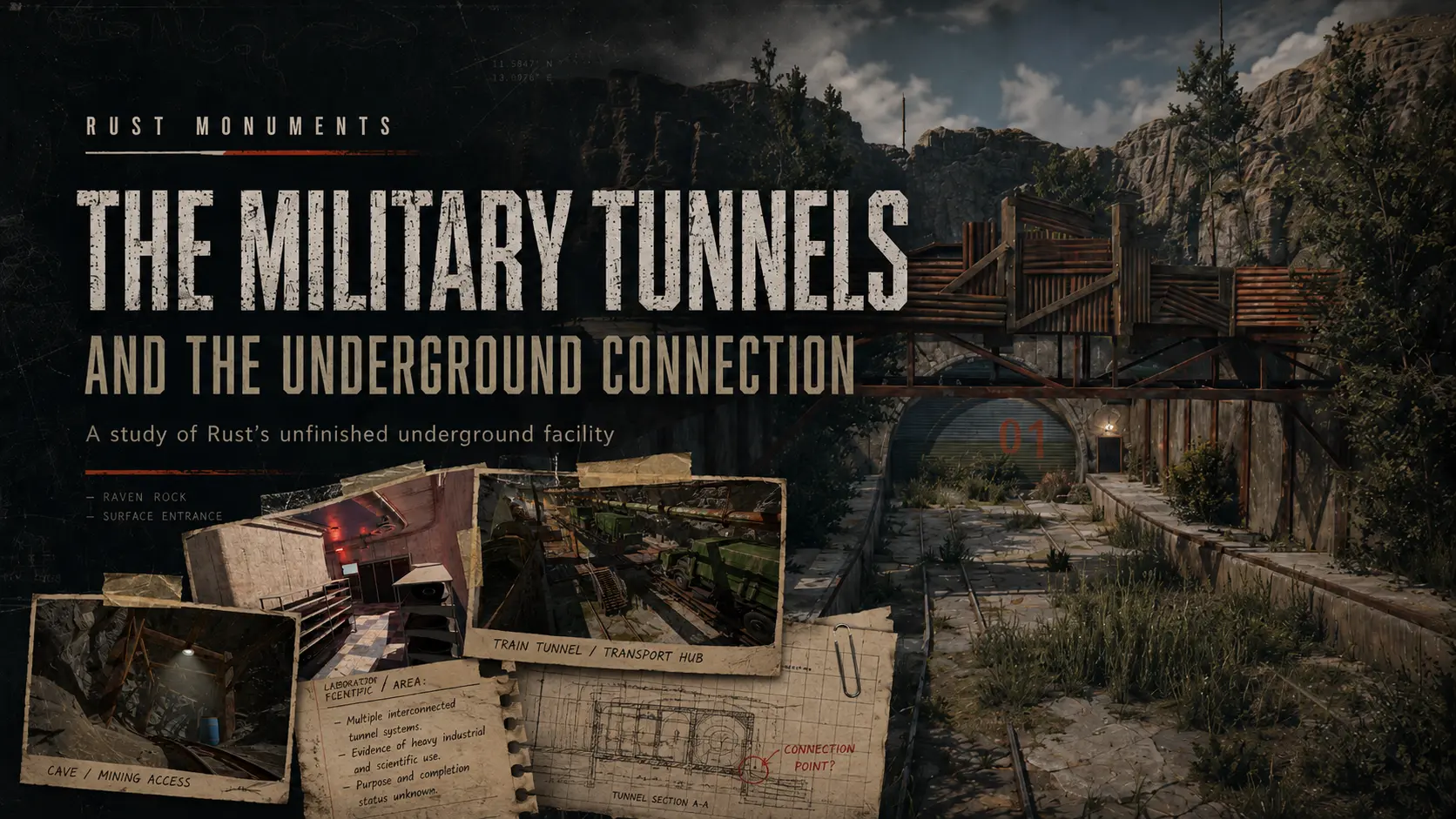
Military Tunnels and the Underground Connection
Military Tunnels looks military because of its name, Scientists, loot, and puzzle systems. But its structure tells a deeper story: cave routes, rail infrastructure, laboratory inserts, and later gameplay layers built onto an old underground dungeon.
Military Tunnels and the Underground Connection
Military Tunnels looks like one of Rust’s most self-explanatory monuments.
The name says military. Scientists patrol its corridors. Weapons, elite loot, card readers, locked doors and warning lights reinforce the impression. Descend far enough and the island seems to have given way to a buried military installation.
That interpretation is correct.
It is also incomplete.
The history of Military Tunnels stretches back to Rust’s early dungeon experiments, and the place players explore today was assembled through several distinct development phases. Military caves became tunnels. A relatively simple underground dungeon was rebuilt. Old mining passages were deliberately inserted as remnants of an earlier industrial age. Scientists arrived years later. A laboratory followed them. Puzzles eventually turned the monument into one of Rust’s highest-tier progression spaces.
Military Tunnels feels layered because it genuinely is.
Military Caves
The first public trace appears on September 17, 2015.
Howard “Howie” Schechtman described work on a new remnant area Facepunch was calling the Military Caves. His first image showed an access tunnel into what he described as industrialized caves containing valuable loot and presenting a considerable challenge to players.
The name matters.
Military Tunnels did not begin as a civilian mine that Facepunch later converted into a military base. The military identity was already present in the earliest documented concept.
So was the underground one.
Howie was already thinking beyond a single tunnel. His plan included a central location or room reached through the access passages.
Three weeks later, that idea became more explicit. He was designing a central hub area for the underground military tunnels, with the possibility of several hub rooms connected by access routes.
By Devblog 82, navigation itself had become part of the design. Howie wanted the area to be interesting for PvP and intentionally confusing enough that players could feel a little lost underground. Large drainage or sewer pipes appeared as visual connections without necessarily functioning as safe entrances.
Military Tunnels therefore acquired some of its most recognizable characteristics before the finished monument existed:
underground scale, branching circulation, difficult navigation, valuable loot, PvP potential and a large central space where several routes could converge.
The basic idea was already strong.
From Concept to Dungeon
Military Tunnels emerged during a much larger change in the way Rust built its world.
Facepunch was developing a modular dungeon system capable of assembling larger monuments from reusable pieces. Power Plant, Train Yard, Water Treatment, sewer environments and underground spaces belonged to the same period of experimentation.
On December 3, 2015, Facepunch announced that the new dungeons were in the game.
That update is currently the strongest release point we have for the first playable generation of Military Tunnels.
It was still far from the monument players know today.
Early dungeon assets remained rough, incomplete and modular. Art continued to arrive after release. Railroad pieces, roads, concrete elements and collision fixes appeared over the following months.
This early Military Tunnels was therefore less a finished monument preserved in amber than a working underground system waiting for Rust’s world design to catch up with it.
And in 2016, Facepunch went back underground.
The 2016 Rebuild
This is where the development history corrects one of the easiest misconceptions about Military Tunnels.
The monument did not simply survive unchanged while later gameplay systems accumulated inside it.
It was rebuilt.
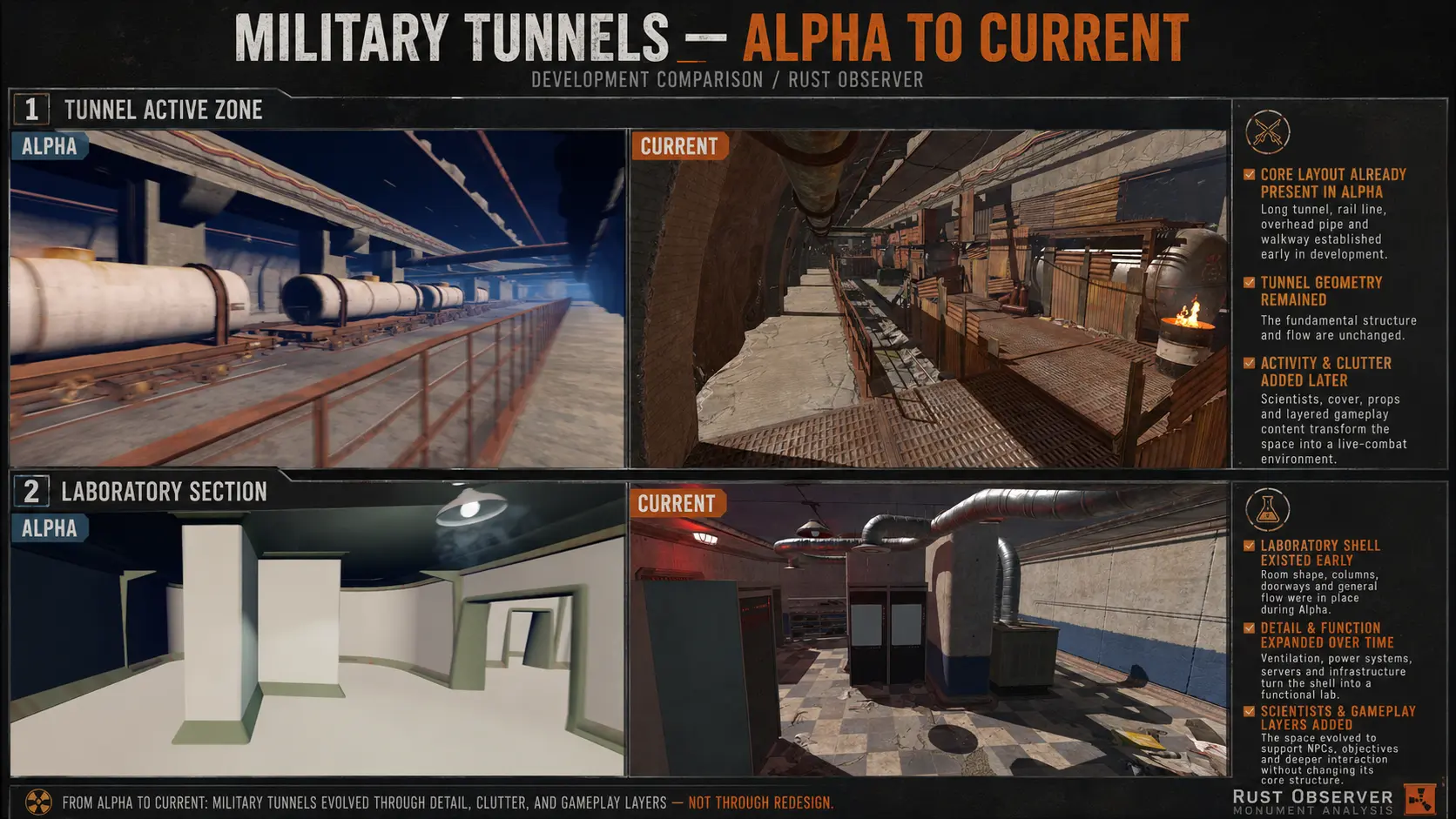
In August 2016, Vincent Mayeur described Military Tunnels as one of the final portions of the new dungeon system still remaining in greybox. He began transforming it toward its finished form, completing the dungeon already in the game and creating additional pieces for larger and more interesting underground spaces.
A week later he was even more direct.
He was revamping the Military Tunnels dungeon because the existing layout felt uninteresting.
New sloped tunnel pieces allowed levels to move vertically. Routes could become more complex. The underground network could connect with other dungeon systems and natural caves.
Then Vincent introduced something that completely changes how the monument’s apparent history should be read.
Old mining tunnels.
An Older Era, Added Later
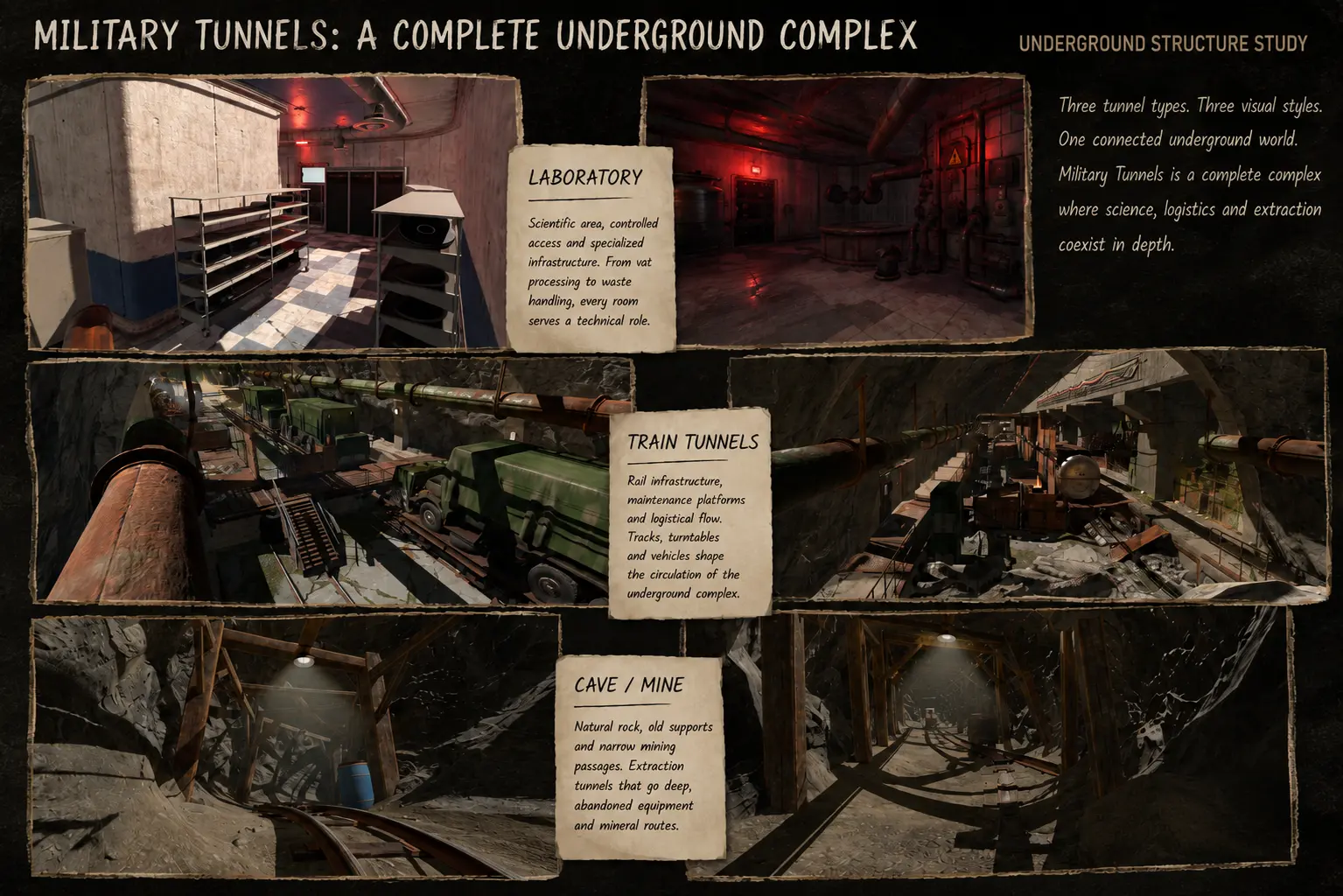
The small timber-supported mine passages look older than the massive concrete military infrastructure.
According to Facepunch, they are supposed to.
Vincent described the new mine tunnel set as a remnant of industrialization from an older era on the island.
That is unusually useful language for interpreting Rust.
The mine tunnels were created later in development than the original Military Caves, yet they were deliberately designed to represent something older inside the world.
Their intended purpose was also practical. Because they were smaller and more twisted than the huge concrete tunnels, they could create secondary routes into military complexes and natural caves.
By August 2016, the reworked Military Tunnels had several entrances and exits and was described as the largest underground place Rust had yet built.
This gives the monument genuine archaeological layering.
The military complex came first in development.
The mine passages came later in development.
Inside the implied history of the island, Facepunch deliberately reversed that relationship: the mine represents an older industrial layer through which later infrastructure can pass or connect.
Rust rarely hands us explicit historical dates for its ruins. Here, the developers at least tell us how one layer should feel relative to another.
The Underground Hub
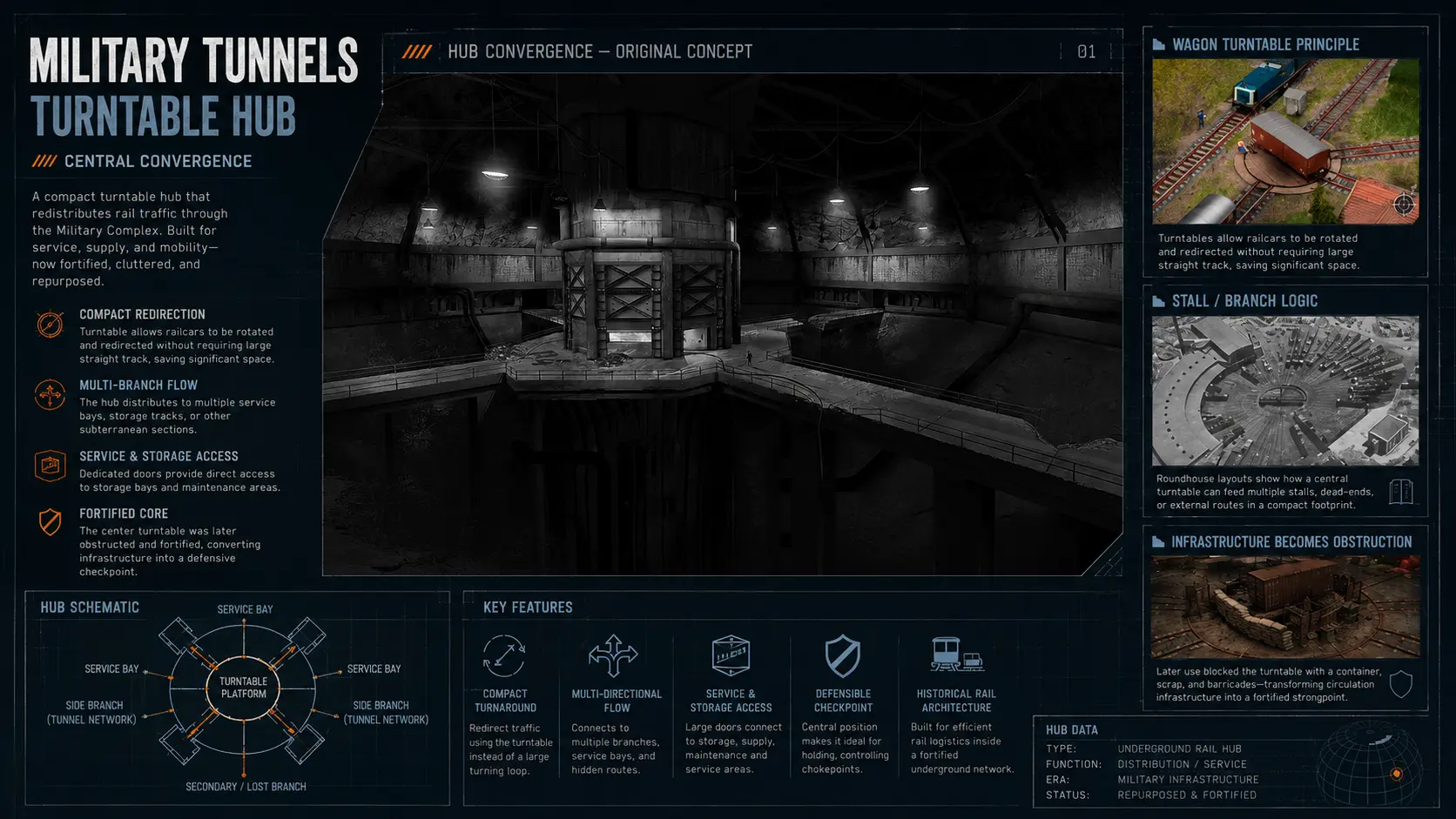
The central rail area remains one of the monument’s strongest pieces of spatial design.
Tracks converge inside a large underground volume. Service routes split away. Rail equipment, concrete infrastructure and restricted passages turn movement itself into part of the architecture.
The turntable fits naturally into this environment.
Rail turntables solve a basic physical problem: a rail vehicle needs substantial space to turn through a normal curve. A rotating platform can redirect it within a much smaller footprint.
That logic becomes especially useful underground, where every large excavation requires more work and space.
Rust turns the same piece of infrastructure into a combat arena.
Sightlines cross the room. Routes meet. Cover interrupts movement. Players arriving from different sections can suddenly occupy the same space.
The result feels technical before it feels decorative.
It also carries forward Howie’s original central-hub idea remarkably well. The exact geometry changed, the dungeon was rebuilt, and other artists transformed the concept into a functioning environment, but the original desire for a large buried point of convergence survived.
Concept art established the direction.
Years of level design made it playable.
Three Ages Underground
Military Tunnels now speaks several architectural languages at once.
The natural rock suggests the island itself: caves, broken surfaces and underground voids that existed before anyone built through them.
The timber mine tunnels suggest an older industrial phase. They are smaller, rougher and visibly supported by construction methods associated with excavation rather than modern fortified infrastructure.
The concrete tunnels, rail corridors, gates, technical rooms and large hubs belong to the military complex.
These layers overlap.
Sometimes concrete presses directly into rock. Sometimes narrow mine passages create alternative movement around much larger engineered spaces. Rails make the underground complex feel logistical as well as defensive.
That mixture gives Military Tunnels an unusual sense of scale.
It feels larger than the portion the player can actually visit because every wall suggests another system beyond it: another shaft, another rail line, another collapsed section, another connection buried somewhere inside the island.
Then, in 2018, another layer arrived.
The Scientists Move In
The original Military Tunnels was designed years before Scientists became its defining occupants.
That history becomes very clear in Facepunch’s own description of the February 2018 refresh.
Vincent explained that when the monuments had been expanded a couple of years earlier, their eventual gameplay direction was still uncertain. Military Tunnels might become a focused PvP location or eventually support PvE.
Because that answer had not yet been decided, much of the tunnel level design had been kept deliberately bare-bones.
By early 2018, the answer had arrived.
Scientists were coming.
The monument needed better traversal, better combat spaces, patrol routes, cover and level design capable of supporting PvE encounters rather than simply providing an underground loot location where players fought each other.
The February refresh prepared the space.
The Scientists were initially still disabled by default while their navigation and behaviour were being developed.
On March 1, 2018, Facepunch made the occupation official:
the Scientists had invaded Military Tunnels.
They patrolled it, used cover, reacted to light and movement, changed weapons, searched for players and — after some development work — stopped escaping the monument to wander indefinitely across the island.
Military Tunnels had acquired a new population.
Its architecture now had inhabitants capable of using it.
The Laboratory Came After the Scientists
The laboratory deserves special attention because its chronology changes the story considerably.
It is easy to look at the current monument and imagine that the laboratory explains why Scientists eventually occupied Military Tunnels.
The documented development order runs the other way.
Scientists were being deployed into Military Tunnels in February 2018 and officially invaded it in March.
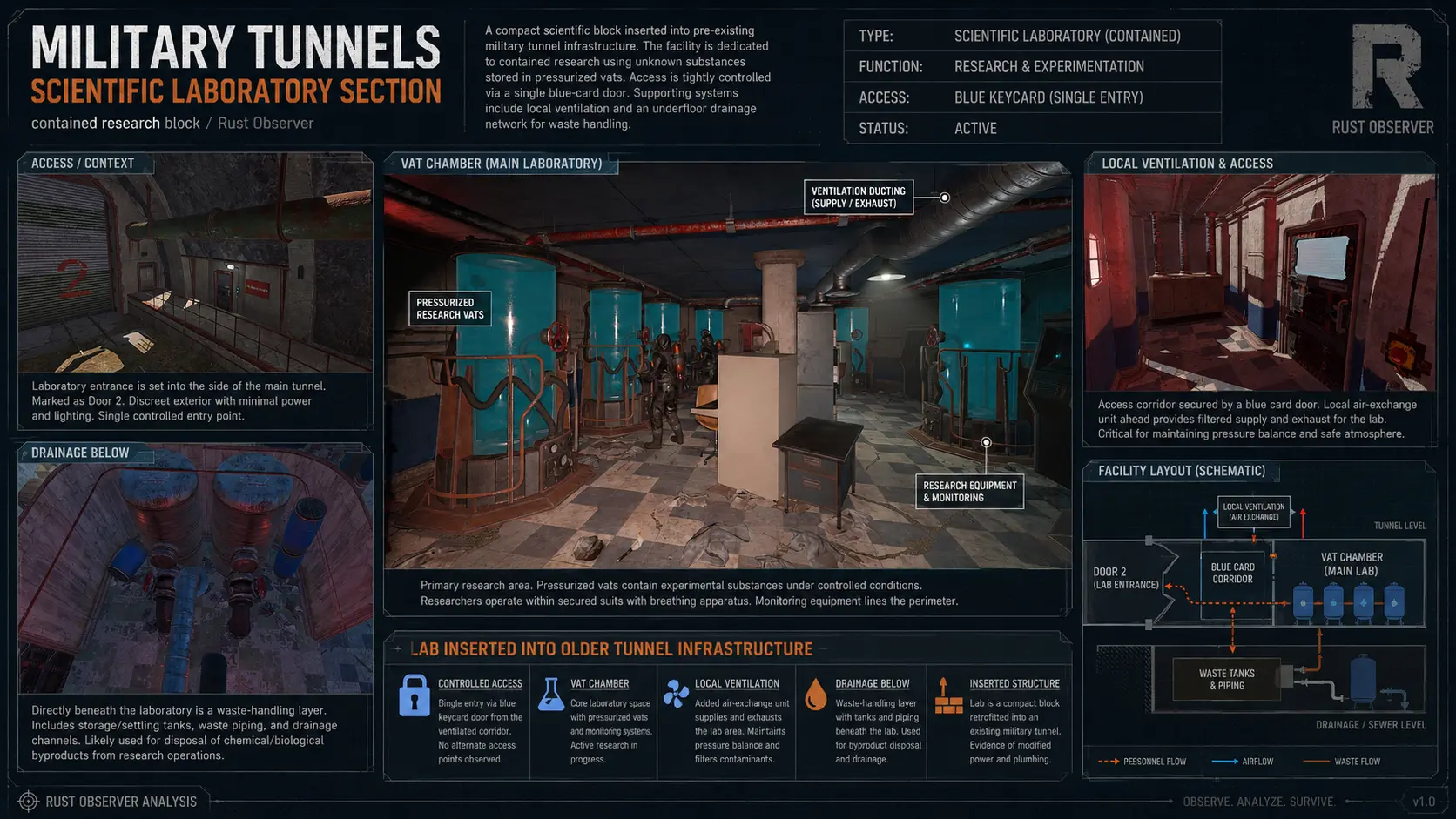
In June, Facepunch referred to a new lab area of Military Tunnels.
The laboratory therefore belongs to the later expansion of the monument rather than its original identity.
Its visual language is noticeably different from the older underground spaces.
Concrete rooms become more controlled. Ventilation, technical equipment, vats, piping, restricted doors and emergency lighting suggest research, processing or containment rather than simple transportation through tunnels.
That gives the modern monument another readable layer.
The caves establish the underground environment.
The mine suggests an older industrial past.
The massive concrete infrastructure establishes the military complex.
The laboratory strengthens the later scientific occupation.
The chronology is not perfectly visible to someone simply walking through the monument, but once the development history is known, the differences become much easier to read.
Puzzles Turn the Facility On
June 2018 transformed Military Tunnels again.
The Puzzle Update introduced progression systems across Rust’s monuments: generators, switches, timers, fuses, card readers and keycards could now control access to additional loot.
Military Tunnels sat at the top of that progression alongside Launch Site.
Facepunch classified both among the harder monument puzzles, rewarding players with access to elite-crate-level loot.
This changed the way players moved through the structure.
The corridors were no longer only routes.
Doors could represent progression.
A fuse could impose time pressure.
A card reader could determine whether preparation elsewhere on the island translated into access here.
Power had to be restored and movement planned.
The monument now connected to the wider wipe.
A player might obtain one card at another monument, acquire the next level somewhere else, gather the equipment required to survive radiation and Scientists, and eventually arrive underground carrying the results of several earlier expeditions.
Military Tunnels had become a destination in a progression chain.
Its old architecture was now supporting systems nobody needed to imagine when Military Caves first appeared in 2015.
The Mine Becomes an Exit
Even after the major 2018 changes, the monument continued to evolve.
In February 2019, Vincent reworked its exit route.
Previously, the primary escape route brought players through the chimney past the laboratory. The mine tunnel that had served as an entrance was changed so it could also function as an exit, while additional surface cover made retreat less vulnerable to campers.
That small change is a useful example of how Military Tunnels continued to absorb gameplay into its architecture.
The mine passages had originally been added as secondary connections through an underground network.
Years later, one of those connections became part of the monument’s survival flow.
The architecture kept finding new jobs.
A Monument Built in Layers
Military Tunnels has been rebuilt, expanded, populated and reactivated several times.
The earliest Military Caves established the underground military identity.
The first dungeon generation gave players a functioning place to explore.
The 2016 overhaul transformed the layout and added the old mining passages.
The mine itself was intentionally framed as a remnant of an earlier period in the island’s industrial history.
The 2018 refresh prepared the tunnels for PvE.
Scientists occupied them.
The laboratory expanded their environment.
Puzzles connected the monument to Rust’s larger progression system.
Later route changes continued adjusting how players entered, fought and escaped.
That history explains why Military Tunnels feels different from a single-purpose bunker.
It was never produced in one pass.
Different generations of Rust are still visible inside it.
Howie’s underground hub survives in spirit.
Vincent’s 2016 rebuild created the maze of large concrete and smaller industrial routes.
The mine deliberately remembers an older island.
Scientists turned empty corridors into occupied territory.
The lab added another function.
Puzzles made doors, electricity and preparation matter.
Military Tunnels began military.
It became something much larger underground.
A dungeon.
A transport system.
A mine connection.
A scientific facility.
A PvE stronghold.
A PvP trap.
And, perhaps more than most Rust monuments, an archive of the game being built around itself.
Sources and Useful References
Facepunch / Rust Development History
These Facepunch development posts document the creation of Military Tunnels from its original “Military Caves” concept through the 2016 rebuild, the arrival of Scientists, the laboratory expansion and later gameplay changes.
- Devblog 78 — September 17, 2015
First public appearance of the project under the name Military Caves. Howard Schechtman describes industrialized underground caves containing valuable loot, an access tunnel and plans for a larger central area.
https://rust.facepunch.com/news/devblog-78 - Devblog 81 — October 8, 2015
Development of a central hub area for the underground military tunnels, intended as the destination of the earlier access tunnel.
https://rust.facepunch.com/news/devblog-81 - Devblog 82 — October 15, 2015
A second hub concept explores PvP, confusing underground navigation, drainage pipes and different scales of rooms within the Military Tunnels.
https://rust.facepunch.com/news/devblog-82 - Devblog 89 — December 3, 2015
The new generation of dungeon environments enters the game. This is currently the strongest release point for the first playable generation of Military Tunnels.
https://rust.facepunch.com/news/devblog-89 - Devblog 121 — August 4, 2016
Military Tunnels is still partly in greybox. Vincent Mayeur begins transforming it into its final form and adding pieces capable of creating larger underground environments and connections with natural caves.
https://rust.facepunch.com/news/devblog-121 - Devblog 122 — August 11, 2016
Vincent explicitly describes revamping the Military Tunnels dungeon because the existing layout felt uninteresting. New sloped pieces allow more complex vertical layouts, and he proposes smaller timber mining tunnels as alternatives to the large concrete structures.
https://rust.facepunch.com/news/devblog-122 - Devblog 123 — August 19, 2016
The old mine tunnels are described as remnants of industrialization from an older era on the island. They are designed as smaller secondary routes connecting military complexes and natural caves. The reworked Military Tunnels now has several entrances and exits.
https://rust.facepunch.com/news/devblog-123 - Devblog 124 — August 25, 2016
Technical work on the new tunnels continues with LODs, colliders, lighting and optimization of the complex underground models.
https://rust.facepunch.com/news/devblog-124 - Devblog 125 — September 1, 2016
Facepunch releases the total revamp of Military Tunnels into the game.
https://rust.facepunch.com/news/devblog-125 - Devblog 139 — December 8, 2016
Culling volumes are added to the underground Military Tunnels, completely disabling underground structures when they cannot be seen and improving performance.
https://rust.facepunch.com/news/devblog-139 - Devblog 196 — February 1, 2018
Major Military Tunnels level-design refresh in preparation for the deployment of Scientists. Vincent explains that the tunnels had previously been kept relatively bare because their eventual PvP/PvE role had not yet been decided.
https://rust.facepunch.com/news/devblog-196 - Devblog 198 — March 1, 2018
Scientists officially invade Military Tunnels, gaining patrol behaviour, cover selection, alertness and improved combat navigation.
https://rust.facepunch.com/news/devblog-198 - The Puzzle Update — June 8, 2018
Monument puzzles introduce fuses, keycards and progression tiers. Military Tunnels is placed in the hardest tier alongside Launch Site, granting access to elite-crate-level loot. The update also explicitly mentions the new lab area of Military Tunnels.
https://rust.facepunch.com/news/the-puzzle-update - The Air Power Update — February 7, 2019
Military Tunnels receives another route change: the mine tunnel that previously served only as an entrance can now also be used as an exit, while additional cover is added above ground.
https://rust.facepunch.com/news/february-update
Concept Art
- Howard Schechtman — RUST: Military Tunnels
Original concept work by Facepunch concept artist Howard Schechtman, including the early underground Military Tunnels designs developed during the 2015 “Military Caves” phase.
https://howie.artstation.com/projects/V8DmN
Railway Turntable Reference
The large underground turntable is compared in the article with real railway infrastructure. Turntables provide a compact way to redirect locomotives or rolling stock where a conventional turning loop or wye would require substantially more space.
- The Henry Ford — Railroad Turntable, 1901
Historical example and explanation of the use of railway turntables where available space was too limited for a loop or wye.
https://www.thehenryford.org/collections-and-research/digital-collections/artifact/175884
Methodological Note
Facepunch’s development history establishes that Military Tunnels was conceived as a military underground environment from its earliest documented appearance in 2015.
The article therefore does not interpret the entire complex as a civilian mine later converted into a military installation.
However, Facepunch explicitly describes the timber mining tunnels introduced during the 2016 rework as remnants of industrialization from an older era on the island. This provides unusually direct evidence that at least part of Military Tunnels was intentionally designed to represent an earlier historical layer within Rust’s world.
The distinction between development chronology and implied in-world chronology is therefore important:
the military complex came first in development, while the mine tunnels were added later but deliberately designed to appear older within the history of the island.