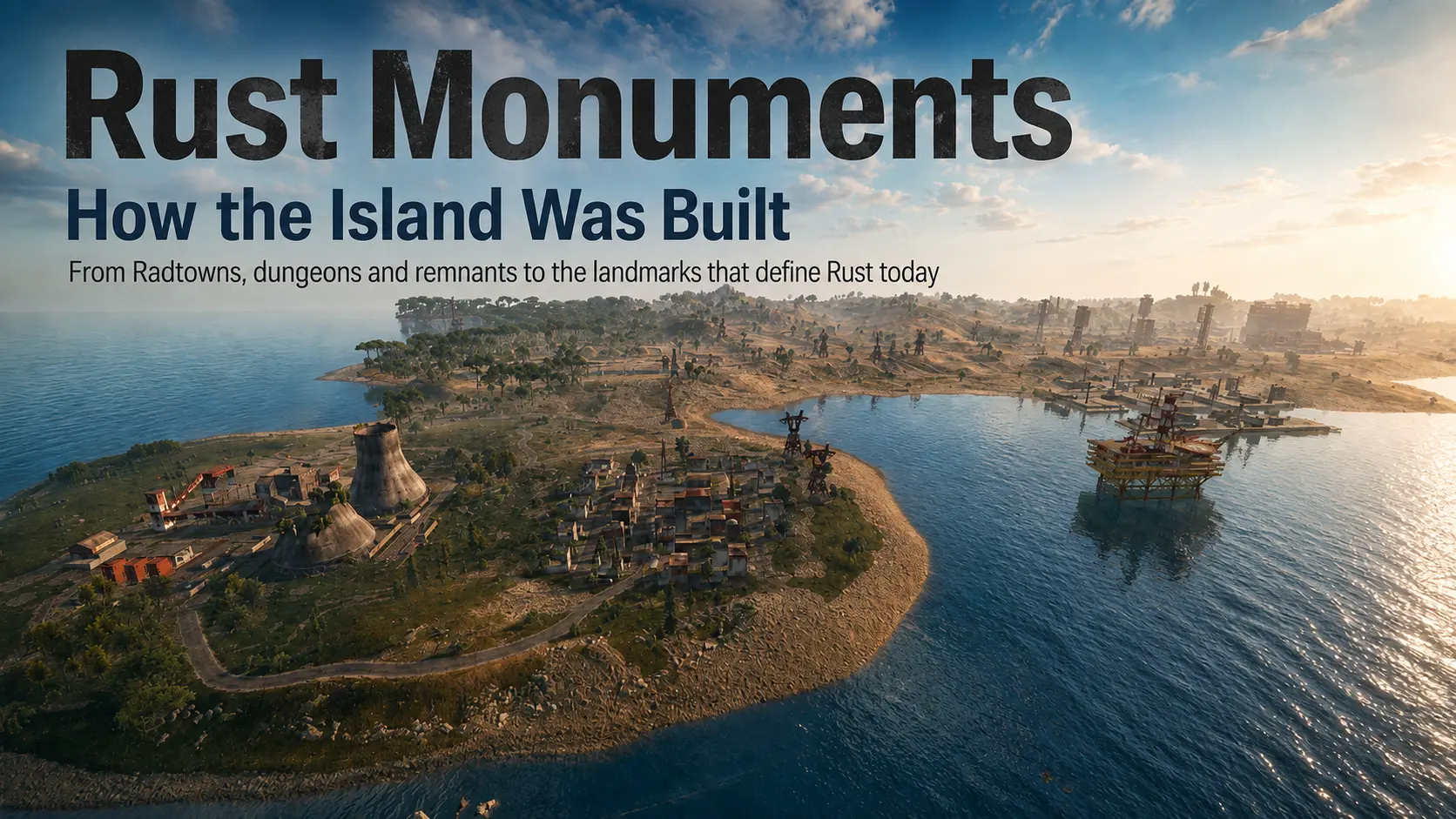
Rust Monuments — How the Island Was Built
Rust’s Monuments were not created as a finished catalogue. From early Radtowns and experimental landmarks to huge industrial complexes, offshore structures and connected infrastructure, this is the history of how the island was gradually built.
From Radtowns, dungeons and remnants to the landmarks that define Rust today
Today, a Monument in Rust is easy to recognize.
The Lighthouse is a Monument. So are the Airfield, Launch Site, Military Tunnels, Oil Rigs and dozens of other locations scattered across the procedural island.
Historically, however, the picture is much less tidy.
Rust did not begin with a finished catalogue of locations carrying the names we know today. The island, procedural generation and the vocabulary used to describe its important places evolved together.
The Airfield was once an Airport Radtown.
The Dome began as a Sphere Tank, then became the Sphere Monument.
Mining Outpost began as a Warehouse.
Military Tunnels began as Military Caves.
Harbor was developed as a Harbor Rad Town.
Satellite Dish appeared under names including Satellite Monument, Satellite Dish Monument and even Radio Telescope.
If we search Rust’s history only under the names currently printed on the map, we lose much of the story.
This history therefore follows the places themselves, while preserving the names Facepunch used at the time.
What Counts as a Monument?
The original meaning was surprisingly broad.
On August 15, 2014, Facepunch described a system for placing distinctive landmarks into procedural maps. Their examples included power stations and airports, but also craters, volcanoes and waterfalls.
One week later, caves were being tested through the same Monument system.
Friday Devblog 21 — August 15, 2014
https://rust.facepunch.com/news/friday-devblog-21
Friday Devblog 22 — August 22, 2014
https://rust.facepunch.com/news/friday-devblog-22
At this point, Monument was less a strict architectural category than a way of giving a procedurally generated world recognizable places.
But Monument was not the only word Facepunch used.
Radtown
During Rust’s early development, Radtown appears throughout the Devlogs.
It can be found in world-generation work, procedural layouts and the names of locations themselves.
Most importantly for this history, some places that later received completely different names first appear as Radtowns.
The clearest example is Airport Radtown, which becomes the Airfield.
Harbor also spends part of its development life as Harbor Rad Town.
This makes radtown an essential historical term, even though today Radtown is once again the proper name of one specific Monument.
Dungeon
Facepunch also used dungeon in its game-design sense.
A dungeon did not have to be underground.
In 2015, Facepunch was developing Power Plant, Train Yard and Silo dungeons. The work concerned routes, cover, sight lines, vertical levels and the way players moved and fought through the location.
Devblog 75 — August 27, 2015
https://rust.facepunch.com/news/devblog-75
A Power Plant obviously is not a literal dungeon.
The word describes the location as a designed challenge space.
That idea survives today in the progression routes, PvP spaces and puzzle structures found throughout many Monuments.
Remnant
A remnant is another kind of old-world presence: a ruin or surviving piece of infrastructure that remains recognizable within the procedural environment.
During 2015, Facepunch developed modular roads, railway pieces, pipelines, sewers, tunnels, industrial structures and residential pieces as material that could form radtowns, Monuments and remnants.
Water Wells later provide a particularly clear example of the idea: small functional vestiges distributed through the world.
These terms overlap because they describe different aspects of a location.
A place can be a Monument geographically, a dungeon in its gameplay structure, and a remnant in what it represents.
How This History Is Counted
For this timeline, a Monument is considered born when the place actually exists in playable Rust.
A concept drawing is not a birth.
A greybox is not a birth.
A screenshot of work in progress is not a birth.
Likewise, an update does not automatically create a new incarnation.
New loot, radiation, Scientists, recyclers, puzzles, entrances, props or internal modular arrangements can dramatically change how a Monument plays while leaving the place itself fundamentally intact.
A new incarnation is recorded only when the physical Monument is substantially replaced or reconstructed.
That distinction matters because Facepunch has used words such as refresh, rework, revamp and update for very different levels of change.
The description — and sometimes the actual before-and-after structure — matters more than the word.
2014 — The First Landmarks
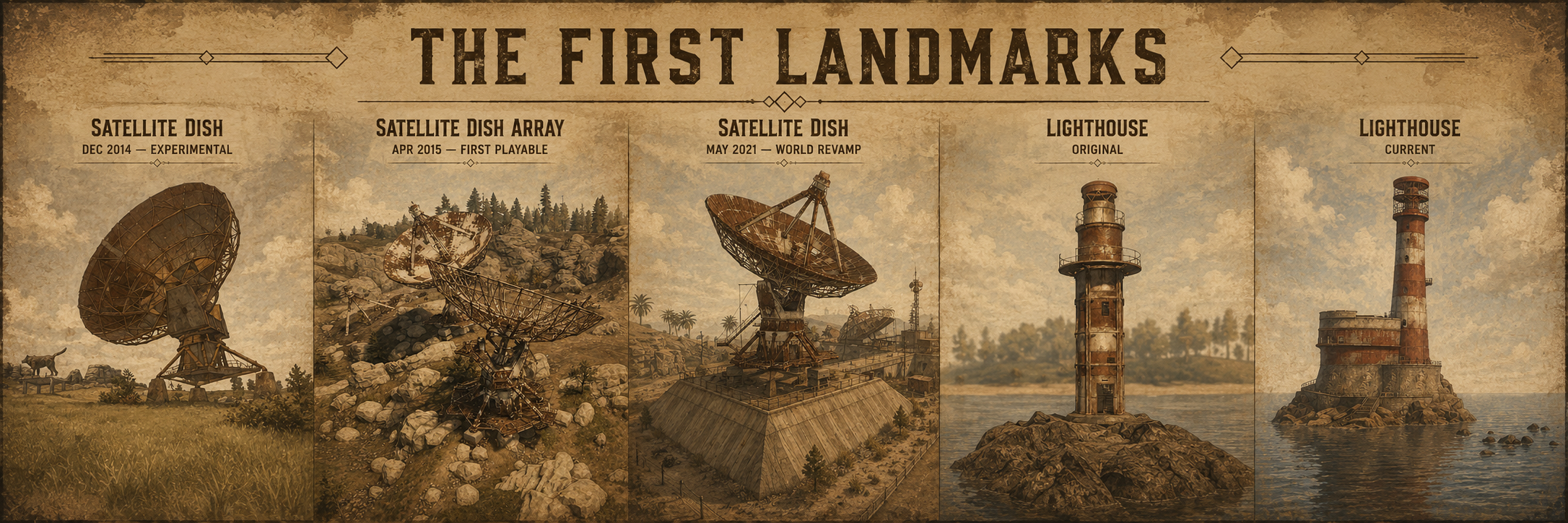
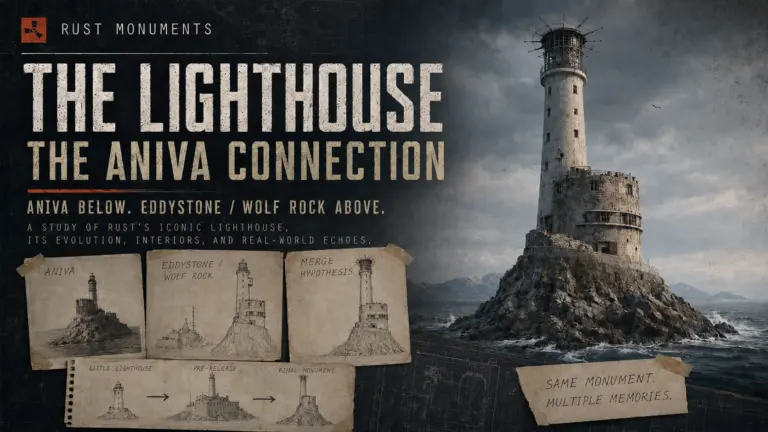
Lighthouse
October 31, 2014 — Release
The Lighthouse is the earliest released Monument securely identified in the modern Devblog chronology.
https://rust.facepunch.com/news/devblog-32
October 6, 2016 — New incarnation
The original Lighthouse was eventually replaced by a substantially new structure.
This was not simply a decorative refresh. Facepunch followed development of a replacement Lighthouse across several Devblogs before the new version entered the world.
https://rust.facepunch.com/news/devblog-130
Satellite Dish
December 5, 2014 — Satellite Monument
The early Satellite Monument enters Rust.
https://rust.facepunch.com/news/devblog-37
The terminology then evolves through Satellite Dish Monument, Radio Telescope and finally Satellite Dish.
April 16, 2014 — Satellite Dish Array
By April 2015, Facepunch was already describing the Radio Telescope and Lighthouse as existing Monuments serving primarily as landmarks.
https://rust.facepunch.com/news/devblog-56
May 6, 2021 — New incarnation
The World Revamp replaces the original scattered-dish installation with the modern concrete Satellite Dish complex.
Facepunch describes the work as a Satellite Dish refresh — a useful reminder that the word refresh alone does not tell us how substantial the physical change actually was.
https://rust.facepunch.com/news/world-revamp
2015 — Building the Industrial Island
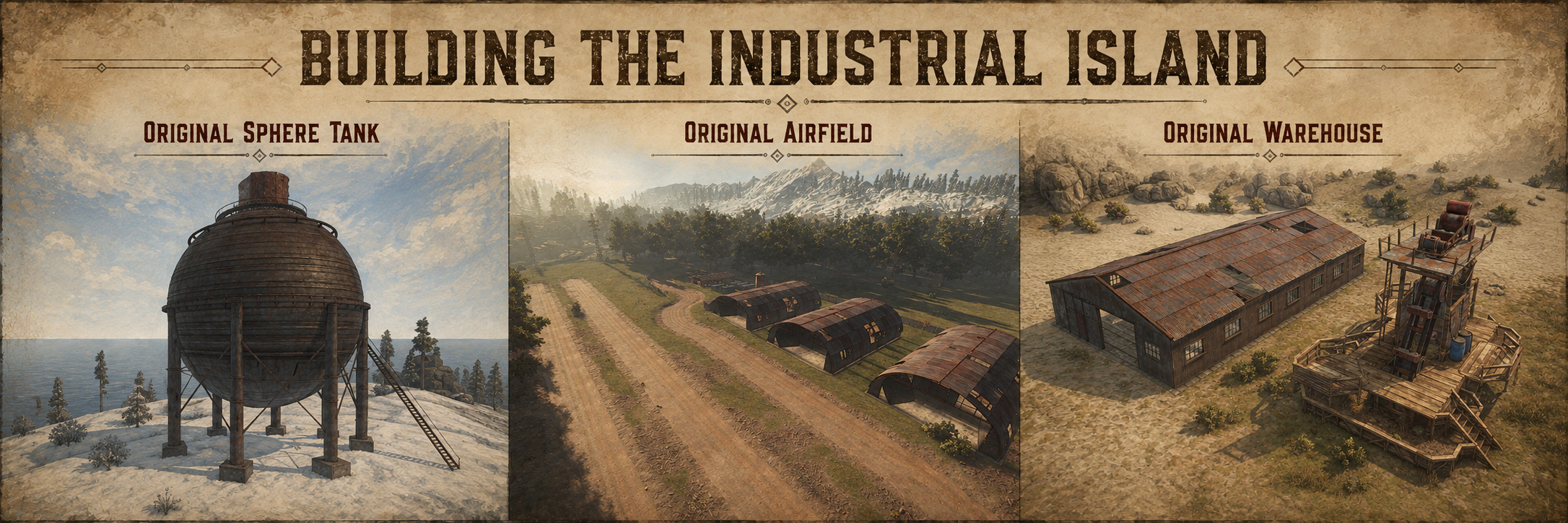
Mining Outpost
March 5, 2015 — Warehouse
The lineage of today’s Mining Outpost appears in terrain generation as a new warehouse landmark.
https://rust.facepunch.com/news/devblog-50
Later Devlogs refer naturally to the Warehouse Monument.
https://rust.facepunch.com/news/devblog-85
Its identity eventually becomes Mining Outpost.
Airfield
June 4, 2015 — Airport Radtown
The first Airfield enters procedural generation under the name Airport Radtown.
https://rust.facepunch.com/news/devblog-63
Soon afterward, Facepunch is already using the name Airfield, confirming the continuity between the two identities.
2016 — New incarnation
The first version was essentially a rough landing strip with a few hangars.
During 2016, Facepunch rebuilt it into a much more developed military installation with new buildings, hangars, concrete surfaces and a stronger perimeter identity.
https://rust.facepunch.com/news/devblog-117
https://rust.facepunch.com/news/devblog-118
This is a genuine second incarnation, not simply an upgrade to the original landing strip.
The Dome
By June 18, 2015 — Sphere Tank
The exact first release remains difficult to reduce to a single Devblog, but the Sphere Tank Monument unquestionably exists by June 18.
Players are already building around it while Facepunch continues working on traversal and structural details.
https://rust.facepunch.com/news/devblog-65
August 6, 2015 — Sphere Monument — New incarnation
The old Sphere Tank is replaced by the Sphere Monument, establishing the lineage that becomes The Dome.
https://rust.facepunch.com/news/devblog-72
The Dungeon Generation
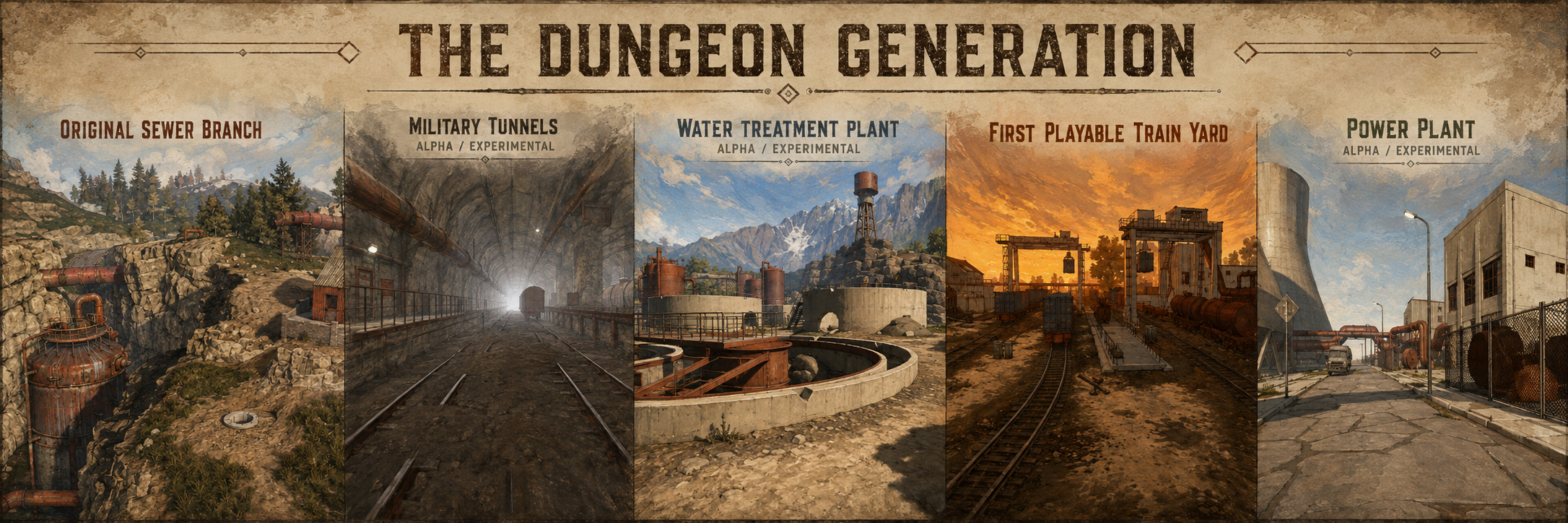
During the second half of 2015, the scale of Rust’s important locations changes dramatically.
Instead of primarily producing isolated landmarks, Facepunch begins assembling larger industrial play spaces using factories, warehouses, rail structures, silos, tanks, pumping equipment, sewers and tunnels.
On December 3, 2015, the first major dungeon generation ships.
Devblog 89
https://rust.facepunch.com/news/devblog-89
This gives us the clearest release point for several major Monument lineages.
Power Plant
December 3, 2015
Developed during the Powerplant Dungeon work and released with the new dungeon generation.
https://rust.facepunch.com/news/devblog-89
Train Yard
December 3, 2015 — Industrial Train Yard / Train Yard
Another major industrial dungeon from the same generation.
https://rust.facepunch.com/news/devblog-89
Later replacement of individual structures inside Train Yard does not automatically make the entire Monument a new incarnation.
Water Treatment Plant
December 3, 2015
Water-treatment structures were developed alongside the same dungeon and remnant environment work.
https://rust.facepunch.com/news/devblog-89
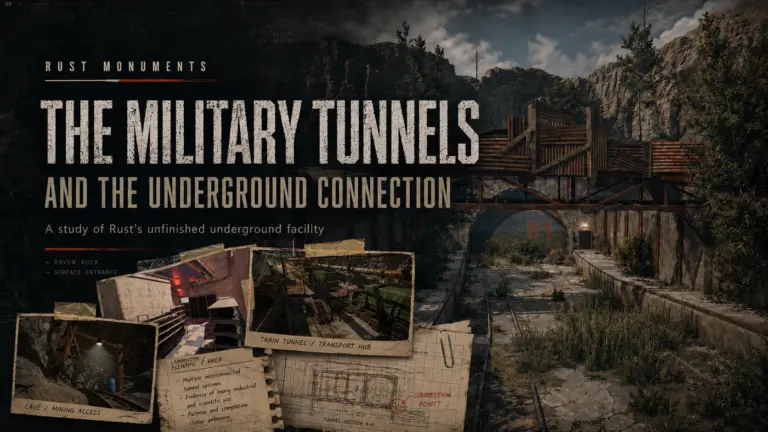
Military Tunnels
December 3, 2015 — Military Caves / Military Tunnels
The location first appears publicly in September as Military Caves, described as a new remnant area.
https://rust.facepunch.com/news/devblog-78
Its later art improvements, Scientists and puzzle systems changed the challenge substantially, but did not replace the underlying Monument.
For this timeline, Military Tunnels therefore has one incarnation.
Sewer Branch
2015–2016 — Sewer / Sewer Dungeon → Sewer Branch
This is one of the cases where following the old vocabulary matters.
In September 2015, Facepunch is already producing modular sewer environments while an abandoned-house Radtown is being replaced in development by a canyon containing caves, sewer spaces and cliff structures.
https://rust.facepunch.com/news/devblog-78
The Sewer environment continues developing into 2016.
The exact release date of the standalone location that becomes Sewer Branch remains one of the few dates still worth tightening.
2017 — The Island Fills Up
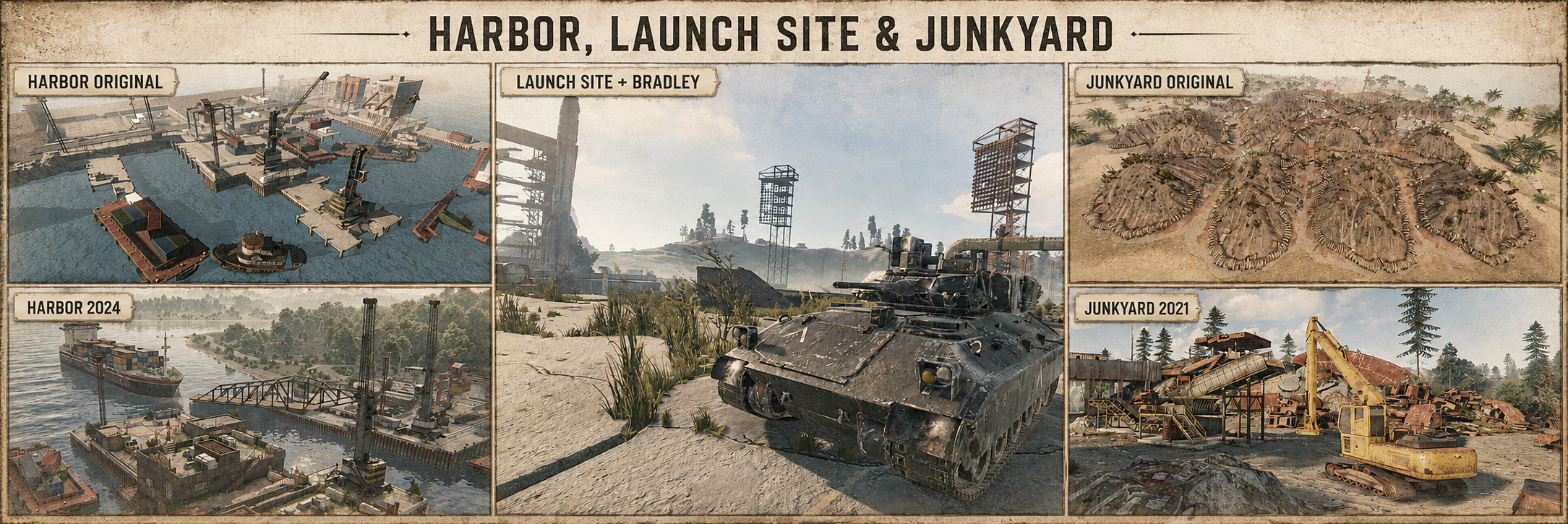
Harbor
January 5, 2017 — Harbours
The project first appears in 2016 as a Harbor Rad Town.
https://rust.facepunch.com/news/devblog-111
By January 2017, the Harbours are in.
https://rust.facepunch.com/news/devblog-142
Small and Large Harbor are treated here as variants of the same Monument family rather than as separate historical births.
April 4, 2024 — New incarnation
The Waves of Change update substantially remodels Harbor to accommodate Cargo Ship docking.
The previous dock structure and parkour routes are rebuilt around a new docking corridor, changing the physical layout of the Monument rather than simply adding a new gameplay function.
For this history, the 2024 Harbor therefore counts as a new incarnation.
https://rust.facepunch.com/news/waves-of-change
Launch Site
July 6, 2017
Facepunch first announces work on a new Rocket Launch Site Monument in March.
https://rust.facepunch.com/news/devblog-153
It is subsequently described as the Rocket Monument before entering Rust as Launch Site.
https://rust.facepunch.com/news/devblog-167
August 24, 2017 — Bradley APC completes the Monument
Launch Site was physically released in July, but one of its defining systems arrived several weeks later.
The Bradley APC had been developed specifically to patrol and guard Launch Site, with its patrol routes, driving AI and weapons built around the Monument.
On August 24, Bradley was released into Launch Site as a high-value combat destination..
https://rust.facepunch.com/news/devblog-174
Gas Station
September 7, 2017
Released as Gas Station, later becoming Oxum’s Gas Station.
https://rust.facepunch.com/news/devblog-176
Supermarket
September 7, 2017
Released alongside Gas Station as Supermarket, later becoming Abandoned Supermarket.
https://rust.facepunch.com/news/devblog-176
Mining Quarries
December 7, 2017
Stone Quarry / Mining Quarry Monuments enter the game as a family.
https://rust.facepunch.com/news/devblog-189
Junkyard
December 7, 2017
https://rust.facepunch.com/news/devblog-189
May 6, 2021 — New incarnation
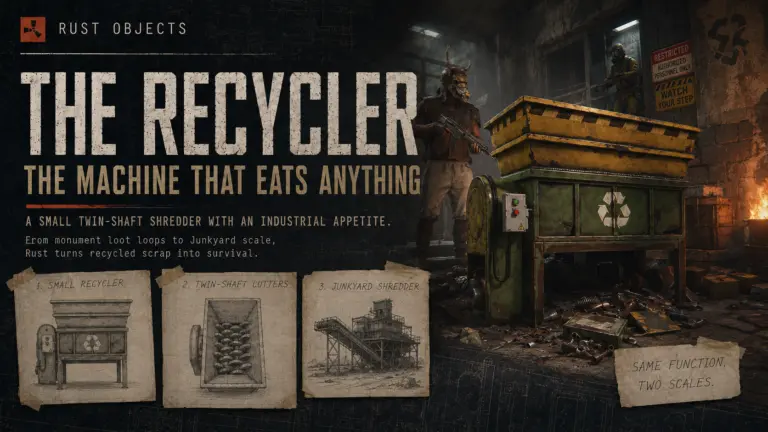
Unlike many refreshes, the World Revamp fully completely redesigned the Junkyard with new gameplay centered on the magnet crane and vehicle shredder. The original version remains one of Rust’s most fondly remembered Monuments, especially for its dense PvP layout and strong post-apocalyptic atmosphere.
https://rust.facepunch.com/news/world-revamp
2018 — Small Monuments and Social Spaces
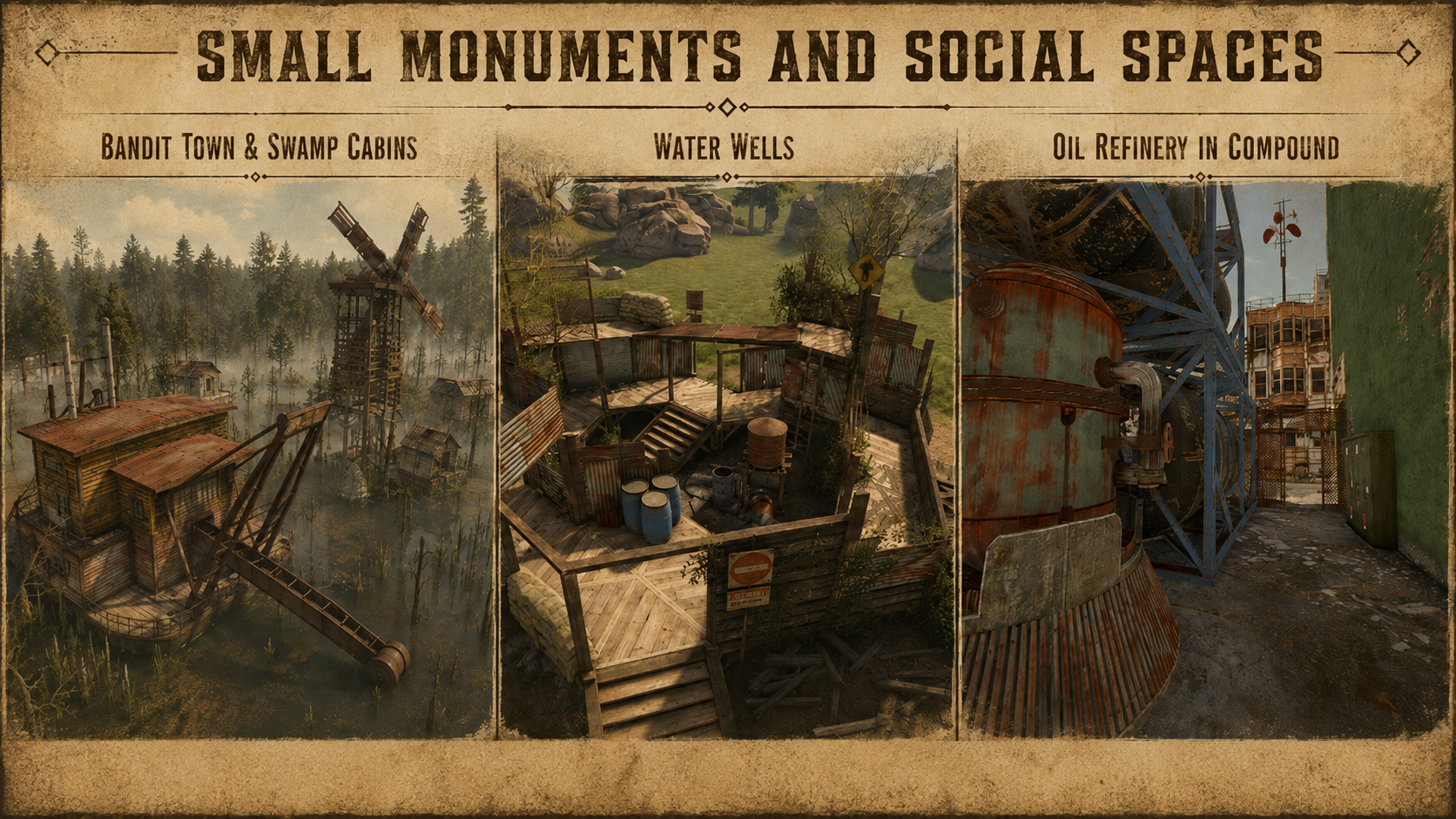
Water Wells
February 1, 2018 — Water Well Mini Monuments
Facepunch explicitly develops them as Mini Monuments, intentionally designed as small, reused old-world structures.
https://rust.facepunch.com/news/devblog-196
Rather than one unique location, Water Wells form a family of functional remnants.
Outpost
May 3, 2018 — Compound
The Compound enters Rust explicitly as a new Scientist-controlled Monument and safe zone.
https://rust.facepunch.com/news/compound-update
Its later identity becomes Outpost.
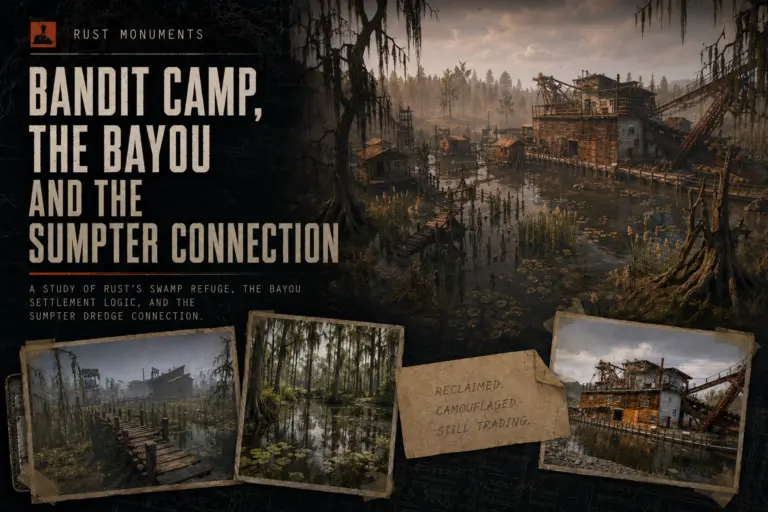
Bandit Camp
August 2, 2018 — Bandit Town & Swamp Cabins
Development initially uses the name Bandit Town Monument. . The Swamp Cabins enter the Monument family during the same release.
https://rust.facepunch.com/news/the-bandit-town-update
Its later identity becomes Bandit Camp and Abandonned Cabins.
2019 — Beyond the Shore
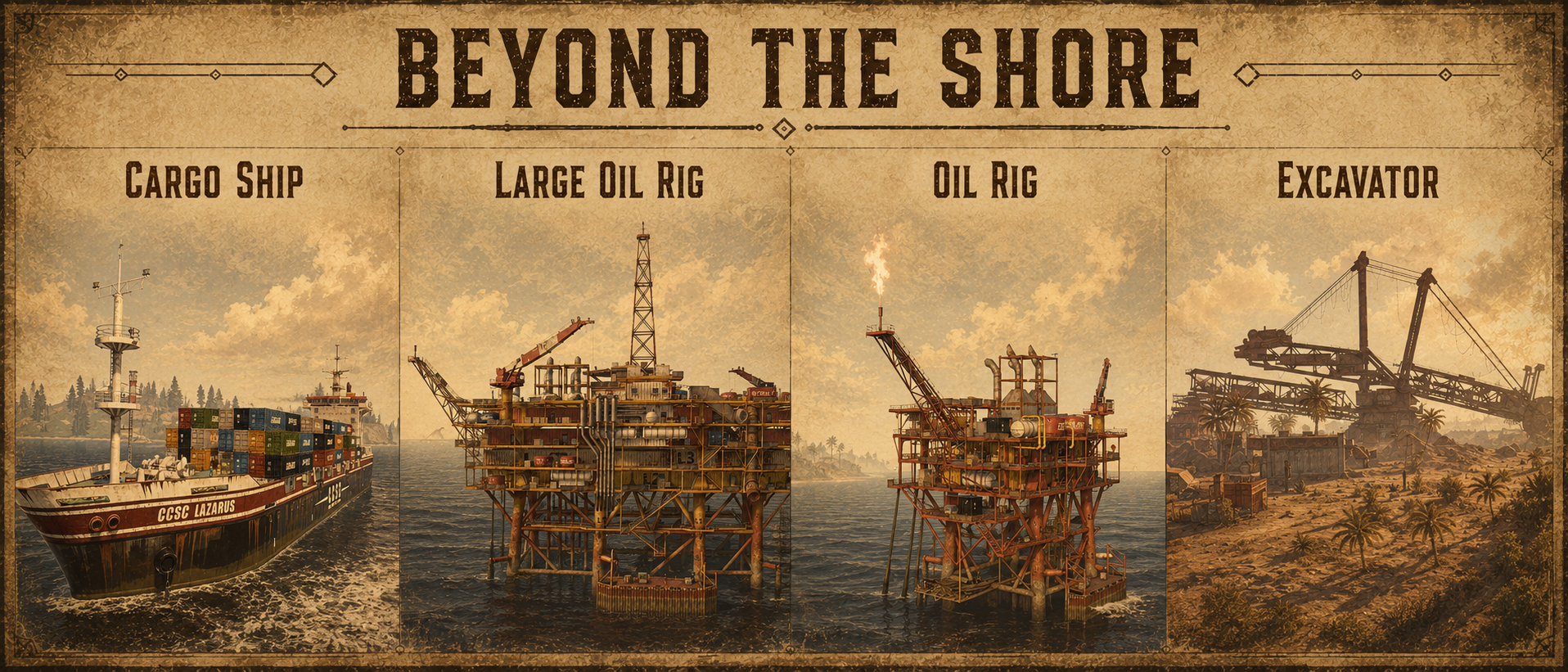
Cargo Ship
October 4, 2018
Cargo Ship expands the Monument idea beyond fixed geography.
The CCSC Lazarus enters Rust as a moving Scientist-controlled PvE and loot location.
https://rust.facepunch.com/news/the-cargo-ship-update
It has no permanent coordinates, but performs many of the same functions as a traditional Monument: destination, combat space, navigation target and source of valuable resources.
Small Oil Rig
March 7, 2019 — Oil Rig
Facepunch introduces the first Oil Rig as a new offshore Monument.
https://rust.facepunch.com/news/oilrig-update
Only after the second rig appears does distinguishing it as Small Oil Rig become necessary.
The underwater access added in 2024 is an update to this Monument, not another incarnation.
Large Oil Rig
April 4, 2019
Large Oil Rig is a separate Monument, not a replacement for the original Oil Rig.
https://rust.facepunch.com/news/qol-update
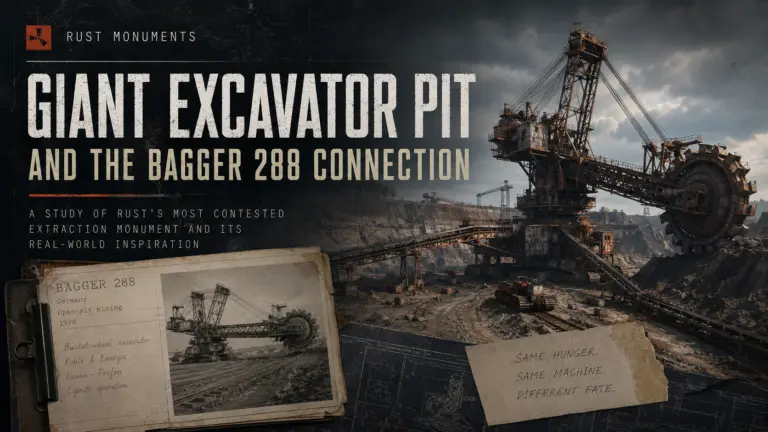
Giant Excavator Pit
August 1, 2019 — Giant Excavator / Excavator Monument
https://rust.facepunch.com/news/excavator-update
2020 — The Monument Family Diversifies
Fishing Villages
September 3, 2020
Three Fishing Villages enter the map as coastal safe-zone micro Monuments.
https://rust.facepunch.com/news/boat-vendor-update
Ranch & Large Barn
November 5, 2020
Facepunch introduces Ranch and Large Barn together as two new Monuments.
https://rust.facepunch.com/news/stables-update
2021 — A Second World Beneath the Island
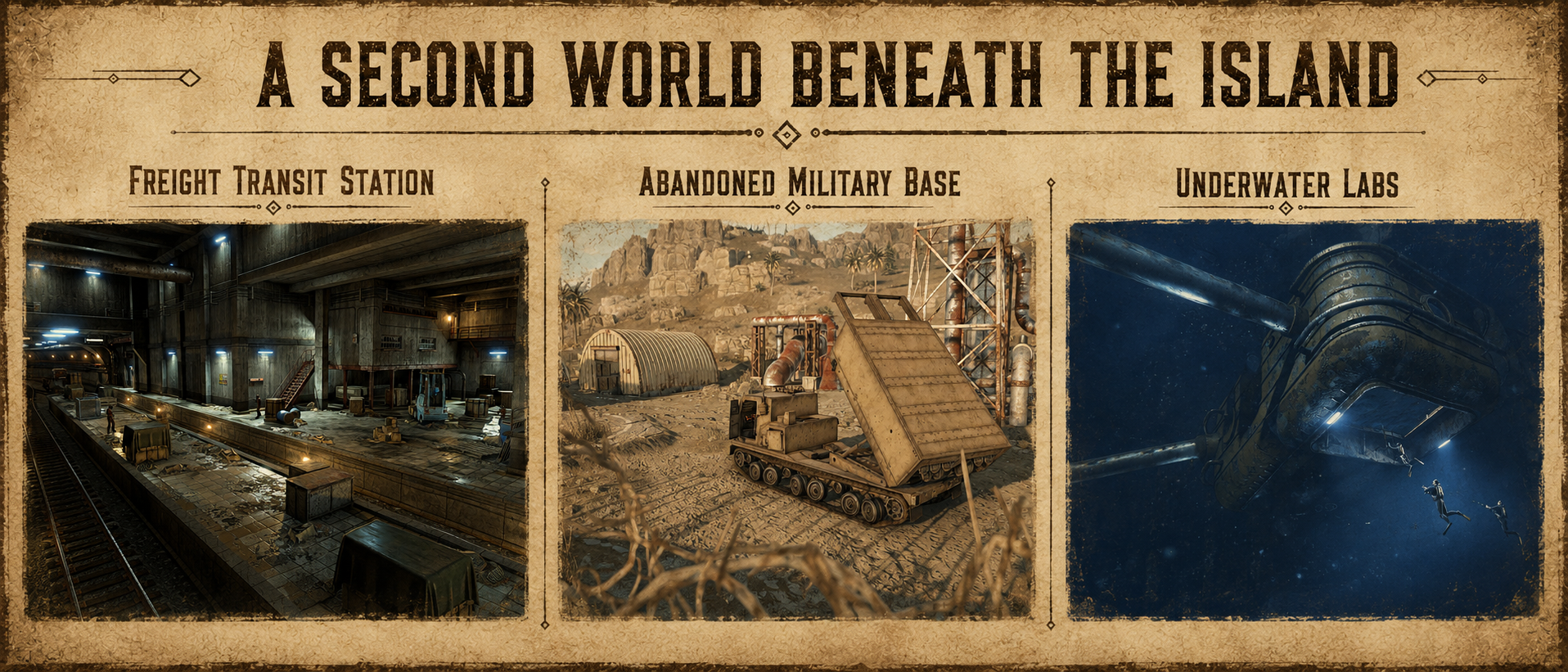
Rail Monument
March 4, 2021
The Freight Transit Line launches a procedural underground rail network.
Its entrances and stations are explicitly described as Rail Monument content.
https://rust.facepunch.com/news/freight-transit-line
This expands the Monument concept beyond isolated surface locations: the procedural world now contains a navigable infrastructure layer beneath the island.
Underwater Labs
August 5, 2021 — Procedural Underwater Labs
Underwater Labs extend the system below the ocean.
https://rust.facepunch.com/news/going-deep
Their internal arrangement is procedural.
Different layouts do not represent different historical incarnations. They are variations produced by the same Monument system.
Abandoned Military Base
November 4, 2021 — Military Desert Base
https://rust.facepunch.com/news/mlrs-and-desert-base-update
This is another clear example of procedural variation occurring inside a Monument.
Tents, radar equipment, small structures and other modules can appear in different combinations or arrangements while the Monument itself remains recognizable.
A different arrangement is not a different incarnation.
2022
Arctic Research Base
February 3, 2022
Introduced as a new Monument.
https://rust.facepunch.com/news/arctic-update
May 5, 2022 — Above-ground Trains
The railway expands to the surface with a procedural above-ground rail network and drivable trains.
This is not a new incarnation of the Rail Monument, but the expansion of the same railway infrastructure beyond the underground layer.
https://rust.facepunch.com/news/above-ground-trains-update
Roughly a year and a half later, Coupling the Rails closes the loop by physically connecting the above-ground and underground rail networks.
https://rust.facepunch.com/news/coupling-the-rails
2023 — Game Changer
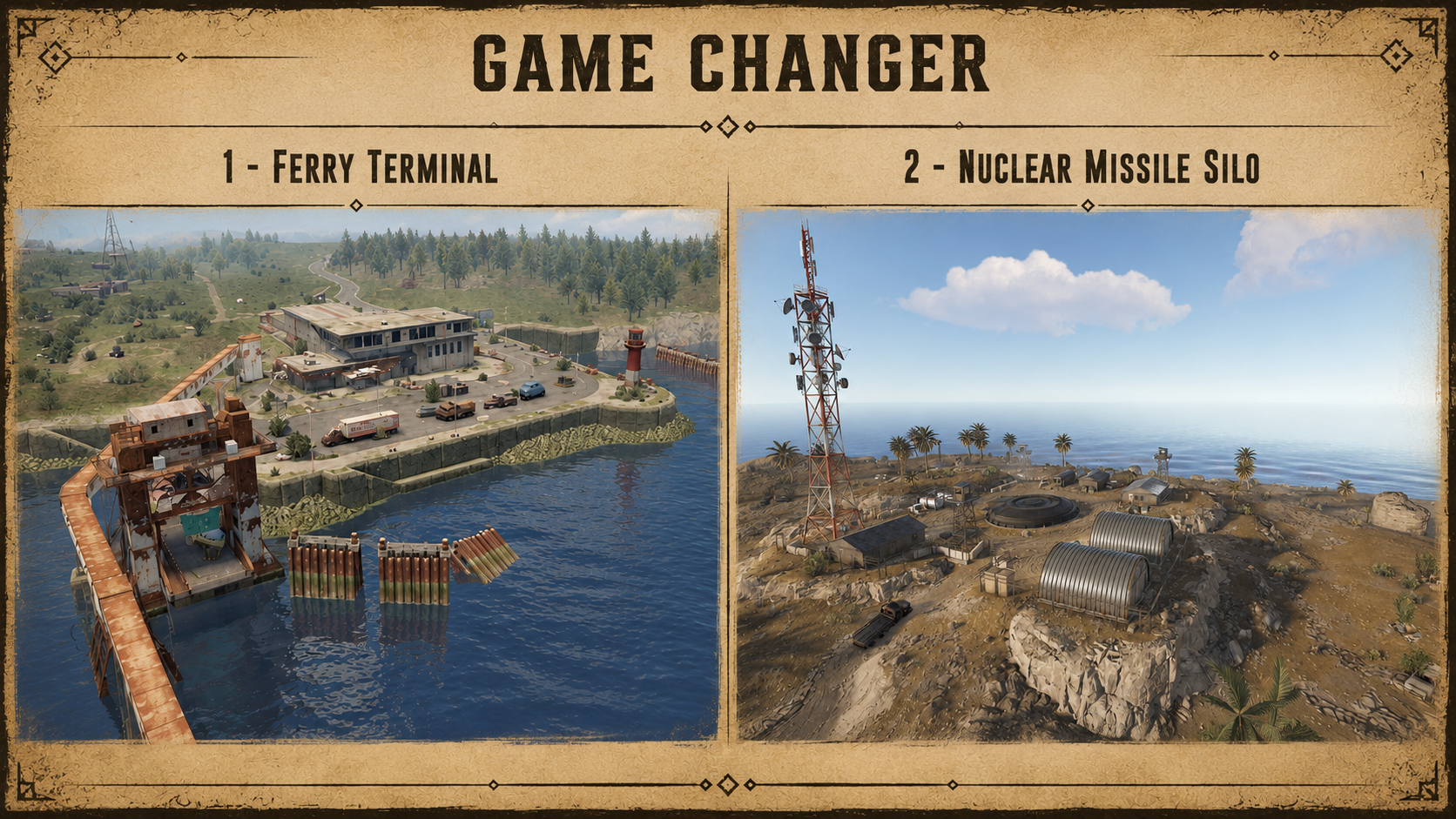
Nuclear Missile Silo
May 4, 2023
An all-new underground Monument. Bringing a menace at the end of a wipe, the Countdown changed globally the game due to Bradley roaming the roads, the missing inside the silo, and the elevation of all scientist aggressiveness.
https://rust.facepunch.com/news/r-u-s-t
Ferry Terminal
July 6, 2023
Released as the Ferry Terminal Monument. Still waiting for the second part of this project, the Nexus system that offers you to visit other islands in the game without disconnecting or without loosing your blueprints.
https://rust.facepunch.com/news/deep-sea
2024 — Radtown Returns
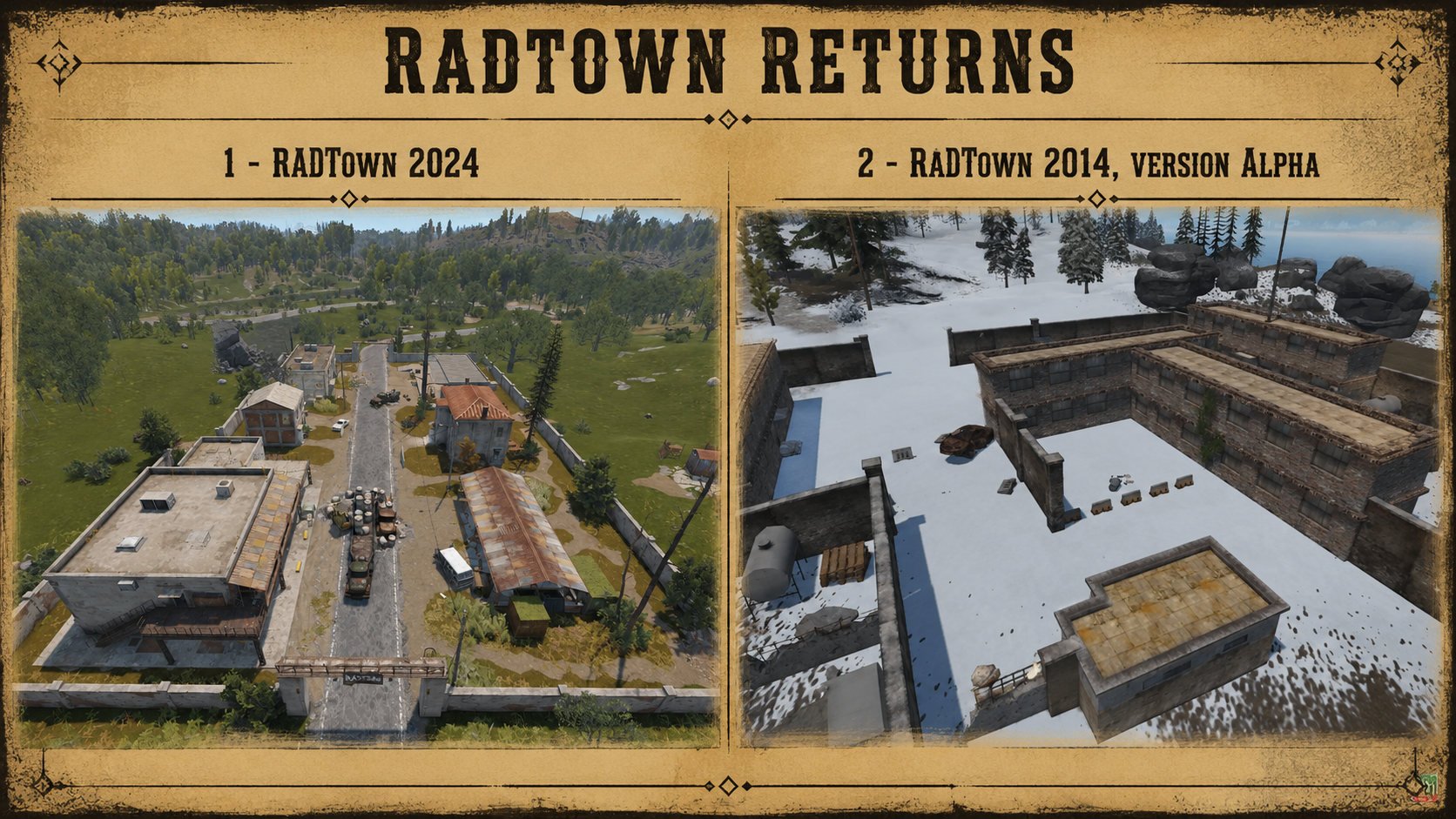
Radtown
The original Radtown belongs to Rust’s earlier Legacy history.
Its modern return is therefore not its birth.
October 3, 2024 — Return + new incarnation
Facepunch reconstructs the Legacy Radtown as a modern Monument while preserving much of its recognizable scale and function.
https://rust.facepunch.com/news/world_update_2
There is a useful historical symmetry here.
During early Rust development, radtown appeared throughout the vocabulary used for multiple locations.
A decade later, Radtown once again becomes the proper name of one specific Monument.
2025 — New Biome, New Neigbors
Ziggurat & Jungle Remnants
May 1, 2025
The Jungle Update deliberately brings the old word remnant back into the modern Monument vocabulary.
https://rust.facepunch.com/news/jungle-update
2026 — The Island Continues to Expand
Floating Cities
February 5, 2026
Four Floating City variants enter the Deep Sea and are explicitly described as Monuments.
https://rust.facepunch.com/news/naval
Ghost Ships remain outside this list because Facepunch describes them as similar to Monuments, rather than actually calling them Monuments.
Apartment Complex
July 2, 2026
The Apartment Complex becomes a new Monument containing rentable rooms, storage, furnaces and a player-operated marketplace.
https://rust.facepunch.com/news/common-ground
A Refresh Is Not an Incarnation
Rust’s Monuments are continually modified, but they are not continually replaced.
Facepunch has used refresh, rework, revamp and update for changes ranging from cosmetic dressing to substantial structural reconstruction.
Military Tunnels received major art and gameplay upgrades.
Oil Rig gained another entrance.
Harbor was altered to accommodate Cargo Ship docking.
Train Yard received replacement components.
Satellite Dish was called a refresh.
Junkyard was called a redesign.
The terminology alone cannot tell us whether a new Monument was created.
For this history:
New loot, NPCs, puzzles or utilities → update
Different procedurally selected modules → variation
New entrances or individual replacement structures → modification
Substantial replacement of the physical location → new incarnation
That is why Lighthouse, Airfield, Satellite Dish and Junkyard can have multiple recorded incarnations while Military Tunnels does not.
The Island and Its Monuments Grew Together
The relationship between Monuments and world size changed repeatedly.
In November 2014, Facepunch introduced configurable world size and reduced the default procedural map from approximately 64 km² to 16 km² for gameplay and performance reasons.
Devblog 35 — November 21, 2014
https://rust.facepunch.com/news/devblog-35
In March 2016, the default procedural size fell again from 4000 to 3000, roughly 16 km² to 9 km², specifically to produce more encounters between players.
Devblog 99.1 — March 3, 2016
https://rust.facepunch.com/news/devblog-99-1
In December, it increased from 3000 to 3500.
Devblog 138 — December 1, 2016
https://rust.facepunch.com/news/devblog-138
Then, in September 2017, the default returned to 4000.
Facepunch gave a particularly relevant reason: caves and new Monuments had reduced the amount of land available for players to build.
The same update introduced Monument placement priorities, with Launch Site receiving the highest priority.
Devblog 176 — September 7, 2017
https://rust.facepunch.com/news/devblog-176
A few months later, Facepunch again reworked Monument placement to fit the available locations more effectively into procedural maps.
Devblog 189 — December 7, 2017
https://rust.facepunch.com/news/devblog-189
By 2019, world size was doing more than determining how closely Monuments were packed together.
Facepunch explicitly removed the largest Monuments from procedural maps below a certain size so that smaller worlds would still have enough space for players to move and build.
Excavator Update — August 1, 2019
https://rust.facepunch.com/news/excavator-update
That distinction has only become more important as Rust has gained larger Monuments and connected systems.
On smaller maps, ProcGen may omit certain large locations entirely. Systems requiring enough geographical room — including surface and underground transport infrastructure — can also depend on world-size thresholds.
Those thresholds have changed as Rust’s procedural generation has evolved, so no single number describes the entire history.
The important change is conceptual:
At first, world size mostly controlled how much land players had and how densely they encountered each other.
Eventually, world size also helped determine which Monuments, networks and layers of the world could exist at all.
The island did not simply become a larger container.
Its scale became one of the rules defining its contents.
From Landmarks to Infrastructure
That may be the largest change in the Monument concept.
The first Monuments primarily gave procedural maps recognizable places.
You could see the Lighthouse.
You could recognize the Satellite Dish.
They gave an otherwise generated landscape identity.
Then they accumulated functions.
Loot.
Radiation.
PvP routes.
Puzzles.
Scientists.
Safe zones.
Vendors.
Transport.
Offshore activity.
Underground rail.
Underwater environments.
And eventually they began interacting with one another.
In August 2026, Power Trip introduced Player Maintained Monuments, connecting existing locations through island-scale infrastructure.
Power Plant can restore electrical services.
Water Treatment participates in the water infrastructure.
Oil-related systems connect existing industrial locations.
Launch Site, Gas Station, Supermarket, Airfield and other established Monuments receive functions tied to the larger system.
Power Trip — August 6, 2026
https://rust.facepunch.com/news/power-trip
None of these are new Monument births.
But they show how far the original idea has travelled.
In 2014, a Monument could simply be something distinctive enough to help a player know where they were.
By 2026, Monuments were beginning to behave as parts of the same island infrastructure.
The Island Was Not Built All at Once
Rust’s Monuments do not form a catalogue that appeared fully defined and then simply grew longer.
They preserve several generations of thinking about what the procedural island should contain.
Landmarks gave the world identity.
Radtowns distributed pieces of an irradiated old world.
Dungeons turned those places into designed challenges.
Remnants populated the environment with surviving fragments.
Then came large industrial complexes.
Safe zones.
Offshore Monuments.
Moving Monuments.
Underground networks.
Underwater locations.
Procedurally assembled Monuments.
And finally infrastructure linking established locations together.
Some names survived.
Others disappeared.
Some returned ten years later.
And several places now considered permanent parts of Rust began life under names that would be almost unrecognizable to a player seeing them today.
That is why the history of Rust’s Monuments is not simply a list of buildings.
It is the history of how Facepunch gradually constructed the island itself.