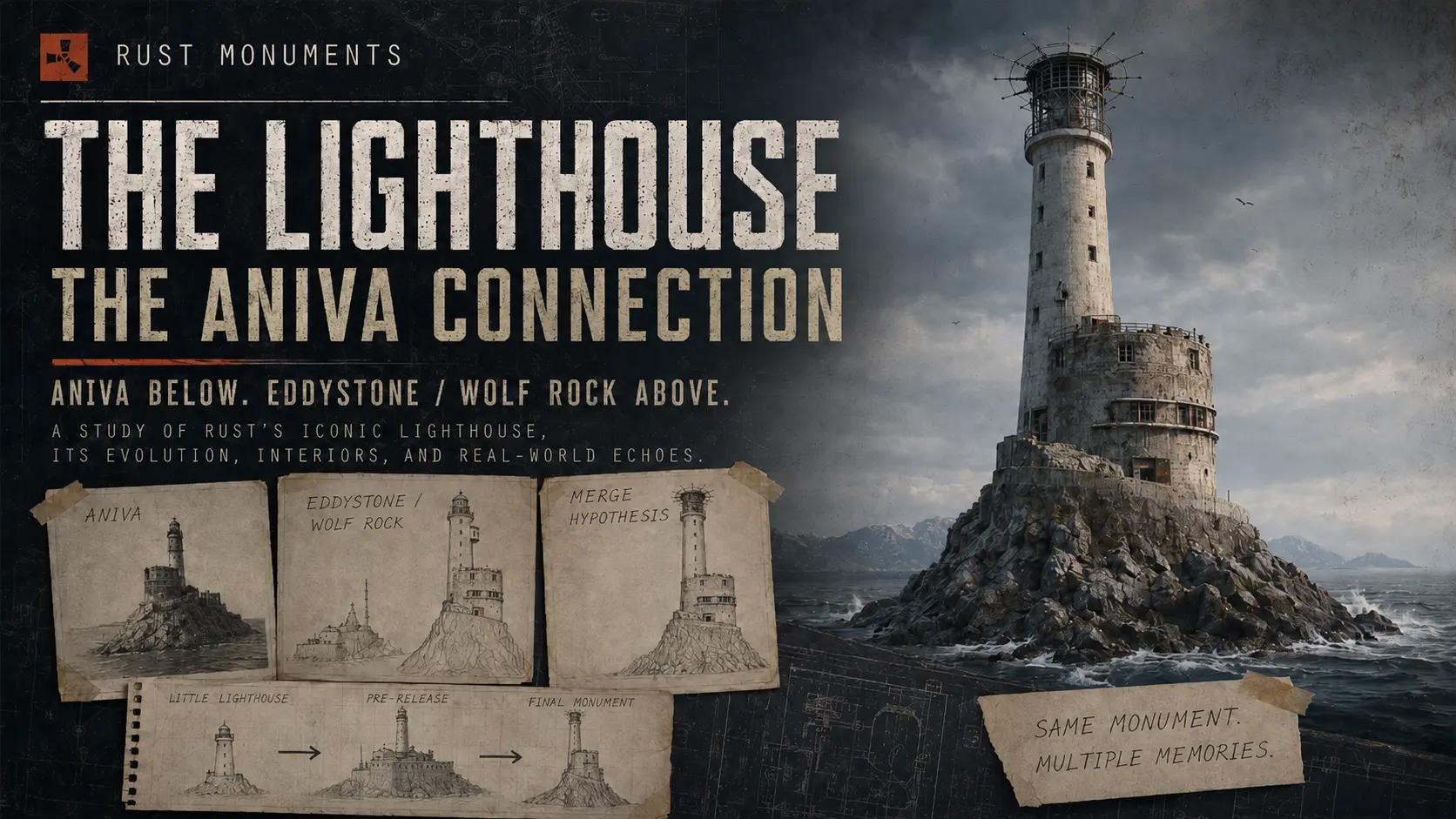
The Lighthouse and the Aniva Connection
A lighthouse is supposed to tell you where you are.
Rust’s does something else.
It began as a small coastal landmark in 2014, was rebuilt into a far larger monument in 2016, and somehow ended up looking like a place that might already exist somewhere else — on a lonely rock, battered by weather, far from shore.
Rust’s Lighthouse: The Merge Hypothesis
Rust’s Lighthouse looks simple at first.
It is a coastal monument, a vertical landmark, a navigational relic turned into a place of loot, elevation, conflict, and memory. It stands at the edge of the island with the authority of something older than the game around it. Like many of Rust’s most effective monuments, it feels instantly familiar — and yet, the longer we look at it, the less likely it seems that it comes from a single source.
The most common comparison is Aniva Lighthouse, and for good reason. Rust’s Lighthouse has a rocky base, an inhabited lower mass, an attached cylindrical annex, and the feeling of a structure that was once lived in and serviced rather than simply erected as an empty tower.
But Aniva does not explain everything.
The upper shaft of Rust’s Lighthouse does not fully behave like Aniva. Its head is more exposed, more vertical, more skeletal. Its lantern language feels closer to the offshore British rock-lighthouse tradition — especially Eddystone and Wolf Rock — than to Aniva alone.
That is where the monument becomes more interesting.
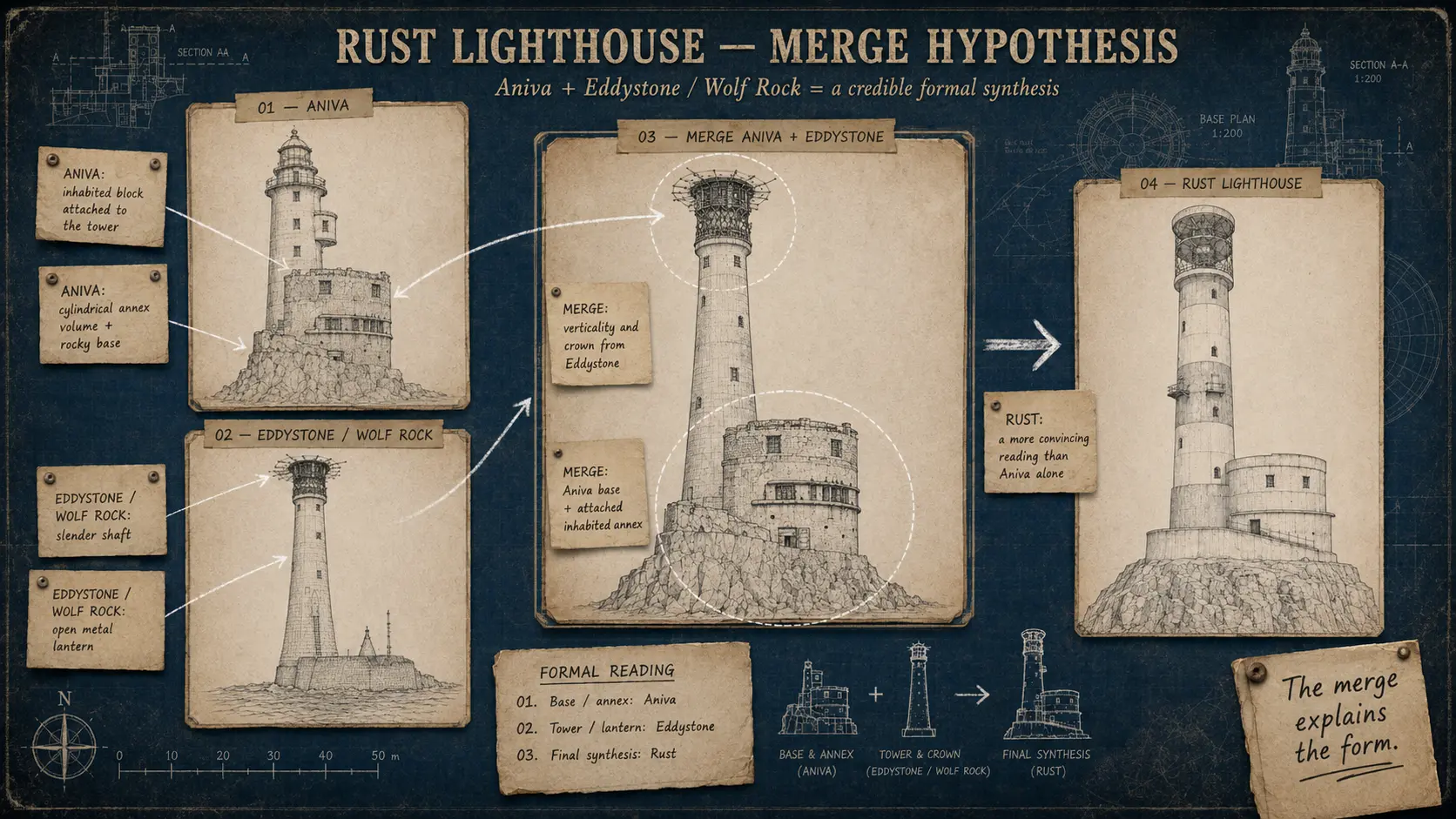
Rust’s Lighthouse is best understood not as a direct replica, but as a merge: Aniva for the inhabited lower body, Eddystone / Wolf Rock for the upper tower and lantern logic, and Rust’s own level-design logic for the destruction, access, loot, and player movement.
This is not a confirmed source claim. Facepunch never states that Rust’s Lighthouse was based on Aniva, Eddystone, or Wolf Rock. The comparison remains observational. But as a visual and spatial hypothesis, it explains the monument better than a single-source reading.
1. Two Lighthouses: 2014 and 2016
Rust’s Lighthouse did not begin with the monument players know today — and it never belonged to Legacy.
Its first generation appeared on the new Rust branch that had spent much of 2014 under the name Experimental, the complete reboot Facepunch was building from scratch alongside the original game. By October 2014, Experimental had become the default version of Rust, while the older game was formally relegated to the Legacy branch.
That distinction matters: there was no Lighthouse monument in Rust Legacy.
In Devblog 31, on October 25, 2014, Facepunch reported that Dan was already working on a “lighthouse monument” for the new version of Rust. One week later, in Devblog 32, the Lighthouse was in the game.
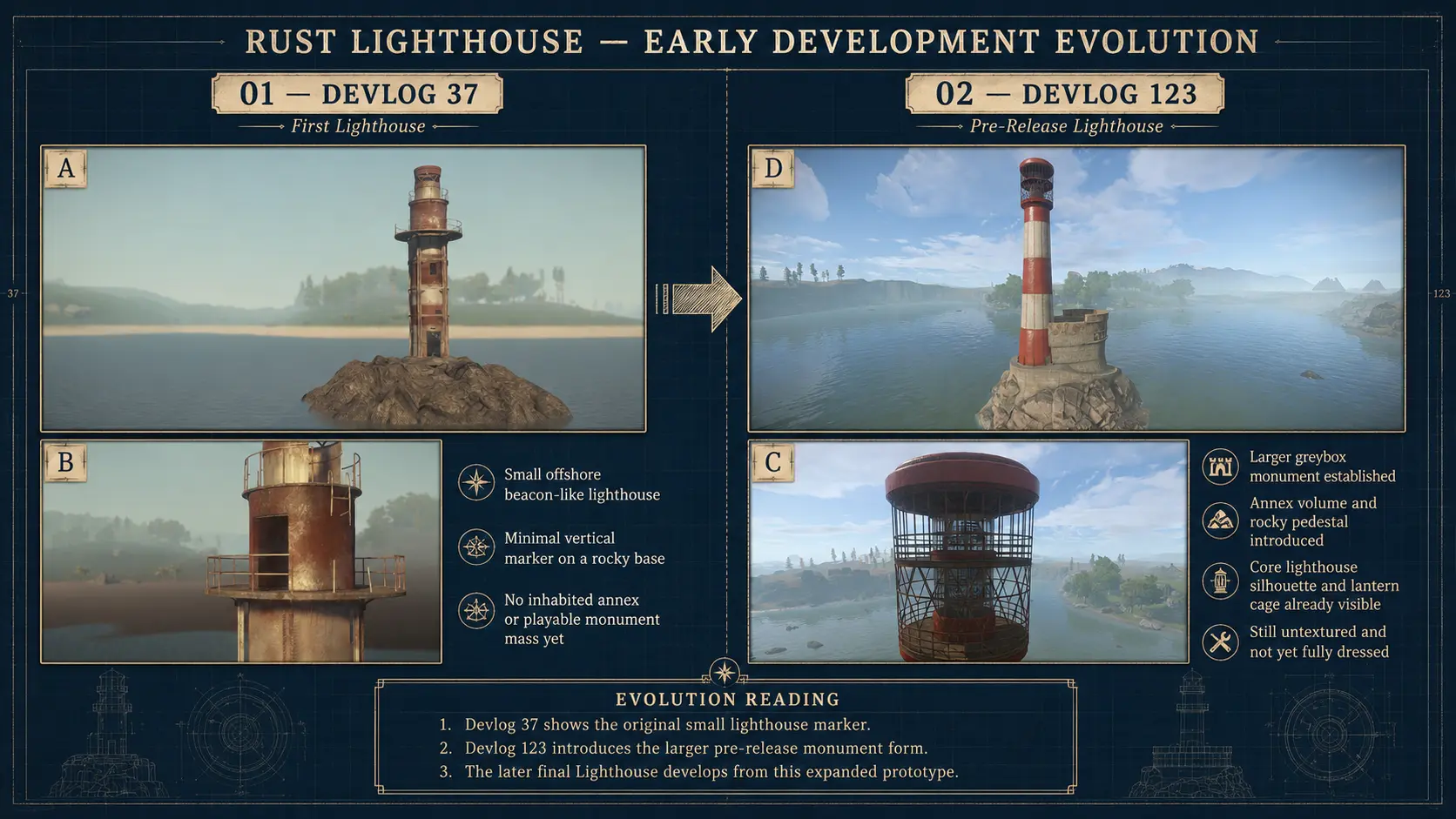
By Devblog 37, in December 2014, Dan had finished what Facepunch casually called his “little lighthouse.”
That wording can be misleading when read from the perspective of the modern game. This was not merely a prototype waiting to become the current Lighthouse. It was Rust’s first actual Lighthouse monument: a much smaller and simpler coastal landmark belonging to an earlier generation of world design.
Its role was also different.
In April 2015, Facepunch described monuments such as the Lighthouse and the radio telescope as largely one-shot landmarks used to help players navigate the procedural world. The Lighthouse already had a place on the island, but monuments had not yet developed into the dense exploration spaces, loot locations and combat arenas they would later become.
That changed dramatically in 2016.
In Devblog 122, Facepunch revealed a completely revamped Lighthouse. The new version was much larger than the old one and combined the tower with a bunker-like structure. Both exterior and interior spaces were designed from the beginning around a more complex layout, exploration and potential combat.
Over the following weeks, the structure was detailed, damaged and opened internally. Staircases, alternate routes, wear, accessible interiors and loot gradually turned the Lighthouse from a navigational landmark into a place players could enter, climb, search and fight over.
An early version of this new Lighthouse entered the game in September 2016 while development continued. By October 6, with Devblog 130, Facepunch released the finished version with its interiors and loot fully accessible.
The distinction between these two generations matters.
The 2014 Lighthouse established the idea of the coastal landmark. The 2016 rework replaced it with something fundamentally more ambitious: a complete playable ruin whose architecture, circulation and damaged interior became part of the gameplay.
It is this second Lighthouse — not the original 2014 monument — that we are comparing with Aniva, Eddystone and Wolf Rock.
2. Aniva: The Inhabited Lower Body
Aniva is the strongest reference for the lower part of Rust’s Lighthouse.
This is where the resemblance is most persuasive. Aniva is not just a tower with a light. It is a compact inhabited offshore structure: part beacon, part service building, part survival machine. It rises from a rocky base, carries attached volumes, and gives the impression of a place where people once worked, maintained systems, moved through tight interiors, and endured isolation at sea.
Rust reproduces that same broad logic.
Its Lighthouse is not simply a vertical shaft. It has a substantial lower body. It feels occupied. It suggests service rooms, circulation, maintenance, and a former daily life inside the monument. The annex is not decorative. It gives the Lighthouse weight. It turns it into a building.
This is why the Aniva connection is stronger than a mere silhouette comparison. The monument does not only resemble Aniva from afar. It behaves like Aniva at the level of its lower inhabited identity.
3. Eddystone / Wolf Rock: The Offshore Tower Tradition
If Aniva explains the lower body, it does not fully explain the upper tower.
For that, Rust’s Lighthouse aligns more convincingly with the family of offshore rock lighthouses associated with the British Isles — especially Eddystone and Wolf Rock.
These are not primarily inhabited lighthouse-complexes in the same sense as Aniva. They are severe engineering objects: towers erected on dangerous reefs, built to resist the sea as much as to emit light. Their visual language is one of vertical discipline, exposed crowns, strong tapering shafts, and lantern structures that feel mechanical rather than domestic.
That is where Rust’s upper portion begins to shift.
The shaft of the Rust Lighthouse is more vertical and severe than Aniva alone would suggest. The head is more exposed, more open, more metallic. The lantern does not feel like the continuation of Aniva’s softer upper silhouette. It belongs to another family.
This matters because Eddystone and Wolf Rock are not minor or obscure comparisons. They belong to one of the great traditions of offshore lighthouse engineering. If Aniva brings the haunted inhabited ruin, Eddystone and Wolf Rock bring the engineering monument: the tower as a survival instrument against the sea.
So the merge begins to clarify itself:
- Aniva gives Rust its lower inhabited body
- Eddystone / Wolf Rock give Rust its upper tower logic
4. Why the Merge Makes More Sense Than “Aniva Only”
Aniva alone explains too much of the lower part to ignore.
But it does not explain the whole object.
The problem with a single-source reading is that the upper Rust Lighthouse resists it. The body points strongly toward Aniva, but the head does not fully follow. The tower and lantern feel simplified, hardened, and redirected into another lighthouse language.
This is why the merge hypothesis is stronger.
Rust seems to borrow the inhabited mass, annex, rocky base, and lower building logic from Aniva, while borrowing the upper tower discipline, exposed crown, and lantern attitude from the Eddystone / Wolf Rock family. Then it compresses the whole thing into a form that is readable, playable, and visually iconic in Rust.
It is not an academic reconstruction. It is a recomposition.
And that is very consistent with Rust.
Its monuments are rarely exact replicas. They are usually built from recognizable real-world fragments, simplified and transformed into playable ruins.
5. Interior Evidence: Aniva Inside the Monument
The most convincing part of the Aniva reading may actually be inside.
The lower interiors of Rust’s Lighthouse strongly suggest that Aniva informed more than just the outer body. The resemblance is not limited to shape; it extends into the spatial atmosphere of the monument’s inhabited lower levels.
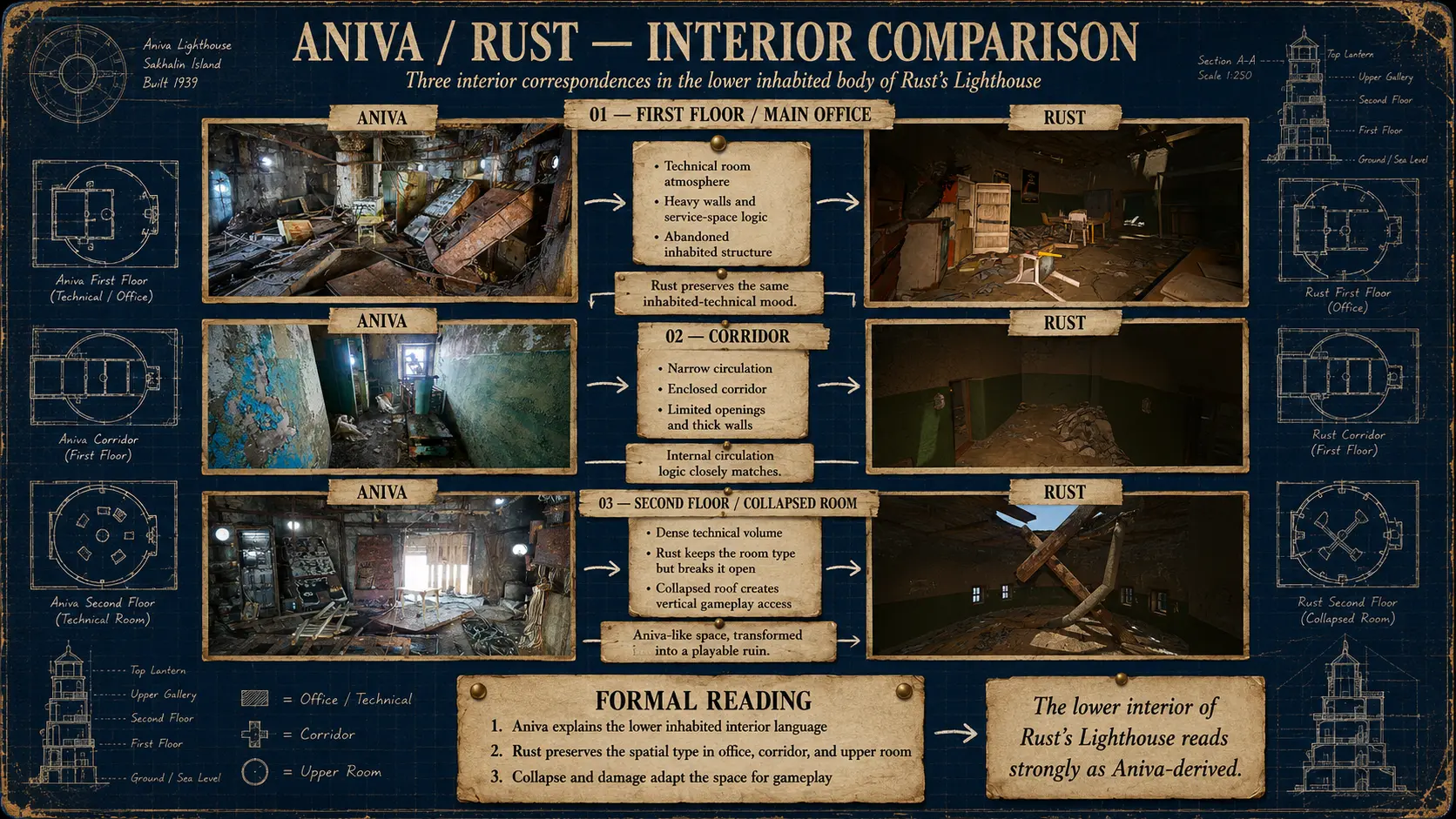
The office / main technical room
The first interior comparison is the lower office-like room.
In Aniva, this space is dense, technical, corroded, and infrastructural. Pipes cross the ceiling. Equipment remains in place. The space feels enclosed, thick-walled, and burdened by the weight of maintenance and abandonment.
Rust’s corresponding room does not copy Aniva exactly, but it preserves the same broad type of space: a service-living chamber inside a working maritime structure. The feeling is remarkably similar — enclosed, practical, damaged, and shaped by utility rather than symbolism.
The corridor
The corridor comparison strengthens the case further.
Aniva’s internal passage is narrow, enclosed, heavy, and functional. Rust’s corresponding corridor shares that same compressed logic: thick walls, limited openings, heavy structure, and a bunker-like atmosphere of movement through a space designed for work rather than comfort.
This is important because the resemblance is no longer restricted to one evocative room. It extends to the circulation logic of the lower inhabited section.
The upper interior chamber
A third comparison adds another layer.
A higher Aniva chamber — technical, battered, enclosed — finds a strong echo in Rust’s upper ruined chamber. The broad spatial type remains legible: circular or semi-circular perception, repeated openings, thick peripheral walls, and the feeling of a service room inside a maritime shell.
But here Rust also transforms the space dramatically.
The roof is broken open. Structural elements have collapsed inward. The room is no longer only a believable interior; it has become a vertical gameplay space.
6. Rust Turns Aniva Into Gameplay
This is where the comparison becomes especially useful.
Rust does not preserve Aniva in a museum-like way. It adapts it.
The broken roof of the upper chamber is a perfect example. A real lighthouse space becomes a playable ruin. What may once have been a closed service room is turned into an open vertical challenge that players must read, climb through, and contest.
This is supported by Facepunch’s own comments about the Lighthouse. Their development notes emphasize exploration, accessible interiors, loot, and conflict potential. So the destruction inside the monument is not just environmental storytelling. It is also level design.
The relationship can be stated very simply:
- Aniva provides the believable inhabited spatial type
- Rust damages and opens it for traversal and gameplay
That is why the interior comparisons matter so much. They do not prove that Rust copied Aniva literally. They show that Rust used Aniva-like spatial logic and then transformed it into a monument designed to be looted, fought over, and climbed.
7. The Lantern and the Optic
The top of the Lighthouse adds a final formal clue.
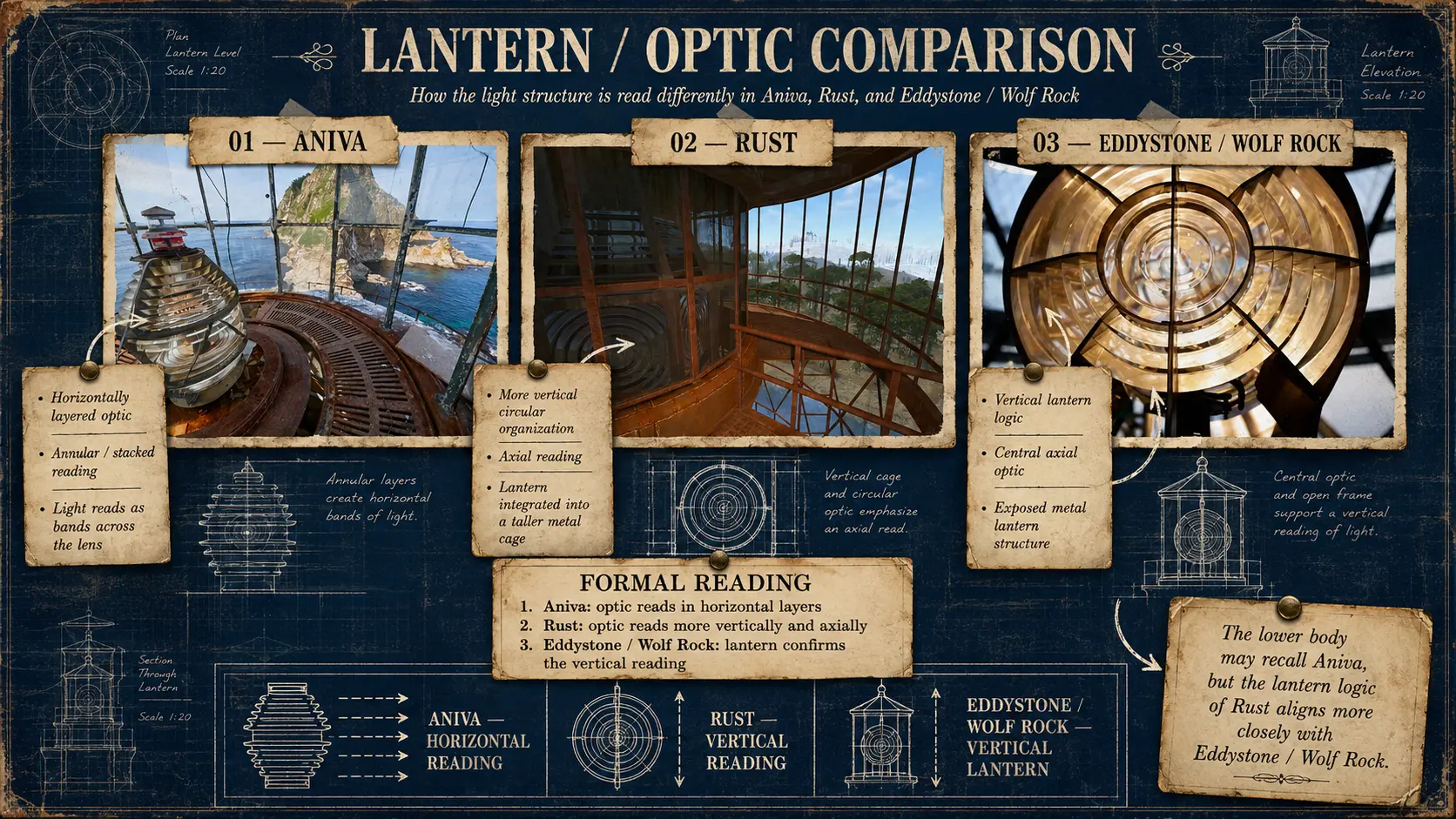
The light itself does not prove any one source. Many lighthouses share common visual elements: glass lanterns, circular optics, metal framing, maintenance walkways, and elevated crowns. But the way the optic reads can still be revealing.
Aniva’s optic tends to read more horizontally layered. It gives the impression of stacked annular bands, a more segmented horizontal reading of the lens system.
By contrast, Rust — like Eddystone / Wolf Rock — reads more vertically and axially. The lantern is enclosed in a taller metal cage. The eye follows the vertical organization of the structure more than a horizontal layering of the optic.
So even at the level of the light, the monument seems divided:
- Aniva below
- Eddystone / Wolf Rock above
8. A Final Question: What Happened to the Upper Chamber?
One detail remains uncertain.
The destruction of the upper interior chamber does not read like simple long-term decay alone. The concrete appears shattered rather than merely sagged or progressively collapsed, as if the roof had been broken by a violent event instead of slowly giving way under age and weather.
If the structure had only failed over time, one might expect more intact slabs dragged down by their own weight. Here, the damage suggests a sharper rupture — perhaps an explosion, perhaps an impact, perhaps some other catastrophic force.
Rust never explains it directly.
But the room leaves a useful question hanging in the air: what exactly happened inside this lighthouse?
That uncertainty is valuable. It gives the monument a layer of tension beyond simple ruin. The lower spaces still feel inhabited and technical; the upper room feels wounded.
9. Lighthouses in Other Games
The lighthouse is not just a real-world coastal structure. It is also a powerful videogame archetype.
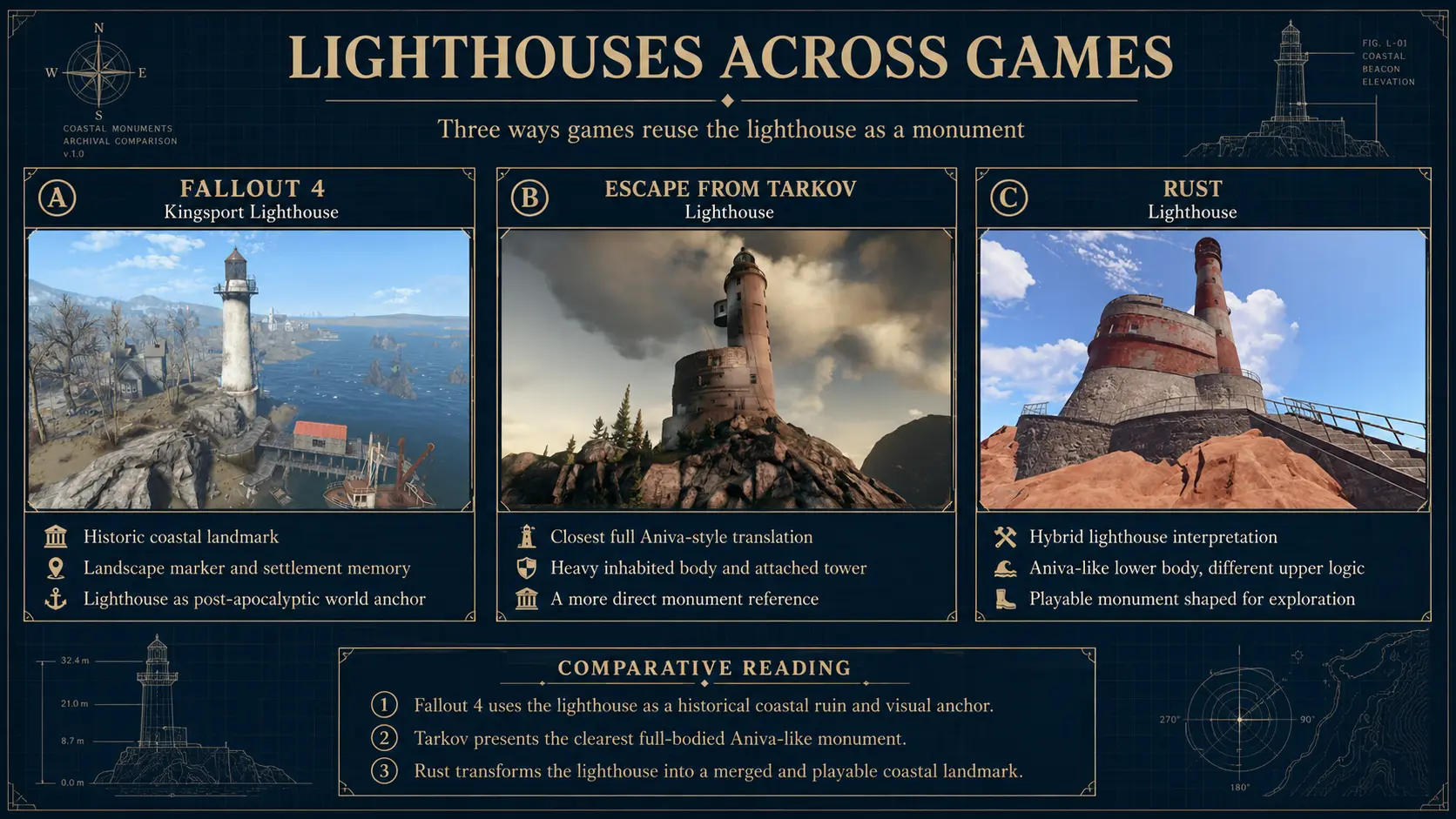
Fallout 4: Kingsport Lighthouse
In Fallout 4, Kingsport Lighthouse shows how naturally this type of monument belongs in a historical ruin-world. It serves as a landscape marker, a memory anchor, and a strong coastal landmark inside a post-apocalyptic environment.
This is useful not because Rust copies Fallout, but because it demonstrates the broader cultural role of the lighthouse in games built around ruins, coastal geography, and settlement memory. Once a world wants to suggest historical depth, orientation, and verticality, the lighthouse becomes an almost inevitable monument.
Escape from Tarkov: A More Direct Aniva
Escape from Tarkov provides a more precise comparison.
Its Lighthouse is much closer to a direct Aniva translation. The heavy inhabited body, attached tower, and strong Aniva-like silhouette are far more explicit there. That makes Tarkov a helpful contrast case.
If Tarkov shows what a relatively direct game adaptation of Aniva can look like, Rust shows something different: Aniva as one component in a broader merge.
This makes the distinction clearer:
- Tarkov = direct Aniva logic
- Rust = Aniva below, Eddystone / Wolf Rock above
10. Why This Feels So “Rust”
In the end, the Lighthouse becomes more interesting when we stop trying to reduce it to a single model.
Rust often builds its monuments this way: not as clean replicas, but as recompositions of known structures. It takes recognizable architectural memories, compresses them, breaks them, simplifies them, and turns them into playable archaeological fragments.
That is exactly what seems to happen here.
Aniva gives Rust its lower inhabited identity: the rocky base, annex, interior circulation, office-like service room, and abandoned technical atmosphere.
Eddystone and Wolf Rock give Rust its upper discipline: the shaft, the exposed crown, the vertical lantern logic, and the sense of an offshore tower hardened against the sea.
Facepunch’s design comments explain the final transformation: the need for routes, interiors, loot, exploration, and conflict.
The result is not simply Aniva.
It is not simply Eddystone.
It is not simply the 2014 Lighthouse made larger.
It is a merge.
And that is what makes the monument feel so satisfying to study. Rust is not merely copying a lighthouse. It is building a new playable ruin from pieces of several powerful lighthouse traditions — and leaving enough clues for curious observers to reconstruct the logic behind it.
Sources and Useful References
Facepunch / Rust Development References
These Facepunch sources document both generations of Rust’s Lighthouse: the original 2014 monument, its early role as a navigational landmark, and the complete 2016 rework that produced the larger, accessible and lootable Lighthouse known today.
- Devblog 31 — Lighthouse monument in development, October 25, 2014
https://rust.facepunch.com/news/devblog-31 - Devblog 32 — first Lighthouse enters the game, October 31, 2014
https://rust.facepunch.com/news/devblog-32 - Devblog 37 — Dan finishes the original “little lighthouse,” December 5, 2014
https://rust.facepunch.com/news/devblog-37 - Devblog 56 — Lighthouse described as an early navigational landmark, April 16, 2015
https://rust.facepunch.com/news/devblog-56 - Devblog 122 — revamped Lighthouse revealed; larger structure, bunker and more complex layout, August 11, 2016
https://rust.facepunch.com/news/devblog-122 - Devblog 123 — exterior detailing and bunker deterioration, August 19, 2016
https://rust.facepunch.com/news/devblog-123 - Devblog 124 — exterior completed; interior routes, spiral staircase and alternate access considered, August 25, 2016
https://rust.facepunch.com/news/devblog-124 - Devblog 125 — WIP Lighthouse monuments enter the game, September 1, 2016
https://rust.facepunch.com/news/devblog-125 - Devblog 126 — interior layout finalized and polished, September 8, 2016
https://rust.facepunch.com/news/devblog-126 - Devblog 128 — Lighthouse finished with collisions, loot spawning and functional doors, September 22, 2016
https://rust.facepunch.com/news/devblog-128 - Devblog 130 — finished Lighthouse released with fully accessible interiors and loot, October 6, 2016
https://rust.facepunch.com/news/devblog-130 - Zipline & Rail Update — later Lighthouse lighting and atmosphere upgrade, April 7, 2022
https://rust.facepunch.com/news/zipline-update
Aniva Lighthouse References
These references document Aniva Lighthouse as a real-world comparison: its location on Sakhalin, Japanese construction history, Shinobu Miura’s design, inhabited technical structure, isolated maritime setting and later abandonment.
- ProSakhalin — Excursion to Aniva Lighthouse / historical context
https://prosakh.ru/eng/nashi-tury/mayak-aniva/ - Wikipedia — Aniva Lighthouse
https://en.wikipedia.org/wiki/Aniva_Lighthouse - Eugene Kaspersky — Aniva: The Lighthouse on the Edge of the World
https://eugene.kaspersky.com/2019/11/07/aniva-the-lighthouse-on-the-edge-of-the-world/
Eddystone, Wolf Rock and British Offshore Lighthouse References
These sources document the British offshore rock-lighthouse tradition used here as a visual and engineering comparison for the upper portion of Rust’s Lighthouse.
- Trinity House — Eddystone Lighthouse
https://www.trinityhouse.co.uk/lighthouses-and-lightvessels/eddystone-lighthouse - Trinity House — Wolf Rock Lighthouse
https://www.trinityhouse.co.uk/lighthouses-and-lightvessels/wolf-rock-lighthouse - University of Plymouth — Wave tank model brings iconic Wolf Rock lighthouse to life
https://www.plymouth.ac.uk/news/wave-tank-model-brings-iconic-wolf-rock-lighthouse-to-life - University of Plymouth — Experimental modal analysis of British rock lighthouses
https://pearl.plymouth.ac.uk/secam-research/185/ - Raby et al. — Wolf Rock lighthouse: past developments and future survivability under wave loading
https://pmc.ncbi.nlm.nih.gov/articles/PMC6710467/
Comparative Videogame Lighthouse References
These references are not presented as evidence for Rust’s source material. They provide comparison cases for the lighthouse as a coastal landmark and playable environment in other games.
- Fallout Wiki — Kingsport Lighthouse, Fallout 4
https://fallout.fandom.com/wiki/Kingsport_Lighthouse - Official Escape from Tarkov Wiki — Lighthouse
The wiki explicitly identifies the Cape Dalniy lighthouse as being based on Aniva Lighthouse.
https://escapefromtarkov.fandom.com/wiki/Lighthouse - Tarkov.dev — Lighthouse map
https://tarkov.dev/map/lighthouse
Methodological Note
Facepunch documents the development and gameplay transformation of Rust’s Lighthouse, but does not identify Aniva, Eddystone, Wolf Rock, or any other real-world lighthouse as an official inspiration.
This article therefore presents a visual and spatial hypothesis, not a confirmed source claim.
The argument is based on observed architectural resemblance, interior comparison, lantern logic, monument evolution, and Facepunch’s documented transformation of the Lighthouse into a larger, accessible, lootable and playable coastal monument.