Bandit Camp, the Bayou and the Sumpter Connection
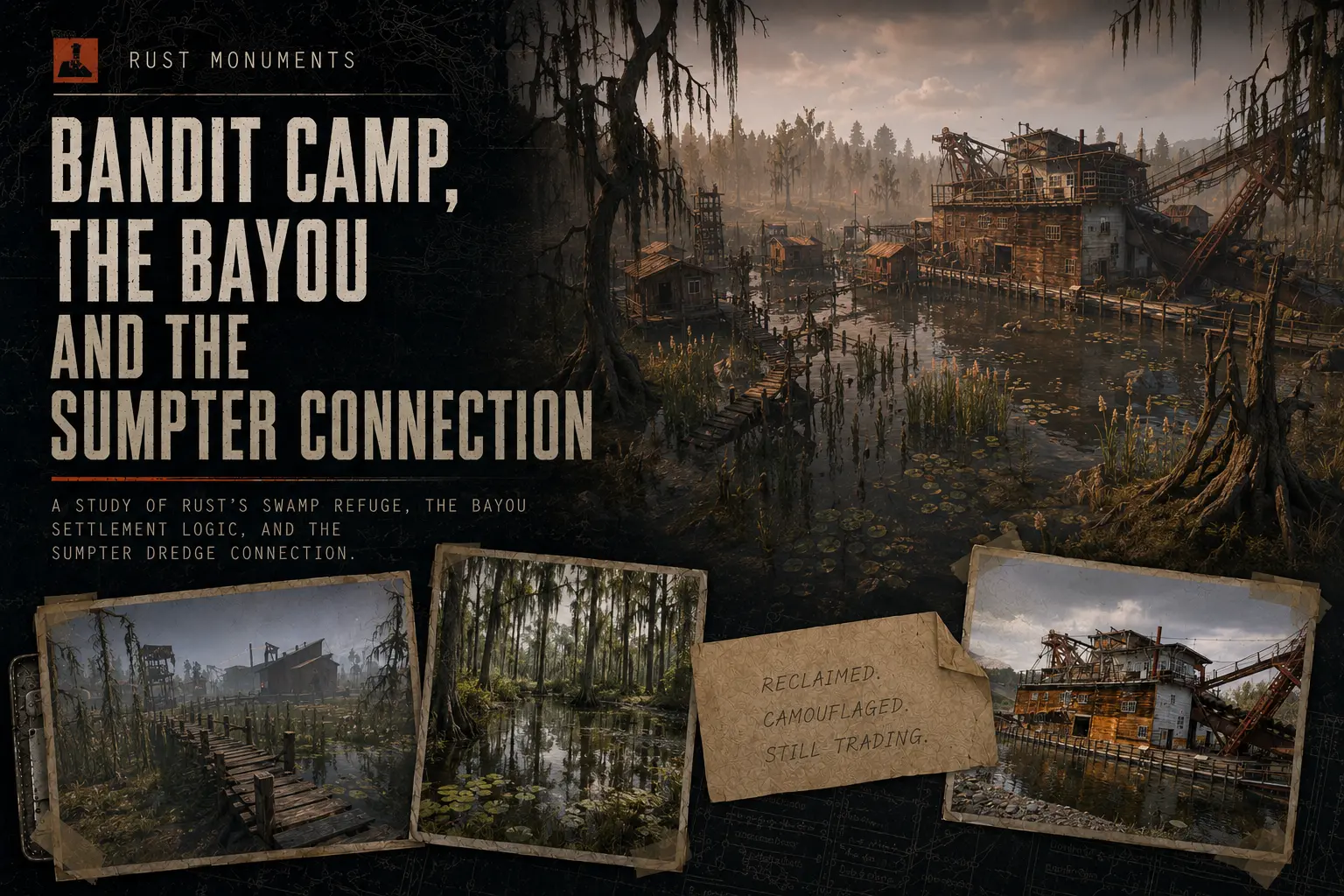
Bandit Camp is Rust’s bayou-like swamp refuge: a Bandit world built around an abandoned dredge, with a strong visual connection to Oregon’s Sumpter Valley Gold Dredge.
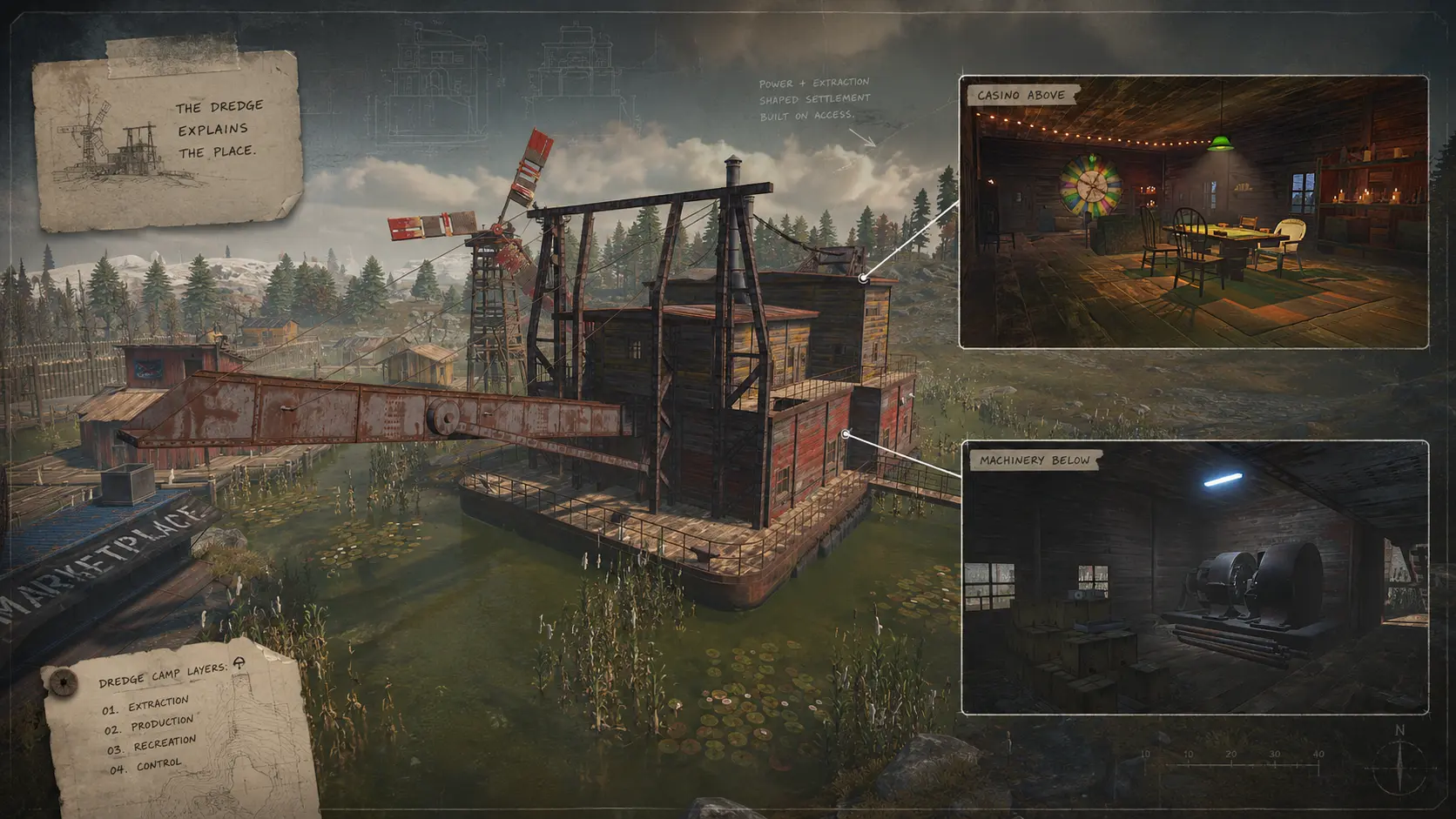
Bandit Camp is one of Rust’s easiest monuments to understand at first glance. There are shops, guards, a casino, wooden cabins and a maze of walkways rising just above the swamp.
Then there is the dredge.
It is enormous compared with everything built around it. Its steel structure, machinery and metal walkways belong to a completely different scale of construction from the timber settlement surrounding it. Facepunch itself introduced the machine in June 2018 as “a large dredge that was abandoned there”, before Bandit Town had even received its finished gameplay systems. (Rust)
That single detail changes how the monument can be read.
The Bandits did not necessarily create everything we see. They occupy a landscape that already had a history.
Before the Camp, the Swamp
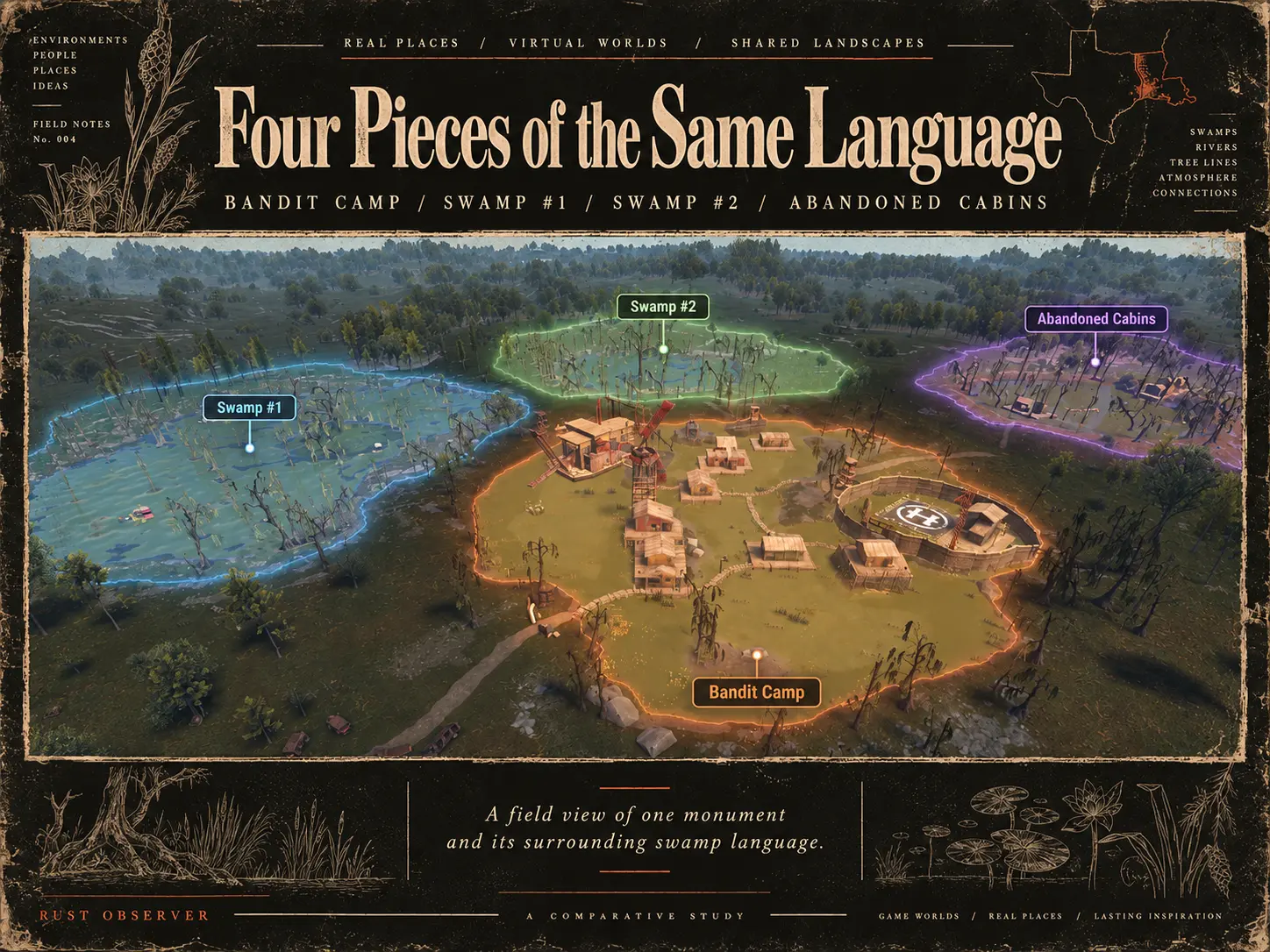
Bandit Town first appeared publicly in [The Puzzle Update] as a collection of wooden shacks linked by rough bridges, surrounded by a large swamp and dense fog. Behind it stood the abandoned dredge that Facepunch intended to turn into a safe zone. (Rust)
A month later, Facepunch expanded the idea beyond the town itself. The swamp became a reusable environment that could appear independently in Temperate and Tundra areas, with reeds, water plants and updated cabins. (Rust)
When the monument finally entered Rust on August 2, 2018, the swamp and Bandit Town arrived together. The finished settlement contained merchants, armed guards and a casino inside the dredge, while separate swamp landmarks provided extra wood and sulfur resources elsewhere on the map. (Rust)
This also gives Abandoned Cabins an interesting place in the same visual family. They reduce the idea to its simplest form: wet ground, swamp vegetation, wooden structures and paths above the water.
Some buildings are already boarded shut. Players can break through those barriers and enter structures that visually appear to have been abandoned.
The environment is showing the passage of time.
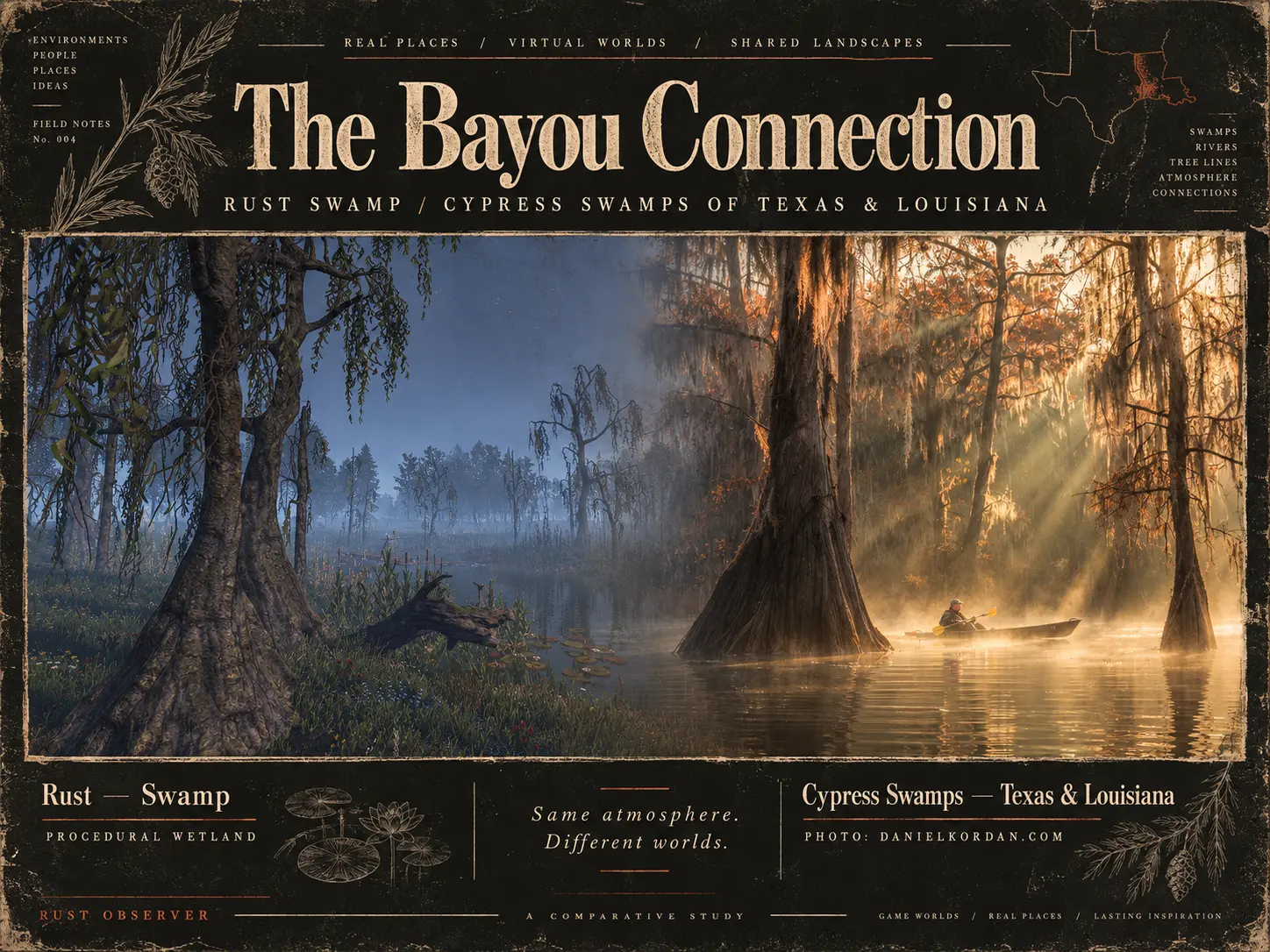
Louisiana immediately comes to mind when we picture American bayous. Texas, meanwhile, is better known for its cowboys, cattle ranches, oil fields and vast arid landscapes. Yet eastern Texas presents an entirely different environment, sharing the humid forests, winding waterways and enormous cypress swamps of its Louisiana neighbour.
One remarkable example is Caddo Lake, on the border between the two states. Its labyrinth of waterways, flooded forests and massive baldcypress trees covered in Spanish moss creates an unusually mysterious environment. Dense vegetation conceals much of the landscape, while isolated buildings and narrow passages gradually emerge between the trees.
Our investigation isn’t always about finding the exact place Facepunch may have reproduced. Sometimes, the more interesting question is whether a Rust monument could plausibly exist somewhere in the real world. Bandit Camp could easily belong in a place like Caddo Lake.
The resemblance extends beyond the vegetation. Caddo Lake has a remarkable history of human occupation, commercial navigation and industrial activity. During the nineteenth century, steamboats travelled through its waterways, connecting settlements such as Port Caddo and Jefferson to the commercial routes leading toward New Orleans. Established in 1838, Port Caddo developed a reputation involving visiting sailors, traders, gamblers and inhabitants who resisted outside authorities. The settlement eventually declined as commerce shifted elsewhere, transportation evolved and water levels changed. ( Atlas: Texas Historical Commission )
Even the geography carries traces of that history. The enormous natural logjam known as the Great Raft helped create Caddo Lake by obstructing the Red River. Its gradual removal altered the waterways and required extensive engineering work. In 1871, Jefferson commissioned the Lone Star, a bucket dredge used to maintain navigation along Big Cypress Bayou. Historical records even document the eventual sinking of an earlier dredge and the construction of another. ( Texas Parks & Wildlife Department )
Industrial development eventually introduced another layer. Oil extraction brought drilling equipment and platforms directly into the wetlands. In 1914, Gulf Refining Corporation constructed a dam to raise the lake’s water level and accommodate its drilling operations. Wooden structures, working boats and industrial machinery consequently became part of an already established wetland landscape. (Texas Water Development Board )
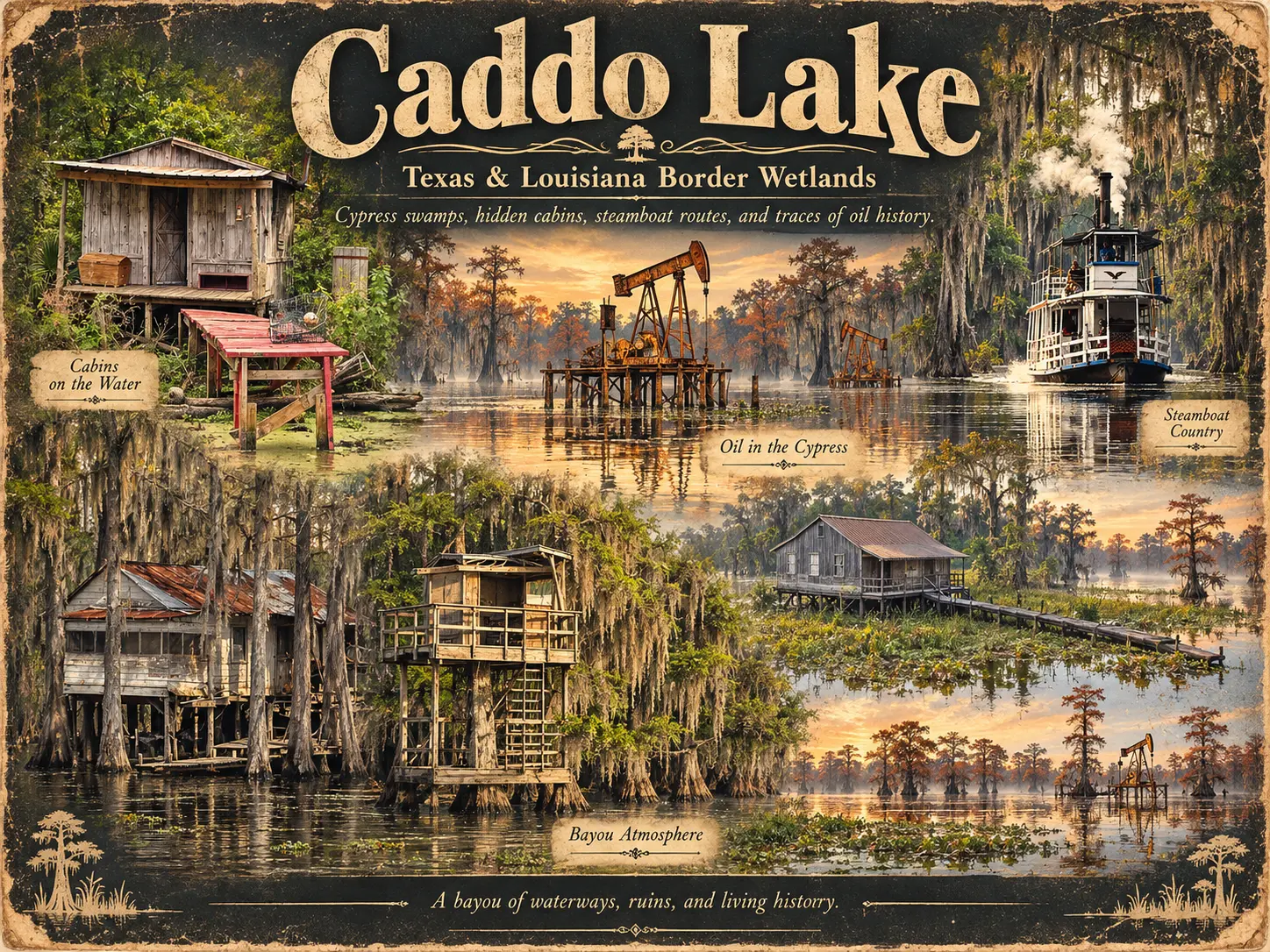
Caddo Lake offers precisely the combination we’re looking for: an inhabited swamp, isolated buildings, commercial activity, abandoned infrastructure and a landscape transformed by successive generations of occupants. Its architecture may differ from Rust’s, but its atmosphere and industrial history make Bandit Camp entirely believable.
And while dredging was genuinely part of Caddo Lake’s history, another location offers a particularly striking comparison with the enormous machine standing at the centre of Bandit Camp.
For that, we travel to Oregon and the Sumpter Valley.
The contrast becomes especially obvious when standing beside the dredge.
The machine has steel walkways and heavy structural members. The settlement surrounding it uses wooden galleries, narrow plank bridges and floors repaired with whatever material appears to have been available.
From above, Bandit Camp looks less like something designed as a single project than something that accumulated around an industrial object already occupying the swamp.
That interpretation also happens to fit Facepunch’s original description remarkably well: the dredge was already described as abandoned while Bandit Town itself was still being developed. (Rust)
The difference does not establish a canonical construction sequence, but visually the two layers are difficult to miss.
The dredge looks permanent.
The camp looks adapted around it.
A Dredge Belongs on This Island
The Giant Excavator was not the only machine on the island capable of making an enormous hole.
Rust repeatedly establishes mineral extraction as part of the island’s older industrial landscape. Even the old timber mine passages introduced around Military Tunnels were explicitly described by Facepunch as remnants of “industrialization from an older era.” (Rust)
A dredge therefore does not need a special excuse to exist here.
What it was extracting is another question.
Rust never tells us.
Why Sumpter?
Bucket-line dredges were used around the world and they were not limited to gold. Malaysia, for example, operated large floating bucket dredges for alluvial tin mining; the National Museum of Malaysia describes machines carrying chains of heavy buckets, revolving screens and separation equipment aboard what was essentially a floating factory. (muziumnegara.gov.my)
So the connection with Sumpter Valley, Oregon, is not that every dredge must be an American gold dredge.
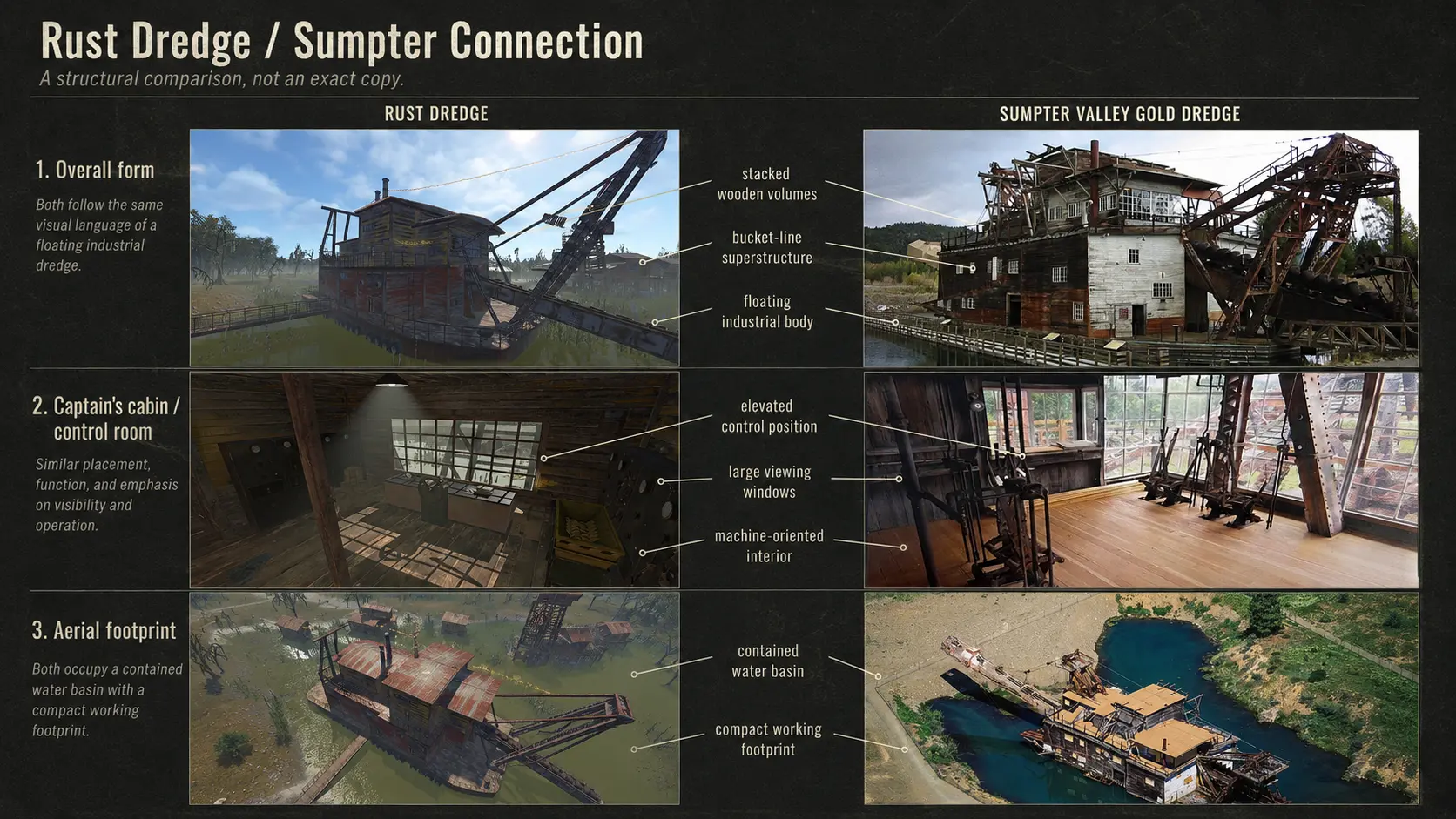
Sumpter is interesting because its surviving machine is unusually close to Rust’s dredge in overall construction and operating logic.
Both use the long bucket ladder at the front, large lifting structures, booms, heavy electric machinery, a substantial enclosed superstructure and a processing system contained within a floating hull. Even the relationship between the working machinery, upper control areas and bridge-like circulation around the machine feels familiar.
The resemblance goes considerably further than simply putting a bucket chain on a boat.
Inside the Machine
Rust’s dredge contains much more of a working dredge than is immediately visible from outside.
The bucket ladder remains. The lifting machinery remains. The major motors remain. Material can be followed into the processing section, including the large rotating trommel used to screen and wash excavated material.
What seems to be absent is the final recovery equipment that would normally separate the valuable material from the processed gravel.
That distinction matters.
The processing plant has not vanished. Much of it is still there.
The empty space instead makes it possible to read the machine as something that was stripped after it stopped working. Large structural machinery is difficult to remove; smaller and more valuable recovery systems are exactly the sort of equipment that might disappear first.
That remains an interpretation of the environment rather than stated Rust history, but it also has a real-world parallel: machinery and equipment were removed from many old dredges once operations ended.
Why Is It in a Pond?
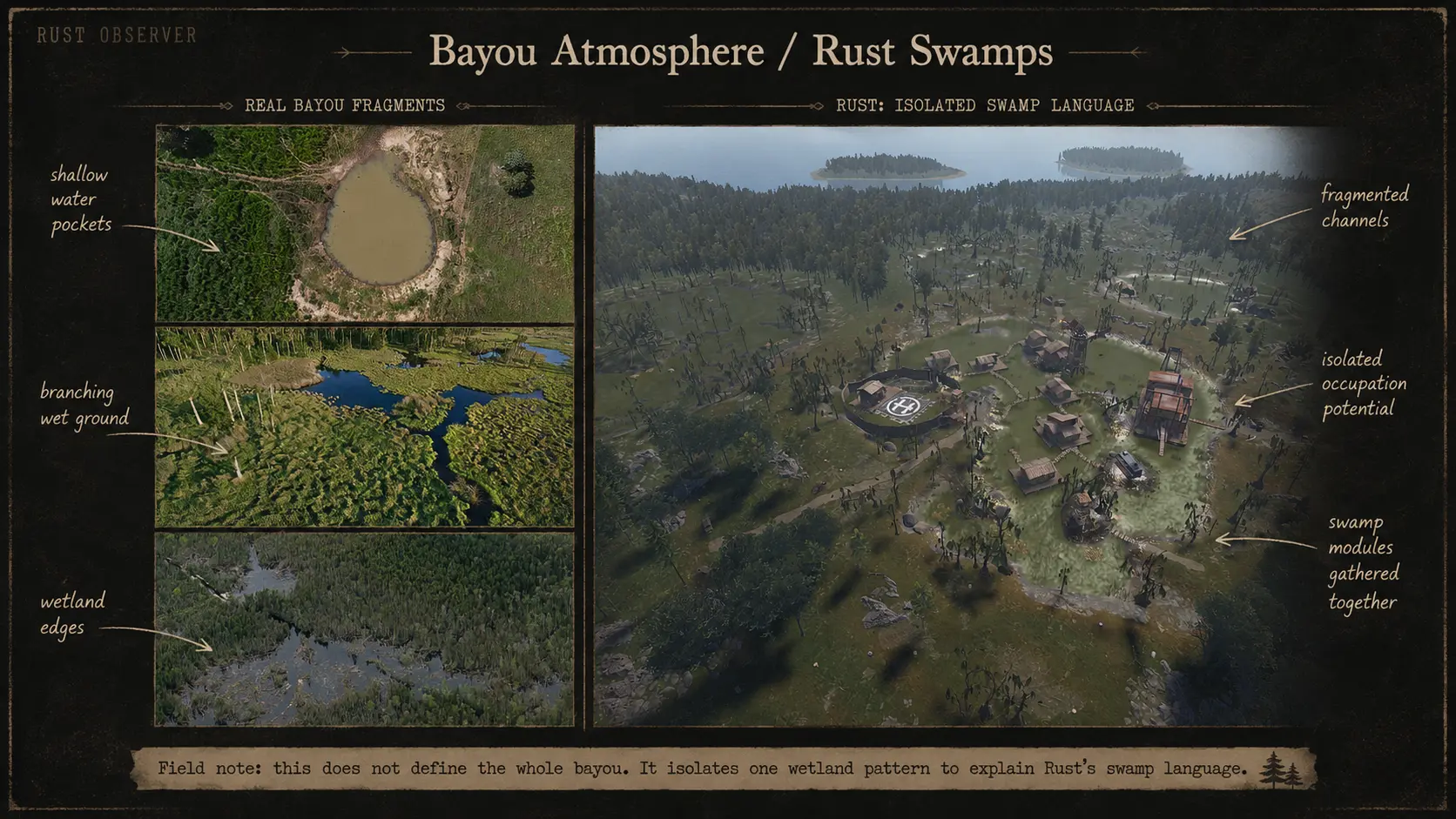
The small pond around Bandit Camp can make the dredge look strangely oversized for the body of water containing it.
That is exactly how a bucket-line dredge can end its life.
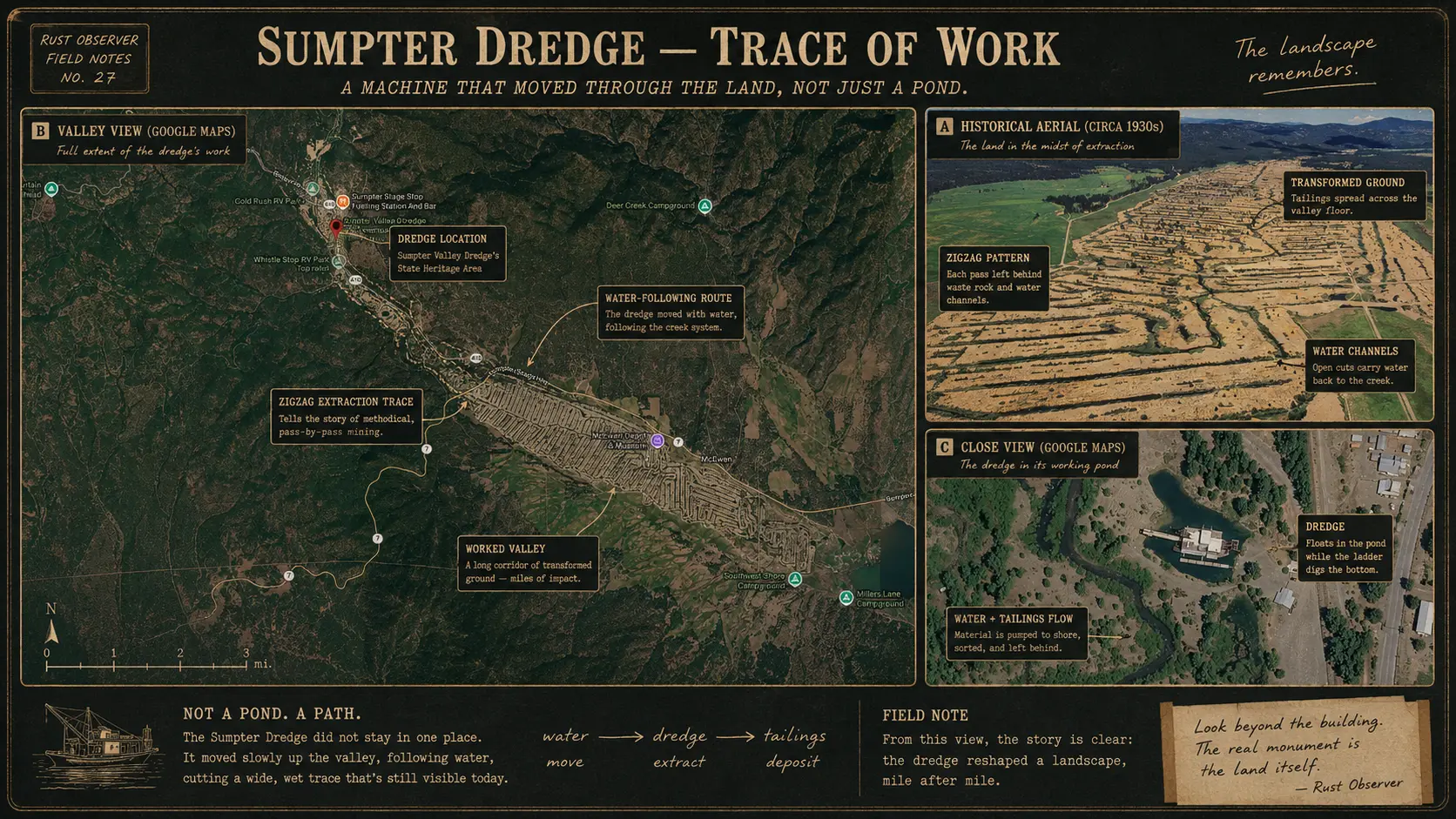
A machine such as the Sumpter dredge did not simply float around an existing lake. Its bucket line excavated material in front of the hull. Water entered the new cut, allowing the dredge to continue floating forward, while processed tailings were deposited behind it.
Oregon State Parks describes the Sumpter machines as having been assembled on the Powder River but then moving away from it into the ancient riverbed, effectively excavating their own route through the valley. (Oregon State Parks)
The little pond surrounding the preserved dredge today is therefore only its final working cut, not an indication of how much territory it once worked.
Bandit Camp has the same intriguing geometry: a huge dredge sitting in a comparatively compact pool, surrounded by raised and disturbed terrain.
The mounds generated around Bandit Camp are not documented by Facepunch as dredge tailings, so that connection should remain a visual possibility rather than a fact.
But a dredge sitting in a hole does not require a lake to have existed there first.
The dredge can make the hole.
Three Dredges, One Valley
Sumpter also gives some scale to what such a machine could do.
Three bucket-line dredges worked the valley during separate periods between 1913 and 1954. According to the Oregon Department of Geology and Mineral Industries, together they worked 2,603 acres and processed more than 60.6 million cubic yards of gravel. (Oregon Publications)
That disturbed area is approximately 10.5 square kilometres.
On a 6 × 6 km Rust island — 36 km² — it would occupy roughly 29 percent of the entire map.
And the surviving Sumpter dredge was only one of the three machines responsible.
The scars remain visible across the valley long after the dredging stopped.
A former river channel does not necessarily continue to look like a normal river after decades of excavation, tailings, redirected water and later vegetation.
That provides another useful real-world answer to Bandit Camp: the river that once supplied or crossed the working area does not need to remain obvious in 1983.
What Was It Looking For?
Sumpter was looking for gold.
Rust never says what its dredge was looking for.
It may have been gold, metal or something else entirely. What matters is that the island once contained enough value in the ground to justify bringing in a machine of this scale.
And whatever justified that machine does not have to remain available to the player.
A history of extraction is not a guarantee that the resource survived it.
Seven Years in the Swamp
Bandit Camp also contains one unusually precise chronological clue.
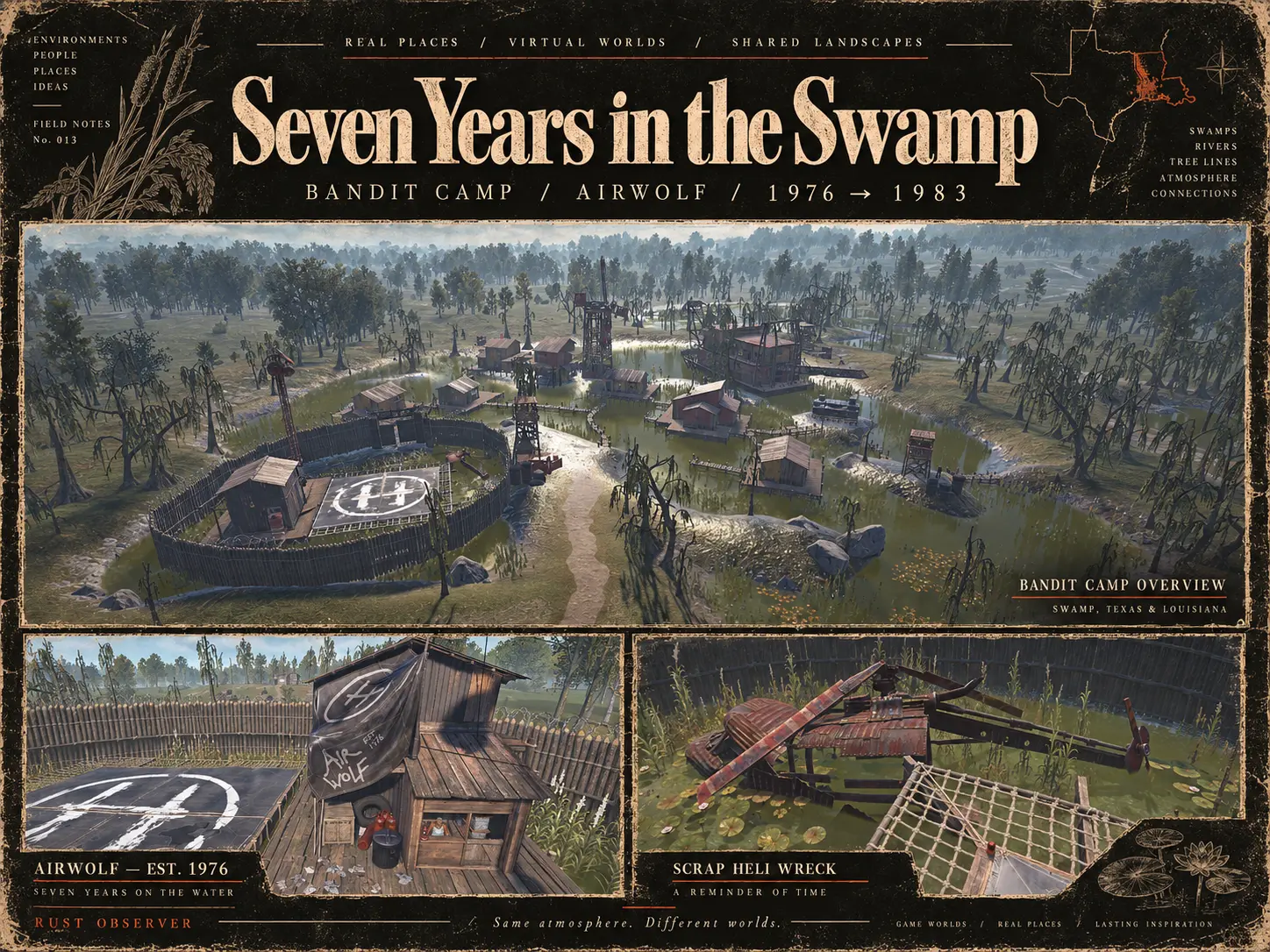
The sign on Air Wolf reads: est. 1976
Every wipe returns the island to April 26, 1983.
At minimum, the sign gives Air Wolf roughly seven years of implied history before the moment represented by the wipe.
And Bandit Camp looks like a place that has had time to age.
Paint has peeled away. Metal is rusting. Timber has weathered. Some floors and docks have been repaired with mismatched planks and whatever material could keep them usable. Elsewhere in the swamp, abandoned buildings have been boarded shut.
Nothing looks freshly installed.
The environment has been occupied, repaired, neglected and reused.
The 1976 inscription does not have to date every structure in Bandit Camp. It does something more useful: it establishes that time has passed here, and the physical condition of the settlement agrees with it.
Air Wolf Came Later — Outside the Island
There is a separate development chronology, and it should stay separate from the history represented inside the world.
The Scrap Transport Helicopter entered Rust in September 2019. At the time, Scrap Helicopters spawned randomly around the map. (Rustafied)
Air Wolf was added to Bandit Town on July 2, 2020. Facepunch simultaneously removed the random roadside spawning of Minicopters and Scrap Helicopters and made the new shop the place where players purchased them. (Rust)
That also explains the destroyed Scrap Transport Helicopter lying beside the Air Wolf building: it is not a special aircraft designed for the shop, but one of the same machines Air Wolf sells.
In development history, the helicopter came first and the shop followed.
Inside the island, the shop simply says 1976.
Those are two different clocks.
The Camp Keeps Changing
Even after Air Wolf arrived, the monument continued to evolve.
The 2021 World Revamp targeted Bandit Town because of its poor performance. Facepunch reduced the number of NPCs, thinned the surrounding forest and completely remodelled the huts, meaning the wooden settlement visible today is not identical to the one released in 2018. (Rust)
The swamp itself continues to receive changes. In September 2026, Facepunch significantly increased the wood available from swamp trees to bring their harvesting closer to other tree types. (Rust)
The monument has changed technically for years.
Its visual idea, however, has remained remarkably consistent: people living in a wet landscape already occupied by the remains of something much larger.
The Sumpter Connection
There is no documented statement from Facepunch saying that Bandit Camp’s dredge is the Sumpter Valley Gold Dredge.
There does not need to be.
Sumpter gives us a real machine with strikingly similar proportions, machinery and operating principles. It explains why such an enormous dredge might sit in a surprisingly small pond. It shows how one could move through a valley rather than remain confined to an existing lake or river. And it demonstrates how drastically a handful of machines could reshape the land around them.
The cabins add another layer. Their construction belongs comfortably beside the ready-cut cottages, worker housing and military buildings that could be shipped to isolated sites during the first half of the twentieth century.
The swamp adds another.
The patched floors, boarded doors, fading paint and rust add another.
And then a small sign says:
est. 1976.
Bandit Camp works because none of these things has to explain the monument alone.
Together, they make the place feel as though people were here before us.
And something else was here before them.
References
- Facepunch — The Puzzle Update, June 2018
- Facepunch — The Team Update, July 2018
- Facepunch — The Bandit Town Update, August 2018
- Facepunch — Devblog 123: Old Mines
- Facepunch — Modular Vehicles Update / Air Wolf, July 2020
- Facepunch — World Revamp, May 2021
- Facepunch — Breach and Clear, September 2026
- Rustafied — Meet the Scrap Transport Helicopter, September 2019
- Oregon State Parks — Sumpter Valley Dredge State Heritage Area
- DOGAMI Bulletin 61 — Gold and Silver in Oregon
- National Museum of Malaysia — Model of a Tin Dredge
- U.S. Forest Service — Baldcypress
- National Park Service — Barataria Preserve