Props #3 — Cars and the Aficionado
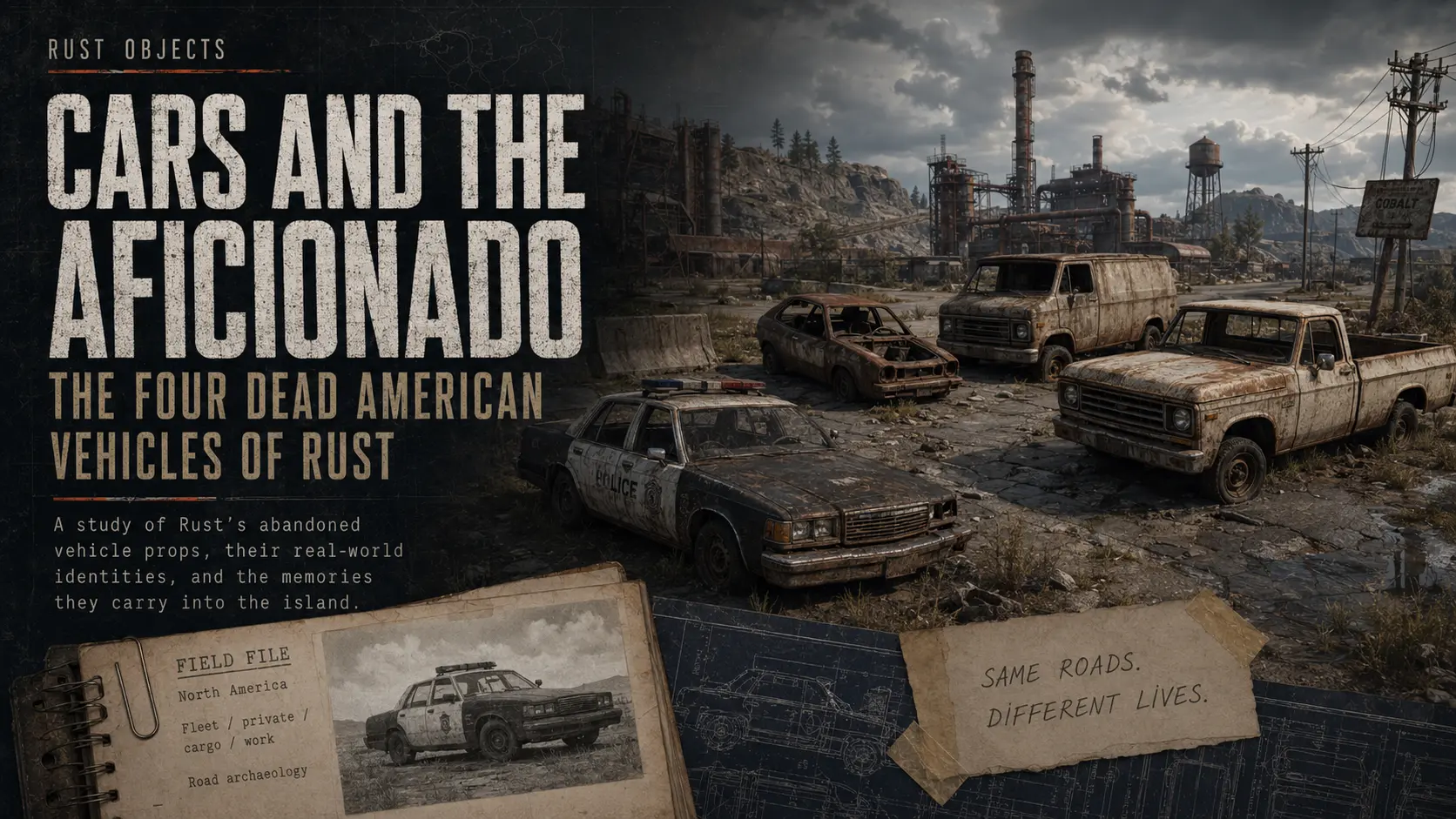
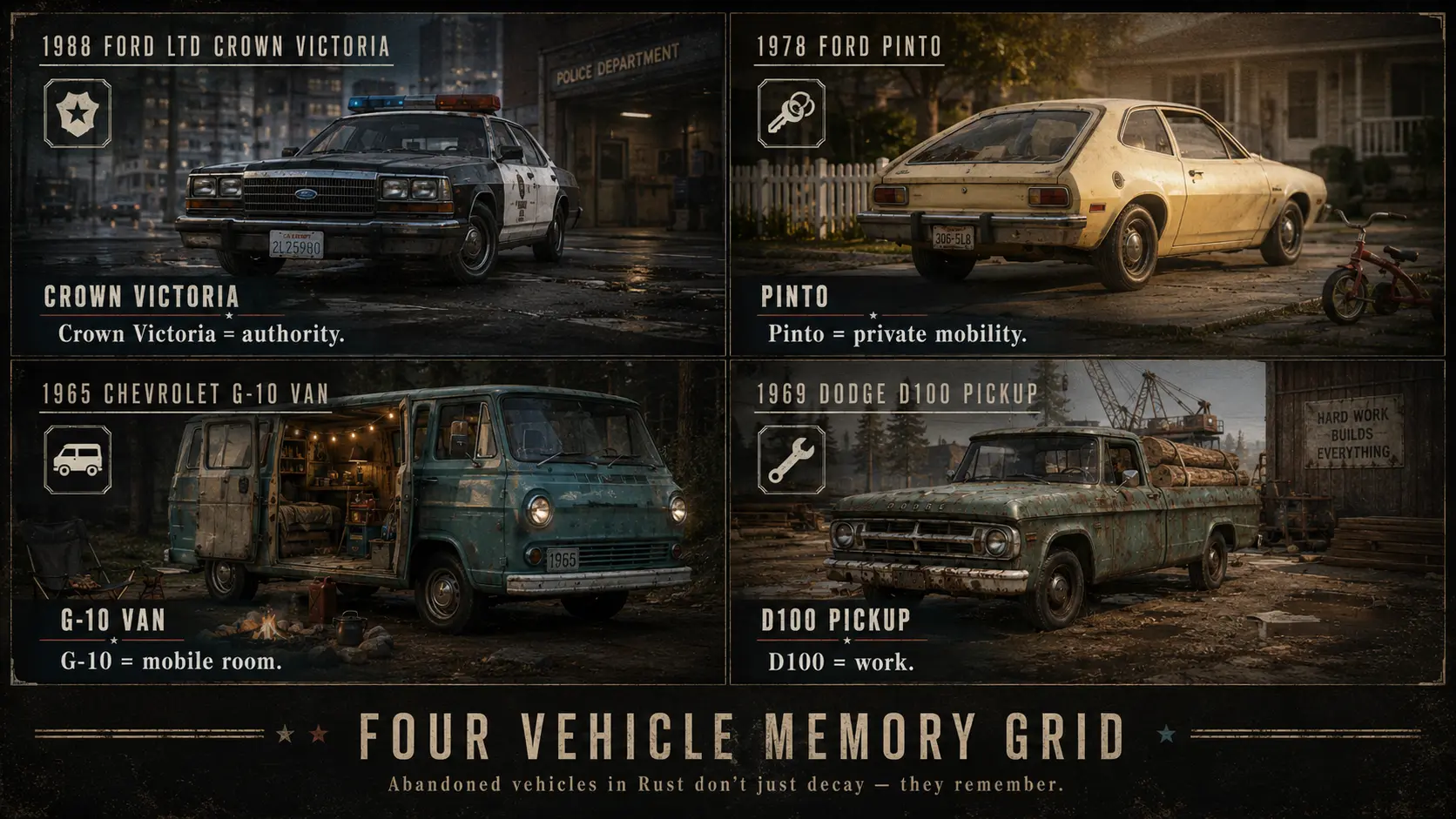
Rust’s abandoned vehicle props are not random wrecks. The Crown Victoria, Ford Pinto, Chevrolet G-10 Van, and Dodge D100 carry decades of police, horror, road-trip, and work-truck memory into the island.
And Here Come the Aficionados…
In the United States, the automobile has never been merely a means of transportation. It became part of regional identity, family history, popular culture and even personal allegiance. Ford, Chevrolet and Mopar loyalties can last a lifetime. Muscle cars, pickups, hot rods, drag racing, restoration clubs and factory-original specifications have produced a culture in which the year, engine, grille, taillights, trim package — sometimes even the smallest production change — can matter enormously.
That is why the word aficionado is in the title.
To most players, the wrecks scattered across Rust are simply old American cars. To an American-car enthusiast, however, “an old Ford” is rarely precise enough. A different grille can separate one model year from another. Headlights, bumpers, taillights, trim and body lines can identify a specific generation — sometimes even a single production year.
And once you start looking at them that closely, these wrecks stop being generic scenery.
They become identifiable machines, with real manufacturers, real model histories, and real places in the chronology of American automobile design.
That is what interests us here: not merely whether Rust’s cars look old, but how closely their surviving details can connect them to actual vehicles.
One of those identifications does raise a small question of chronology, but that particular problem belongs elsewhere.
For now, we have four dead American vehicles to identify.
How four ruined props carry decades of North American road memory.
Rust looks like an island full of abandoned cars.
At first glance, the roads, parking lots, junk piles, monuments, and ruined towns seem scattered with dozens of different wrecks. But once you slow down and observe them carefully, the illusion becomes clearer: Rust is not filled with endless vehicle types. It is built from a small group of recognizable base models, reused in different conditions, colors, decay states, and placements.
Some are half buried. Some are stripped. Some are open. Some are used as cover, scenery, loot containers, or small shelters. Rust’s art team then does what Rust does best: it takes a familiar object, damages it, empties it, recolors it, and lets the environment write the rest of the story.
This article is not about confirmed developer lore. It is an Observer reading: a visual identification of four recurring Rust vehicle wrecks, their likely real-world model families, their original use in life, and the cultural memory they carry into the island.
The result is more interesting than a simple vehicle list.
Rust’s four recognizable vehicle wrecks are not just cars. They are four dead forms of mobility.
The sedan recalls institutional movement.
The Pinto recalls private everyday mobility.
The van recalls collective escape and mobile shelter.
The pickup recalls work, cargo, and ordinary road life.
Rust kills all four. But it does not kill them in the same way.
1. 1988 Ford LTD Crown Victoria — Authority Without the Patrol
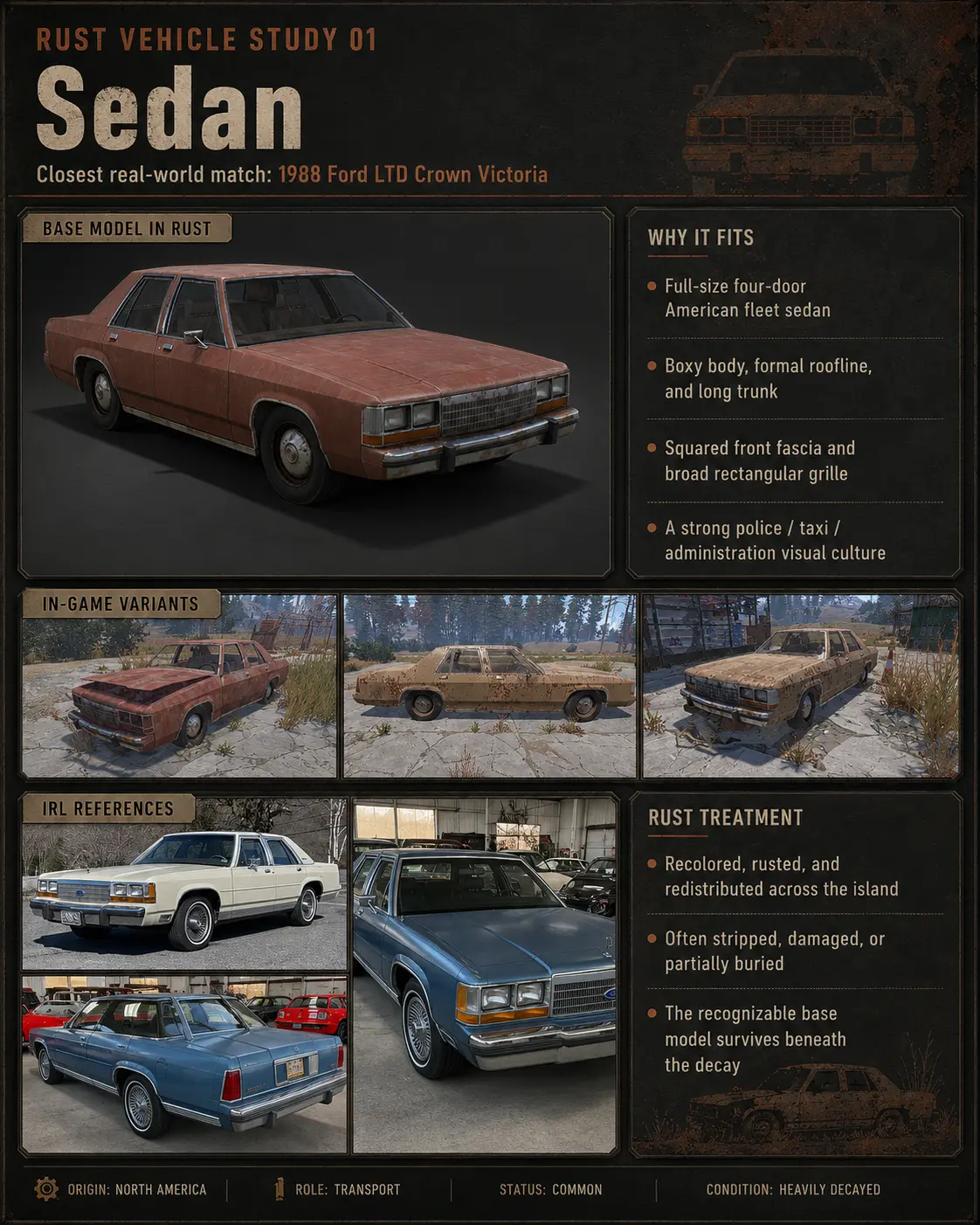
The Rust sedan strongly recalls the 1988 Ford LTD Crown Victoria. The identification rests on the long full-size body, square sedan proportions, chrome-heavy front end, stacked rectangular headlights, large grille, and the overall Panther-platform fleet-car silhouette.
The 1988 model year is especially important because Ford revised the LTD Crown Victoria’s exterior that year. The front and rear fascias were restyled, the grille was lowered and widened, and the headlights and turn signal lenses were integrated into a single assembly. Those details help separate the late LTD Crown Victoria from earlier versions and from the visually similar 1989–1990 family variants. (Wikipedia)
In Rust, the sedan appears without its original purpose. No patrol markings. No taxi sign. No fleet number. No civic service. No family driver. Just the body.
That is exactly why the model works.
A full-size Crown Victoria-type sedan is not just a private car in North American visual culture. It belongs to police fleets, taxis, municipal departments, government lots, old detectives, roadside stops, and institutional movement. Even stripped of markings, the shape carries a memory of authority.
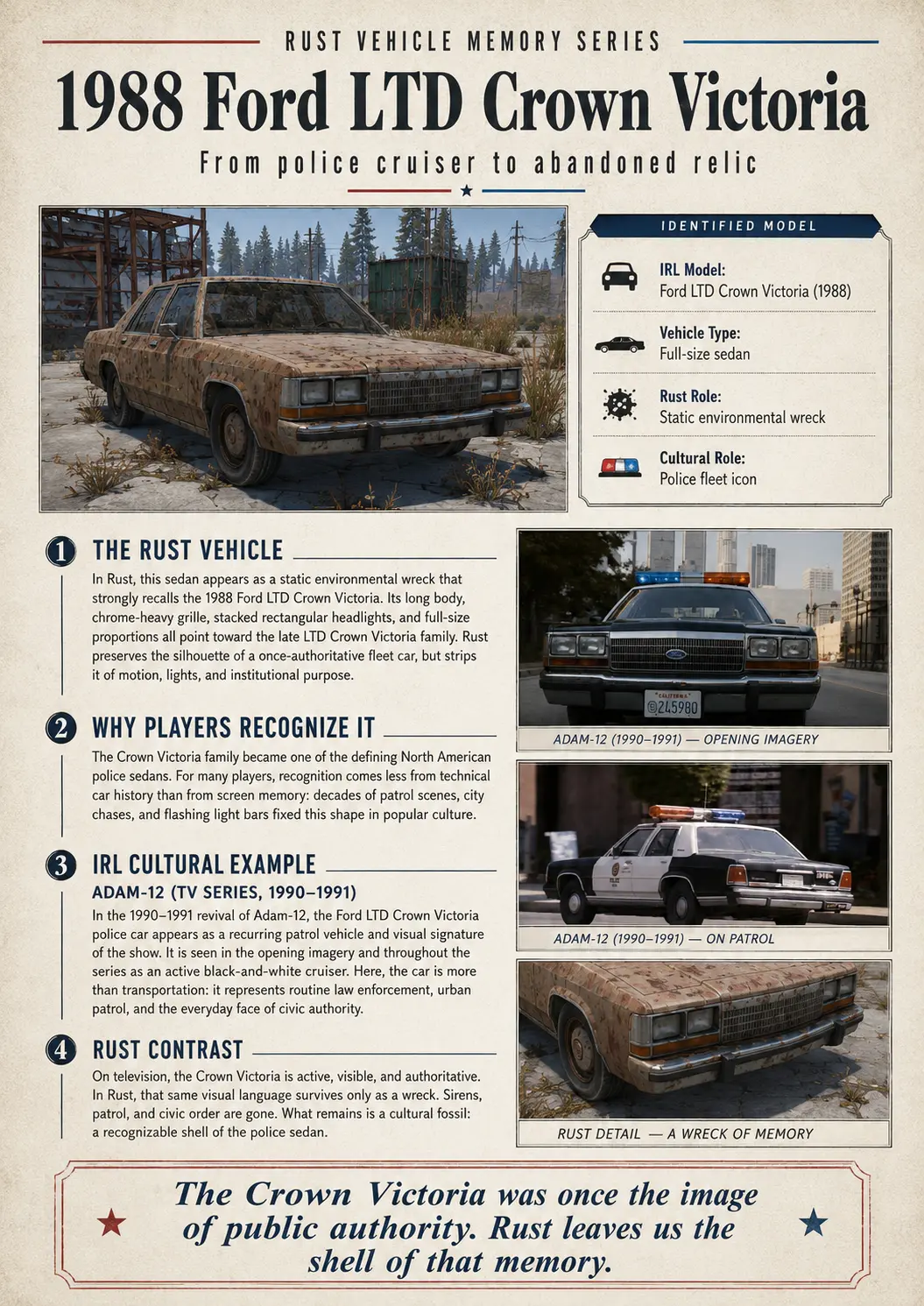
The cultural example is unusually precise: The New Adam-12.
In the 1990–1991 revival of Adam-12, IMCDB identifies a 1988 Ford LTD Crown Victoria as a heavily used police vehicle. The series page also describes the show as a syndicated revival with many shots of the car driving around Los Angeles. (IMCDb.org)
That matters because the Crown Victoria is not just background dressing there. It is the moving office of the police procedural. It carries officers, radio calls, patrol logic, urban observation, and the everyday face of civic authority.
On television, the car moves through the city as part of the system.
In Rust, the system is gone.
The sedan remains, but the patrol is dead. No siren, no radio, no officers, no municipal order. The body is still recognizable, but its function has collapsed into archaeology.
2. 1978 Ford Pinto — The Everyday Car That Became a Trap
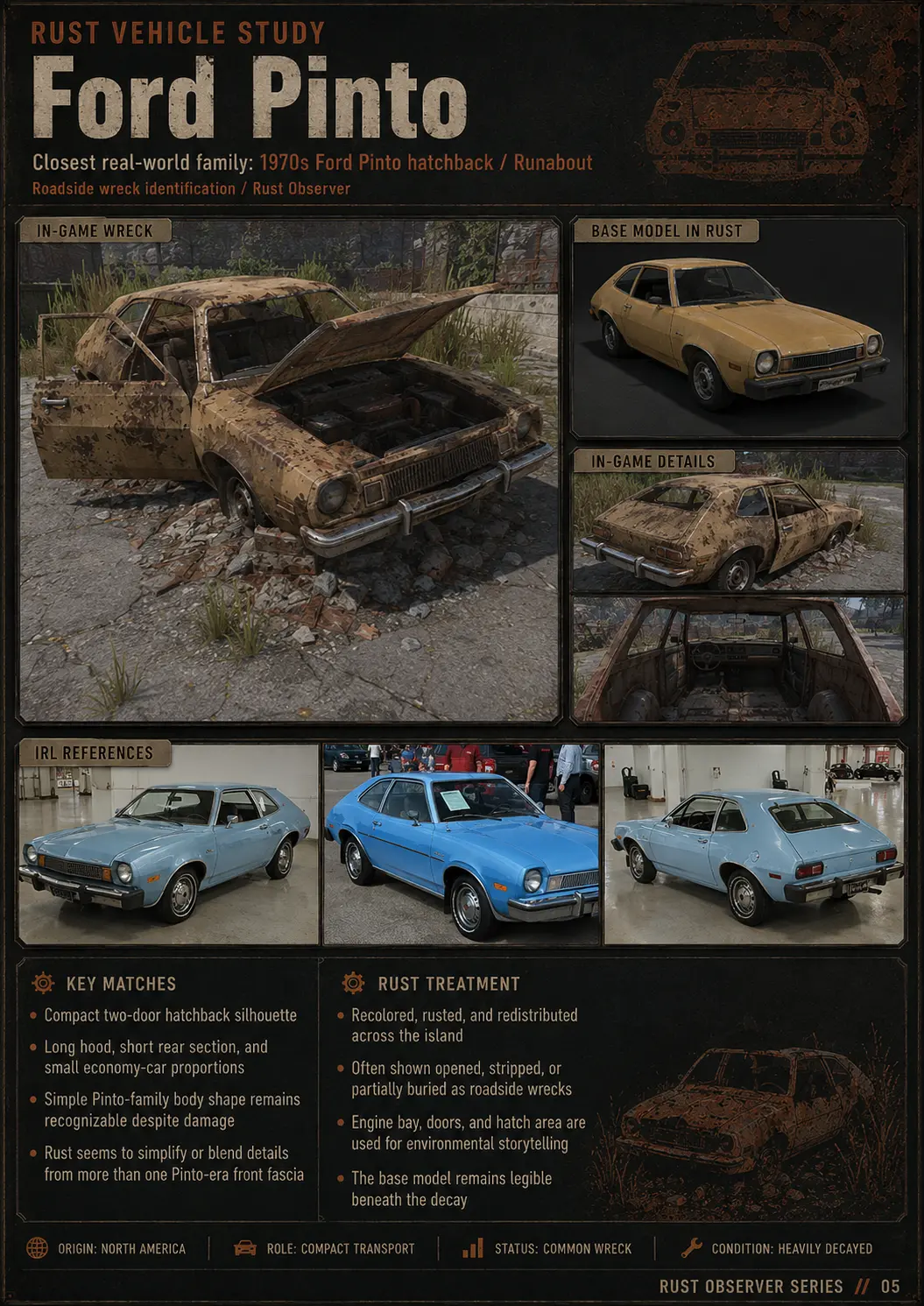
The small Rust hatchback strongly recalls the Ford Pinto, especially the late-1970s Runabout / hatchback family. Its compact body, short wheelbase, small economy-car proportions, sloped rear hatch, simple front treatment, and low-cost private-car silhouette all point toward the Pinto line.
The Ford Pinto was produced in North America from 1970 to 1980 and was sold in several body styles, including a two-door sedan, a three-door hatchback, and a station wagon. (Wikipedia) In ordinary life, it belonged to errands, commuting, suburban routines, tight budgets, first cars, and cheap private mobility.
Rust preserves that ordinariness.
The Pinto-like wreck is not grand, heroic, or institutional. It is a small dead car. It sits open, rusted, sometimes with the hood raised, sometimes stripped, sometimes half absorbed into roadside debris. It is readable, but not inhabitable in the same way as the van.
That distinction becomes important once we bring in the cultural memory.
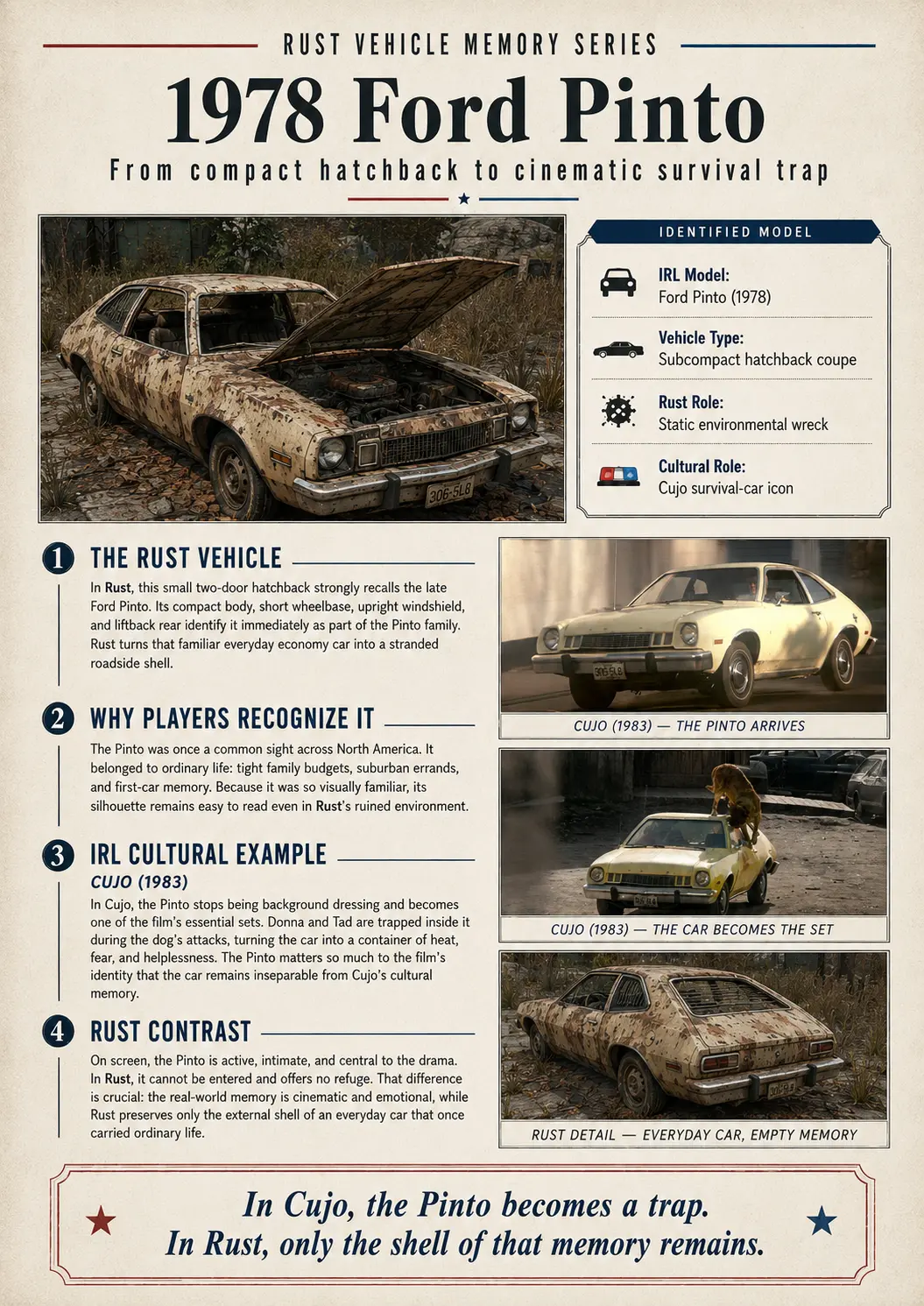
The cult example is Cujo.
IMCDB identifies the car in Cujo as a 1978 Ford Pinto Runabout and classifies it as a vehicle used heavily by a main character or for a long time. The movie page also contains a user observation that the Pinto deserves higher prominence because it becomes the setting for the entire dog attack sequence. (IMCDb.org) A 2024 article from Schmit Bros Auto also describes Donna and Tad taking their 1978 Pinto Runabout to a mechanic before the attack scenario unfolds. (schmitbrosauto.com)
This is exactly why the Pinto matters.
In Cujo, the car stops being a prop. It becomes a set.
Donna and Tad are trapped inside it during the dog’s attacks. The Pinto becomes a container of heat, fear, exhaustion, and helplessness. It is no longer transportation. It is a fragile room that cannot protect its occupants well enough, but cannot release them either.
That is a rare cinematic transformation: an ordinary economy car becomes a survival chamber.
Rust does something different.
The Pinto-like wreck in Rust cannot be entered as a meaningful shelter. It does not become a playable room. Its doors may be open, its engine bay exposed, and its body recognizable, but it remains mostly an exterior shell. Rust keeps the memory of the everyday car, not the full cinematic trap.
That contrast is useful. It shows that not all vehicle wrecks in Rust retain the same level of interior function. The Pinto dies mostly as a car.
3. 1965 Chevrolet G-10 Van — The Mobile Room After the Road Trip
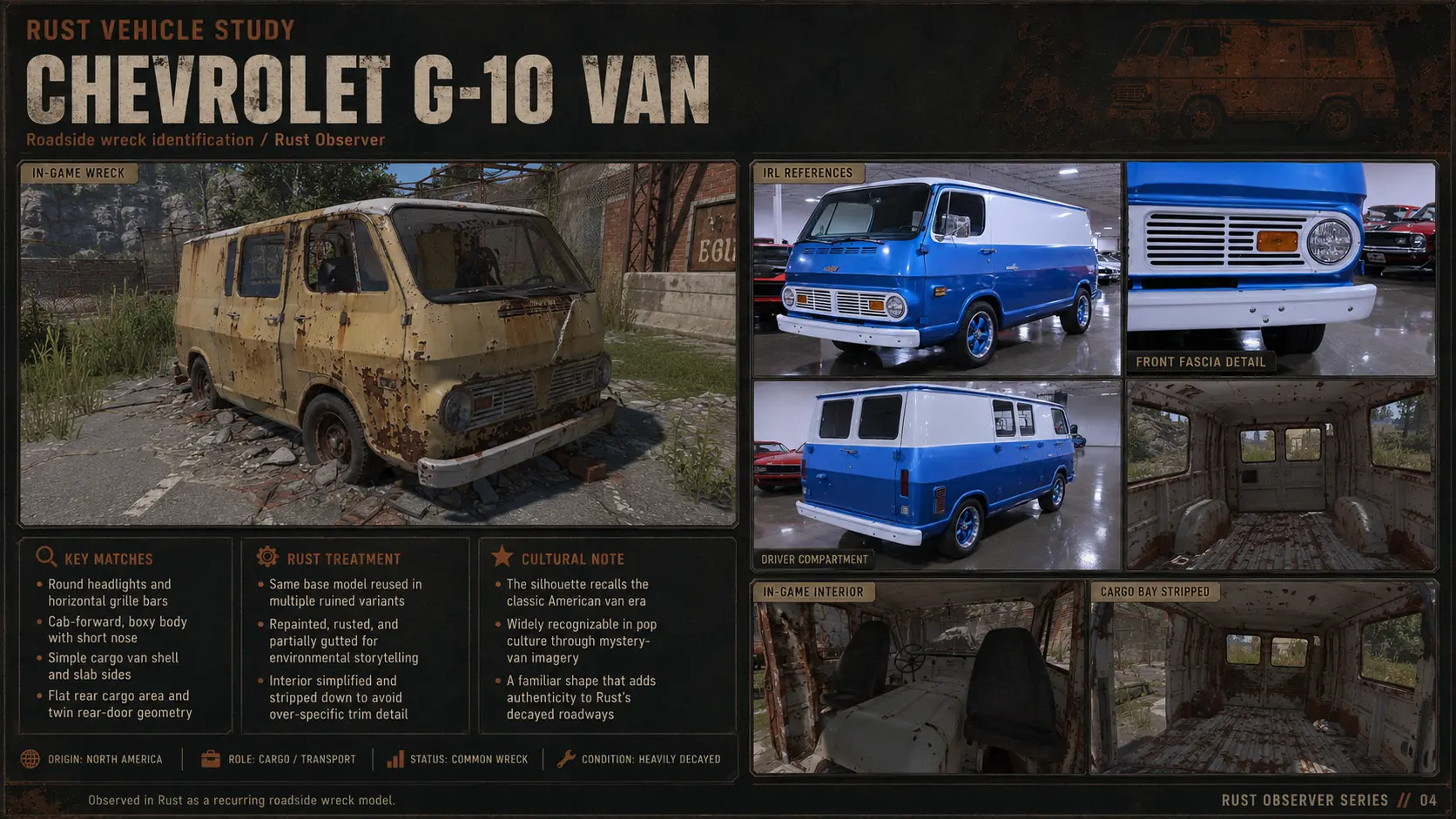
The Rust van strongly recalls the first-generation Chevrolet G-10 / Chevy Van family: flat face, forward-control cab, round headlights, horizontal grille, simple box body, short nose, and practical cargo shell.
The early Chevrolet Van was originally utilitarian, but it was also flexible. Chevrolet’s 1965 van brochure advertised multiple side and rear window options, and the 1965 Sportvan added a more passenger-oriented configuration with integrated windows. (xr793.com) That flexibility matters because the same body language could support several lives: cargo van, service van, passenger van, student van, surf van, road-trip van, and pop-culture adventure van.
Rust’s G-10-like wreck keeps that flexibility in a dead form.
Unlike the Pinto, the van can still behave as a space. Players can move into it, hide inside it, search it, and sometimes find food or loot. It no longer drives, but it remains a small room.
That is the key to its cultural memory.
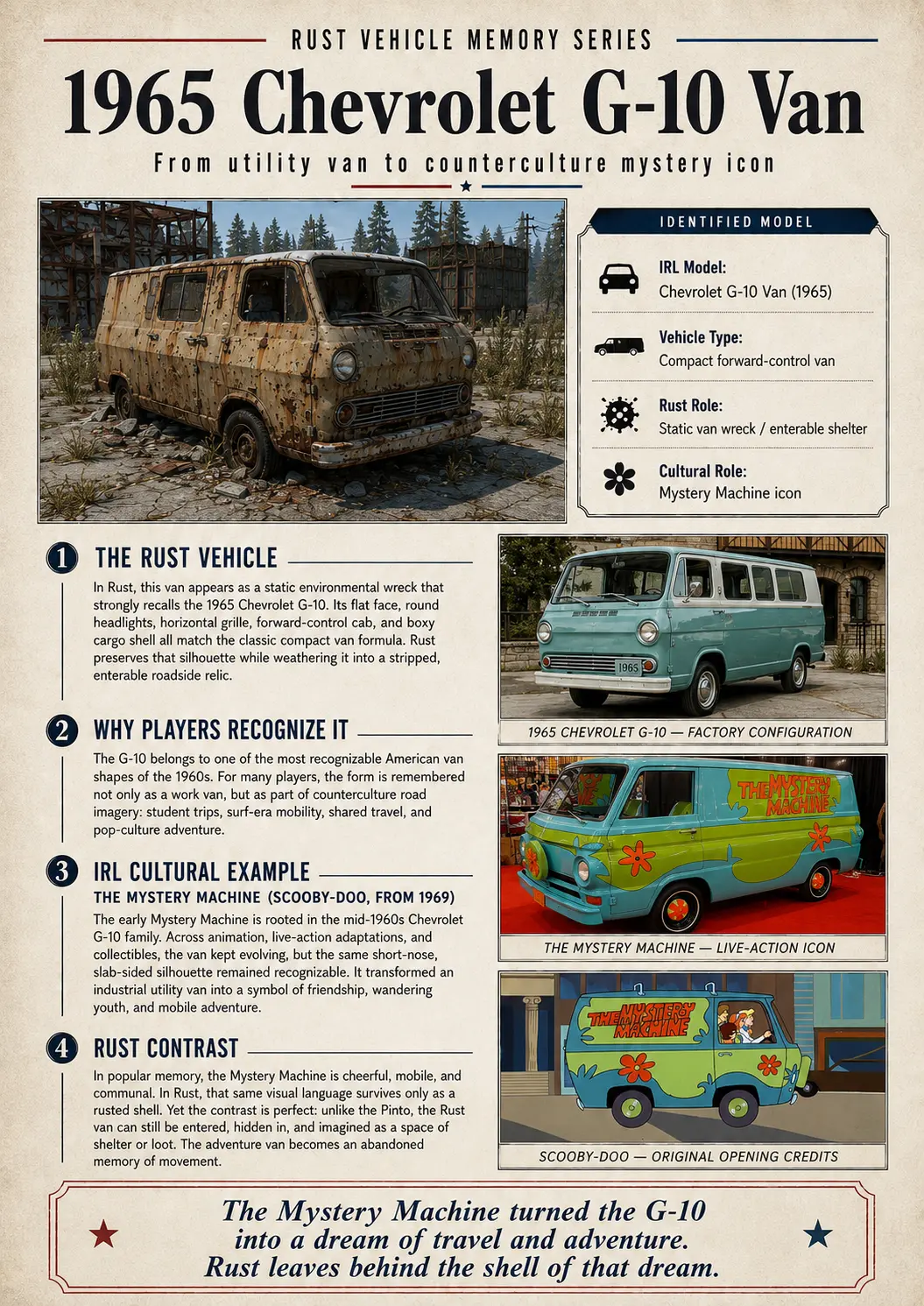
The cult example is the Mystery Machine from Scooby-Doo.
IMCDB identifies the original Scooby-Doo, Where Are You! Mystery Machine as a 1964 Chevrolet Chevy Van [G-10], used heavily by the main characters across the 1969–1971 animated series. (IMCDb.org) Later live-action Mystery Machines were not always the same exact model; for example, IMCDB notes that the Scooby-Doo 2 live-action van began as a later Chevrolet G-Series cargo van and was heavily customized into the recognizable Mystery Machine. (IMCDb.org)
That evolution is part of the point.
The Mystery Machine is not important because it proves one exact Rust source. It is important because it shows how a vehicle type becomes a cultural room.
The van is the team’s mobile clubhouse. It carries friends, snacks, gear, fear, jokes, maps, escape, and wandering youth. It belongs to the student road trip, the California dream, the festival road, the surf-road imagination, and the fantasy that movement can temporarily solve adulthood.
Rust removes everything cheerful: no flowers, no logo, no crew, no road trip.
But Rust keeps the most important architectural idea.
The van is still a box you can enter.
The wheels no longer matter. The room survives.
The Pinto dies as a car. The van survives as a room.
In that sense, the Rust G-10-like wreck is one of the most successful vehicle props on the island. It is not just scenery. It preserves the last usable part of the van myth: shelter.
4. Dodge D100 Pickup — The Work Truck That Was Always There
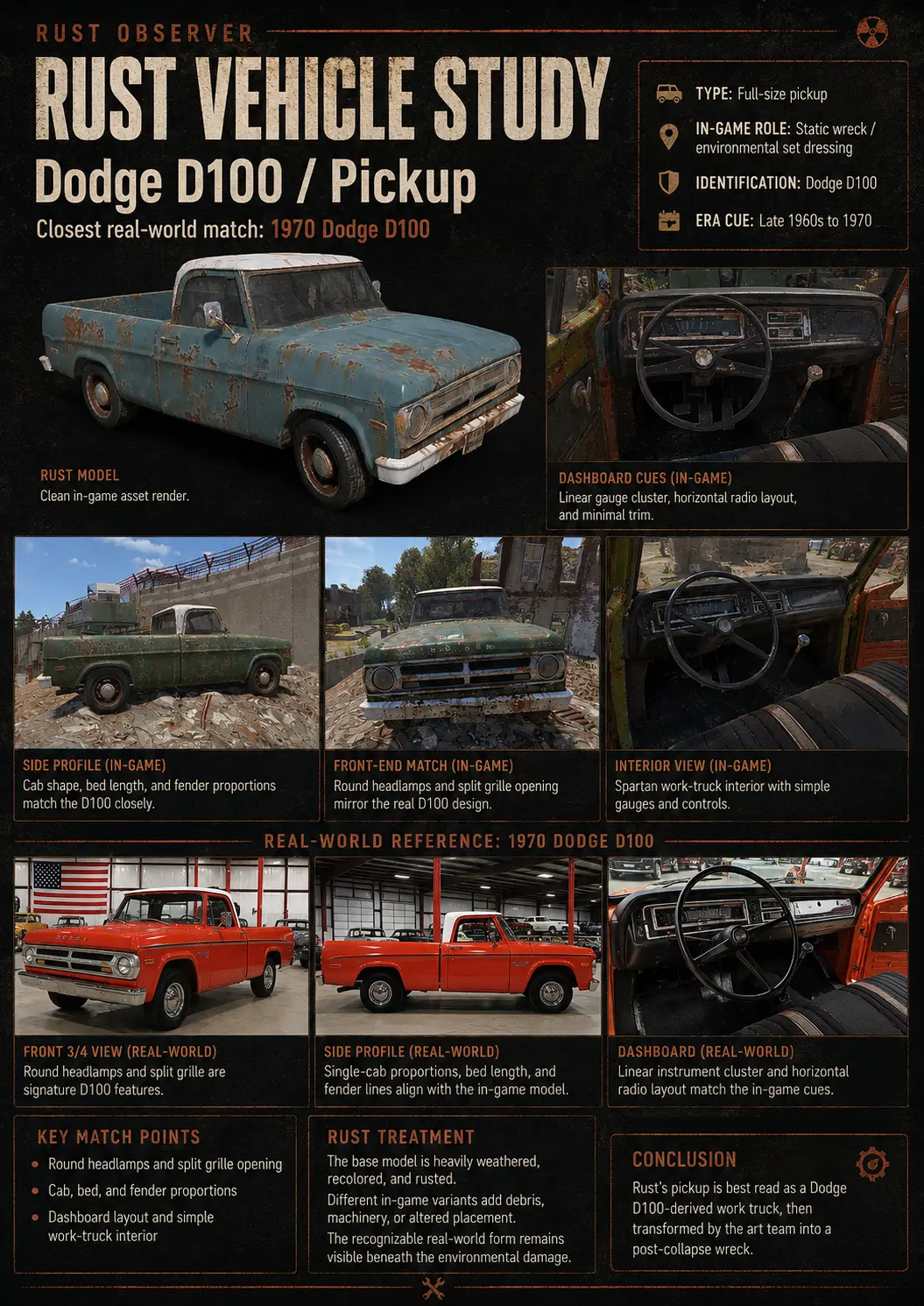
The Rust pickup strongly recalls the late-1960s / early-1970s Dodge D100 family. The round headlamps, split grille opening, squared hood, simple single-cab body, bed proportions, and plain work-truck stance all fit the D-Series vocabulary.
The Dodge D-Series second generation ran through the late 1960s into the early 1970s, with important grille changes around 1968 and 1970. The 1968 models received a new grille with two rows of openings, while the 1970 models moved toward a four-section grille arrangement. (Wikipedia) Dodge’s 1970 pickup brochure also documents the D100 as part of the pickup lineup, reinforcing the work-truck context of this family. (xr793.com)
This vehicle carries a different kind of cultural memory.
The Crown Victoria has institutional identity.
The Pinto has a famous horror set-piece.
The G-10 has the Mystery Machine.
The D100 is not remembered because it became one single universal icon.
It is remembered because it was everywhere.
This type of pickup appeared on farms, in yards, around garages, on construction sites, in small businesses, on back roads, in border regions, in Mexican and Californian visual culture, and across countless modest productions because trucks like it were common, durable, believable, and easy to cast.
It is the screen extra of road life.
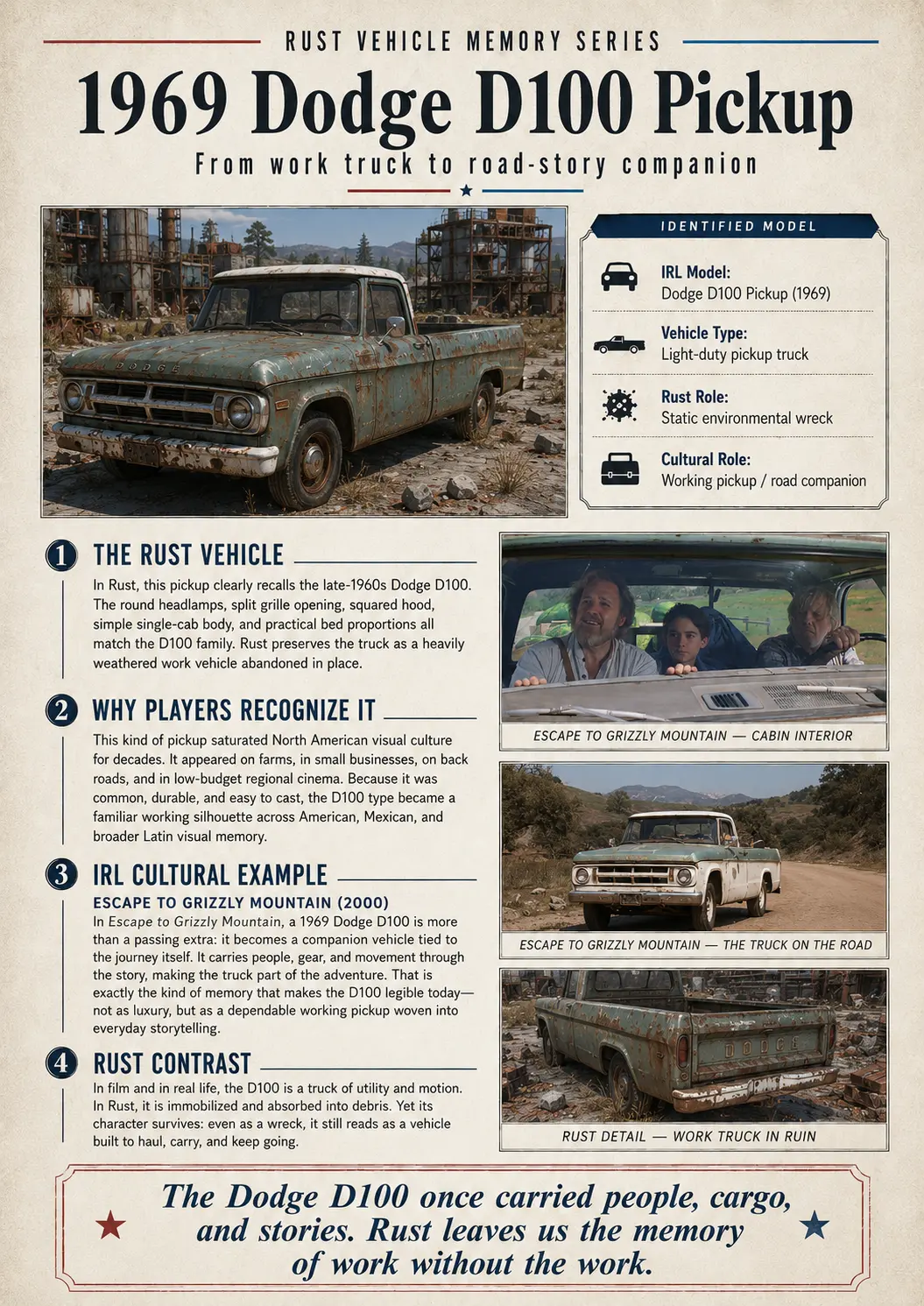
The cultural example selected here is Escape to Grizzly Mountain.
Public film databases describe Escape to Grizzly Mountain as an adventure/family film involving a boy, a bear cub, a mountain cave, and a time-travel adventure, with Dan Haggerty, Miko Hughes, and Jan-Michael Vincent among the cast. (Rotten Tomatoes) The exact Dodge D100 identification in this article is based on visual comparison with the film stills and the D-Series features visible on the truck, not on a public IMCDB vehicle page found during this search.
That honesty matters.
But the example still works beautifully because the truck is not just a passing vehicle. The film spends time with it. Characters sit inside the cab. The truck moves through rural roads. Its bed carries objects and action. It becomes a companion vehicle tied to the journey.
That is the D100’s cultural strength.
It does not need to be glamorous. It needs to feel useful.
Rust understands this.
The pickup is often placed where work has died: rubble piles, broken roads, industrial ruins, abandoned towns, and improvised monument spaces. It can be recolored, rusted, loaded with debris, fitted with machinery, or half buried. But it still reads as a work vehicle. Its dead form continues to say: haul, carry, repair, move, build, survive.
In Rust, the work is gone.
But the truck still remembers it.
Conclusion — Rust Does Not Just Place Wrecks. It Places Dead Roles.
These four vehicles are not random junk.
They are recognizable because they already lived in collective memory before Rust killed them.
The Crown Victoria was a patrol car, fleet car, taxi-shaped institution.
The Pinto was ordinary private mobility, later transformed by cinema into a trap.
The G-10 was a work van that popular culture turned into a mobile room for youth, friendship, and escape.
The D100 was the background workhorse of roads, towns, farms, and film sets.
Rust turns all four into archaeology.
Not museum archaeology.
Playable archaeology.
The sedan becomes dead authority.
The Pinto becomes dead private movement.
The van becomes dead travel, but living shelter.
The pickup becomes dead labor, still readable as work.
This is why Rust’s vehicle props feel stronger than simple decoration. They do not only fill space. They bring old roles into the island and let decay finish the sentence.
The roads are not full of cars.
They are full of memories that stopped moving.
Reference URLs / source notes
Ford LTD Crown Victoria / Crown section
Ford LTD Crown Victoria model history and 1988 update: (Wikipedia)
1988 Ford LTD Crown Victoria in The New Adam-12: (IMCDb.org)
The New Adam-12 series page and production notes: (IMCDb.org)
Ford Pinto / Cujo section
Ford Pinto overview and production range: (Wikipedia)
1978 Ford Pinto Runabout in Cujo: (IMCDb.org)
IMCDB Cujo vehicle page comment about the Pinto as attack-sequence setting: (IMCDb.org)
Schmit Bros article on the Ford Pinto in Cujo: (schmitbrosauto.com)
Chevrolet G-10 / Mystery Machine section
1965 Chevrolet Van brochure, window options: (xr793.com)
Chevrolet Van / G-Series overview and Sportvan context: (Wikipedia)
Original Scooby-Doo, Where Are You! Mystery Machine identified as Chevrolet Chevy Van [G-10]: (IMCDb.org)
Live-action Scooby-Doo 2 Mystery Machine customization note: (IMCDb.org)
Dodge D100 / Pickup section
Dodge D-Series history and 1968–1971 grille context: (Wikipedia)
Classic Industries Dodge D/W Series history, including 1968 and 1970 grille changes: (news.classicindustries.com)
1970 Dodge Pickups and Stakes brochure: (xr793.com)
Escape to Grizzly Mountain film overview / cast / premise: (Rotten Tomatoes)