Props #2 — Quarries, Pumpjacks, Water Wells and the Bandit Connection
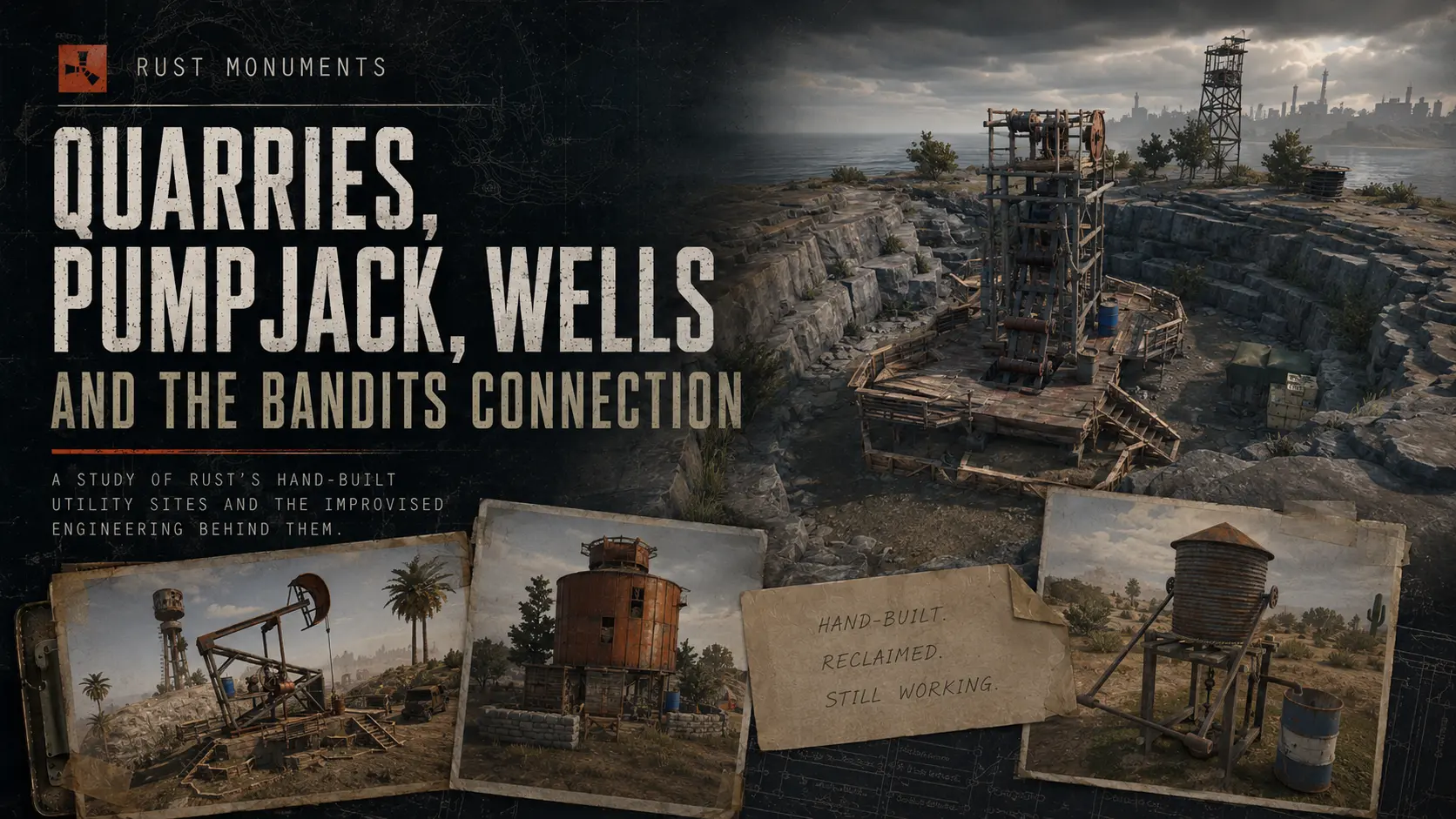
Quarries, Pumpjacks and Water Wells reveal a hidden Bandit connection in Rust: a survivor-built utility layer of water, fuel and extraction.
Not an IRL Connection, but still a Connection
Most Rust Observer monument articles look for an IRL connection: a building, a structure, a facility, a landscape, or a historical reference that helps explain why the monument looks the way it does.
This article is different.
The Quarries, Pumpjacks and Water Wells do not point toward one clear real-world landmark. Their real-world references are mostly fragments: bucket elevators, pumpjacks, wells, tanks, silos, barrels, sheet metal, motors, wooden frames and industrial leftovers.
Their connection is not geographic.
It is factional.
These small utility sites appear connected to the Bandit layer of the island: survivor-built, technically improvised, accessible, functional, and made from recovered materials.
Why These Sites Belong Together
These are not monuments of prestige. They are service points.
They provide:
- water;
- stone;
- sulfur;
- high quality metal;
- oil;
- fuel.
They are easy to overlook because they do not dominate the skyline. But they matter because they keep the island usable.
Unlike the large military/scientific monuments, they are not heavily guarded, sealed, or presented as official assets. They are open. They are available. They wait for players to use them.
That availability is the first Bandit clue.
The Material Language of the Bandits
Across these utility sites, the same visual grammar returns:
rough planks, rusted sheet metal, reused tanks, barrels, silos, concrete slabs, exposed mechanisms, patched shelters and broken industrial parts.
To understand the look of these machines, they should be read alongside the broader Bandit style explored in Bandit Camp and the Bayou Connection. The same rough planks, rusted metal, patched structures and salvaged industrial parts appear there at settlement scale. Here, that language is reduced to utility: water, fuel and extraction.
This is not primitive construction. It is salvage engineering.
The Bandits do not build like people who know nothing. They build like people who know exactly what to keep.
Low-value materials become shelters, platforms, walls and frames. High-value technologies become shop inventory, weapons, electrical systems, agriculture tools, mechanical parts and services.
This suggests selective scavenging rather than random looting.
Selective Scavenging — The Missing Debris Problem
Many older monuments look damaged, abandoned or partially destroyed, but often lack the amount of loose debris we would expect.
One possible reading: the ruins were harvested.
Useful pieces were removed and reused elsewhere. Heavy concrete, broken foundations and useless rubble stayed behind. Planks, metal sheets, doors, tanks, barrels, machine parts and intact industrial fragments were carried into forests, swamps, service sites and Bandit locations.
The island was not only damaged. It was stripped.
Water Wells — Rebuilt Access to Water
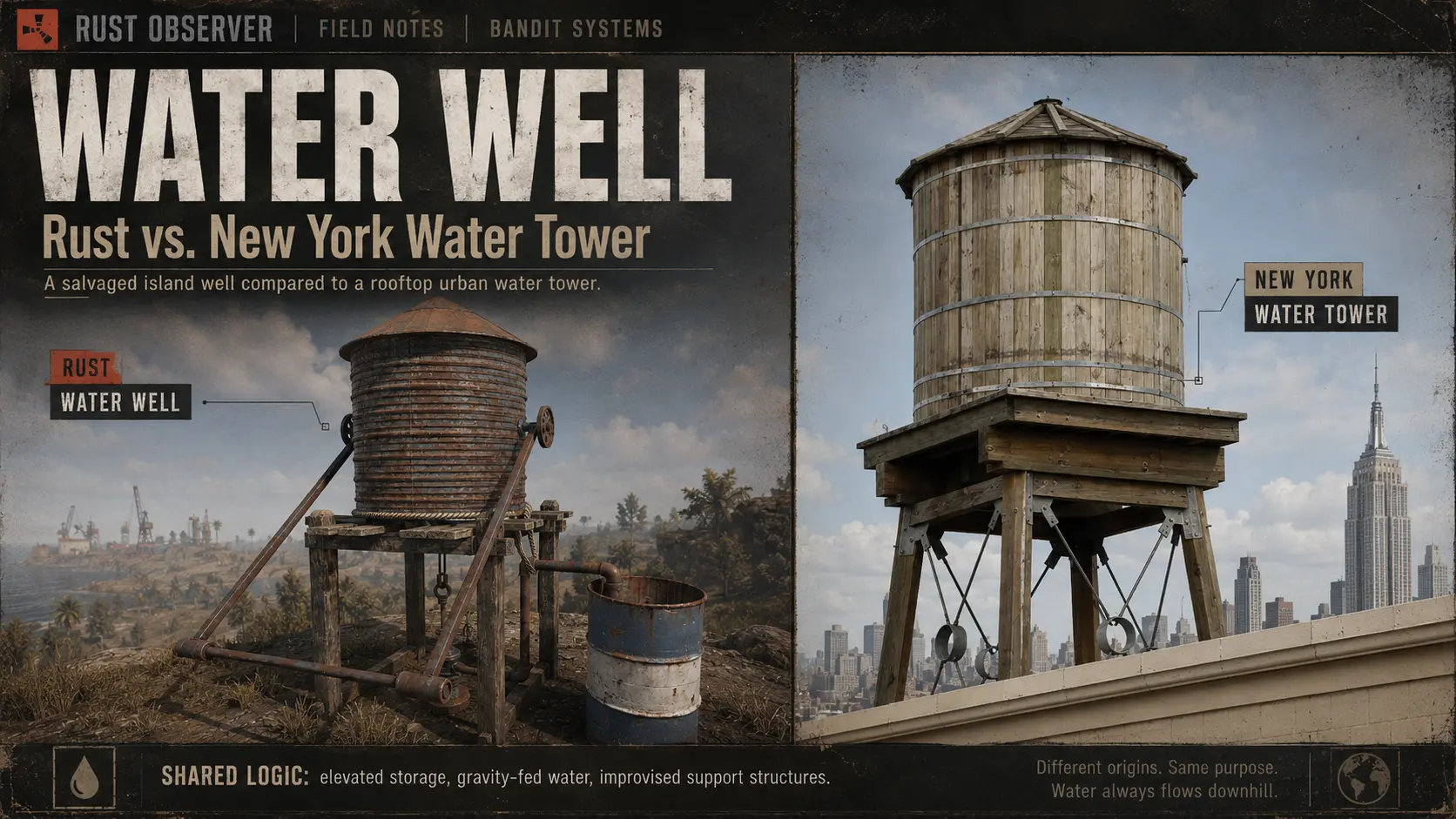
The Water Wells are the clearest service sites in this group.
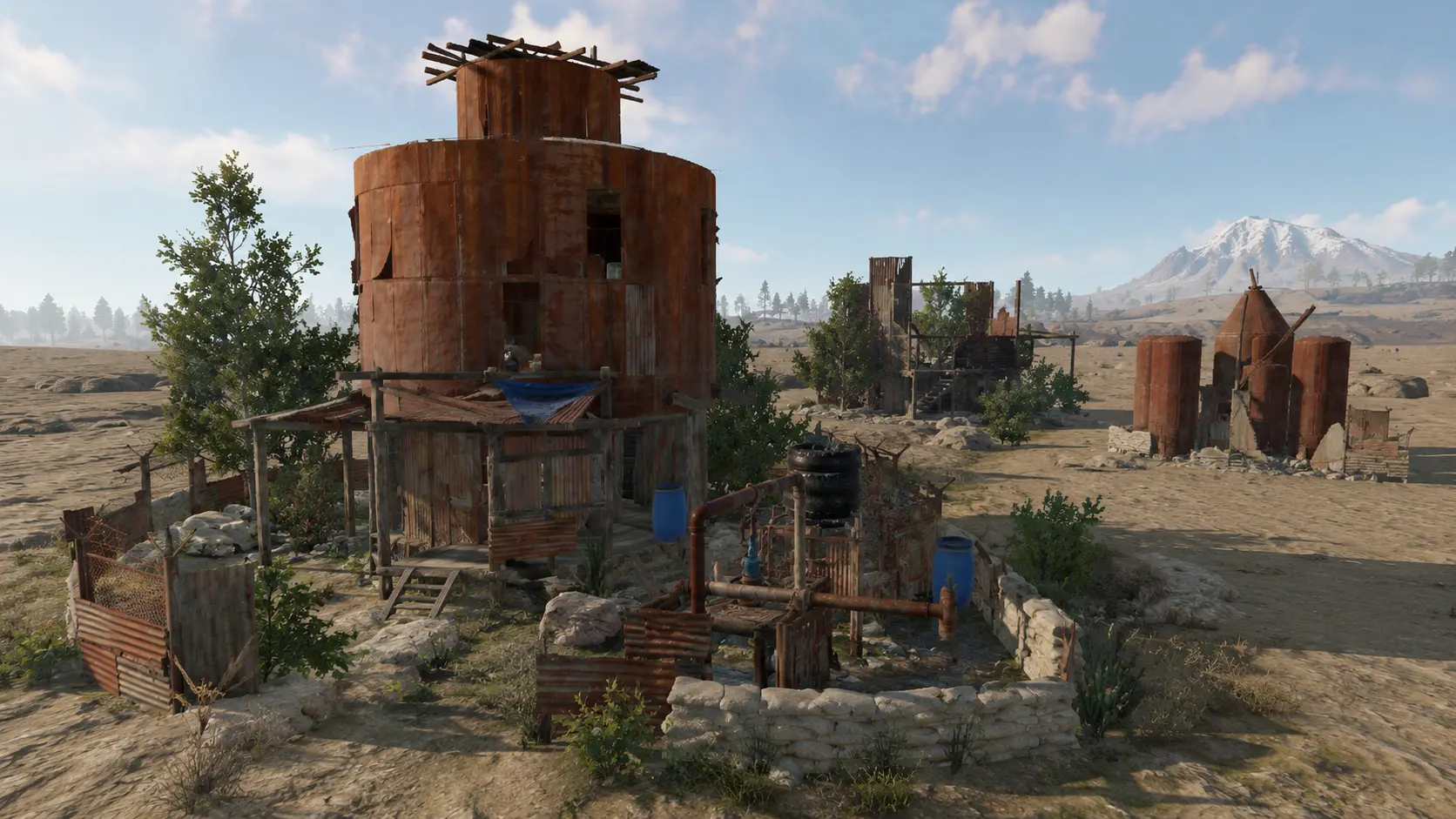
They are scattered in the landscape, not protected by scientists, and built from recovered materials. They do not all share one clean design. Each one looks like a local solution built from whatever could be reused.
The five Water Wells can be described as variations on the same need:
- one built around rusted silos;
- one built from a demolished and patched structure;
- one using the fallen head of a water tower;
- two built more like tree cabins or small survivor shelters.
The official development wording is important here. In Devblog 194, Vincent described the Water Well Mini Monuments as having a “player-made look,” placed inside decayed and overgrown player-base lookalikes or repurposed landmarks. He also explained that the work combined player deployables with existing landmark art.
That wording does not prove that the Bandits built every Water Well. But it does confirm the visual direction: these sites were intentionally designed to look improvised, reused, local and survivor-made. A better reading is therefore not clean infrastructure, but rebuilt access to water — functional, scavenged, and close to the Bandit layer of the island.
Quarries — Field Extraction, Not Industrial Prestige
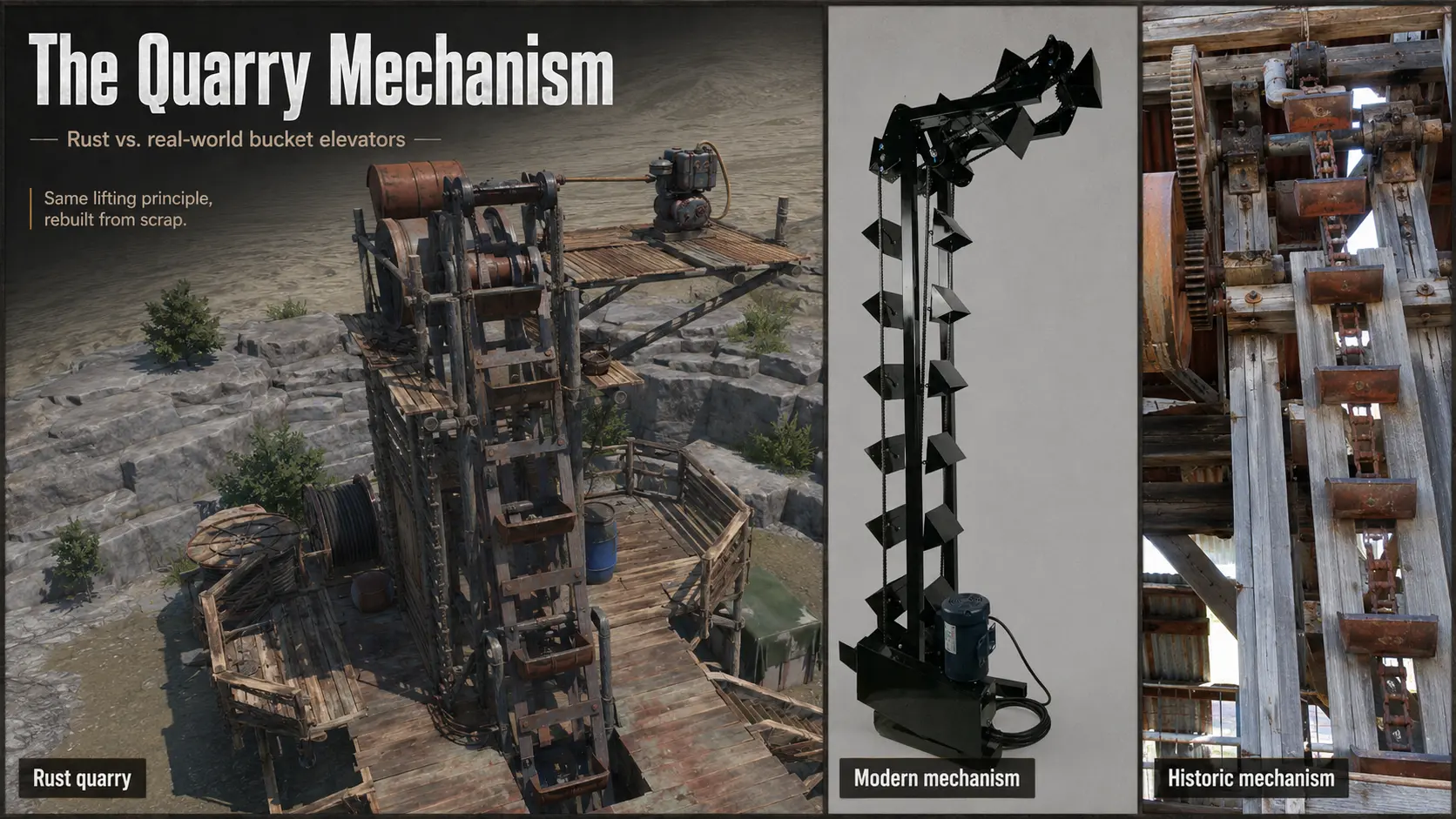
The Quarries are not complete real-world quarry complexes. They do not show a full mining operation, crusher system, conveyor network or industrial processing site.
They show a function.
The visible machine is best read as a belt bucket elevator or vertical bucket conveyor: a simple material-handling system that lifts broken material upward into a receiving bucket or hopper.
The site is the Quarry.
The machine is the bucket elevator.
Its rough wooden frame, exposed motor, pulley system and reused container-like buckets make it feel hand-built, but not ignorant. It looks like someone understood the principle and rebuilt it with island salvage.
Pumpjacks — A Real Principle Rebuilt in Rust’s Scrap Language
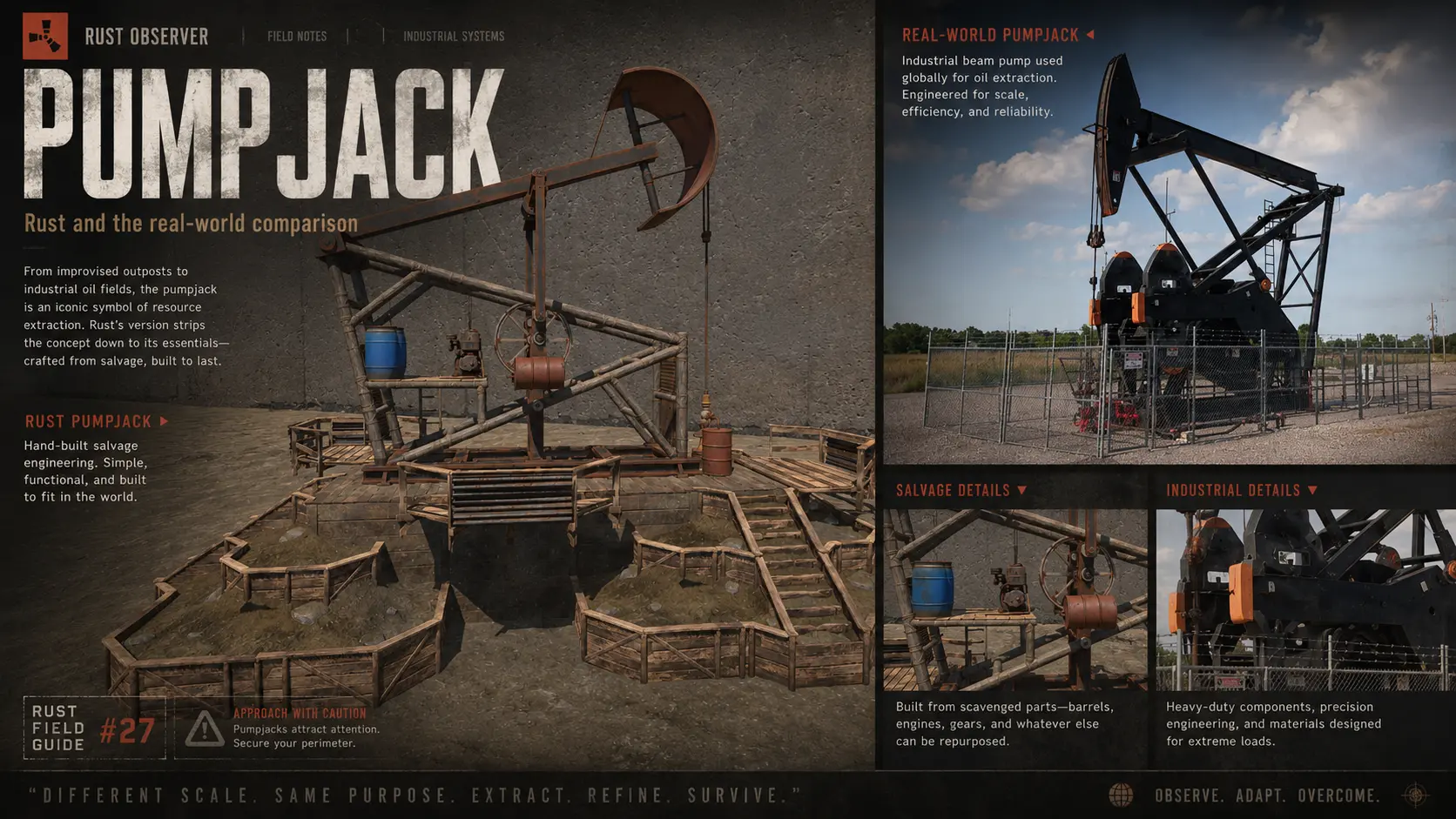
The Pumpjack has the clearest real mechanical family: it belongs to the world of beam pumps and pumpjacks.
But Rust’s version does not feel like a clean industrial installation. It feels like the principle of a pumpjack rebuilt with rough materials, exposed supports, barrels, improvised counterweights and a survival-world construction style.
It is also different from the Quarries in placement.
Quarries stand alone in the landscape as field utilities. Pumpjacks are embedded inside larger technological monuments such as Power Plant, Train Yard and Water Treatment. That suggests inherited or repurposed industrial extraction rather than standalone Bandit territory.
Pump Jack — A Visible Team Effort
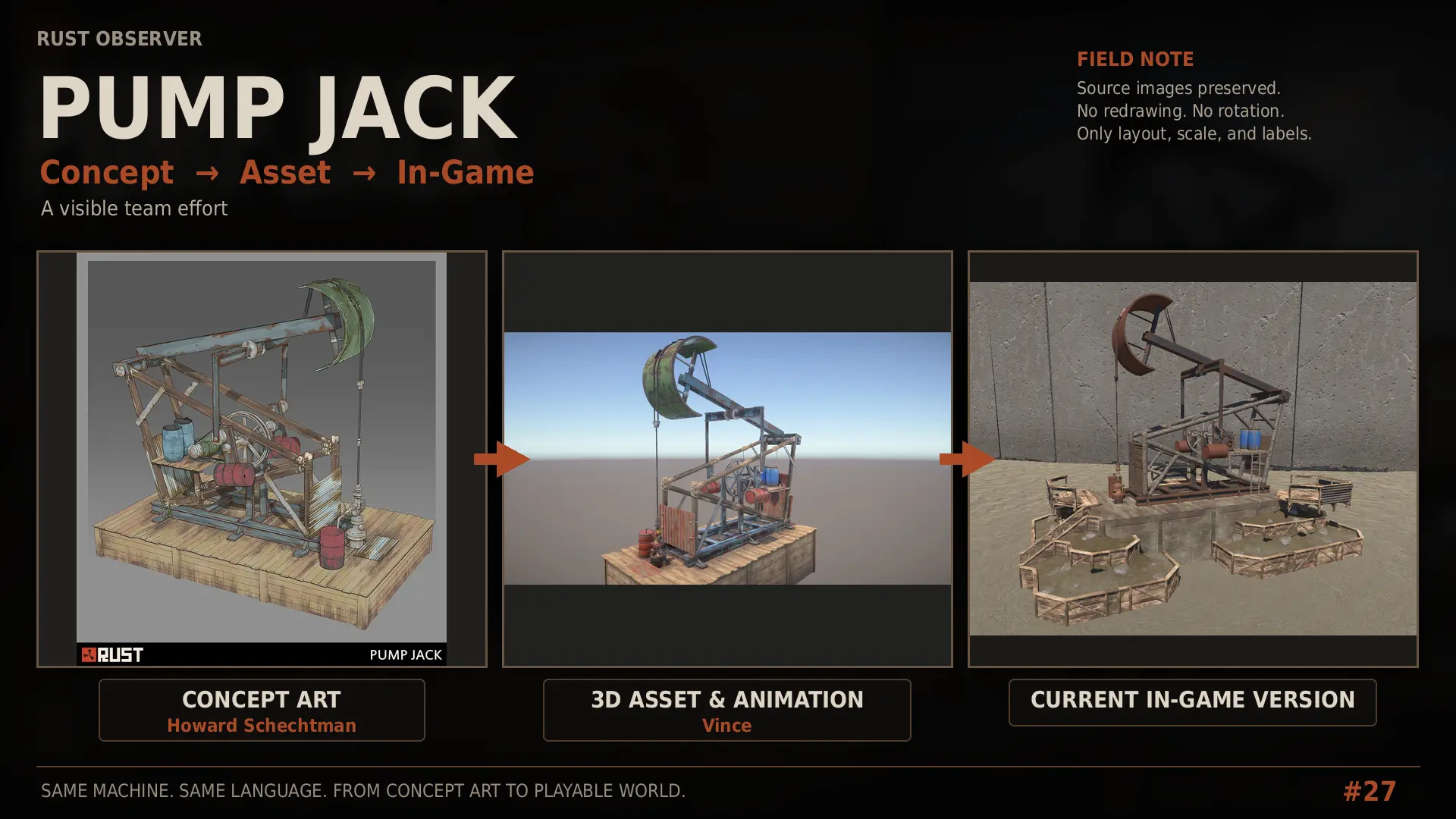
The Pump Jack also gives a rare look at Rust’s production chain.
Howard Schechtman’s concept art established the machine’s improvised industrial language: the rough wooden platform, the exposed frame, the barrels, the rope lashings, the patched sheet metal, and the strange crescent-shaped head. Vince then brought that machine into 3D and animation, preserving most of the concept’s visual details rather than replacing them with a cleaner industrial asset.
At the same time, the gameplay side was turning these machines into working extraction systems. The Pump Jack was not just a prop. It became a playable machine, tied to oil discovery, fuel use, crude oil and refining.
That makes it one of the clearest examples of teamwork visible in the final world: concept art, 3D production, animation and gameplay implementation all converging into the same rough machine.
Why the Bandits Would Leave Them Open
If these sites are connected to the Bandit layer, one question matters:
Why leave them available?
Because the Bandits do not behave like ordinary thieves. Ordinary bandits steal resources from infrastructure. Rust’s Bandits appear to maintain infrastructure that others can use.
Water Wells, Quarries and Pumpjacks help players progress. They provide water, resources and fuel. They keep subjects moving through the island’s survival economy.
This does not make the Bandits generous. It makes them strategic.
They may be observing, supporting or developing useful subjects.
Development Note — From Player Machines to Public Utilities
The development history of these sites helps explain why they feel different from Rust’s larger official monuments.
Quarries and Pumpjacks began much closer to player tools than to fixed monuments. In mid-2015, the Mining Quarry and Pump Jack were part of an extraction loop based on survey charges, resource discovery, fuel, crude oil and refining. In that early form, extraction was not only something the map provided. It was something players could build, fuel, defend and operate.
Only a few weeks later, in August 2015, Rust added public utilities around the map. This is the important transition: resource extraction began moving from purely player-owned equipment toward shared map infrastructure. The same basic function — extracting useful material from the island — was no longer limited to private machines.
Water Wells belong to a later layer of that evolution. In early 2018, they were introduced as mini-monuments, not player deployables. Their official development notes describe them as player-made-looking sites placed inside decayed bases or repurposed landmarks.
A much later update, in late 2024, made Water Wells more active by adding vendor NPCs, farming items and rotating stock. These vendors are unusual because they exist outside safe zones and can be killed. That detail matters. Water Wells are not protected civic centers like Outpost, and they are not scientist-controlled monuments. They remain exposed, practical, low-authority service points.
This does not prove a direct Bandit ownership label. But it strengthens the article’s reading: Quarries, Pumpjacks and Water Wells belong to Rust’s improvised utility layer — a space between player machinery, public infrastructure, scavenged settlement and Bandit-style survival engineering.
Conclusion — The Bandit Connection
The Quarries, Pumpjacks and Water Wells do not connect Rust to one real-world monument.
They connect Rust to one of the island’s hidden systems.
They suggest a survivor network with technical knowledge, selective scavenging, practical engineering and a reason to leave useful infrastructure available. The dev history reinforces that reading: these sites grew out of player machines, public utilities and intentionally improvised mini-monuments.
These sites are not spectacular, but they are important because they show what happened after the official systems failed.
The military and scientists built facilities.
The Bandits kept the island usable.
References
Howard Schechtman — Rust – Pump Jack
https://howie.artstation.com/projects/EvWG4
Official concept art for Rust’s Pump Jack by Howard Schechtman. Used here to document the visual origin of the machine: wooden platform, exposed frame, barrels, patched metal, rope lashings and improvised industrial silhouette.
Facepunch — Devblog 64
https://rust.facepunch.com/news/devblog-64
Development note where Vince says he finished the oil jack pump and its animations. Also useful because Maurino discusses the Mining Quarry implementation and the upcoming pumpjack as the second mineral extractor.
Facepunch — Devblog 70
https://rust.facepunch.com/news/devblog-70
Update where the Pump Jack is added to the game. It confirms the early gameplay loop: survey charges, oil detection, low grade fuel, crude oil extraction and refining.
Facepunch — Devblog 72
https://rust.facepunch.com/news/devblog-72
Important for the transition from player-owned extraction machines to public utilities. The update introduces public utilities, including public quarries, to help players access resources without depending only on private deployable machines.
Facepunch — Devblog 194
https://rust.facepunch.com/news/devblog-194
Key source for the Water Well mini-monuments. Vincent describes them as having a player-made look, placed inside decayed and overgrown player-base lookalikes or repurposed landmarks, and built by combining player deployables with existing landmark art.
Facepunch — Devblog 195
https://rust.facepunch.com/news/devblog-195
Follow-up development note on Water Well monuments. Useful as part of the short development sequence showing the Water Wells being expanded before final implementation.
Facepunch — Devblog 196
https://rust.facepunch.com/news/devblog-196
Confirms that the Water Well monuments are finally in game. Also explains the working pump interaction, water yield, calorie cost, and placement in temperate forests and arid biomes.
Facepunch — World Update 2.0
https://rust.facepunch.com/news/world_update_2
Modern update that makes Water Wells more active by adding vendor NPCs at some Water Wells, with rotating stock related to teas and farming equipment.
Facepunch — Armed and Animated
https://rust.facepunch.com/news/armed-and-animated
Follow-up update confirming that vendor NPCs were added to all Water Well variants, and that every Water Well variant now has a killable vendor.