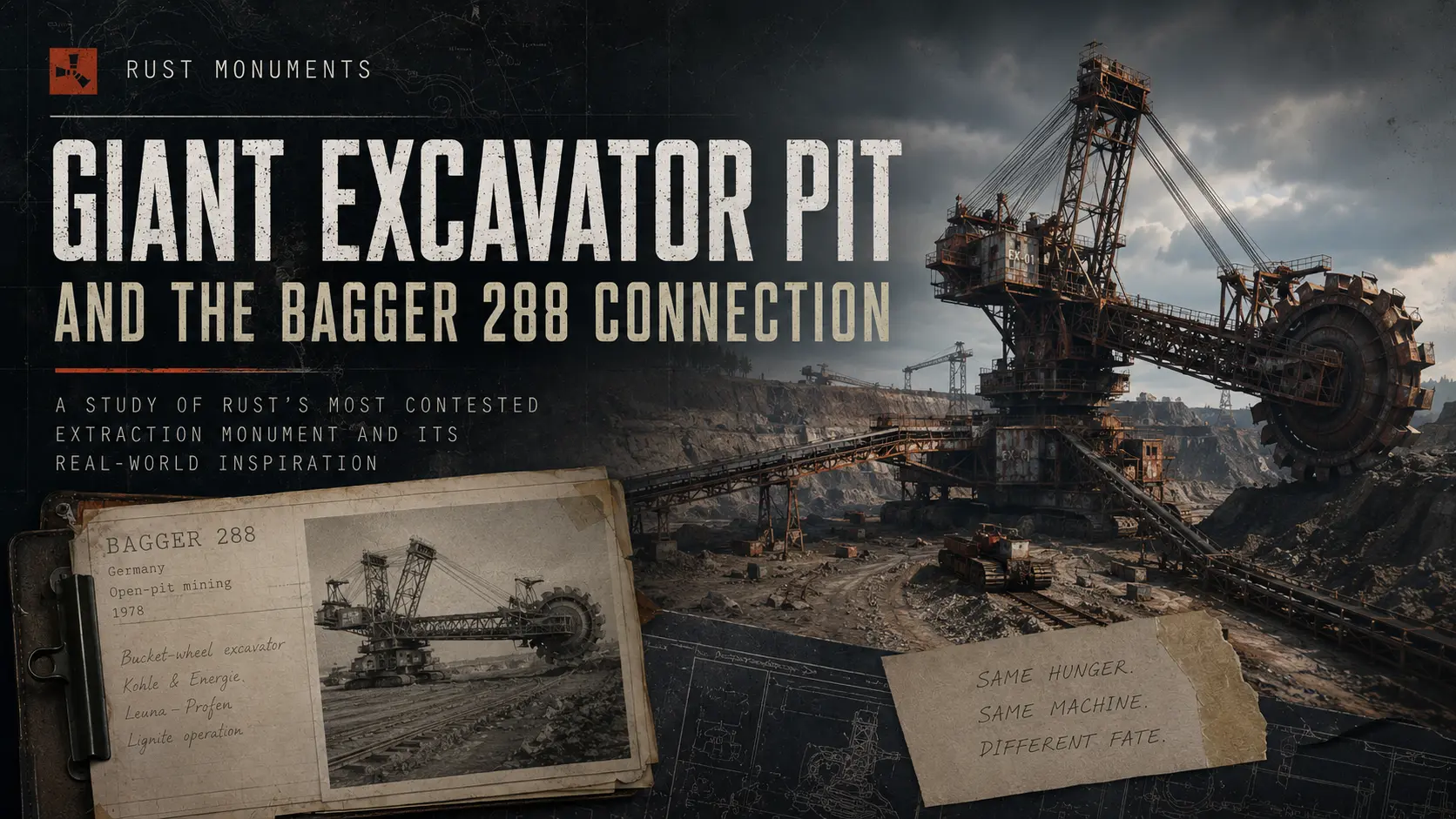
Giant Excavator Pit and the Bagger 288 Connection
Giant Excavator Pit is Rust’s broken Bagger: a Cold War-inspired industrial monument, PvP trap, resource machine, and possible failed copy of the Bagger 288.
Giant Excavator Pit: Rust’s Broken Bagger
Giant Excavator Pit is one of Rust’s strangest large monuments. From a distance, it looks vertical: a massive industrial machine rising above the terrain, with steel arms, cables, towers, and a bucket wheel large enough to make the player feel ridiculous. But in gameplay terms, it is one of Rust’s great flat monuments.
The playable space spreads outward. The pit, the conveyor lines, the rail access, the open yard, the height positions, and the two resource outputs all turn the monument into a wide industrial arena. It is not a building to clear room by room. It is a machine-site to occupy, defend, and contest.
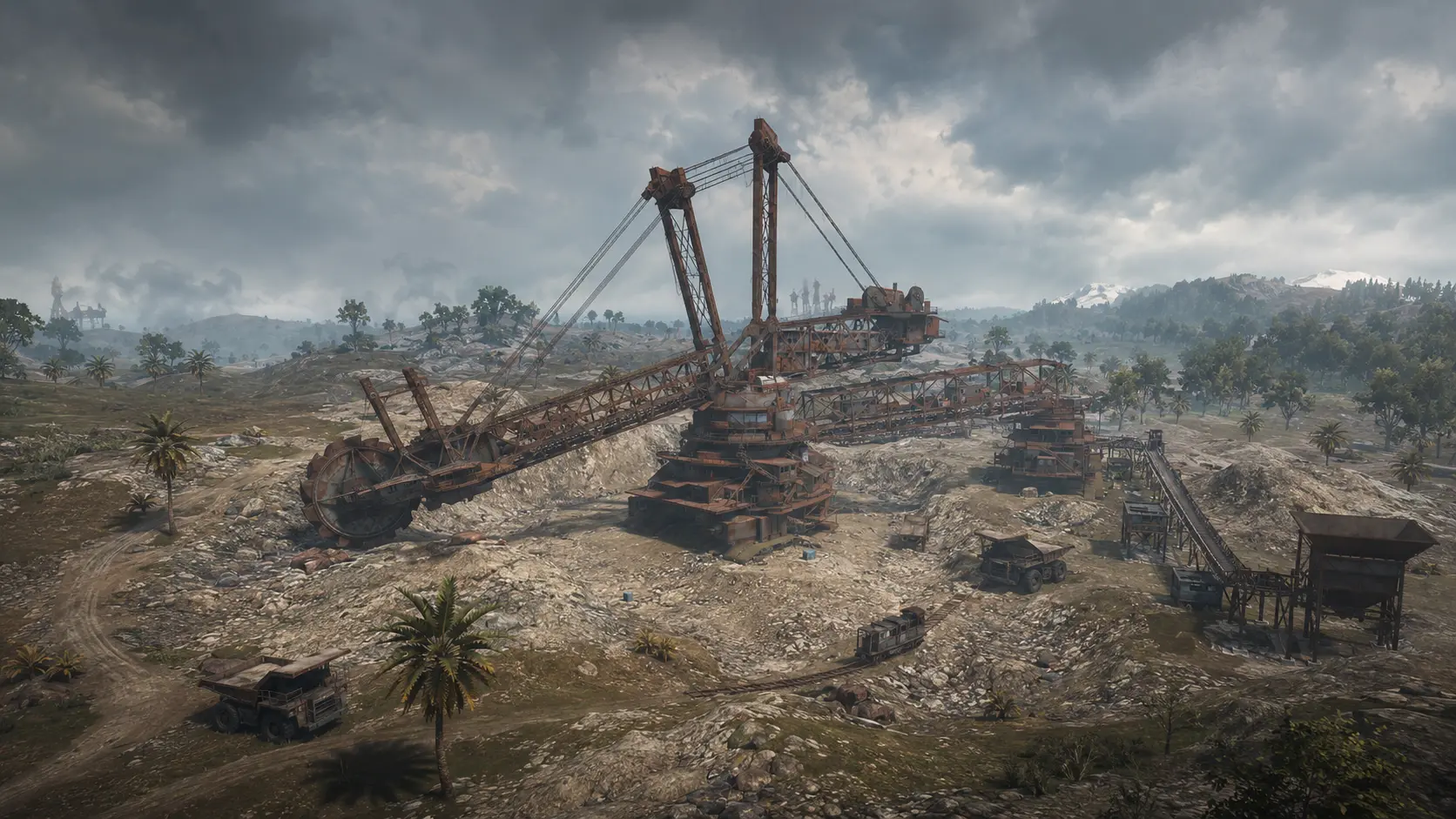
The development history of the Giant Excavator confirms that this was never treated as an ordinary monument. In March 2019, Vincent Mayeur presented it as the “next big thing” after the Oil Rigs and shared early development screenshots of the machine. By August, Facepunch introduced it as more than a static prop: a Diesel-powered mining excavator that players had to clear, start, operate, and defend. Later, in December 2021, the monument was reworked because its sheer scale consumed too much playable space on some map seeds. That sequence matters. The Giant Excavator was not only built as a large object; it became a long-running negotiation between spectacle, gameplay, terrain, and performance.
A Bagger 288 shadow
The real-world inspiration is hard to miss. Giant Excavator Pit appears to be based on the German Bagger family of bucket-wheel excavators: huge open-pit mining machines built to remove enormous quantities of overburden and lignite.
The internet often points to Bagger 293 because it is the later record-holder and one of the most famous “largest land vehicle” examples. But for Rust’s Cold War reading, Bagger 288 is the stronger anchor.
Bagger 288 belongs to the right era. It was put into service in 1978, at a time when industrial megaprojects, nuclear infrastructure, missile systems, deep bunkers, and state-scale engineering still shared the same Cold War imagination. Rust’s island does not feel like it was originally built in the 1990s. It feels like a place whose deepest industrial and military layer began earlier, then collapsed, was reused, and was later recaptured.
So the safest reading is this:
Giant Excavator Pit is not a one-to-one copy of Bagger 288, Bagger 291, or Bagger 293. It is Rust’s edited version of that family of machines, with Bagger 288 standing out as the best historical and visual reference.
Before the Monster Was Buried
Vincent Mayeur removes any doubt about the source of the monument: Rust’s Giant Excavator was based on Bagger 288. But that direct attribution does not make comparison less useful. It changes the question. The question is no longer whether Rust’s excavator resembles Bagger 288. The question is what had to change when a mobile mega-machine became a fixed Rust monument.
The March 2019 development screenshots are some of the most important images attached to the Giant Excavator because they show the monument before its final atmosphere was applied. At this stage, the machine is still mostly grey, raw, and exposed. The final rust, dirt, material language, and environmental dressing are not yet doing the visual work. What remains visible is the harder problem: scale.
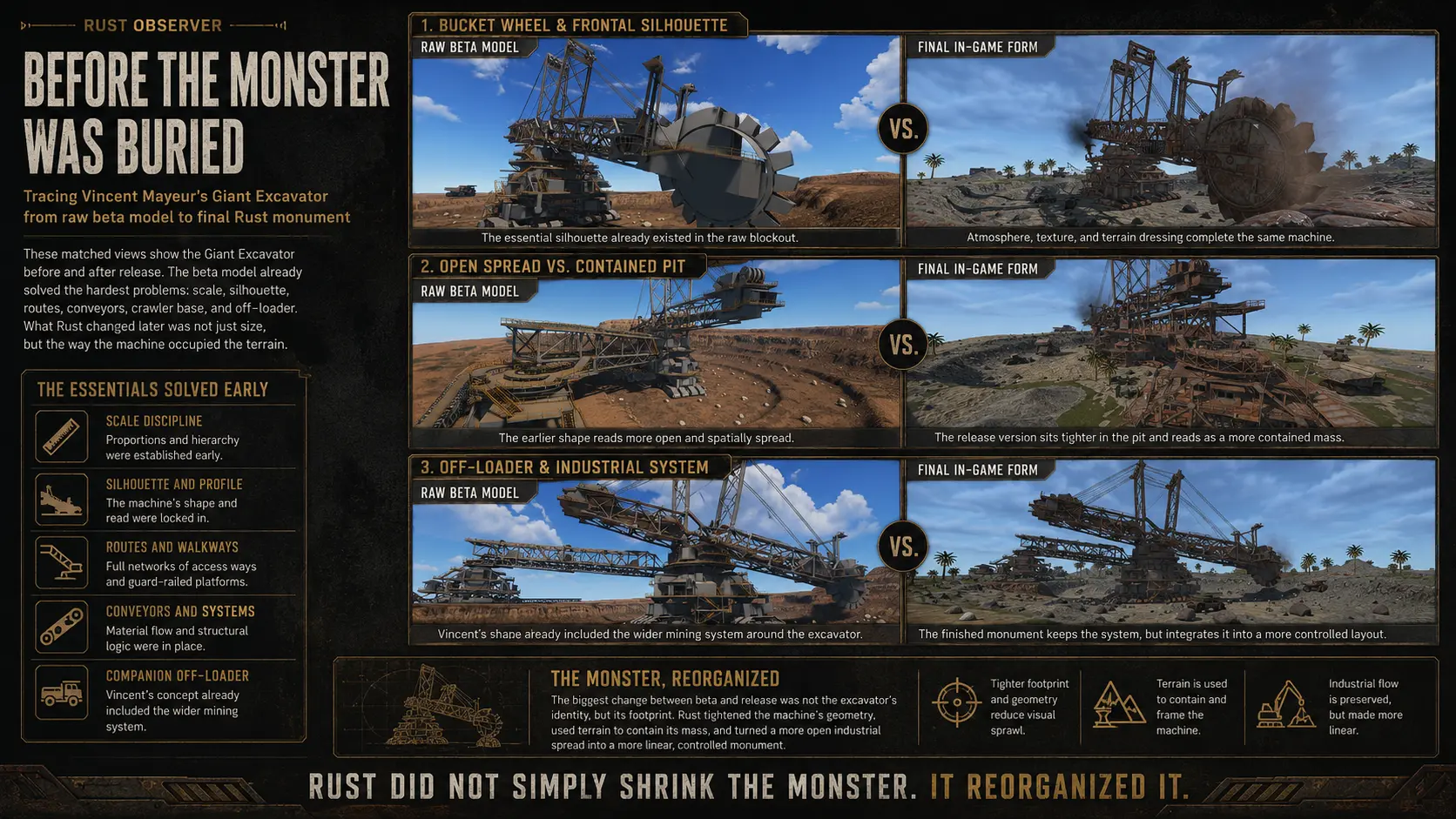
The matched beta and final views show that the Excavator’s evolution was not only a matter of surface dressing. The raw model already contained the machine’s identity; the release version changed how that identity occupied the terrain.
Vincent’s early model already contains the essential body of the monument. The bucket wheel, long boom, cable towers, crawler base, walkways, stair systems, conveyor arms, and companion off-loader are already organized into a coherent industrial structure. This was not simply a matter of placing a large machine in Rust. A bucket-wheel excavator is almost too large for a survival map. If it is scaled down too much, it becomes a toy. If it remains too faithful to its real-world proportions, it starts to devour the playable world around it.
This is where the early images become more than development curiosities. They show the moment where Bagger 288 was being translated into Rust’s language: not as a moving machine, but as a monument that players could enter, climb, activate, defend, and raid. The raw beta model already solves the most important questions. The machine has a readable silhouette from far away. It has human-scale walkways and guardrails. It has routes through its structure. It has conveyors and transfer systems that explain how material moves. It has a crawler base that preserves the memory of mobility, even if the final monument no longer travels across the landscape.
The matched views also reveal that the change was not only about texture or atmosphere. The early version appears more open in shape, with parts of the structure spreading more aggressively around the central body. In some views, the monument almost reads like an X laid across the terrain, with booms, conveyors, platforms, and support structures radiating from the core. The final monument is more disciplined. It becomes more linear, more contained, and easier to frame inside the pit.
That difference matters. The Giant Excavator’s footprint was not reduced only by making it smaller. Its spatial logic was tightened. The beta version spreads more broadly into the surrounding terrain, while the released version channels more of the machine into a straighter, more controlled layout. Rust did not simply shrink the monster. It reorganized it.
The tragedy of the Giant Excavator is that it was never meant to be modest. A bucket-wheel excavator is a landscape-eating machine, a moving horizon of steel, noise, dust, and exposed industrial violence. It should be seen across the island before it is reached, and heard before it is seen. But Rust had to tame the monster.
The final monument hides much of its mass inside the pit. Terrain controls what the player sees, when they see it, and how much of the machine the world must carry at once. From a distance, the Excavator still has its iconic profile: the wheel, the boom, the cable towers, the off-loader, and the industrial body remain recognizable. Up close, it still works as a playable space. But its mass has been contained by the landscape.
This makes the Giant Excavator one of Rust’s hardest environmental compromises. A bunker, a train yard, or a compact industrial building can hide complexity behind walls, terrain, or distance. A bucket-wheel excavator cannot. Its identity depends on an enormous open silhouette. The player must understand the machine from far away, navigate it up close, and still believe that it belongs to the world around it.
The final version succeeds because it preserves the industrial logic of the beta model while making it survivable inside Rust. The off-loader remains. The conveyors remain. The crawler base remains. The boom and bucket wheel remain. The monument still feels like a machine that should be moving, even though the island has forced it to stay in one place.
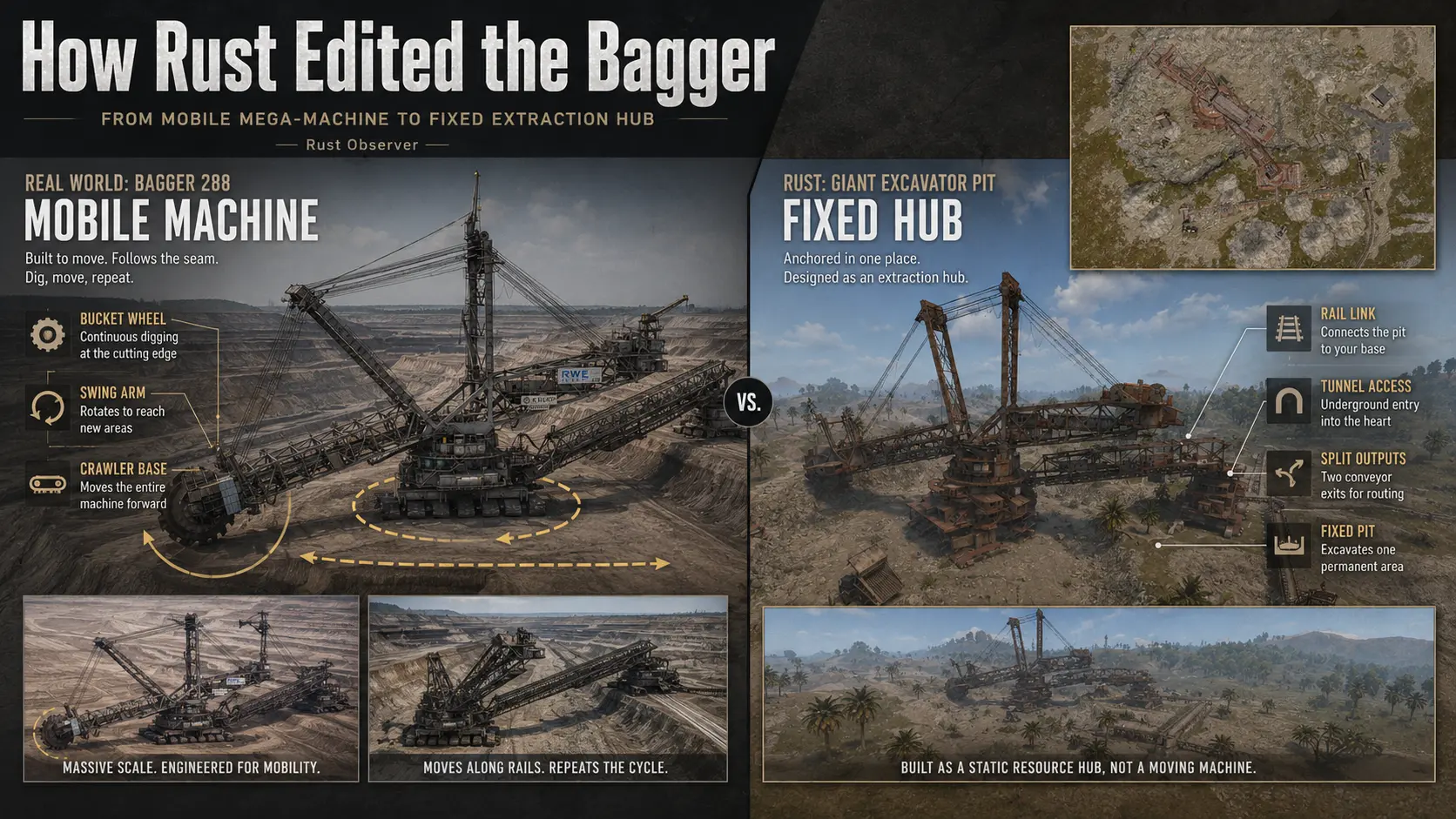
That is the real transformation. The real Bagger 288 was built to move, dig, and repeat the cycle across a mining landscape. Rust’s Giant Excavator was edited into something else: a fixed extraction hub, anchored in a permanent scar, loud enough to attract conflict, but contained enough to fit inside the procedural island.
It is still a monster. It has simply been buried.
Rust edited its version of the Bagger
A real Bagger is not meant to be frozen in one place forever. It is a moving mining machine. It follows the mining front, moves across open-pit terrain, rotates, adjusts its boom, and stays connected to a larger industrial chain.
Rust does the opposite.
The Giant Excavator is locked into the island. It sits in a dedicated pit, beside rail infrastructure and an underground access point. It does not travel to the resource field; the island’s logistics seem to have been built around the machine.
The clearest gameplay edit is the output system. The secondary conveyor does not follow the technical logic of a mobile Bagger. Instead, it cuts across the site and helps split the output into two exposed collection points. That change may not make much sense for a fully mobile mining machine, but it makes perfect sense for Rust.
It turns industrial logistics into PvP.
Players do not defend one comfortable collection point. They have to control the engine, the high ground, the open pit, the conveyor line, and two separated output fronts. The machine is one object, but the monument is too wide to hold casually.
Rust did not simply recreate a Bagger. It turned a Bagger into a conflict machine.

A machine made fixed
This fixed configuration is one of the monument’s most important story clues.
The real Bagger is a beast of movement. It can crawl across terrain on its own tracks, follow a cut, work along a slope, or move through a grid of extraction. It is not like the crawler systems used to move rockets to launch pads. A Bagger is not a transporter carrying something else. It is the working machine itself.
In Rust, however, the Giant Excavator feels like a mobile machine that lost its mobility and was then converted into a permanent extraction hub.
That could simply be a gameplay decision. But visually, the monument gives us room for a stronger interpretation: maybe the island version was never as reliable as the original machines it copied. Maybe it was built from stolen or reverse-engineered plans. Maybe some components were imported, while others were manufactured or repaired locally with lower standards, different materials, or missing expertise.
A Bagger is not just a blueprint. It is an entire industrial ecosystem: foundries, specialized steel, giant bearings, precision gears, massive rotating assemblies, external power, skilled engineers, and constant maintenance. Rust’s island has harbors, rail, military tunnels, oil infrastructure, laboratories, and industrial ruins — but nothing that clearly resembles the heavy manufacturing base needed to build and maintain a Bagger-class machine from scratch.
The island could steal the idea of the Bagger. It could not easily steal the industrial world that made the Bagger possible.
That makes the broken, fixed version more believable. The machine may have worked well enough to dig, but not well enough to remain a true mobile Bagger. Once its movement or rotation system failed, the project would have done what desperate industrial projects always do: keep the useful parts alive. Lock it in place. Add rail. Add a secondary conveyor. Connect it to the underground network. Turn the broken machine into a fixed extraction asset.
The bandit layer
The Excavator also does not look clean.
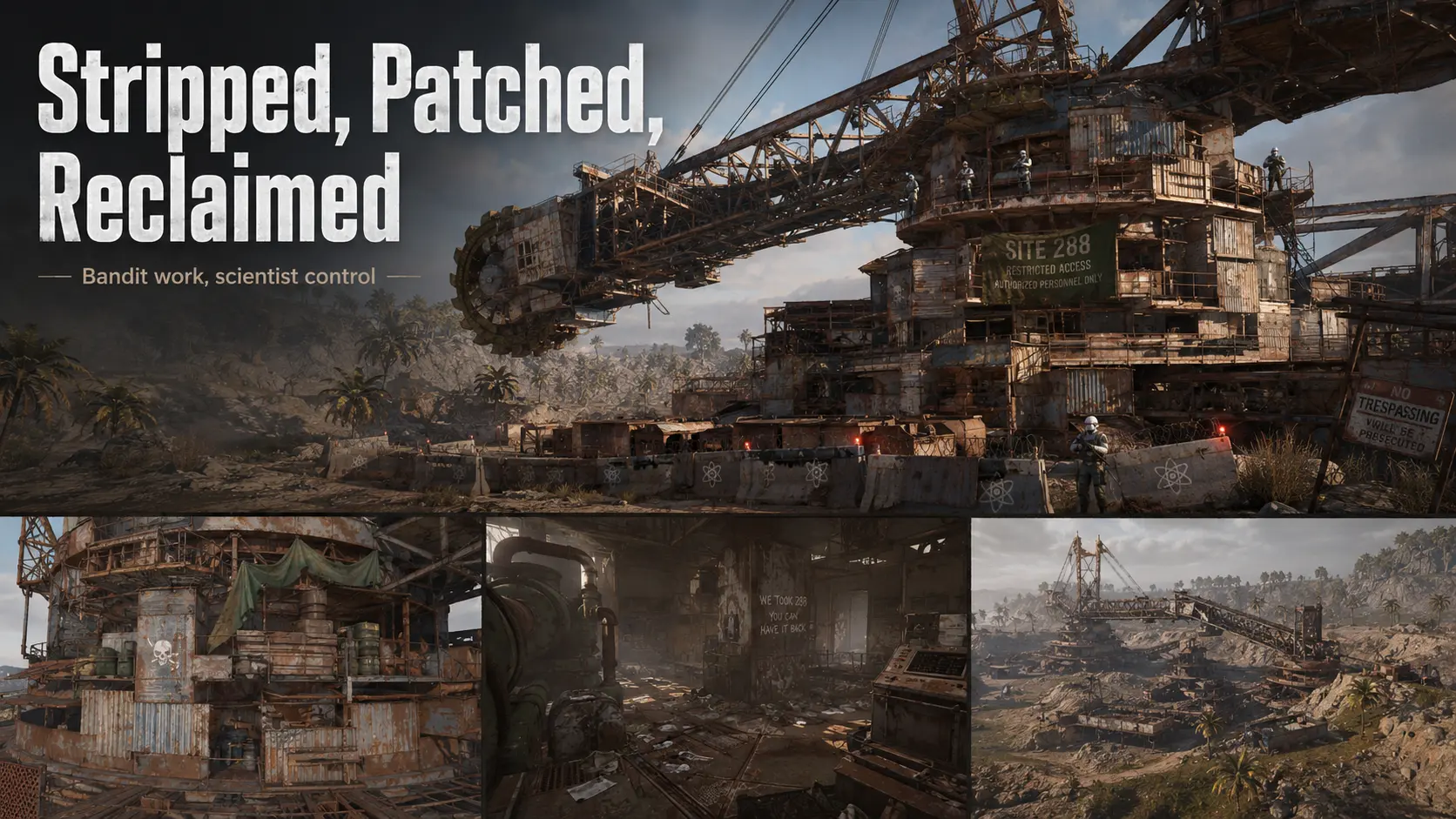
Some parts of the monument feel patched, enclosed, fenced, and modified in a rough way. Corrugated panels, improvised barriers, dirty interiors, rough metalwork, and practical little enclosures do not feel like factory design. They feel like field repairs. In Quebec, we would call that kind of thing “broche à foin”: not elegant, not official, but kept alive because it still has to work.
That visual language feels closer to bandit occupation than scientist engineering.
This suggests another layer in the monument’s life. After the original disaster or collapse on the island, bandits or survivor groups may have occupied the site, patched it, stripped it, and used whatever still functioned. Later, the scientists returned and took back the strategic monuments.
That would explain the current contradiction: the site still looks dirty and improvised, but it is now guarded by scientists.
The lack of signage does not necessarily make the Excavator feel clean or classified. It feels stripped. If bandits occupied the site before the scientists returned, they may have removed anything useful, visible, or valuable. The scientists now guard the machine, but they have not re-established a proper industrial presence on the ground. They reclaimed the asset without restoring its identity.
The scientists did not restore the Excavator. They reclaimed it.
Why the Excavator matters
Giant Excavator Pit is not just valuable because it is big. It is valuable because it concentrates clan-scale resources in one exposed place.
Compared to the smaller quarry and pump jack system, the Excavator offers much higher return per Diesel Fuel for the main building and raid-resource economy. The exact numbers change how we understand the monument: this is not only a cool machine. It is one of the strongest profit traps on the island.
| System | Fuel / time | Output | Why it matters |
|---|---|---|---|
| Giant Excavator — Stone | 1 Diesel / 2 min | 10,000 stone | Massive bulk building output |
| Stone Quarry | 1 Diesel / ~2 min 10 sec | 5,000 stone + 1,000 metal ore | Smaller, quieter, less contested |
| Giant Excavator — Metal | 1 Diesel / 2 min | 5,000 metal fragments | Strong direct industrial output |
| Sulfur Quarry | 1 Diesel / ~2 min 10 sec | 1,000 sulfur ore | Useful, but lower yield |
| Giant Excavator — Sulfur | 1 Diesel / 2 min | 2,000 sulfur ore | Major raid-resource output |
| HQM Quarry | 1 Diesel / ~2 min 10 sec | 50 HQM ore | Valuable, but limited |
| Giant Excavator — HQM | 1 Diesel / 2 min | 100 HQM | High-value clan resource |
This is why the Excavator is not just another resource monument. Quarries generate resources. Giant Excavator Pit generates conflict.
The scientists are not simply guarding an old machine. They are guarding one of the island’s strongest economic baits.
The PvP signal
In Rust’s player culture, starting the Excavator is one of the clearest PvP signals in the game. When players hear or see that the Excavator has been activated, the message is simple: someone is turning diesel into clan-scale resources, and those resources can be stolen.
Apart from Bradley exploding at Launch Site, few signals in Rust say “PvP is about to happen” as clearly as the Excavator coming online.
This is also why the monument is rarely treated as a true solo location. It may look like one machine, but it does not behave like one small objective. The site is too wide. The engine, high ground, conveyor line, two outputs, scientists, rail approaches, and counter angles all pull attention in different directions.
Power Plant can be looted. Excavator has to be held.
That difference matters. Power Plant has many small opportunities spread across many buildings. A solo player can move through it, take some loot, recycle, and leave. Giant Excavator Pit concentrates value into a public event. It asks players to stay, defend, watch, split, and fight.
WHAT IF: A far-fetched theory, because apparently no one else asked the question
If Giant Excavator Pit is read through Rust’s Cold War backstory, one strange possibility becomes difficult to ignore: the machine may not be an official Bagger at all.
It could be an unauthorized island-built copy inspired by the Bagger 288 generation. Not the real Bagger 288. Not a forgotten commercial model. A classified Cold War clone.
That sounds far-fetched, but it fits Rust surprisingly well. Industrial espionage, stolen plans, secret projects, rogue scientists, and impossible machines hidden where no one was supposed to look are part of the cultural imagination of the era. James Bond did not become James Bond because everyone respected patents and export controls.
The island project may have copied the design, imported what it could, built what it could not import, and discovered too late that copying the plan was not the same as copying the metallurgy, the supply chain, the maintenance culture, and the industrial base behind the original machine.
In that reading, the Rust Excavator is not a failed Bagger because it was poorly imagined. It is a failed Bagger because it was copied too well on paper, but not well enough in steel.
When it broke, it was too valuable to abandon. So it was immobilized, patched, connected to rail and tunnels, and converted into the fixed monument we see now.
From the starting rock to the dead machine
There is one final symbolic layer.
Rust begins with a rock.
The player starts by striking the world with a piece of the world, extracting just enough material to survive. The Giant Excavator is the same gesture at civilization scale. It is the final, monstrous version of that first action: not a naked survivor hitting a node, but a dead industrial beast eating the island’s bones.
Stone, metal, sulfur, high quality metal — everything that drives Rust’s economy can end up on the conveyor.
That is why Giant Excavator Pit works so well as a monument. It is a real-world industrial reference, a PvP machine, a clan bait, a possible Cold War failure, a bandit-scarred ruin, and a scientist-controlled experiment site all at once.
Rust turns a bucket-wheel excavator into a question:
How far can the hunger for resources go before the machine breaks, the island breaks, or the survivors do?
References
Official Rust / Facepunch sources
Facepunch — The Oil Rig Update, March 7, 2019. Early development mention of the Giant Excavator by Vincent Mayeur, with development screenshots.
https://rust.facepunch.com/news/oilrig-update
Facepunch — Excavator Update, August 1, 2019. Official release of the Giant Excavator as a Diesel-powered functional mining monument.
https://rust.facepunch.com/news/excavator-update
Facepunch — December Update 2021, December 2, 2021. Excavator production buff, supply drop terminal, terrain rework, and reduction of the monument’s consumed surface by roughly 30%.
https://rust.facepunch.com/news/december-update-2021
Vincent Mayeur — Rust: Giant Excavator, ArtStation. Portfolio page confirming Bagger 288 as the basis, with Vincent responsible for the machine, companion off-loader, and surrounding level environment; additional art by Damian Lazarski.
https://paroxum.artstation.com/projects/mzzmnd
Facepunch — Excavator Update
Official Rust devblog introducing Giant Excavator Pit.
https://rust.facepunch.com/news/excavator-update
Facepunch — December Update 2021
Official reference for the Giant Excavator buff: Diesel Fuel timing, resource outputs, and the Excavator airdrop terminal.
https://rust.facepunch.com/news/december-update-2021
Facepunch — Meta Shift
Official update that replaced several world-event UI popups, including Excavator activation, with global environmental sounds.
https://rust.facepunch.com/news/meta-shift
Rust gameplay and monument data
RustHelp — Giant Excavator Pit
Secondary gameplay reference for Giant Excavator Pit, including monument details, mining outputs, Diesel Fuel use, NPC presence, and site features.
https://rusthelp.com/monument/giant-excavator-pit
RustHelp — Giant Excavator Pit mining section
Direct reference for the monument’s mining output values.
https://rusthelp.com/monument/giant-excavator-pit#mining
RustHelp — Diesel Fuel
Secondary reference for Diesel Fuel and its use in the quarry / pump jack / excavator system.
https://rusthelp.com/items/diesel-fuel
RustClash Wiki — Mining Quarry
Secondary reference for quarry output comparison against Giant Excavator Pit.
https://wiki.rustclash.com/item/mining-quarry
RustClash Wiki — Excavator Scientist
Secondary reference for the Excavator Scientist NPC type guarding Giant Excavator Pit.
https://wiki.rustclash.com/entity/excavator-scientist
Real-world Bagger references
KuLaDig — Bagger 288
Technical and historical reference for Bagger 288, including its Hambach / Garzweiler context and industrial configuration.
https://www.kuladig.de/Objektansicht/BKM-20102006
KuLaDig — Bagger 293
Technical reference for Bagger 293 / RB293, the later record-holding member of the Bagger family.
https://www.kuladig.de/Objektansicht/BKM-20103007
Guinness World Records — Heaviest land vehicle
Record reference for the Bagger 293 / RB293 as the heaviest land vehicle.
https://www.guinnessworldrecords.com/world-records/384401-heaviest-land-vehicle
TAKRAF — Bucket-Wheel Excavators
General industrial reference for bucket-wheel excavators and their conveyor-based mining logic.
https://www.takraf.com/portfolio/detail/bucket-wheel-excavators/
Savree — Bagger 288
Interactive 3D model and technical overview of Bagger 288, useful for studying the machine’s silhouette and conveyor layout.
https://savree.com/en/encyclopedia/bagger-288
SIBO — Biggest mining machines in the world: Bagger 288
Accessible secondary reference comparing Bagger 288 and Bagger 293, including dimensions, scale, and pop-culture perception.
https://www.sibo.eu/en/biggest-mining-machines-in-the-world-bagger-288/
Origin Machinery — The World’s Largest Excavator: Bagger 288 & Bagger 293
Secondary industrial overview connecting the Bagger 288 / 293 family with Krupp, TAKRAF, and MAN-TAKRAF context.
https://www.originmachinery.com/news/the-world-s-largest-excavator-bagger-288-bagger-293-295286.html
Video and web culture references
Megaprojects — Bagger 293
Video reference for the popular megaproject view of the Bagger family, including scale, mining function, and the internet’s focus on Bagger 293.
https://youtu.be/3jjUUD3yuig?si=3420h6dO41bwP14Y
Interesting Engineering — Biggest mining vehicles
Video reference for the broader historical idea of mining tools becoming larger, more powerful, and more industrial over time.
https://youtu.be/gmotqc2C94Q?si=OG8j4DWD2SC6T2Iq
Reddit / EngineeringPorn — Bagger 293 thread
Community reference showing how the Bagger 293 often dominates popular internet discussions about giant excavators. Useful as culture-web context, not as a primary technical source.
https://www.reddit.com/r/EngineeringPorn/comments/uunzi2/the_bagger_293_bucket_wheel_excavator_aka_the_man/
Map size and Island Atlas context
Rustafied — Giant Excavator Pit Incoming
Community update about the arrival of Giant Excavator Pit and related map-generation context at the time. Best used as historical context, not as the main technical source.
https://www.rustafied.com/updates/2019/7/31/giant-excavator-pit-incoming