

The Recycler and the Machine That Eats Anything
The Game Props
All because of Paul
Most Rust objects require caution when we connect them to the real world. Sometimes the match is obvious. Sometimes the object only belongs to a broader visual family. Sometimes the best method is simply to describe what we can observe and avoid pretending that we know exactly how Facepunch worked.
The Recycler is different.
For once, Facepunch gave us the idea almost directly.
In Devblog 130, published in October 2016, the Recycler appeared on pre-release as part of the upcoming component system. It was described as a public works item found in most radtowns: a machine that would destroy items and return a fraction of their components. The goal was not only visual. The Recycler was introduced to support a new material economy, where specific loot items such as propane tanks or tarps could be spawned in the world, then broken down into useful materials like metal or cloth.
In the same devblog, the artistic concept becomes even clearer. The Recycler was imagined as a machine that could take almost anything from the top, crunch it down, and collect fragments and parts underneath. The reference was described as “the machine that eats anything.” And the link that is now dead refer to the page here.
That sentence explains almost the whole object.
The Recycler is not a bottle-return machine. It is not a municipal recycling bin. It is not a vague science-fiction prop. It belongs to the industrial world of shredders: machines built to grip, tear, crush, shear, and reduce physical objects back into usable material. And from the kick of it, the recycler can shred more than 750 items from the gameplay.
A Small Twin-Shaft Shredder
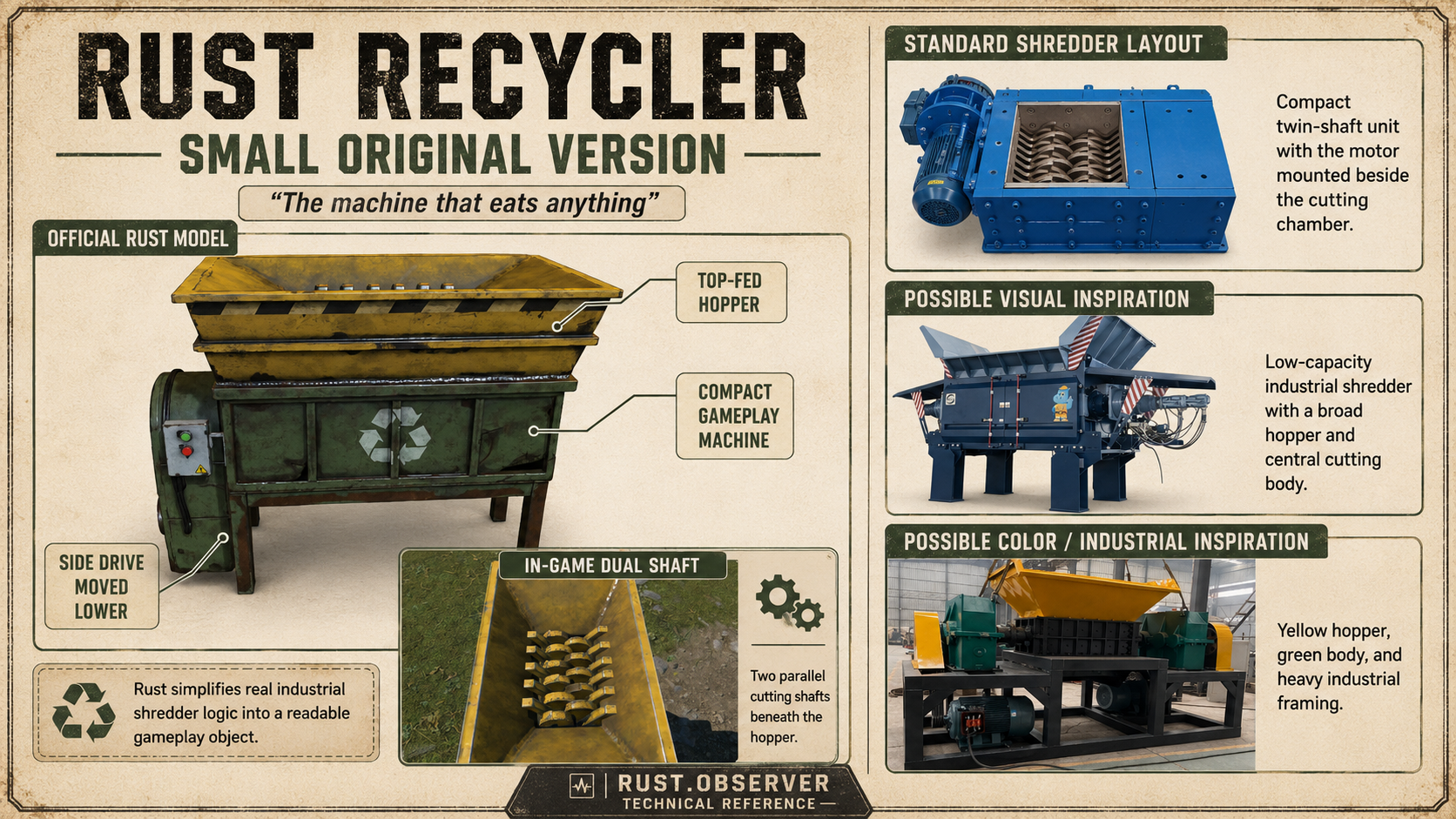
When viewed from above, the Rust Recycler reveals its mechanical language. Beneath the yellow hopper, the machine contains two parallel toothed shafts. This is the core principle of a twin-shaft industrial shredder.
These machines do not work like jaw crushers or hammer mills. They do not simply smash material from one side. Instead, two slow, powerful shafts rotate against each other. Their cutters pull material into the center of the chamber, grip it, shear it, tear it, and reduce it into smaller fragments.
Rust simplifies this mechanism, but it does not invent it.
The in-game Recycler keeps the essential vocabulary of a compact industrial shredder: a top-fed hopper, a rectangular cutting chamber, paired cutting shafts, a heavy metal body, and a side drive system. The exact commercial model is not the main point. Real-world catalogs contain many similar machines, from compact workshop shredders to heavy industrial recycling systems. What matters is the family: the Recycler is a compact twin-shaft shredder translated into a readable gameplay object.
That readability is important. In a real machine, the motor, gearbox, guards, hydraulic parts, cables, doors, and maintenance panels can make the design visually busy. Rust removes most of that noise. The player sees a yellow mouth, a green industrial body, a side drive, a control box, and a recycling symbol.
In one second, the object explains itself.
Put items here.
The machine eats them.
Materials come back.
Small Body, Industrial Appetite
The funny part is that the Recycler looks small, but its appetite is not small at all.
In gameplay, the Recycler can process a huge range of objects: weapons, tools, clothing, signs, traps, electrical components, decorative items, ammunition, deployables, and more. It does not behave like a specialized recycling machine. It behaves like a universal material converter.
This is where Rust exaggerates the real industrial idea. A compact shredder of this size would be useful, but it would not casually eat the entire material culture of the island. In Rust, however, the Recycler can turn the disorder of survival into a smaller set of useful resources: scrap, metal fragments, high quality metal, cloth, wood, gears, springs, pipes, and other components.
That makes the Recycler one of the most important machines in Rust’s economy. It is not only a prop. It is a translation system.
Rust is a world where objects rarely stay objects forever. A weapon can become metal. A trap can become components. A sign can become wood. Loot becomes material, material becomes progression, and progression becomes risk again.
The Recycler is where objects stop being objects.
The Junkyard Version

There is also a larger version of the same idea.
The standard Recycler is the player-scale machine: small enough to fit inside monuments, industrial rooms, shops, and safe zones. The Junkyard shredder is the same concept rebuilt at monument scale.
With the 2021 HDRP Art Backport, Junkyard was redesigned and received its car scrapping system. The player can operate the Magnetic Crane, pick up vehicles, bring them to the large shredder in the center of the monument, and watch the machine pull the car into its teeth. The resources then move through the conveyor system.
This is no longer just an inventory station. It is a full industrial scene.
The closest real-world comparison is not the small Recycler anymore, but fixed car shredders such as the Franzoi TF500. The logic matches: a large open hopper, a heavy fixed shredding body, vehicle loading from above, and output handled by a conveyor or discharge system. Rust turns this into a monument loop: crane, car, shredder, conveyor, payout.
This gives Rust two recycling scales.
The small Recycler turns inventory objects back into material.
The Junkyard shredder turns vehicles back into material.
Same function. Two scales.
Not More Post-Apocalyptic Than Reality
At first, the Recycler looks like something that could have come from a post-apocalyptic film. It is rough, yellow, green, industrial, and placed in abandoned spaces where players fight over leftover material.
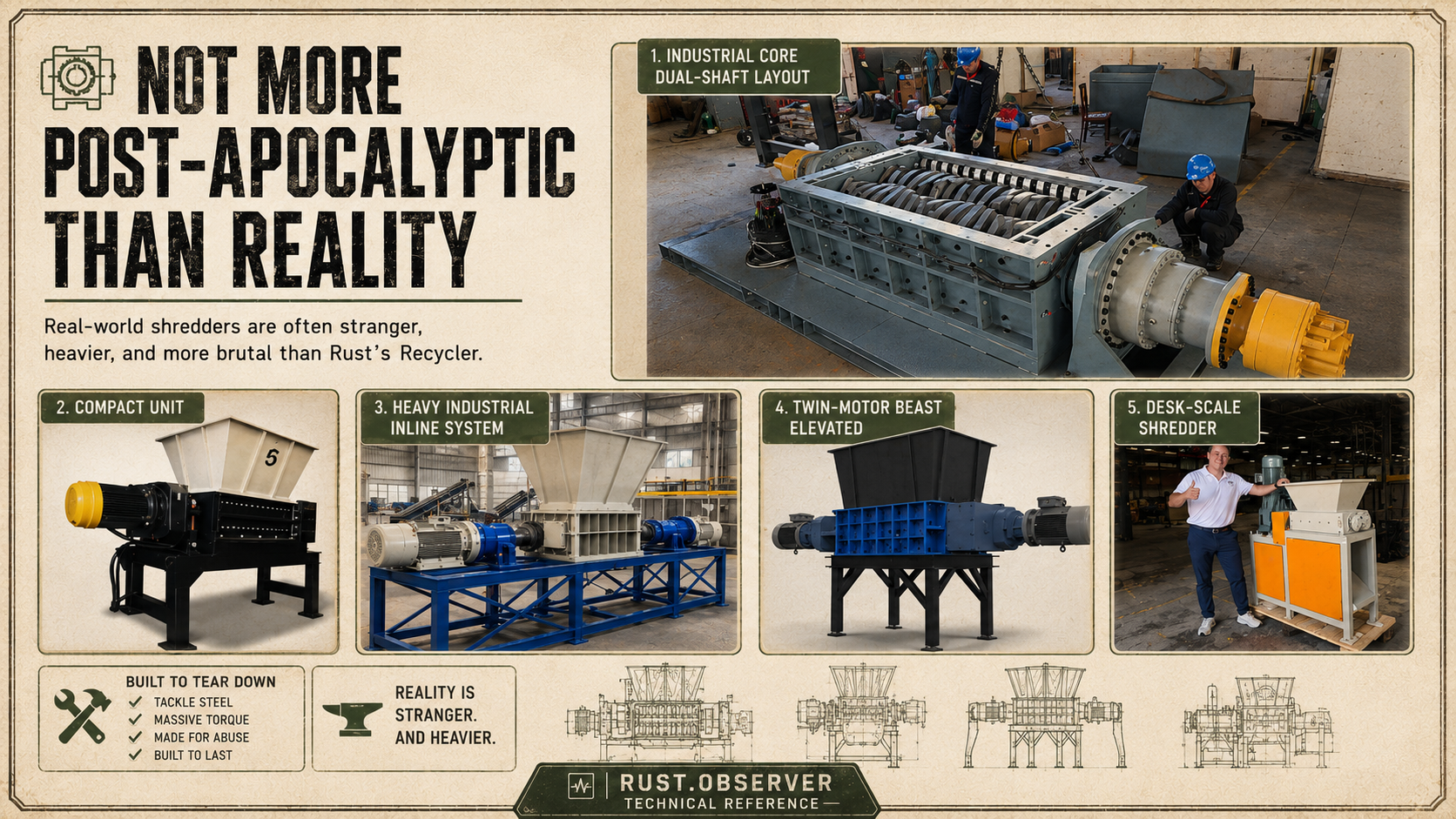
But after looking at real industrial shredders, the surprise goes the other way.
The real machines are often stranger, heavier, and more brutal than Rust’s version. They have oversized hoppers, exposed drives, huge cutter stacks, hydraulic systems, warning colors, heavy frames, and enough torque to reduce scrap, tires, metal, plastic, car bodies, and bulky waste.
Rust did not make the shredder more extreme.
It made the real industrial machine calmer, smaller, and easier to read.
That is what makes the Recycler such a good Rust object. It is believable because the real machine exists. It is useful because the gameplay system needs it. And it is memorable because it compresses one of Rust’s central ideas into a single object.
In Rust, survival is not only about finding things.
It is about breaking them down.
The Recycler is the machine that turns the island back into raw material.
What If: The Traveling Recycler

If the island ever lost its monument recyclers, recycling would stop being a fixed service and become a moving event.
The Traveling Recycler would be the industrial answer: a mobile shredder on tracks, patched with scrap armor, escorted by Scientists, and moving slowly along the roads like a heavier, dirtier cousin of the Traveling Vendor. Not a shop for comfort items, but a machine carrying one of the island’s most valuable functions: turning loot back into usable material.
Players would not visit it because it is safe. They would visit it because they need it.
When it stops, the road becomes temporary territory. Players arrive with bags of components, broken weapons, signs, traps, tools, and vehicle parts. The machine opens its hopper, runs its conveyor, and turns the island’s debris back into scrap, metal fragments, cloth, wood, and parts.
Then the real Rust question begins.
Who uses it first?
Who waits nearby?
Who attacks the escort?
Who ambushes the players leaving with recycled materials?
The small Recycler makes objects temporary. The Junkyard shredder makes vehicles temporary. A Traveling Recycler would make recycling itself temporary: a short window of opportunity, guarded, contested, and impossible to ignore.
It would not be a monument.
It would be a machine too important to stay in one place.
References and Useful URLs
Facepunch / Rust Sources
Facepunch — Devblog 130
Recycler pre-release, component system, public works item, and “the machine that eats anything.”
https://rust.facepunch.com/news/devblog-130
Rustafied — HDRP Art and Car Scrapping!
Junkyard redesign, HDRP Art Backport, Magnetic Crane, and car scrapping system.
https://www.rustafied.com/updates/2021/5/6/hdrp-art-and-car-scrapping
RustClash — Recycler
Recycler usage table and 60% return description.
https://wiki.rustclash.com/entity/recycler
Corrosion Hour — The RUST Traveling Vendor Event
Reference for the existing roaming vendor/event structure used in the What If section.
https://www.corrosionhour.com/the-rust-traveling-vendor-event/
Industrial Shredder References
Lessine / DirectIndustry — Primary Shredder
Useful explanation of the double-shaft principle: slow rotating shafts, knives, material reduction.
https://www.directindustry.com/prod/lessine/product-4598239-2667546.html
SSI — Dual-Shear M180
Heavy two-shaft industrial shredder family; useful for understanding the high-power end of the same mechanism.
https://www.ssiworld.com/en/products/dual-shear-m180
SSI — PRI-MAX PR6600
Primary reducer / heavy industrial shredding context.
https://www.ssiworld.com/en/products/pri-max-pr6600
SOYU — Metal Shredder
Metal shredder family reference for scrap and industrial recycling applications.
https://soyushredder.com/products/metal-shredder
Yize / Made-in-China — Double-Shaft Industrial Shredder
Useful visual reference for yellow hopper, green body, heavy frame, and industrial-scale double-shaft shredder layout.
https://yizemachine.en.made-in-china.com/product/EOXfYHsUhyrR/China-Double-Shaft-Steel-Scrap-Wire-Cars-Tire-Metal-Shredders-Crushing-Plastic-Crusher-Machine-Price-Waste-Textile-Shredding-Machine.html
Franzoi — Car Shredder TF500
Best real-world comparison for the Junkyard shredder: fixed car shredder, large hopper, vehicle loading, and discharge system.
https://www.franzoisrl.com/en/car-shredder-tf500/index.html
Views: 11