Oxidation #4 — Legacy Please!
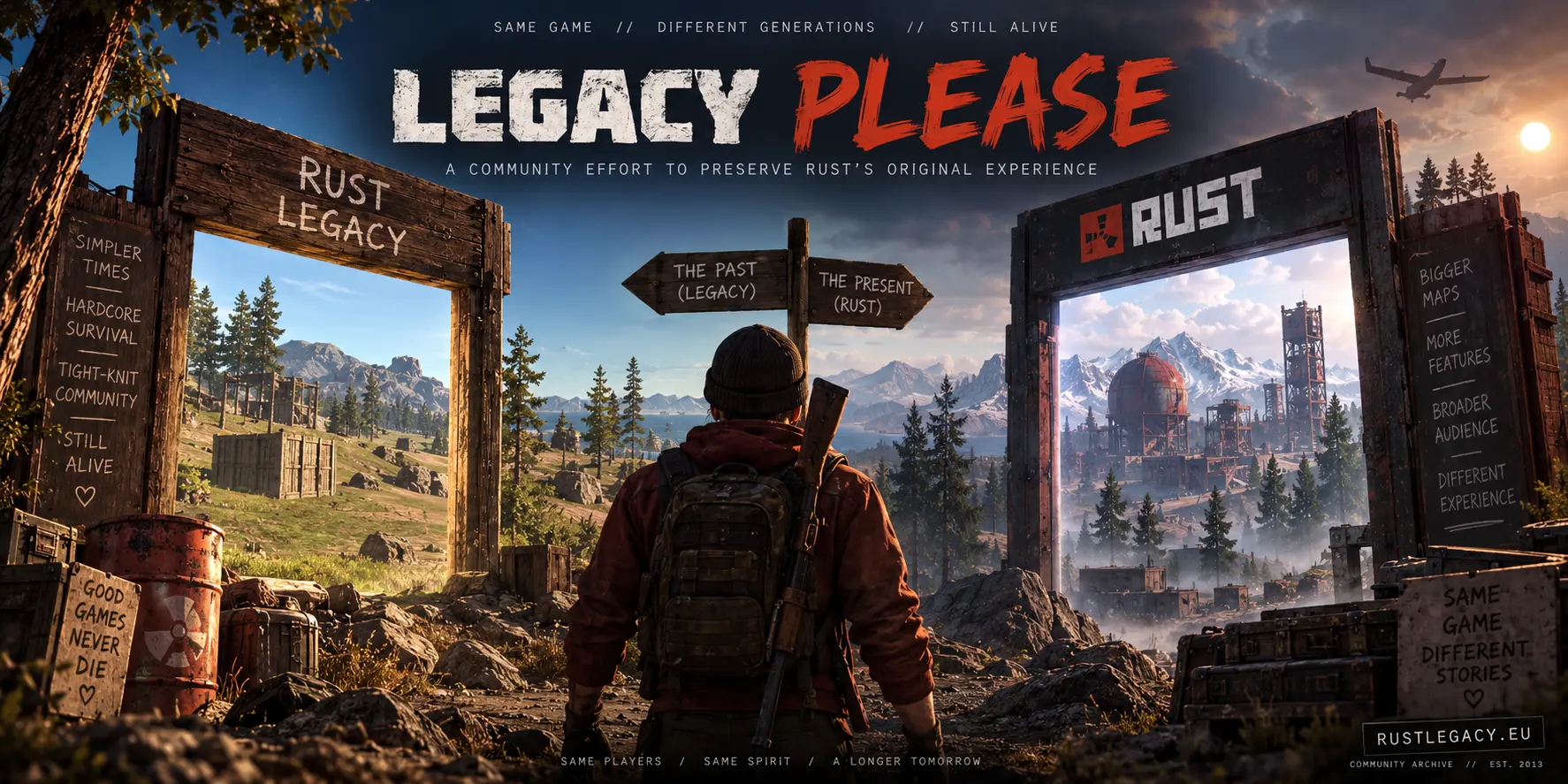
What if Rust Legacy appeared on Steam today? Oxidation #4 rediscovers the original Rust through contemporary reviews, gameplay tests, Experimental, game preservation projects and RustLegacy.eu.
Would You Play This?
A survival game catches your attention on Steam.
The screenshots are intriguing enough to make you stop scrolling, but you have been through this before. “Open-world survival crafting” can describe a remarkable sandbox or an evening spent punching trees before uninstalling the game. The store page alone is not going to settle the question.
So you Google it.
At this stage, you are not particularly interested in what engine it uses, how many developers are working on it or whether someone considers the graphics technically impressive. You are trying to answer a much simpler question: what does it feel like to play this thing?
The first reviews make the world sound distinctly unpleasant.
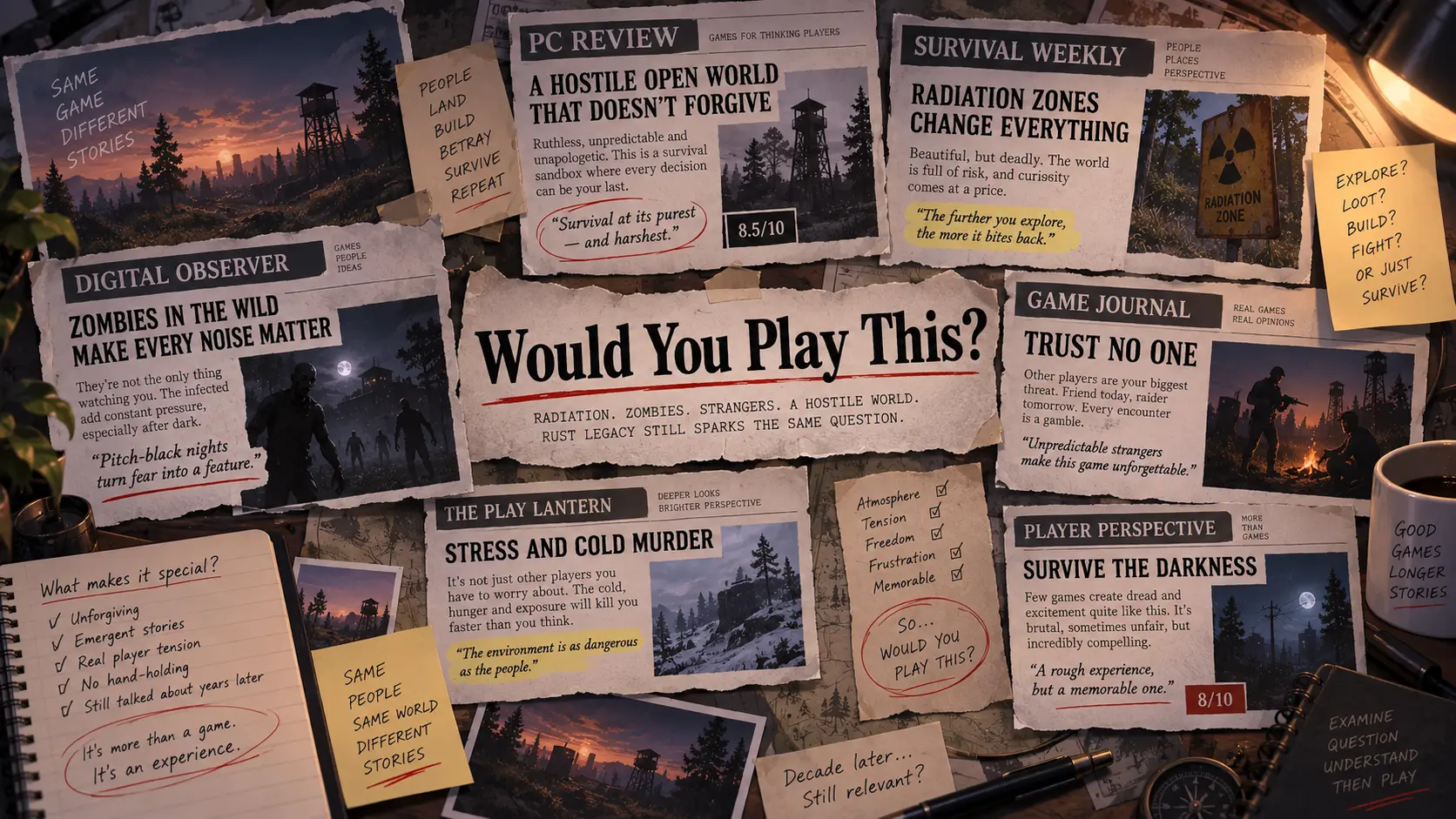
GameSpot describes a multiplayer survival environment capable of producing radically different situations depending on the people inhabiting it. A player might discover a trading post, build something with friends, be taken prisoner by bandits or simply find someone shooting at them through what the reviewer calls the “terrifying pitch black” of night. There is no campaign director arranging these encounters. The world supplies the conditions and the players create most of the story themselves. (GameSpot)
PCGamesN describes the same basic proposition in even harsher terms. You begin almost naked, trying to establish enough food and shelter to survive. Bears, zombies and other players occupy the wilderness, while increasingly ambitious equipment and construction eventually allow you to push farther into the world. Depending on the people sharing the server, a life there can turn into what the reviewer calls “tense minute-by-minute survival horror.” (PCGamesN)
PC Gamer adds an important detail: equipment does not eliminate vulnerability. You can spend hours gathering weapons and supplies, become comfortable enough to believe you finally control the situation, then lose everything because another player reaches you while your attention is somewhere else. In the reviewer’s case, that lesson arrives while looting a corpse near radioactive fuel tanks. Two players approach from behind and erase several hours of confidence with a shotgun. (PC Gamer)
Other accounts describe the setting as an online post-apocalyptic world where shelter, food and dealing with other survivors matter more than understanding whatever catastrophe produced the landscape. Roads, scattered homes and dangerous territory establish an eerie world whose immediate question is not what happened here, but whether you can stay alive in what remains. ABC’s early impression eventually predicts a game of “stress and cold murder.” (ABC News)
As the reviews accumulate, a fairly coherent game begins to appear.
The environment itself is part of survival. A badly planned trip into the wilderness can become a navigation problem, and being unable to relocate the shelter containing your possessions becomes considerably more serious when night is approaching. Dangerous locations also create their own incentive. You do not necessarily travel toward them because a quest marker told you to go there; you go because there may be something useful inside, while the world gives you increasingly persuasive reasons not to remain.
The social element is even harder to predict. One player can kill a stranger for equipment they barely need, while another can encounter somebody struggling to survive and decide to help. There is no visible morality scale announcing which one is approaching you. Trust has to be built from behaviour, and sometimes the useful information arrives one shotgun blast too late.
A wolf is dangerous because it behaves like a wolf.
Another player is dangerous because they might not.
That sounds interesting enough to keep investigating.
But written reviews can make almost any survival game sound exciting. Eventually you want to see someone actually play it.
So you go to YouTube.
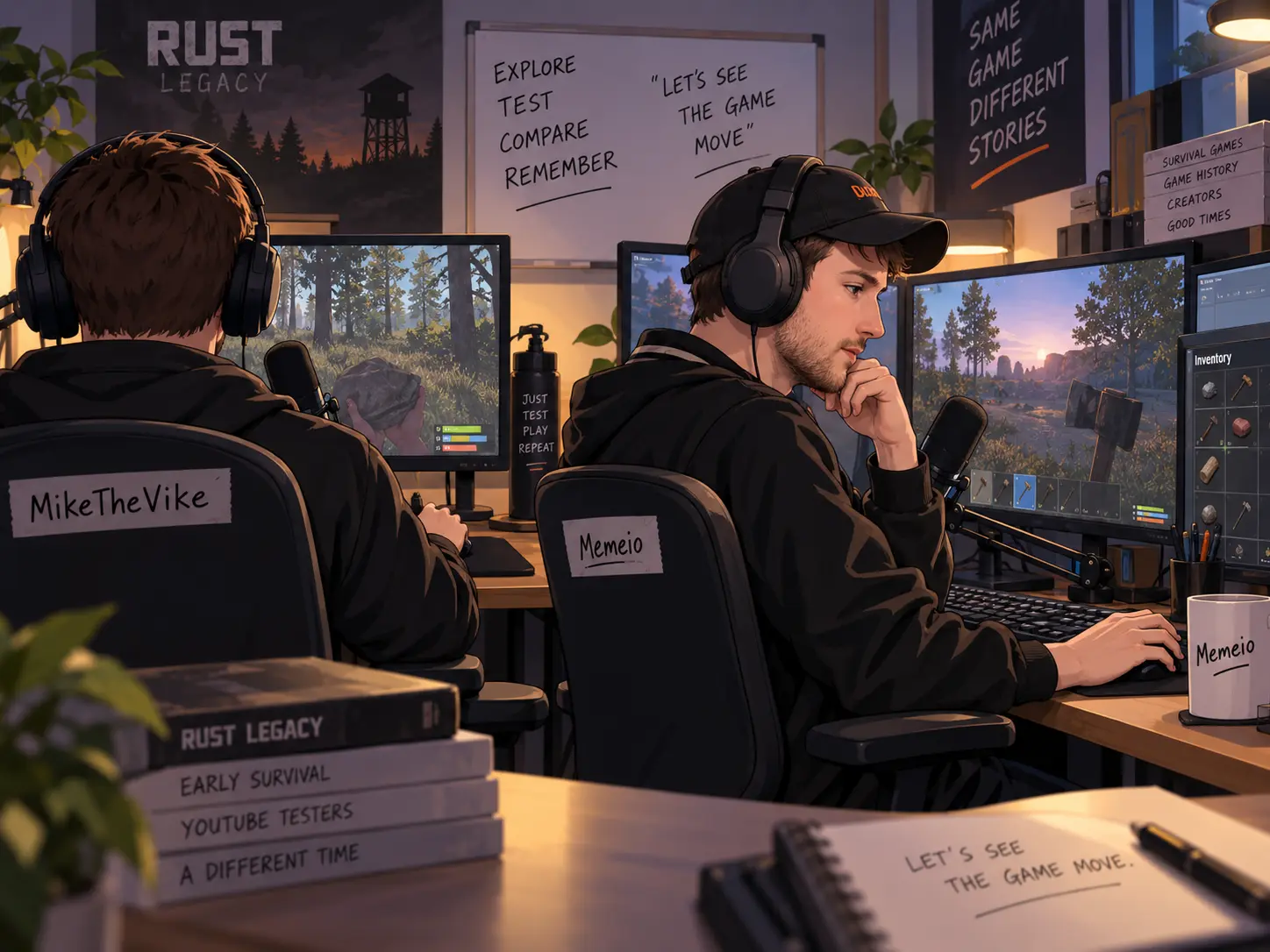
Let’s See the Game Move
MikeTheVike is exactly the kind of creator you want to find while deciding whether a game interests you. He talks while he tests things. He opens menus, experiments with systems and explains what he is seeing instead of hiding most of the game behind a montage.
His commentary fills in many of the practical details the reviews leave abstract. Inventory, equipment and crafting occupy compact functional windows. Construction depends on preparing the things required to build rather than turning the entire process into a nearly invisible background action. The important point is not that these systems are especially difficult to understand. Most are quite direct. What stands out is that the game expects you to perform them.
Looting, crafting and construction remain activities with their own rhythm. The interface is not constantly trying to save another half-second from every interaction.
Memeio’s test exposes another side of that simplicity almost immediately. Gathering wood is wonderfully literal until it suddenly is not. You hit a tree, receive wood and eventually exhaust the resource.
The tree remains standing.
Apparently, its primary function is to contain a quantity of wood. Once that function has been completed, the simulation sees no urgent reason to finish the visual story.
Stone works with a similarly simple logic. One source can provide several useful resources, while exploration offers very little assistance beyond what the player learns from travelling. Radioactive wildlife can abruptly turn an ordinary trip into a retreat, and contaminated locations punish badly prepared exploration quickly enough to make greed part of the survival calculation.
Memeio summarizes the overall impression almost immediately:
“This is true survival. This game does not hold your hand at all.”
Night supports that conclusion without requiring a special event or scripted monster. Once daylight disappears, the same landscape simply becomes much harder to read. Continuing to travel can become less sensible than getting behind a door and waiting for morning.
Other players complete the experiment. Some encounters are friendly enough to suggest that cooperation may be surprisingly common, but that impression does not survive indefinitely. Someone Memeio helps eventually returns as part of a raid against him.
The game did not need a betrayal system to arrange that reversal. It only needed persistent buildings, useful possessions, weapons and human beings capable of remembering where somebody lived.
That tells us enough. We do not need Memeio’s entire adventure to understand what his test reveals about the product.
By now, the written reviews and the demonstrations are reinforcing one another. This does not seem to be a survival game made difficult by hundreds of layered systems. Much of it is remarkably simple. The tension comes from exposing those simple systems to a world where darkness, geography, radiation, wildlife and other people can interfere with almost everything the player is trying to accomplish.
The visual presentation contributes heavily to that feeling.
Daylight exists without making the landscape particularly welcoming. Brown earth, dirty greens and muted light give much of the world a filtered appearance, as though something were sitting between the player and a clear sky. Shadows beneath vegetation can become surprisingly heavy, while radioactive animals rendered in bright red look especially unhealthy moving through such subdued scenery.
The world produces an aftermath feeling without needing to explain an aftermath. Roads cross the terrain, structures remain from some previous occupation and radiation makes parts of those remains dangerous. Zombies fit comfortably into the same landscape because the game is not asking you to investigate their origin either.
Something happened.
You arrived afterward.
The first-person view has its own physical character. Nearby objects can appear exaggerated, the image has a soft wide-angle quality, and walking produces a floating bounce that never seems completely attached to the character model visible from outside. From inside, the sensation can occasionally feel less like walking than sitting on a unicycle with a soft tire and being pushed through a forest.
None of that needs to be defended as brilliant design.
Some players would hate it. Others would accept the awkwardness because the rest of the proposition interests them. The question is the same one you were trying to answer when you opened Google.
Would you play this?
You now know that the game offers a hostile multiplayer wilderness where food, shelter and equipment matter; where dangerous locations tempt the player with better resources; where zombies and animals remain legitimate threats; where geography has to be learned; and where another person can change an evening more dramatically than almost anything the simulation itself produces.
If this appeared in your Steam queue today, would you buy it?
Would you at least want to find out what happens after the first few hours?
There is one detail we have deliberately left out.
This is not a new survival game inspired by Rust.
This was Rust.
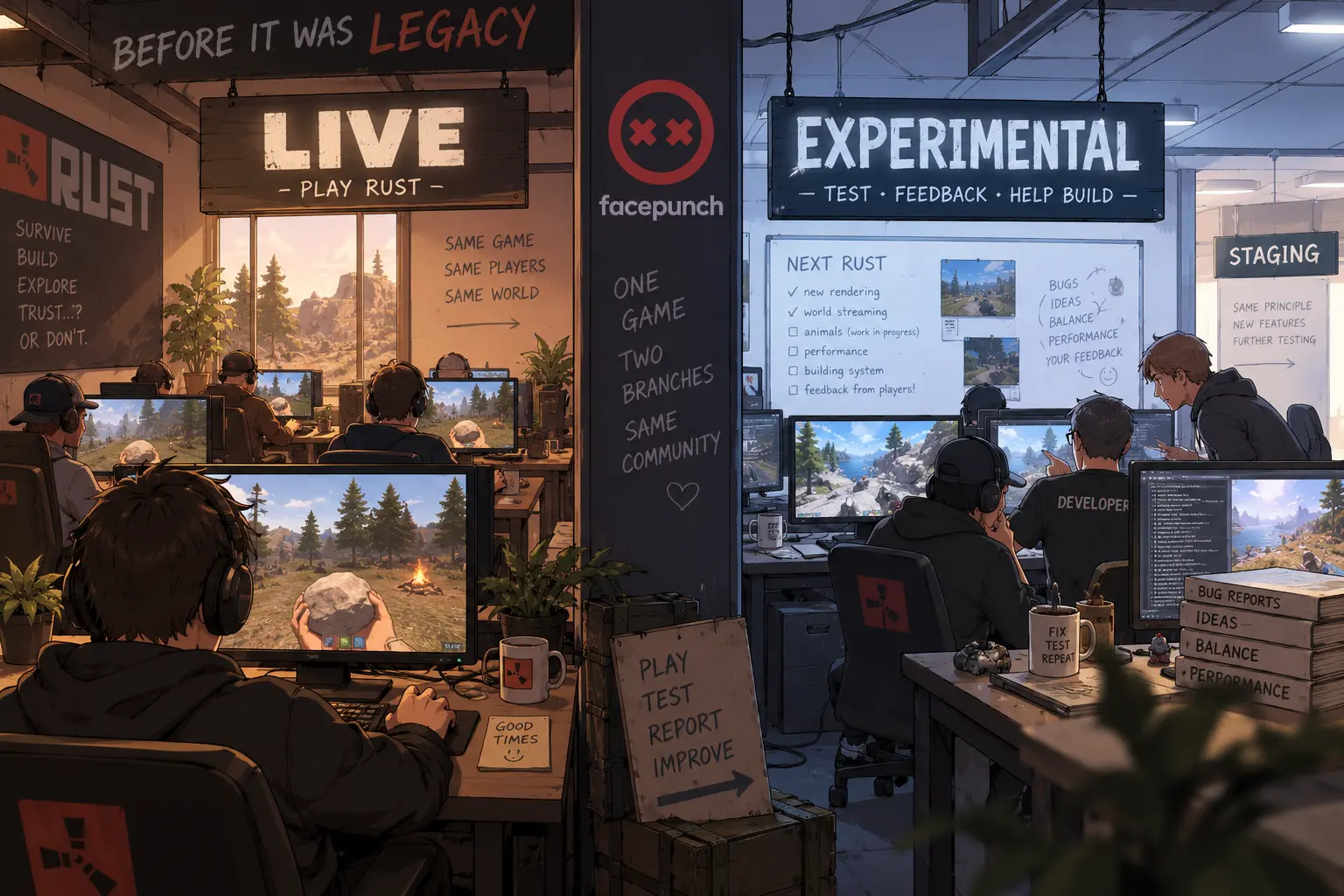
Before It Was Legacy
Nobody originally bought a game called Rust Legacy. When Rust arrived on Steam Early Access, the product we have just described was simply Rust.
The other name became necessary because Facepunch eventually began constructing another Rust beside it.
In May 2014, that second version was already accessible through Steam as the Experimental Branch, but Garry Newman made the relationship unusually clear. Players who were primarily interested in playing Rust were advised to stay on the existing live branch. Experimental was available for people who wanted to watch and participate while another implementation of the game was being assembled. Facepunch’s stated plan was to continue porting the required systems until Experimental became sufficiently complete to take over; the old live version would then remain accessible through a Legacy branch. (Rust)
Maintaining the two versions served more than one purpose.
The existing game remained the stable product. Someone who had bought Rust and simply wanted to spend an evening playing did not have to accept every unfinished system, broken experiment or radical change involved in reconstructing the game underneath them.
Experimental, meanwhile, became a public workshop. Curious players could opt into instability themselves, expose unfinished systems to real hardware and real servers, report problems and watch the replacement take shape. Facepunch did not need to construct a large closed testing program around every stage of development because part of the player base effectively selected itself for the job.
That arrangement also created a useful relationship of trust. Entering Experimental meant voluntarily walking into the workshop; instability was part of the bargain rather than something imposed without warning on everybody who had purchased Rust.
The development model survived the replacement itself. Facepunch’s modern Staging Branch follows the same basic principle: it is a separate version where new features, bugs, balance changes and performance problems can be exposed to players who deliberately opt into the development process before those changes reach the main game. (Rust)
What made 2014 exceptional was not simply the existence of a development branch beside the live game.
Experimental was not preparing the next Rust update.
It was preparing the Rust that would replace the live game.
By October, the relationship had reversed. Experimental became the default version and Garry’s announcement was deliberately blunt: “This is what Rust is.” The old game remained available, but it was now called Legacy and would no longer receive updates. (Rust)
That is how the game we just discovered acquired its second name.
Rust did not begin as Legacy.
It became Legacy because Rust moved on.
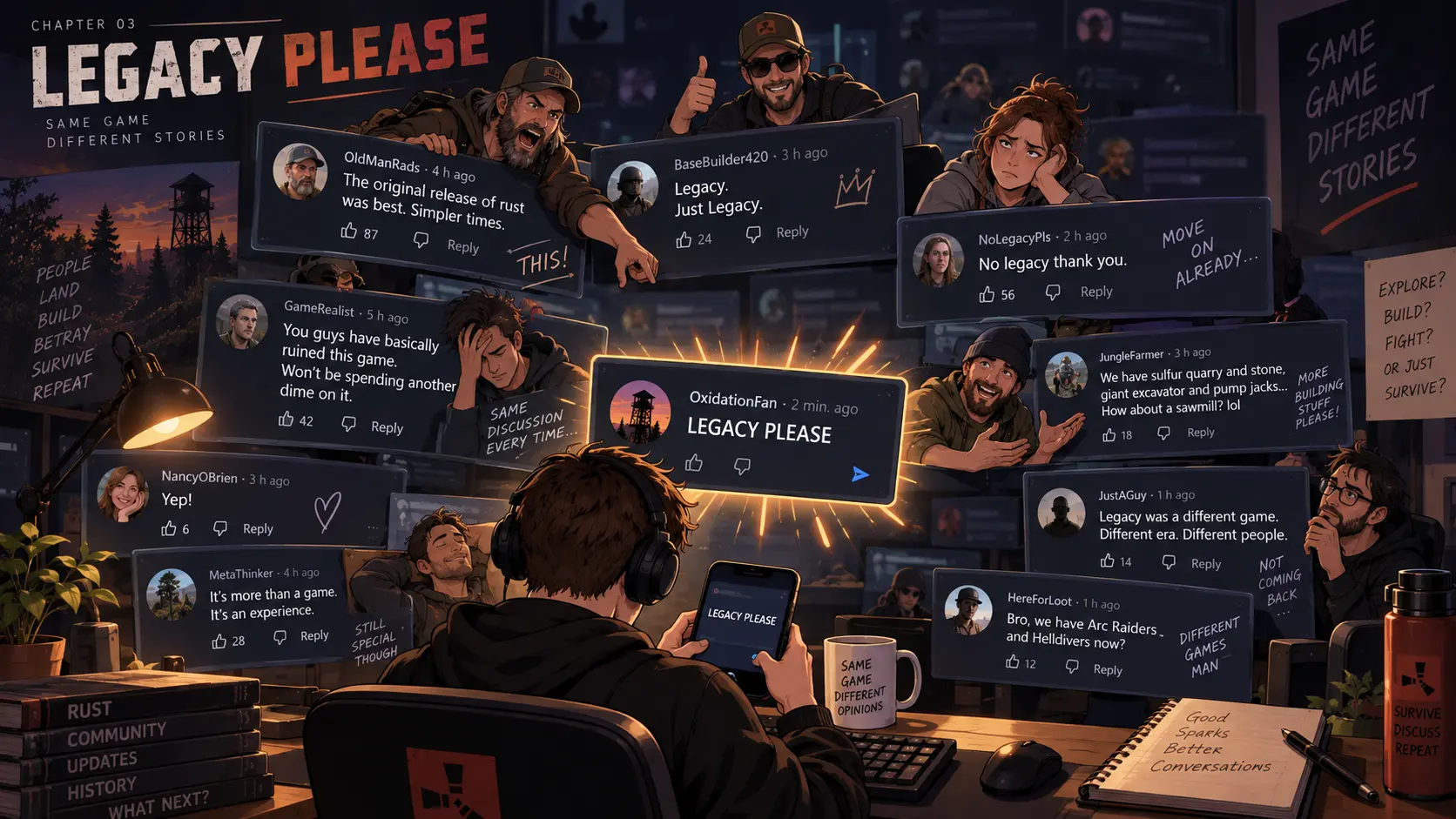
So What Does “LEGACY PLEASE” Actually Ask For?
That question is much harder to answer than the history of the name.
LEGACY PLEASE has been repeated for so many years that the phrase itself no longer proves very much. Some people undoubtedly remember playing the old game and genuinely want it back. Others may miss one particular element: the map, zombies, building, gunplay or atmosphere. Some have probably only seen Legacy in videos. And some know perfectly well that typing those two words beneath a Rust update is enough to start an argument without contributing anything else.
There is therefore little value in treating the slogan as though it represented a carefully defined product request. Ask exactly what should return and the original commenter may never answer.
The arguments we can construct around Legacy belong to us. We cannot retrospectively assign them to everyone who has ever typed the phrase.
But after actually looking at the game, a much simpler question becomes difficult to avoid.
Why shouldn’t an older version of a successful game remain accessible if people still want to experience it?
In fact, the question is almost backward.
Keeping the beginning of a successful franchise available is hardly unusual. The original Call of Duty from 2003 is still sold today and Steam’s Call of Duty Warchest bundles it with United Offensive and Call of Duty 2. (Steam Store) The original Counter-Strike from 2000 remains commercially available beside its descendants, while Valve still sells the first Half-Life and the first Left 4 Dead. (Steam Store) Even the 1998 Delta Force remains on Steam, where its own bundle includes Delta Force 2 and the early games that followed it. (Steam Store)
Some of these games operate imperfectly on contemporary systems. Their online infrastructure may have changed, their hardware assumptions can be archaic, and modern operating systems were never part of the environment for which they were designed. Yet replacing them with sequels did not automatically require removing access to the product that began the series.
Preserving Legacy would therefore not be an eccentric exception created specifically to satisfy a few nostalgic Rust players. It would place Rust inside a very ordinary tradition in PC gaming: the successful game does not have to destroy access to the game that made the success possible.
The more interesting cases begin when leaving an old executable on a store page is no longer sufficient.
That is where game preservation becomes a technical problem, and different games have solved it in remarkably different ways.
Old School RuneScape — Start With the Actual Past
Old School RuneScape is one of the cleanest examples because Jagex possessed something unusually valuable: an actual historical version.
The company still had a backup of RuneScape dating from 2007. When there was enough interest in returning to that period, Jagex did not attempt to strip years of development out of the contemporary game until it looked old again. The historical version became its own official game in 2013. Jagex now describes Old School RuneScape explicitly as the 2007 backup relaunched in 2013 and subsequently developed in a completely different direction. (RuneScape Support)
What happened afterward makes the example much more interesting than simple restoration.
Old School did not remain trapped in 2007. Once the historical game had an active population again, it acquired a future of its own. The original snapshot provided the rules, rhythm and identity from which another development path could begin.
The result is therefore neither modern RuneScape nor a museum image of a particular day in 2007. It is a legitimate branch descended from the older game.
That is probably the most ambitious form of preservation available to a live-service title: restore the historical branch and then turn it back into a living product.
It is also expensive, because the moment the preserved game starts receiving continuous support, new content, balance changes and long-term development, preservation has quietly become another production line.
Rust could theoretically follow that path.
Nothing says it has to.
World of Warcraft Classic — Preserve the Behaviour, Not the Old Server Room
Blizzard approached World of Warcraft Classic from another direction.
The desired game was historical, but the company had little reason to restore every obsolete part of the technology simply because that technology had once produced the old experience. Blizzard recovered historical database information, art and code, then worked out how to make those pieces function inside its modern development environment. Even old terrain required conversion because current tools interpreted historical formats differently. (World of Warcraft)
The objective was authenticity where authenticity affected the game. Blizzard restored old combat formulas, old lighting behaviour and other rules that changed what playing the historical version actually felt like, while contemporary Battle.net integration, support infrastructure and other machinery could remain modern. (World of Warcraft)
That creates an important distinction.
Players asking for classic World of Warcraft were not nostalgic for obsolete databases, deployment tools or server management. They wanted the world, progression, combat rules and social structure those systems once produced.
The machinery underneath could change if the historical behaviour above it remained recognizable.
That lesson is particularly useful for Legacy. Preserving Rust’s old game does not imply preserving every server, authentication and deployment limitation from 2013 for sentimental reasons. The infrastructure that delivers the game and the game experienced after joining a server are not necessarily the same historical object.
Marathon and Aleph One — When the Custodian Changes
Marathon demonstrates another possibility because the relationship between Bungie and the community project Aleph One evolved over time.
Bungie released the Marathon 2 source code in 2000, providing the foundation from which Aleph One developed. That release did not automatically make the commercial game content freely redistributable. The engine code and the data that actually constituted the Marathon games remained separate questions.
Over time, that relationship changed. Bungie made the Marathon game content freely available in 2005 while retaining ownership of it. Aleph One eventually bundled that content with its modern distributions, and in 2021 Bungie granted the project a limited licence explicitly allowing the game data to be distributed. (GitHub)
Today the result is strikingly straightforward. Classic Marathon can be downloaded free from Steam, is maintained by the fan community, uses the original game data and surrounds it with optional modern support such as widescreen presentation, positional audio and smoother interpolation. Steam explicitly notes that the Marathon trilogy data is being distributed with Bungie’s permission. (Steam Store)
That history is more interesting than simply saying that fans refused to let Marathon disappear.
It demonstrates how the role of the rights holder can evolve. Bungie did not need to maintain an internal Classic Marathon development team forever. It allowed a community already doing the preservation work to become the practical custodian of the classic game while Bungie remained its owner.
For Rust, that creates a particularly interesting precedent.
There is considerable territory between Facepunch must rebuild and maintain Legacy itself and Facepunch must have absolutely nothing to do with people preserving it.
Diablo and DevilutionX — Bring Your Own Diablo
DevilutionX represents another point on that spectrum.
The project provides a modern port of Diablo and Hellfire, intended to make the games straightforward to run on current operating systems while adding engine improvements, bug fixes and optional quality-of-life changes. What DevilutionX does not provide is Blizzard’s commercial game data. To play the full game, the user still needs the original files from a legitimate copy. (GitHub)
That division is the important part here.
Blizzard’s content remains Blizzard’s content.
DevilutionX maintains the machinery capable of running it.
The player brings Diablo; the project provides a modern road into it.
The history behind Devilution itself is considerably more complicated than that simple description, but none of those legal and reverse-engineering details are necessary for the point Legacy needs from it. The preservation model demonstrates that the old product and the contemporary technology required to operate it do not always have to be maintained by the same party.
Unlike Marathon’s present arrangement, the replacement engine and the commercial game have not become one freely distributable package.
Both approaches keep an old game playable.
They simply divide responsibility differently.
Morrowind and OpenMW — Replace the Engine Entirely
Morrowind pushes that separation much farther.
OpenMW is not a modification applied to Bethesda’s old executable. It is a completely new engine written to interpret Morrowind’s original content. OpenMW’s own documentation makes the division explicit: anyone who wants to play Morrowind still needs to legally own the game and provide its art, data and other copyrighted assets. OpenMW replaces the program responsible for understanding those files. (OpenMW)
That is remarkable when you consider how much of Morrowind exists inside those files. The landscape, characters, quests, dialogue, sounds, objects and art can continue to constitute Morrowind even though the executable interpreting them is no longer Bethesda’s original program from 2002.
The replacement engine can support contemporary operating systems, improve stability and remove old technical limitations without pretending that the world being loaded has become somebody else’s game.
The machine has been replaced.
The thing the machine interprets has not.
For old software, that distinction eventually becomes extremely important. Executables age with operating systems, hardware assumptions and obsolete APIs. Historical game data can survive much longer if somebody still knows how to read it.
RollerCoaster Tycoon 2 and OpenRCT2 — Modernize Around the Original
OpenRCT2 provides a related model with a somewhat different emphasis.
The modern implementation still requires the object files from RollerCoaster Tycoon 2 or RollerCoaster Tycoon Classic. Those files contain the original graphics, sounds and models, and they can come from an old copy or from versions still sold through stores such as Steam and GOG. (docs.openrct2.io)
Around those files, however, the software responsible for operating them can continue evolving. Compatibility with contemporary operating systems improves. Modern displays can be supported. Bugs can be corrected, networking maintained and limitations of the old executable removed without asking the historical content to become a different RollerCoaster Tycoon.
This is not simply emulating an old computer and insisting that every surrounding inconvenience remain untouched.
OpenRCT2 treats the historical game content as the valuable object while allowing the environment responsible for presenting it to remain alive.
For preservation, that can be considerably more useful than attempting to freeze an entire technological stack.
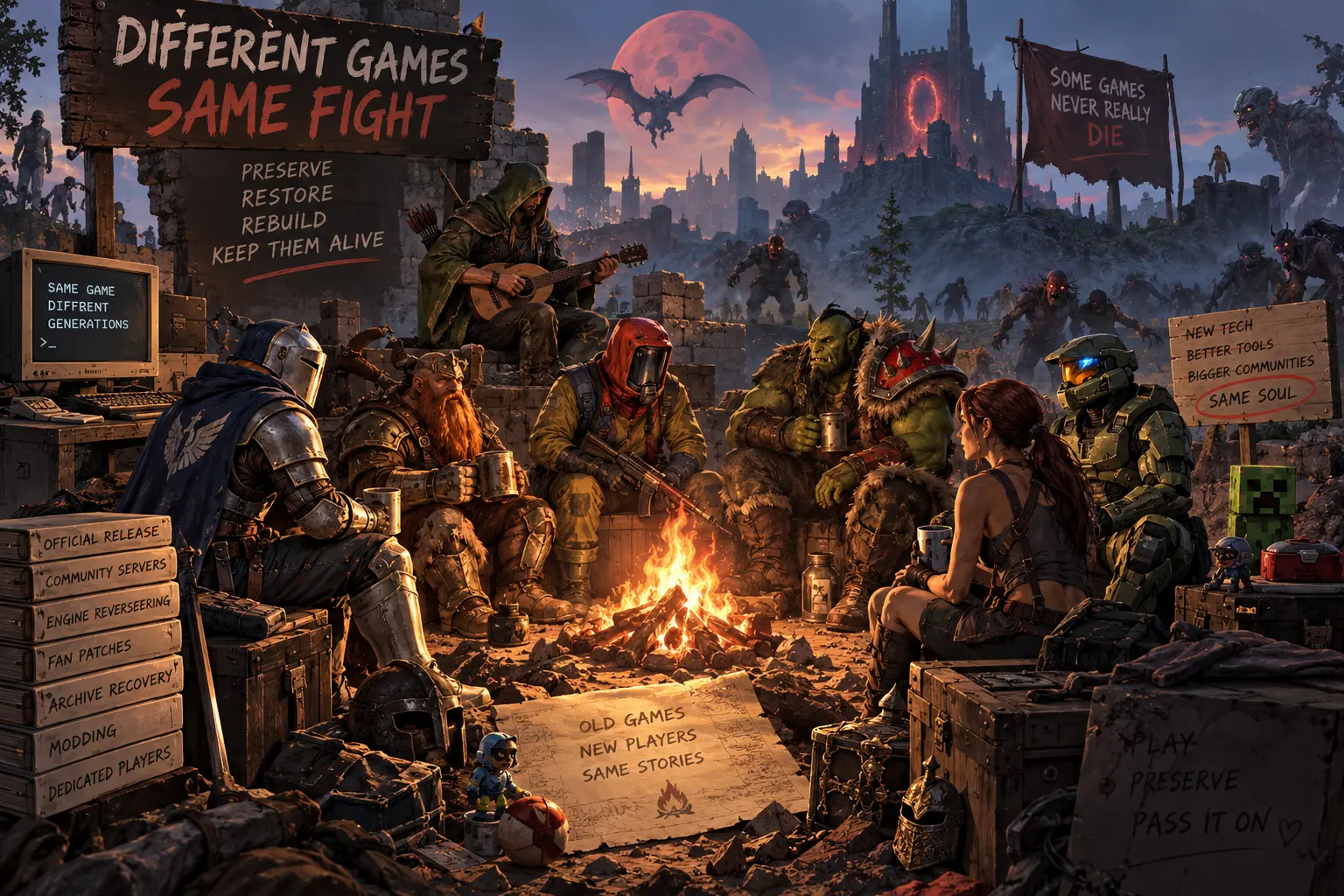
What Are We Actually Trying to Preserve?
These examples do not point toward one universal technique, and that is precisely why they matter.
Old School RuneScape revived a historical branch and allowed it to develop another future. World of Warcraft Classic recovered historical behaviour while placing it on contemporary company infrastructure. Marathon gradually moved from a community engine surrounding protected content toward explicit permission to distribute the classic games themselves. DevilutionX supplies the modern machinery while the player supplies Diablo. OpenMW replaces an entire executable while leaving Morrowind’s content in place. OpenRCT2 allows the technological environment surrounding the original game data to continue improving.
The important question is therefore not how old everything has to remain.
It is what are we actually trying to preserve?
That becomes particularly dangerous with Legacy because many of the things a modern developer would instinctively improve are also part of what makes the old game immediately recognizable.
The movement is awkward, so smoothing it would be reasonable. The camera looks strange, so it could be corrected. Inventory interaction takes longer than modern Rust players expect, so it could be streamlined. Building could be accelerated. Darkness could be made easier to read. The tree that remains standing after all its wood has been harvested could finally be given the animation nature intended.
Every one of those changes would be defensible.
Facepunch has spent more than a decade making defensible improvements to Rust.
That is exactly the problem.
If the goal is to preserve Legacy, replacing every old inconvenience with the solution Rust eventually adopted does not preserve Legacy. It gradually rebuilds Rust.
Preservation does not require worshipping bugs or pretending technical limitations are sacred. Classic Marathon does not require a 1994 Macintosh monitor. Morrowind does not become historically meaningless because OpenMW operates correctly on a modern computer. World of Warcraft Classic does not need Blizzard’s original server room to reproduce historical combat.
The useful boundary lies elsewhere.
Modernize what prevents the old game from reaching the player.
Be much more careful with what changes the experience once the player gets there.
Then We Found RustLegacy.eu
For much of this investigation, it was easy to imagine that Rust would eventually require one of those restoration projects.
Perhaps Facepunch would have to create an official Classic release. Perhaps somebody would need to reconstruct missing infrastructure. Perhaps an old client could survive while another project rebuilt everything around it.
Then we found RustLegacy.eu.
Which made part of that hypothetical discussion wonderfully unnecessary.
Legacy is already playable.
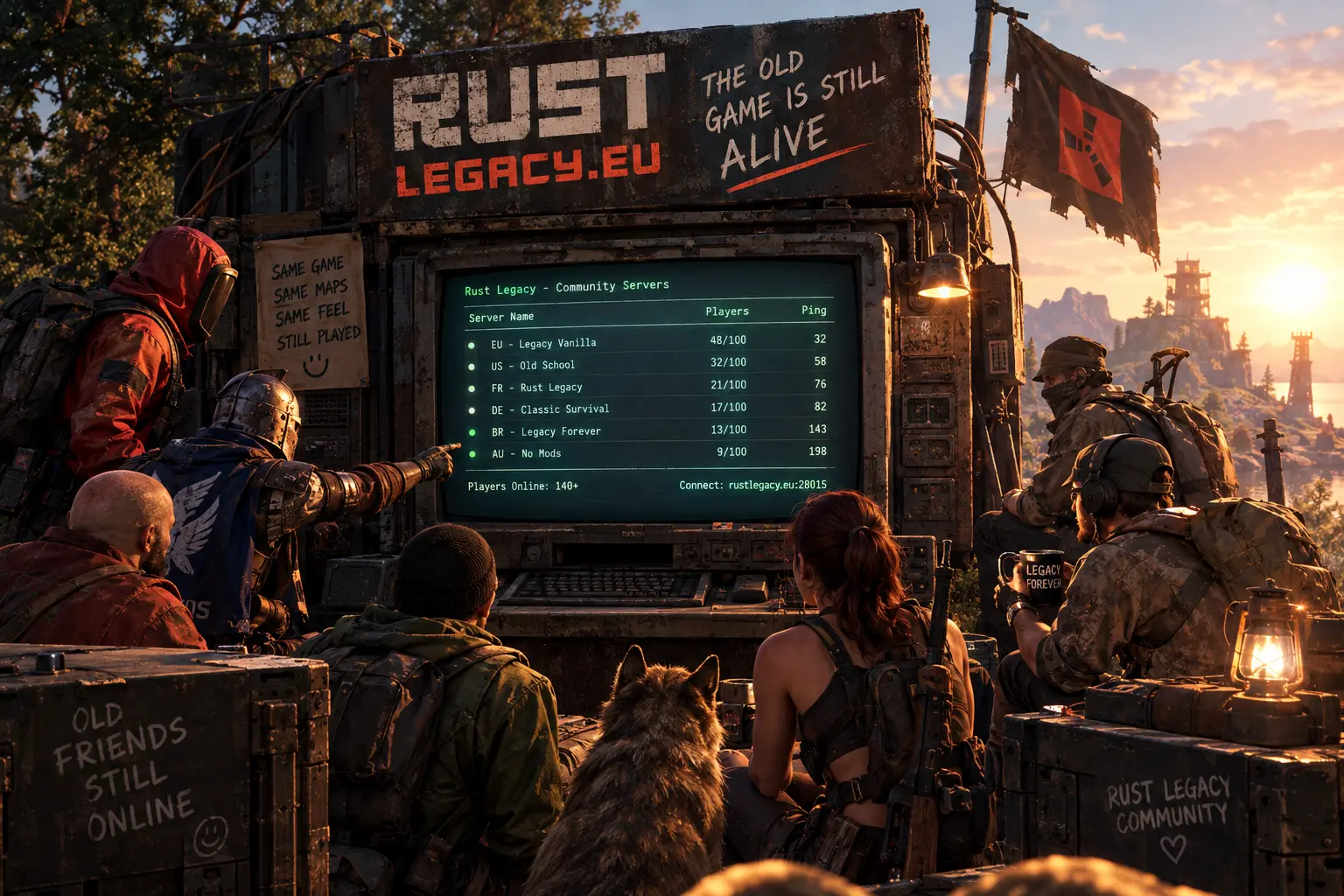
RustLegacy.eu describes itself as a community archive preserving the versions, knowledge and infrastructure necessary to play the original Rust. It maintains archived clients, live server information, hosting, client modification and an anticheat system designed for today’s Legacy community. The project currently offers two historical snapshots: the raw 2013 zombie-era game and the familiar 2015 Classic version. (Rust Legacy)
This is not a modern game attempting to reproduce Legacy’s atmosphere.
It is the old game surrounded by enough contemporary infrastructure to keep reaching players.
That distinction places the project directly beside the preservation models we have just examined elsewhere. Servers can remain reachable without redesigning the game. Hosting can be simplified. Anticheat can respond to contemporary problems. Clients can be archived and maintained. New server or map tools can be built around the historical product without reopening the gathering system and deciding that 2026 has finally waited long enough for those trees to fall.
At the time of writing, RustLegacy.eu displays more than 51,000 hosted customers, 18 of its own servers online and €1,842 spent keeping Legacy alive. Its public browser continues listing a network of Legacy servers that can still be joined. (Rust Legacy)
Those numbers do not need to challenge modern Rust to matter.
Preservation is not a popularity contest with the successor.
OpenMW does not need to defeat Skyrim. Classic Marathon does not need to become Bungie’s largest contemporary title. OpenRCT2 does not have to outsell modern management games.
The relevant question is whether somebody who becomes curious about the old game can still reach it.
With Legacy, they can.
Facepunch Does Not Have to Bring It Back
That changes what an official response to LEGACY PLEASE could mean.
Facepunch does not necessarily need to restart Legacy development. It does not need another balance team, another monthly update schedule or a second Rust roadmap. Turning the old game into a continuously maintained official branch would move it toward the Old School RuneScape model, and that model creates obligations preservation alone does not require.
Marathon suggests something much lighter.
A rights holder can recognize that a community is doing valuable preservation work without taking the work away from them. It can provide clearer archival access, technical information, permission where permission helps, or simply acknowledge that maintaining access to the historical game has value.
Support can be less glamorous still.
Servers cost money. Archives require hosting. Infrastructure needs maintenance long after the exciting reverse-engineering problem has been solved.
RustLegacy.eu openly displays what its maintainers have spent keeping Legacy alive. There would be nothing particularly strange about Facepunch deciding that helping with some of those costs is worthwhile preservation of its own history.
And if Facepunch has no interest in assuming that role, the community itself could eventually decide that preservation is worth supporting collectively.
That is very different from crowdfunding another Rust.
The objective would not be another weapon, another monument, another balance pass or another roadmap. It would simply be to ensure that when somebody becomes curious about what Rust originally was, the answer can still involve playing it instead of only watching footage made by somebody else.
A screenshot preserves how a game looked.
A video preserves what happened to someone else.
A working game preserves the possibility of discovering what happens to you.
LEGACY PLEASE?
That brings the old slogan back into focus without requiring us to psychoanalyse everyone who has ever posted it.
We still have no reason to assume that every LEGACY PLEASE means the same thing. Some people probably want exactly this game. Others may want an old map, zombies or a particular atmosphere. Some may be nostalgic for something they actually played; others may be nostalgic for a Rust they have only watched. Plenty are almost certainly trolling.
That matters much less than it seemed to at the beginning.
The interesting thing is that the object behind the slogan is real.
Legacy was a survival game before it was a historical curiosity. Contemporary critics described darkness, vulnerability, radioactive expeditions, zombies and uncertain encounters with other players. Watching the game in motion adds its own peculiar rhythm: simple gathering, deliberate construction, a primitive interface and a world that spends very little time explaining itself.
Someone discovering that description in 2026 can decide for themselves whether it sounds interesting.
That is much more useful than being told that Legacy was merely an obsolete version of Rust with fewer features.
The game did not become historically relevant because every old mechanic was secretly better. Some obviously were not. It became relevant because those mechanics once existed together as a complete product, and enough of that product remains distinctive that a modern Rust player can encounter it and feel as though they have discovered another survival game.
That feeling produces a wonderful historical inversion.
If the same product appeared independently on Steam today, someone unfamiliar with its history could easily describe it as a strange, rough survival game heavily inspired by Rust.
But it did not copy Rust.
This is the Rust that Rust replaced.
Keeping it accessible does not require proving that it was better than what followed. Successful game series preserve their beginnings all the time. Call of Duty, Counter-Strike, Half-Life, Left 4 Dead, Delta Force and countless others still allow players to reach versions that ceased being technologically current years or decades ago.
Rust moved on.
That does not make the Rust it moved on from worthless.
More importantly, it turns out we do not even have to wait for somebody to bring it back.
It is already here.
We Armed the Troll
There is one unfortunate consequence to taking all of this seriously.
For years, LEGACY PLEASE had the enormous advantage of requiring almost no argument.
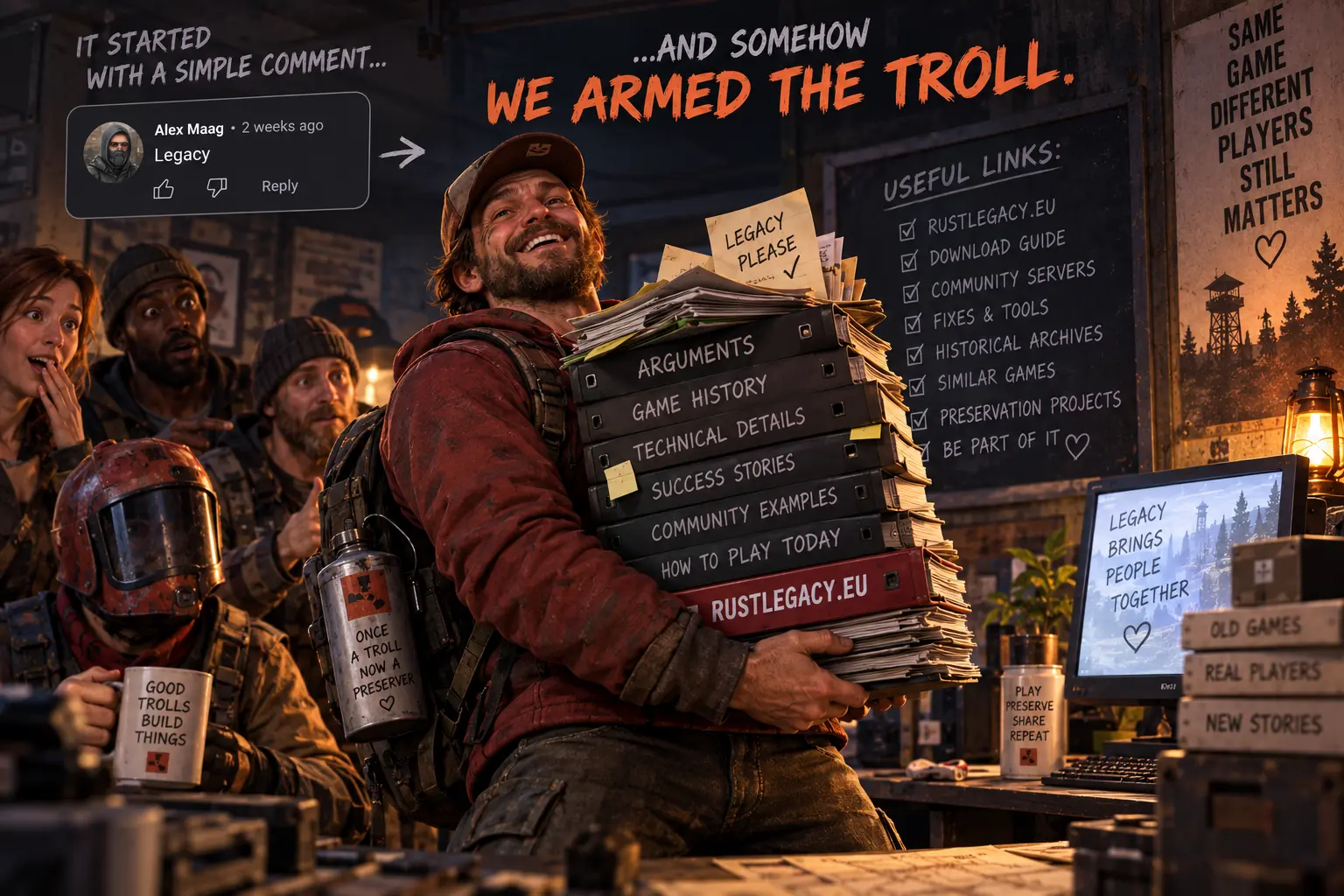
Two words could trigger an entire comment section. Someone else would demand an explanation, other people would begin providing arguments for and against the idea, and the original commenter could disappear comfortably while everybody fought over what they supposedly meant.
We have now made their job considerably easier.
There is an actual game behind the slogan. There are perfectly ordinary reasons why somebody might still want to experience it. The games industry already contains numerous examples of historical versions surviving through official branches, rebuilt infrastructure, community engines and cooperation between rights holders and preservation projects.
Worst of all, there is now somewhere to send the troll.
The next time somebody writes LEGACY PLEASE, the most useful response may no longer be oh, not these guys again.
For somebody who has never played it, the answer can simply be:
Go see what they mean.
And for somebody genuinely asking Facepunch to bring the old game back, there is an even stranger answer.
Legacy is already here. Maybe the people preserving it are the ones you should thank.
References
- Rust contemporary reviews: GameSpot, Rust Early Access Review (January 28, 2014) GameSpot — Rust Early Access Review; PC Gamer, Rust Alpha Review PC Gamer — Rust Alpha Review; PCGamesN, Rust Early Access Review PCGamesN — Rust Early Access Review; ABC, Rust Alpha: first impressions (February 4, 2014) ABC — Rust Alpha: first impressions
- YouTube observations: MikeTheVike, Experimental-era Rust test MikeTheVike video; Memeio, Legacy Rust in 2025 Memeio — Legacy Rust in 2025
- Facepunch — Experimental and Legacy: Friday Devblog 6 (May 2014), including Garry Newman’s advice to remain on the live branch if primarily interested in playing Rust Facepunch — Friday Devblog 6; Friday Devblog 28 (October 3, 2014), Experimental becoming the default game and the former Rust becoming Legacy Facepunch — Friday Devblog 28; current Staging Branch description Facepunch — Staging Branch
- Old School RuneScape: Jagex support documentation describing Old School RuneScape as the 2007 backup relaunched in 2013 and subsequently developed separately Jagex — RuneScape and Old School RuneScape
- World of Warcraft Classic: Blizzard, Restoring History: Creating WoW Classic, detailing the recovery of historical data, art and code and their integration with modern infrastructure Blizzard — Restoring History: Creating WoW Classic
- Marathon / Aleph One: Aleph One’s historical account of Bungie’s source releases, free distribution of Marathon content and the 2021 limited distribution licence Aleph One — Marathon game data history; Classic Marathon on Steam, maintained by the fan community with original game data distributed with Bungie’s permission Steam — Classic Marathon
- Diablo / DevilutionX: DevilutionX project documentation describing the modern port and its requirement for original Diablo game data GitHub — DevilutionX; original Devilution documentation and project history GitHub — Devilution
- Morrowind / OpenMW: OpenMW FAQ explaining that OpenMW is a new engine replacing the original executable while requiring a legally owned copy of Morrowind for Bethesda’s content OpenMW — FAQ
- RollerCoaster Tycoon 2 / OpenRCT2: OpenRCT2 documentation explaining the requirement for original RCT2/RCT Classic object files and modern compatibility around them OpenRCT2 — Getting RCT2
- RustLegacy.eu: project description, archived 2013 and 2015 clients, server network, hosting, anticheat and current preservation statistics RustLegacy.eu
- Commercial preservation of early franchise titles: the 2003 Call of Duty remains sold individually and through the Call of Duty Warchest with United Offensive and Call of Duty 2 Steam — Call of Duty (2003); the original Counter-Strike remains sold on Steam Steam — Counter-Strike; Half-Life remains available and bundled with its early expansions and Valve catalogue Steam — Half-Life; the original Left 4 Dead remains sold beside its sequel Steam — Left 4 Dead; Delta Force and Delta Force 2 remain commercially available, with the early titles included in the Delta Force 1 Bootcamp collection Steam — Delta Force