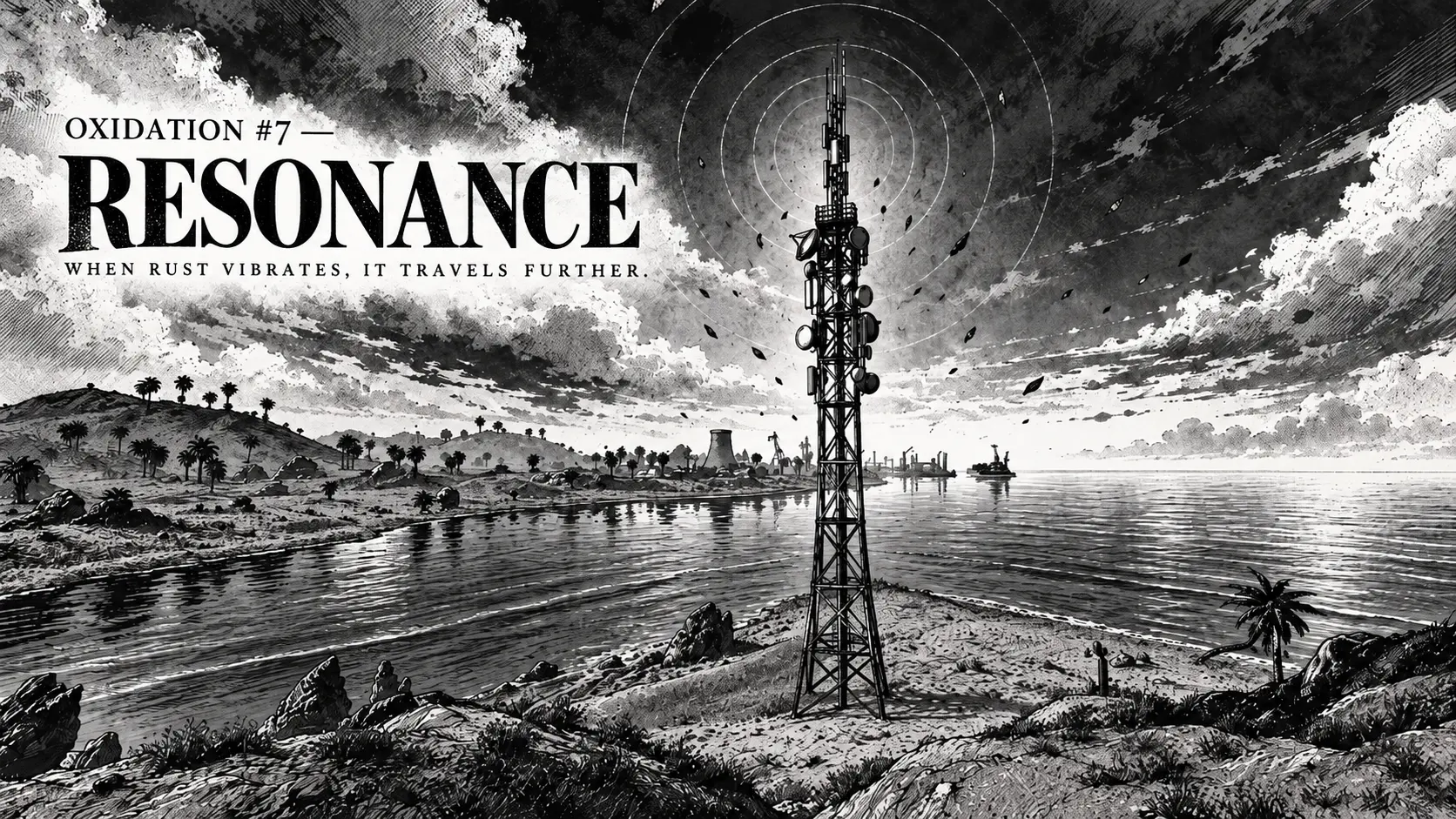
Oxidation #7 — Resonance
Rust does not end at the edge of the island. Creators, viewers, platforms, events and communities carry its stories outward — and sometimes bring them back changed.
Rust has never had just one face.
A streamer can turn it into a war story. Another can spend three hours quietly building a house. Someone else explains electricity, hunts cheaters, designs bunkers, organises hundreds of players into armies or spends months editing a single wipe into a movie.
Sometimes the same person does several of those things.
And the people watching them may live on the other side of the planet, speak another language and have discovered Rust without ever searching for Rust in the first place.
The game remains recognisable.
What travels around it does not.
It passes through players, creators, artists, platforms, communities, events and audiences. Each changes something before passing it further.
That is resonance.
BEFORE THE STREAMER
Rust was producing things worth watching almost as soon as there were enough pieces of a game to work with.
Facepunch’s first Community Update, published in July 2014, was built around a simple idea: look at what the community was already making and show some of it to everybody else. (Rust)
That distinction matters.
Facepunch did not invent those creations.
It found them.
Within months, Rust had already escaped the ordinary gameplay-video format. People recreated mechanics in real life, staged scenes, produced machinima and experimented with camera tools that had never been designed as filmmaking equipment.
In March 2015, Boris The Blade showed Rust functioning as a movie set with The Shack, a machinima Facepunch itself highlighted at the time. (Rust)
Its bloopers made the process particularly obvious: scenes were planned, takes were repeated and performances were assembled inside a survival game.
Phaedo82 approached the game from another direction. Using admin free-cam, he turned large raids into something closer to live battlefield coverage. Facepunch would later describe him simply as “the man who started the Raid Cam phenomenon.” (Rust)
Holdacious was already testing another possibility. When Rust’s early community-made Battle Royale mode appeared, Facepunch specifically asked for somebody to jump in and document it.
Holdacious did. (Rust)
The result was not simply another wipe recorded for YouTube. Rust was already becoming a stage on which entirely different game formats could be tested in front of an audience.
Ser Winter made encounters with strangers into stories of their own. Facepunch was already pointing readers toward his videos and his Rust for Dummies series in 2015. (Rust)
VERTiiGO developed another form of observational Rust. Brendon could be loud, funny and constantly involved, but some of his strongest material came from simply watching people long enough for a story to happen around them.
By November 2015, Facepunch was celebrating him passing 100,000 YouTube subscribers, while specifically praising the variety of Rust situations his channel had documented. (Rust)
Rust was still deep in Early Access.
Its creators were already learning how many different things it could become.
NOBODY STARTED AT THE TOP
Looking at the familiar names today can distort the picture.
Welyn, Blooprint, Willjum and the other large creators are useful examples precisely because their trajectories lasted long enough for us to see what happened to them.
They did not appear with hundreds of thousands of viewers waiting.
Welyn’s YouTube channel predates his Rust career by years. Some of his early material had nothing to do with gaming at all: exercise, music and rap existed before the pumpkin-headed storyteller people now recognise.
Blooprint began putting Rust material on YouTube in 2016.
Willjum’s first Rust uploads in 2019 included straightforward building and base-design material long before the quiet, long-form survival style associated with his channel became established.
They were small.
They published.
People found them.
Their work changed.
More people returned.
Repeating their actions does not guarantee their result. Their histories establish something simpler:
the path from almost nobody watching to a large independent audience exists.
And it still starts at zero.
WHEN THE CREATOR BECOMES THE FORMAT
Eventually, people stop watching only because Rust is on the screen.
VERTiiGO was an early example. Brendon talks almost continuously, but not like somebody commentating a match. He sounds more like the friend sitting beside you at the computer — thinking out loud, laughing when things fail and turning whoever appears nearby into part of the afternoon.
Welyn developed a different storytelling language. A wipe becomes a cast of characters, callbacks, recurring companions and a story reconstructed after the fact.
After enough appearances, some of those companions stop feeling like guests.
Repeated collaborations can develop an audience of their own.
Viewers learn the chemistry between people. They remember what happened last time. Eventually, they can begin anticipating the reaction before it happens.
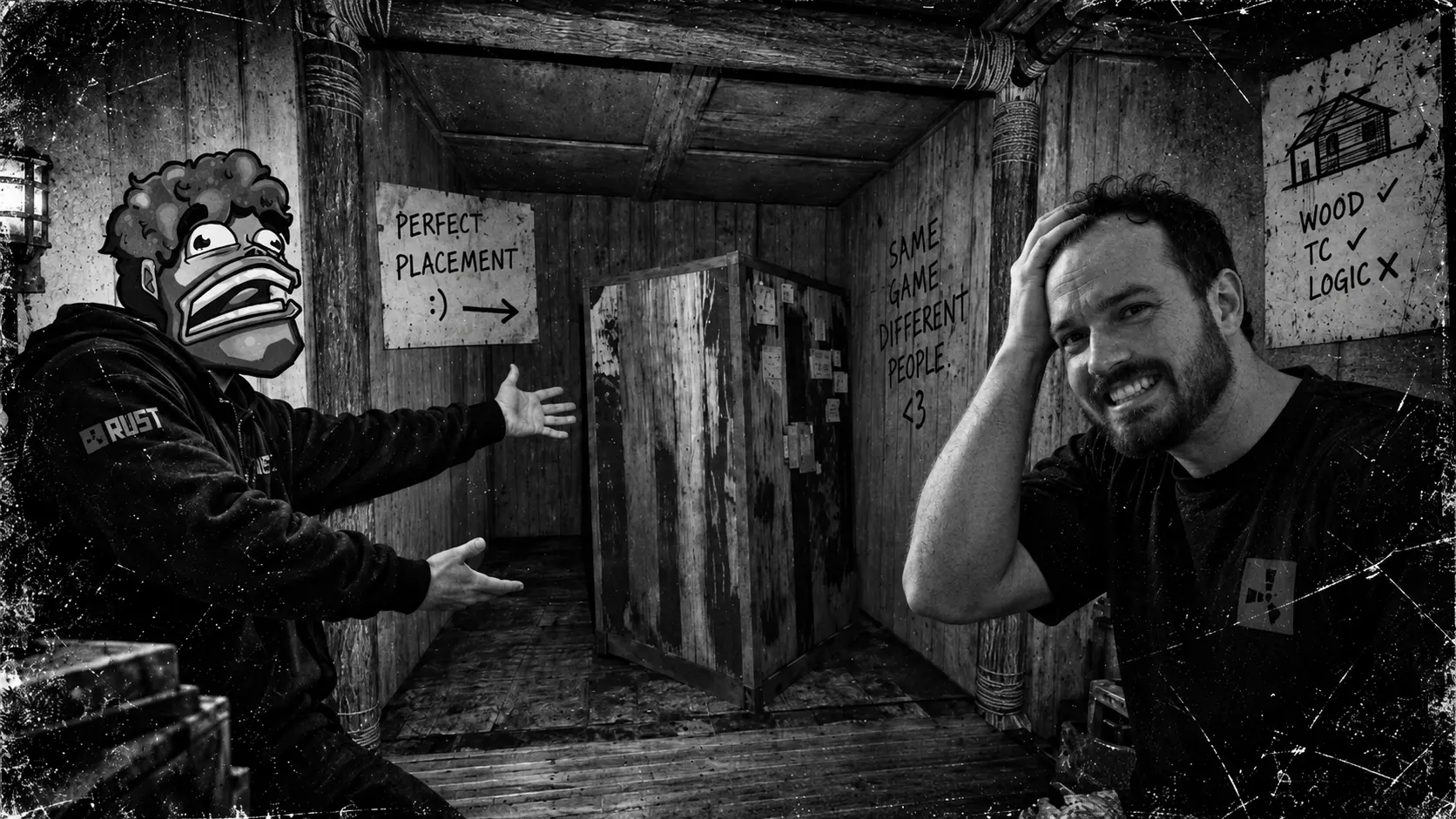
Porgie illustrates the point particularly well. He is a cool content creator, but also a friend, with a twisted mind!
His value beside Welyn was never simply audience size. It was comedy and familiarity. He knew which habits could be pushed, which frustrations could be exploited and how far a ridiculous idea could go before Welyn finally snapped.
Rhys and ZChum could become part of the machinery as well.
Headset problems that may or may not be real. A base arranged in a way Welyn would never tolerate. A TC placed somewhere absurd. Each part becomes funnier because the people constructing the situation know their target.
The audience knows him too.
The viewer is no longer simply watching Porgie prank Welyn. The viewer understands the setup, recognises the warning signs and waits for Welyn to discover that everybody else was in on it first.
Their history together has become material.
Blooprint and Willjum produce another version of the same effect.

One became closely associated with high-energy progression, PvP and spectacular reversals. The other built an audience around a much calmer rhythm of farming, building and surviving.
Put them together and part of the attraction is simply watching those two versions of Rust occupy the same wipe.
People want that pairing.
Personality develops its own shorthand as well.
Blooprint has a particularly audible one.
Catch a cheater in the act, let one of his teammates produce something completely ridiculous, or have an impossible play suddenly work, and there is a reasonable chance his microphone is about to receive considerably more input than its manufacturer intended.
Somehow, it survives.
Long-time viewers do not necessarily need to see what happened first.
Sometimes the scream tells them enough.
The reaction has become part of the format.
ImBernE works in the same broad storytelling universe but pushes harder toward raids, goons, ridiculous plans and reversals. Welyn and BernE have crossed paths while each developed a very different format of his own.
Then there are creators who move much closer to filmmaking.
Stevie can spend months shaping one highly polished production.
Frost pushed that language somewhere else again.
His 2020 film The Last Survivor has accumulated more than 2.4 million views.
That is an enormous audience.
It is not even one of Frost’s most extraordinary numbers.
What makes The Last Survivor especially important here is that a few seconds near the end escaped the film that contained them.
Frost reaches a position with apparently no survivable exit. He runs toward the edge, jumps, and a teammate rises beneath him in a minicopter at exactly the right moment.
The setup is pure action cinema.
Impossible position. One remaining way out. Perfect timing.
Jump.
The sequence is constructed with the language of film, and that has occasionally produced the predictable criticism: several camera angles must mean the entire thing is fake.
That misunderstands what filmmaking can do inside Rust.
Two players can already record the same attempt from different perspectives — Frost and the pilot. Recorded footage can provide other options. And a filmmaker can simply do what directors have always done: reproduce parts of an action afterward to obtain the shots that make the successful moment readable.
The real attempt can remain the centre of a sequence even when other shots exist to make it more dramatic.
Internet trick shots work on a similar principle. Someone may throw a basketball from an absurd distance fifty times before finally landing it. The audience normally watches the successful attempt, not the forty-nine failures.
Editing changes how an achievement is presented.
It does not automatically erase the achievement.
And the jump did not remain inside Frost’s movie anyway.
It entered Rust’s imagination.
Players began trying to reproduce it themselves — sometimes as a deliberate challenge, sometimes as an absurd escape during an actual raid.
The maneuver became recognisable enough to acquire a name that Rust never officially gave it:
the Frost jump.
Even Frost later tried to reproduce his own famous move.
He failed.
Spoonkid tried it.
He landed it.
Outside a planned scene, coordinating the jump, the minicopter’s approach, the landing and everything else happening around the players turns the cinematic idea into a genuine mechanical challenge.
Other creators can then look back at the original sequence and respond to the thing Frost was really constructing.
Cinema.
That is where this particular piece of resonance becomes unusually clear.
Frost used Rust to create an image.
The audience remembered it.
Players tried to reproduce it.
The maneuver returned to ordinary gameplay as a challenge the game had never defined.
Eventually even Frost could find himself trying to reproduce something Frost had already made famous.
The film travelled.
The moment came back.
WHEN RUST ISN’T EVEN ON THE SCREEN
Once a creator becomes strong enough as a format, even Rust can temporarily disappear.
TheBurntPeanut demonstrates this from the opposite direction.
Peanut did not build his original audience around Rust. His rise came largely through Escape from Tarkov and later through a comedy-driven streaming persona capable of moving between games.
Then that audience entered Rust.
In April 2026, Peanut’s Wasteland gave Peanut his own Rust environment.
Established Rust creators entered that orbit too. Welyn later published his own view of helping Peanut build his first Rust base.
The direction of travel matters.
Rust did not create Peanut’s audience.
Peanut brought an audience into Rust.
But the relationships reinforced there did not need to remain inside Rust.
The same people could later appear together in another game, another event or another ridiculous evening.
CoconutB provided a wonderfully small demonstration of that during WARDOGS.
A chaotic incident involving Peanut ended with CoconutB abruptly kicked and banned.
Not from a Rust server.
From Sans Raiders.
These were players familiar to Rust audiences playing something else for a change.
CoconutB was understandably frustrated. His gear was gone, his teammates were left figuring out what should happen to the loot, and the entire situation had become absurd.
It would have been a very easy moment for status to become entitlement.
It did not.
There was no grand celebrity meltdown.
He stayed CoconutB.
Frustrated CoconutB, certainly.
But still funny CoconutB.
Even getting banned became CoconutB content.
That may be one of the clearest signs that the creator has become the format.
The entertainment no longer depends entirely on Rust producing the correct situation.
Sometimes it does not even depend on Rust being there.
The game can create a meeting.
The relationship can survive the game.
MANY DIFFERENT JOBS
Other creators occupy completely different parts of the ecosystem.
People such as FancyOrb and Enardo can gather enough participants that the mass of players becomes content.
Admin-oriented creators expose another Rust entirely. Camomo and Memeio can show spectating, logs, noclip, investigations, baiting cheaters and intervention from outside ordinary gameplay.
MikeTheVike can take a strange server, build, map or community project and make it visible far beyond the people who created it.
Jfarr can take a system apart and explain it.
Rustafied can spend weeks following an incoming update, then turn wipe day into something closer to a live community briefing.
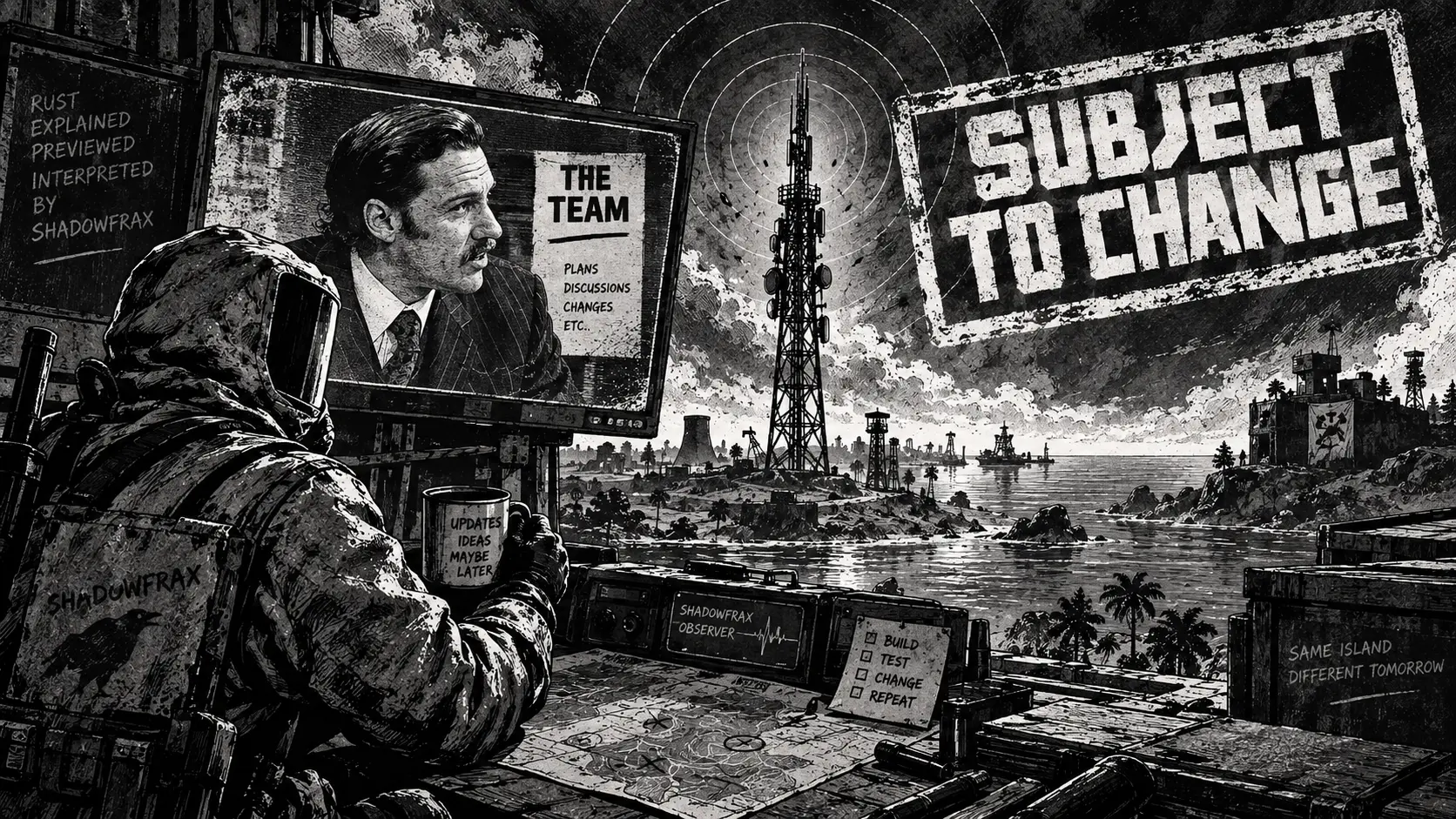
Shadowfrax occupies an unusually strong position in that information layer. For years, Facepunch has repeatedly pointed its own audience toward his videos to understand changes to Rust. He gained access to Staging and unfinished material, built recurring jokes around “the Team” and his SUBJECT TO CHANGE warning, and became close enough to the development cycle that Facepunch itself could joke back.
He never had to become an employee to become one of the most recognisable voices explaining what Facepunch was doing.
BUILD IT, THEN SHOW US HOW
Construction developed its own language as well.
A Base Creator does not have to make nothing but base videos. The useful distinction is that, at some point, the creator stops and clearly demonstrates how something is built: layout, bunker, placement, cost, traps, efficiencies, expansion path or a complete design viewers can reproduce.
Reksmore does it directly.
Oblivion often turns construction into trap design, where architecture and player behaviour become part of the same mechanism.
Memeio and Stimpee have repeatedly used building systems for demonstrations, traps and absurd experiments.
Willjum frequently pauses his larger stories long enough to make a build understandable.
Welyn and Blooprint build plenty of bases.
That alone does not make those sequences tutorials.
The distinction is whether the viewer is being shown a structure or being shown how to make it.
There is memory in this kind of content too.
Creators sometimes return years later to a design they once published and rebuild it with everything learned since. Reksmore’s “three years ago I built…” format is a clean example. Welyn and Willjum have made comparable returns to older concepts.
The old tutorial becomes a record of technical progression.
PHENOMENA
Not every successful creator needs a career-long mountain of uploads.
Sometimes one idea travels much farther than the person who made it.
Templetaps is a useful example. At the time of writing, the channel has roughly 33,000 subscribers with only about ten public videos, yet individual base designs accumulated enormous circulation and remained searchable and recommended for years.
This is the one-hit wonder side of online creation.
A build, trick, clip, meme, exploit or tutorial can become larger than the channel around it.
Sometimes the creator keeps going.
Sometimes the useful thing keeps circulating almost independently.
A small catalogue does not necessarily mean a small footprint.
THE EXPERT WHO ARRIVES LATE
HiddenJoint demonstrates almost the opposite trajectory.
Denis did not learn Rust in front of an audience.
He had already spent more than a decade with the game — around 15,000 hours — before seriously turning his building knowledge into YouTube content in 2024.
His public catalogue also gives a misleading impression of his production. Roughly 95 videos have been associated with the channel, but much of that catalogue sits behind a paid membership costing around $19.99 per month.
The public videos are the window.
They show enough expertise to convince some viewers that what is behind the window is worth paying for.
That is a very different model from Welyn or Blooprint.
HiddenJoint does not need an enormous public audience.
He needs a smaller group of viewers who specifically value what he knows.
Popularity is not the only form of efficiency.
Sometimes the right audience matters more than the largest audience.
RUST DOES NOT SPEAK ONE LANGUAGE
English-language YouTube cannot stand in for the entire Rust media world.
Rust has creators and communities across Europe, Asia, Africa, Oceania, Russia and Latin America. Some work almost entirely in their own language. Some deliberately use English to travel farther. Others move between linguistic spaces.
Coma comes from Denmark and produces long English-language Rust stories built heavily around aggressive PvP, groups and the full life of a wipe.
XkEVV is Dutch and makes no particular effort to erase it. His accent and local identity remain obvious while he plays and collaborates internationally in English.
RustyForge is Ukrainian, considerably smaller than the names normally dominating Rust discussions, and produces useful English-language coverage of updates, electricity, automation and technical systems.
cemen2000 moves between Russian identity and partly English-facing Rust content rather than fitting neatly into one linguistic box.
French creators such as Raven and Krolay occupy their own audiences. Spanish- and Latin-American communities produced Egoland and later Bellum. Japanese creators developed another huge ecosystem around events such as VCR Rust. South African and Australian creators occupy still other parts of the network.
Most of the time, assigning one creator to one flag tells us very little.
Coma does not become understandable simply because he is Danish. XkEVV is not a representative sample of the Netherlands. RustyForge does not exist to explain Ukraine.
Their national identity does not disappear.
It simply stops being the limit of their audience.
There is, however, one spectacular exception where the flag is the point.
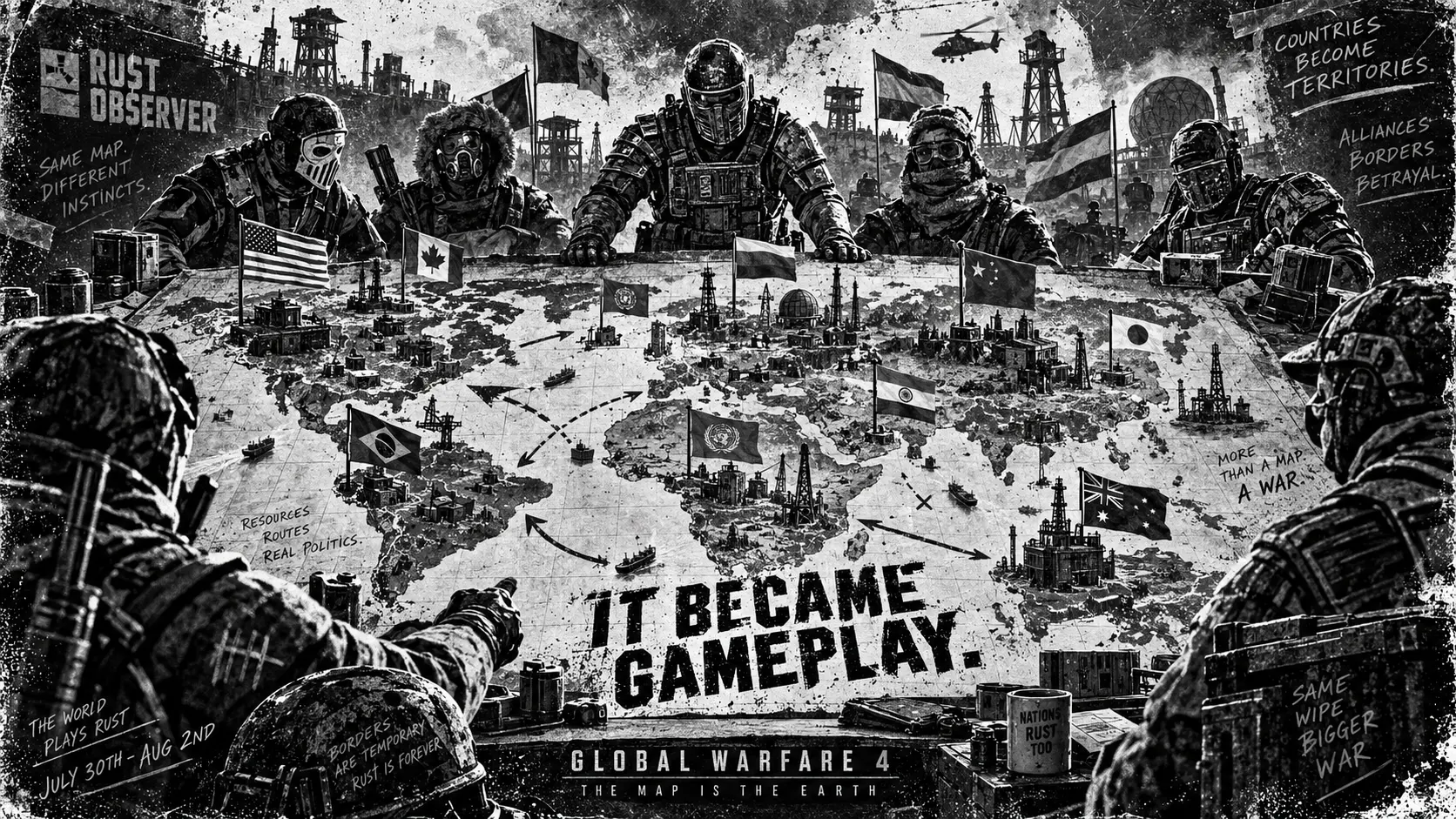
FancyOrb’s Global Warfare turns geography itself into the format.
Global Warfare uses the world as its map. Countries and regions become territories. Players organise nations, form alliances, betray neighbours and fight over recognisable pieces of Earth.
Its sequel expanded the idea toward roughly 1,000 players, with many representing their real countries or regions.
Geography was no longer background information about the creator.
It became gameplay.
That inversion is useful.
Everywhere else, Rust allows audiences to escape geography. In Global Warfare, geography is deliberately brought back into the server and turned into the story.
Speaking English still does not magically turn a Danish, Dutch, Ukrainian or Russian creator into an anglophone creator.
It is often simply a language of circulation.
Large events make this visible. Participants need enough shared language to coordinate while broadcasting the same activity toward entirely different audiences.
The event shares a server.
It does not require everyone to share an audience.
LIVE IS ONLY ONE STATE OF THE CONTENT
YouTube made Rust watchable after the fact.
Twitch made it simultaneous.
The viewer could now be present while an encounter happened, react in chat and see mistakes before an editor removed them.
Twitch also helped establish a habit that survived its changing archive system. As early as 2012, Twitch provided ways to export broadcasts to YouTube. In 2014, when ordinary Past Broadcast storage became temporary rather than permanent, Twitch explicitly encouraged creators to preserve important material through Highlights and YouTube export.
Then Clips gave viewers another way to isolate moments worth keeping.
The result is still obvious.
A Welyn stream can pull numbers in the thousands, while a polished YouTube story built from the material can later reach hundreds of thousands of views.
Those measurements are not directly comparable.
Their scale still tells us something.
The livestream was the event.
It was not necessarily the final audience.
YouTube allows the same material to become searchable, recommendable and discoverable months or years later.
Frost’s jump shows the next stage.
The complete movie survives.
The isolated moment survives too.
And sometimes the isolated moment becomes easier to recognise than the work around it.
For many creators, livestreaming became where the raw material happens.
YouTube became where it survives.
Clips and Shorts became places where it keeps travelling.
THE PLATFORM IS NOT THE POINT
By 2026, none of this is particularly exotic.
YouTube, Twitch, Discord, TikTok, Instagram, Reddit, Steam and search engines surround thousands of games.
Players already know how to use them.
That is useful.
Facepunch gains little by forcing Rust players through a proprietary alternative to something that already works.
Players were taking team communication outside games long before Discord existed. TeamSpeak, Ventrilo and Mumble filled that role during earlier generations of online gaming.
Rust has its own communication system.
Proximity voice belongs to the world. Press V, talk, and nearby players can hear you. Distance and the danger of being overheard are part of the mechanic.
External voice solves another problem.
The teammate across the map can hear you without the naked man outside the compound hearing the raid plan.
Discord is simply the dominant modern solution. The same job could technically be done elsewhere.
Facepunch has enough pieces to imagine private group voice inside Rust: teams, text communication and voice already exist.
It has not needed to make that a priority.
And when Facepunch wanted Discord closer to Rust, it integrated Discord rather than rebuilding Discord.
The surrounding platforms perform different jobs because users already made them useful for different things.
| Layer | What tends to happen there |
|---|---|
| Twitch / live | Live interaction, events, subscriptions, Drops |
| YouTube | Edited stories, tutorials, archives, search and long-term discovery |
| Shorts / TikTok / Reels / clips | Small pieces capable of travelling much farther than the original stream |
| Discord / external voice | Team communication, creator production, event organisation, persistent communities |
| Reddit / social media | Discussion, reaction, memes and discovery |
| Search | Discovery without already knowing the creator |
| Steam | Game ownership, commerce and Rust inventory |
| Rust itself | Where many external signals return and become playable |
The interesting part is not that Facepunch invented this arrangement.
It did not.
The important part is that Rust can connect to it without having to own every piece.
And the arrows do not all point away from Rust.
Peanut can arrive with an audience built elsewhere.
That audience can meet Rust creators.
Some viewers stay.
Some creators leave together for another game.
The network is not a funnel.
It is a mesh.
ENOUGH INDEPENDENCE TO CHOOSE
Using outside platforms does not mean Facepunch wants to be helpless if one changes.
The Unity licensing controversy provided a particularly visible reminder that a third party can alter terms after another studio has spent years building on its technology.
Independence does not require rebuilding everything for ideological purity either.
Rust still uses Twitch for Drops.
Twitch handles Twitch.
Steam handles Steam.
Facepunch handles the pieces Rust needs to connect them.
Being capable of replacing a dependency is different from needing to replace it today.
THE FRONT DOOR
The Rust Store shows where Facepunch did want another layer.
After larger paid DLC such as Instruments, Sunburn and Voice Props, Facepunch introduced the permanent in-game Store in November 2021.
Steam remained underneath it.
Steam can process the transaction and hold the inventory.
Rust gained its own storefront — and, more importantly, Facepunch controls the front door.
A player does not even need to enter the Store deliberately. The HOME screen can expose an item or promotion before the player presses Play.
The player did not search Steam.
The player opened Rust.
For a skin, creator item, collaboration or promotion, that distinction matters.
Facepunch does not have to rebuild Steam to control what appears inside its own game.
RECOGNITION
Facepunch does not discover or publish every useful Rust creator.
It does not need to.
RustyForge can build a modest audience around useful technical videos without regularly appearing in a Community Update. HiddenJoint can build a paid specialist audience. Templetaps can produce a tiny catalogue whose designs continue circulating for years.
Facepunch recognition is an amplifier.
It is not a prerequisite.
When Facepunch does become involved, that recognition carries another function: trust.
A video can appear in a Community Update. An achievement can be highlighted. An event can receive an official announcement. A skin can be approved. Twitch Drops can be enabled. A fundraiser can be linked through official channels.
That matters in an ecosystem containing money, accounts, virtual items and enormous amounts of third-party activity.
The surrounding Internet contains sites promising skins, scripts, rewards and services that Facepunch did not create.
Their existence does not make them Facepunch projects.
The official layer therefore becomes a useful trust anchor.
Independent and recognised are not the same thing.
Neither necessarily means forbidden.
WHEN THE SIGNAL LEAVES THE GAME
Most of the resonance surrounding Rust is harmless, creative or useful.
There is a darker version.
And it does not require fame.
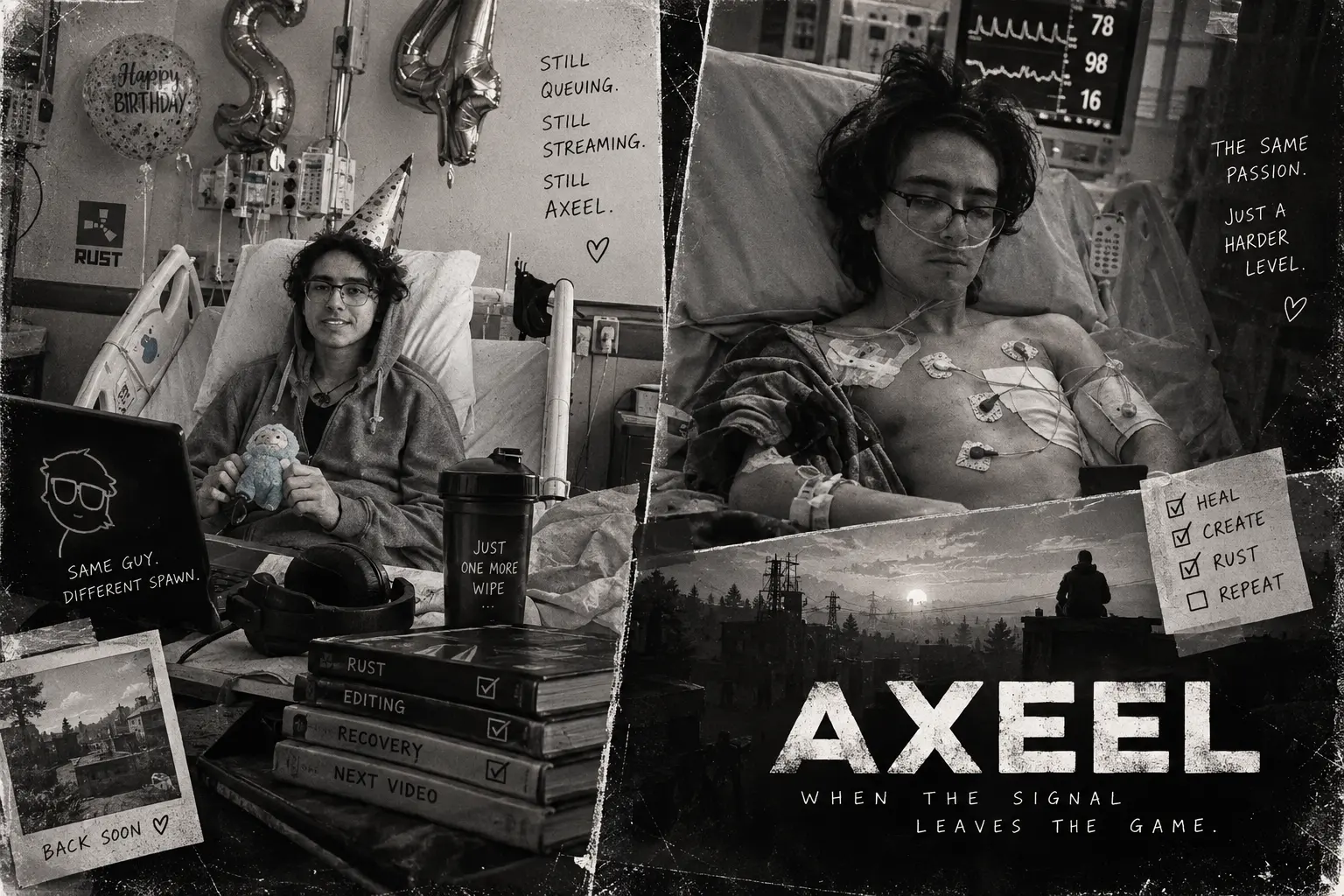
In April 2026, Axeel Melendez, a 24-year-old Rust player in Tucson, Arizona, became the victim of a catastrophic swatting incident after a dispute originating around Rust moved into his real identity.
The story began with an accusation of cheating and what was presented as a PC check. According to reporting and Melendez’s legal claim, access to personal information was followed by threats and extortion.
Melendez contacted law enforcement himself and warned that he might be swatted.
Two days later, someone impersonating him reported a violent emergency at his home.
Deputies arrived before dawn. Melendez, believing someone connected to the earlier threats might be breaking in, obtained the legally owned handgun kept in the home. Deputies fired several rounds when they encountered him armed.
Two bullets struck him.
A spinal injury left him paralyzed from the chest down.
His family later filed a $176 million notice of claim against Pima County and the Sheriff’s Department.
IGN — Rust Fan Seeks Legal Action After Swatting Incident Leaves Him Paralyzed
What makes the case especially disturbing is that Axeel was not a major streamer whose public visibility made him an obvious target.
This was not someone attempting to destroy a celebrity’s reputation in front of an audience.
He was a player.
Fame can make someone easier to find.
Fame is not required.
A sufficiently malicious person only needs a way to connect the player on the screen to the person behind it.
A cheating accusation became access to a computer.
Access became personal information.
Personal information became extortion.
Extortion became a false emergency call.
And something that began around a Rust server eventually reached a bedroom in Tucson.
The connection matters without pretending that Rust itself caused the shooting.
The game was where the contact began.
The consequences escaped it.
STELIC, normally associated much more closely with Rust guides, tips and building content, brought the story back into the Rust media ecosystem in September 2026.
The video shows another side of creator work. STELIC reconstructs the chronology for a Rust audience using footage and contemporary news coverage on screen, turning a scattered real-world story into something viewers of his usual material can follow.
The event happened once.
The story travelled again.
A network capable of carrying films, jokes, collaborations, charity campaigns and careers can also carry harassment, doxxing and abuse.
Resonance is not automatically positive.
THE DROP
Twitch Drops show a much more benign way that external attention can return to Rust.
A creator announces an event.
The event travels through Twitch, YouTube, Discord and social media.
Facepunch identifies the recognised campaign.
Twitch measures viewing.
The resulting object reaches the player’s Rust inventory through the linked Steam identity.
Some people deliberately hunt every Drop.
Others never started watching for the Drop at all.
For those viewers, the first reward may arrive almost accidentally — a notification attached to time they were already spending with a creator they liked.
That small difference matters.
The reward did not always produce the relationship.
Sometimes it simply marked one that was already there.
Years later, those objects remain.
A Steam inventory can quietly become an archive of events and people the owner once watched.
The stream is gone.
The object still exists.
AN AUDIENCE BECOMES MEASURABLE
Creators do not need to begin by understanding the entire economy that may eventually grow around them.
Platforms eventually turn attention into numbers: subscribers, average views, watch time, concurrent viewers, returning viewers and clicks.
Those numbers are not artistic scores.
They tell somebody else that an audience exists.
Sponsors, affiliates and brand partnerships begin to appear.
Welyn has worked with brands such as G Fuel.
Willjum spent years making Manscaped promotions fit his own humour rather than dropping an unrelated commercial block into the middle of a video. In 2025, one of his Father’s Day promotions still carried a dedicated WILLJUM15 code.
War Thunder does not need a Rust raid to have anything to do with tanks.
It wants the people watching.
An audience initially assembled around Rust becomes valuable to something completely outside Rust.
The important result is simple:
the creator has become a medium.
SUPPORT CAN MEAN DIFFERENT THINGS
Even a “subscription” does not mean the same thing everywhere.
On Twitch, subscribing can become part of the performance. The alert fires, the streamer sees it, chat sees it, and the act of support enters the live moment.
Resubscriptions make the relationship especially visible: the viewer is not only here.
They came back.
Anyone who watches enough Welyn live-derived material eventually becomes familiar with one particular sound:
“Welcome Back.”
The stream continues.
YouTube’s free Subscribe button does something else. It places the creator in the viewer’s future. The relationship can then deepen into paid memberships where available.
HiddenJoint pushes that second layer unusually far. Public videos attract viewers to an expertise-heavy building channel while much of the larger catalogue is reserved for paying members.
A giant audience is not required.
A sufficiently interested audience can be enough.
THE SAME NETWORK CAN DO SOMETHING ELSE
Once creators, communities, sponsors, platforms and server operators are connected, the network can be pointed toward something other than entertainment.
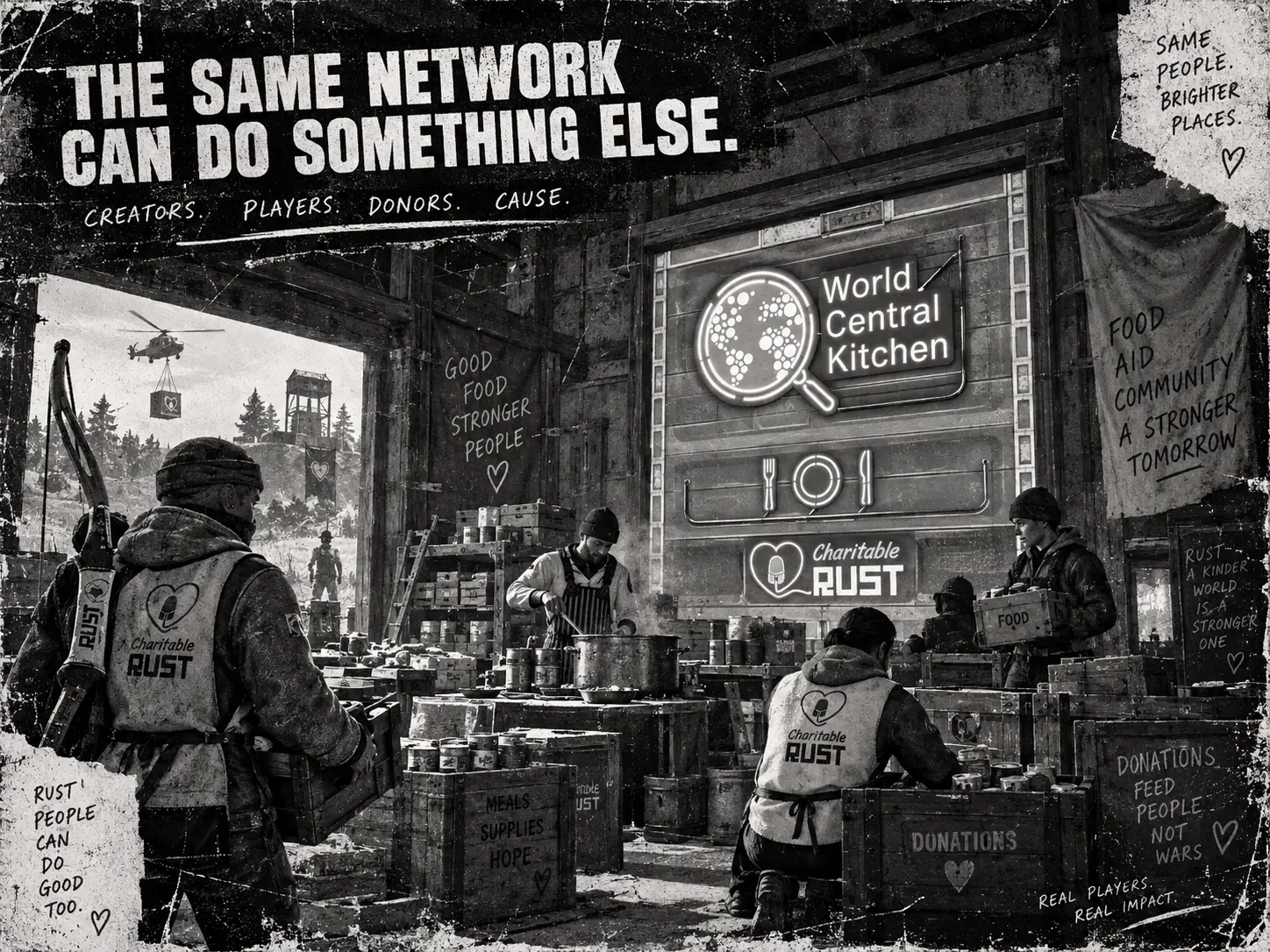
Charitable Rust demonstrates the principle clearly.
What began as community charity activity grew into events involving Rustafied, participating creators, custom servers, Facepunch, Twitch, Drops, charity skins, sponsors, giveaways and large public donations.
The 2022 Charitable Rust campaign for World Central Kitchen ultimately raised roughly $253,796.
Earlier and later campaigns supported other causes, including mental-health services, humanitarian relief, clean water and medical organisations.
Trust in Rust, YouAreRAD, Uterust and other events use different arrangements. Some begin close to Facepunch. Others emerge farther out in the community and later gain support, infrastructure or visibility.
The participants do not all contribute the same thing.
Creators bring audiences.
Artists bring objects.
Server operators bring infrastructure.
Partners bring services or money.
Viewers bring attention and donations.
The network already existed.
The cause temporarily gave it another direction.
THE VIEWER
The viewer leaves the smallest individual footprint.
A view. A click. A little watch time. A subscription. Perhaps a comment, membership, purchase or donation.
Collectively, those tiny actions are what everyone else eventually measures.
How someone becomes that viewer is an entire field of study: titles, keywords, search results, thumbnails, recommendations, Shorts, external links, friends and algorithms.
The useful observation here is simpler.
Different kinds of players bring different kinds of viewers.
Someone entering through Willjum is being shown a very different Rust from somebody discovering ImBernE.
Someone looking for a bunker may land on Reksmore.
Someone troubleshooting automation may find RustyForge.
Someone wanting the life of a full PvP wipe may discover Coma.
Someone might encounter XkEVV during an international event, then follow him back to his own community.
Someone can arrive with TheBurntPeanut without having been interested in Rust at all.
And someone who originally found CoconutB through Rust may happily watch him get thrown out of WARDOGS because, by then, the game is only part of why they are watching.
The viewer does not have to discover Rust media.
They discover a person, a problem, a story or a moment.
Rust happens to be underneath it.
Sometimes.
NOBODY HAS TO SELL RUST
Most creators are not Rust salespeople.
They want their own work to succeed.
Welyn wants people to watch Welyn. An artist drawing his thumbnails wants people to discover the artist. A builder wants viewers to use the design. A streamer wants viewers to return. A sponsor wants clicks. An event organiser wants people to show up. A charity wants donations.
Those motives do not need to match.
Welyn regularly points viewers toward the people behind artwork used in his videos. One creator’s audience becomes another creator’s opportunity.
Rust benefits without being the transaction.
OTV demonstrated the same principle at enormous scale.
Viewers followed personalities they already knew into Rust. They watched them build, role-play, fight, organise groups, argue and improvise.
Nobody needed to stop every ten minutes and say:
Buy Rust.
The game advertised itself by being useful material for something people wanted to watch.
TheBurntPeanut demonstrates the same mechanism from another direction.
An audience established somewhere else can enter Rust because the creator entered Rust.
Welyn can appear beside Peanut.
Rust viewers discover Peanut.
Peanut viewers discover Welyn.
Later, the same people can appear together somewhere that is not Rust at all.
Nobody has to sell anything for that circulation to happen.
Rust does not need creators to sell Rust.
It needs to remain useful enough that people continue wanting to do things with it.
A LINK IN THE CHAIN
That principle changes what an article like this should do too.
There is little value in mentioning hundreds of creators simply to prove that hundreds exist.
But when an active creator is used as an example, there is value in leaving the door open.
A reader should be able to click on Welyn, RustyForge, XkEVV, HiddenJoint, Reksmore, Frost or another contemporary example and see what that person is making now.
Older creators and vanished channels still belong in the historical record when they establish how the medium developed.
Contemporary examples should lead somewhere alive.
The article then becomes a tiny part of the same mechanism it describes.
A reader discovers a name.
Clicks.
Watches.
Perhaps subscribes.
Perhaps becomes a fan.
Perhaps follows that creator somewhere completely unexpected.
The report itself becomes another link in the chain.
RESONANCE
Facepunch made Rust.
It did not make every movie, tutorial, stream, community, illustration, joke, server, event or audience that grew around it.
Nor did it invent the platforms carrying them.
Most of those systems belong to the larger culture of online gaming and digital media.
What Facepunch has repeatedly managed to do is leave enough room for them to work.
Sometimes it highlights what people made.
Sometimes it provides Drops.
Sometimes it adds an item to Rust.
Sometimes it offers an official link people can trust.
Sometimes it builds another layer of its own.
And sometimes Twitch, Steam, Discord, YouTube or the players themselves are already doing the necessary job.
Around that structure, completely different careers can emerge.
One creator grows from zero into a million-view storyteller.
Another stays small and sells specialised knowledge to committed members.
Another publishes ten videos and leaves behind a design that circulates for years.
Another plays Rust for a decade before deciding anybody should hear from him.
A filmmaker spends months constructing a story, and a few seconds from that story survive long enough to become a challenge ordinary players try to perform themselves.
Two collaborators play together often enough that viewers begin anticipating the joke before either creator explains it.
A scream becomes recognisable.
A friendship becomes a format.
One creator brings an audience from another game into Rust.
A Rust creator meets that audience.
Then the same people leave Rust for an evening and discover that the audience followed them anyway.
A technical creator finds a terrible story outside normal gameplay and carries it back to an audience that might otherwise never have seen it.
A viewer comes for a Drop.
Another comes for a raid.
Another wants to learn electricity.
Another follows a celebrity into an event and discovers Rust almost accidentally.
None of them needs the same objective.
None of them even needs to recognise the same Rust.
And Rust does not always have to be the beginning of the signal.
Sometimes the signal starts somewhere else, enters Rust, picks up new people and ideas, then leaves again.
Sometimes something born in Rust escapes into the outside world.
Sometimes it returns years later as a clip, a joke, a skin, an event, a collaboration, a challenge or a memory.
The signal does not simply move outward.
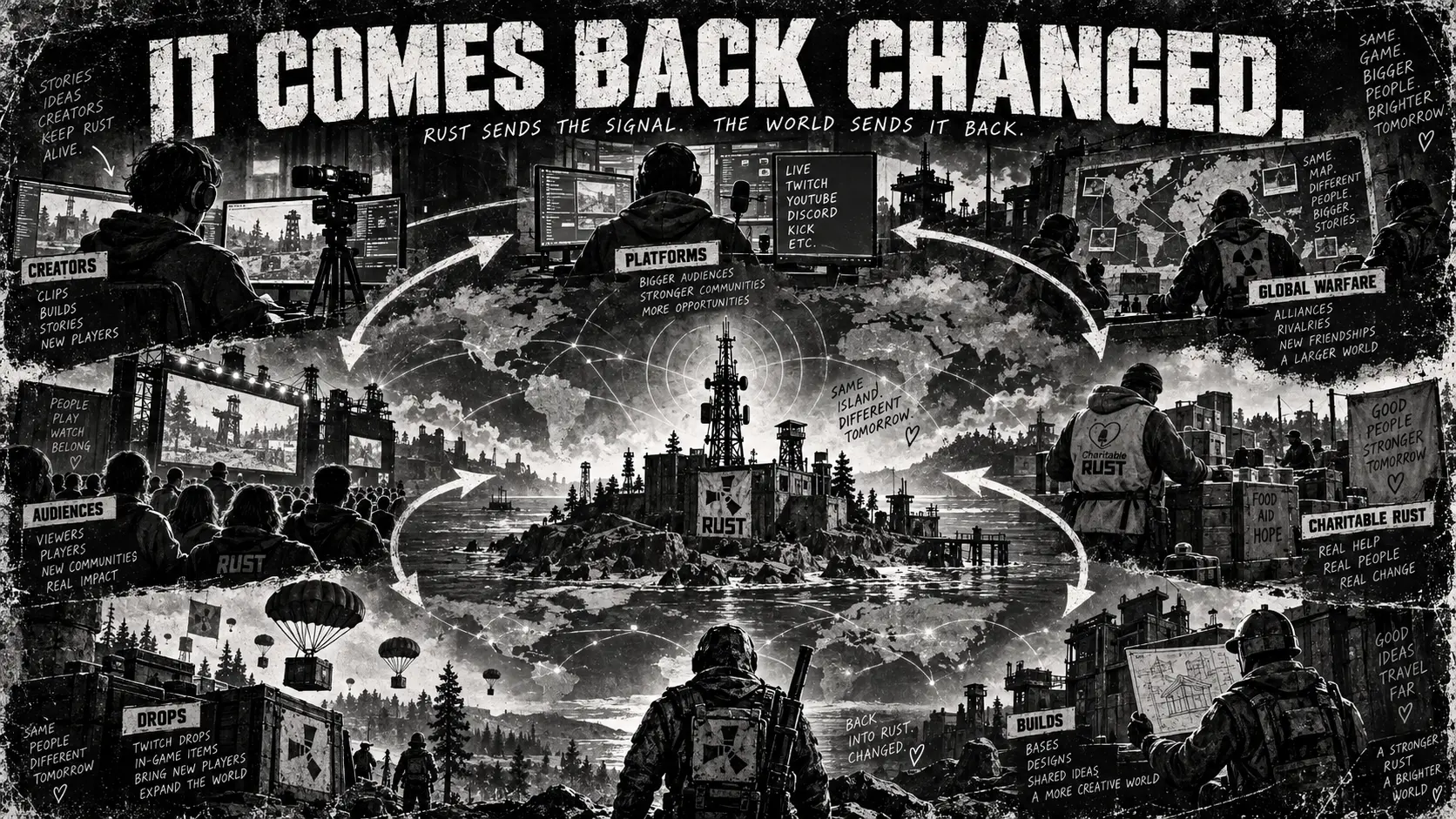
It comes back changed.
That is resonance.