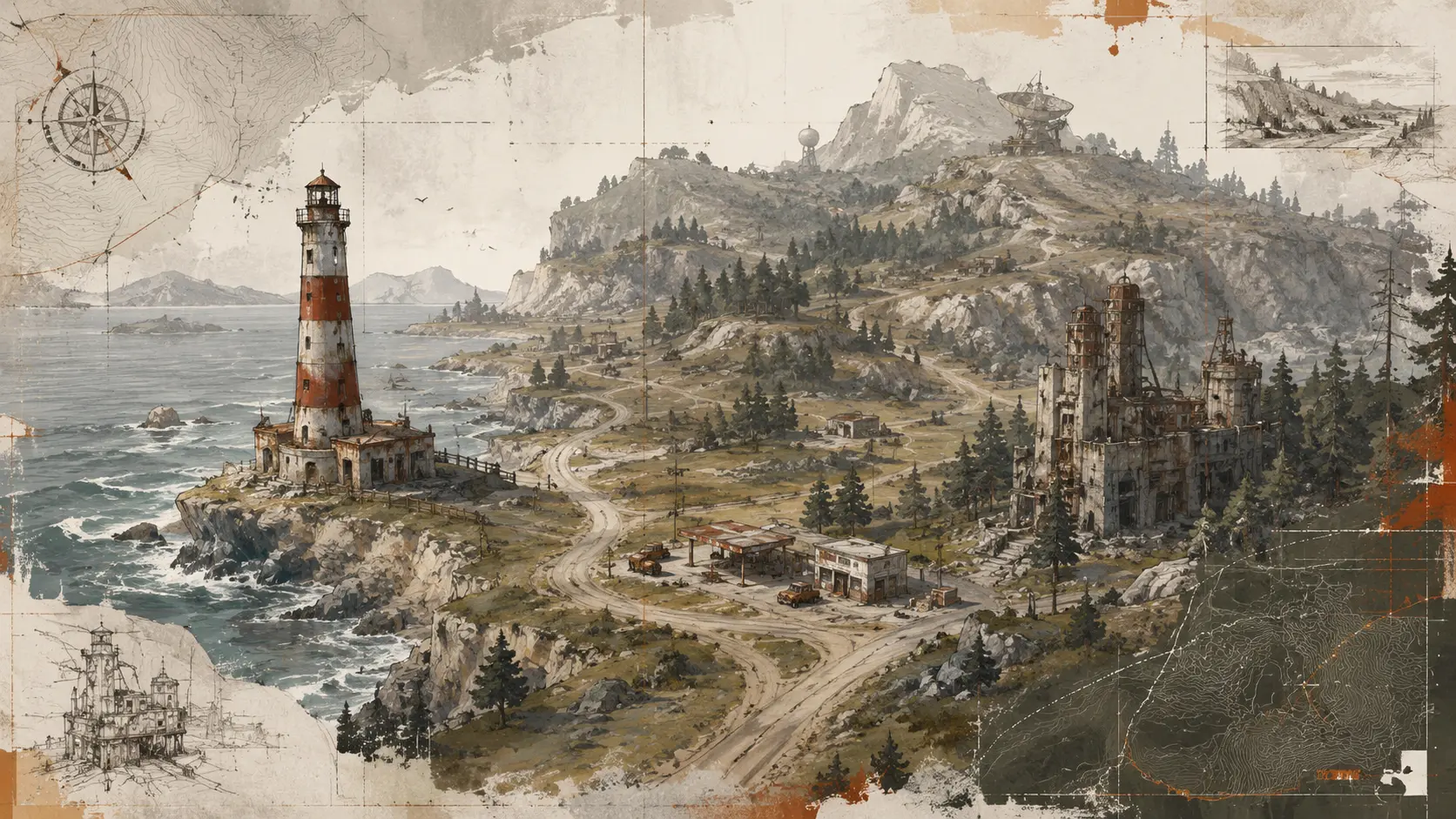
Why Rust Observer Exists
Rust has always been more than a survival game. Yes, the main goal is simple: stay alive. Find food. Avoid the cold. Build a base. Survive the wipe. Watch the horizon. Listen for footsteps. Learn very quickly that every quiet moment in Rust is probably not as quiet as it sounds. But after enough hours…
Rust has always been more than a survival game.
Yes, the main goal is simple: stay alive. Find food. Avoid the cold. Build a base. Survive the wipe. Watch the horizon. Listen for footsteps. Learn very quickly that every quiet moment in Rust is probably not as quiet as it sounds.
But after enough hours on the island, something else starts to appear.
You stop seeing only loot rooms, recycler spots, ambush angles, and raid targets. You start seeing places.
A lighthouse is not only a place to loot.
A gas station is not only a stop on the road.
A harbor is not only a monument.
A bus stop is not only a spawn point or a strange bit of roadside furniture.
These places have shapes.
They have silhouettes.
They have routes, blind spots, entrances, dead ends, hiding places, vertical movement, exposed ground, and stories that are never fully explained.
That is where Rust Observer begins.
Looking at Rust as a world
Rust is brutal, funny, unfair, chaotic, social, creative, and strangely beautiful.
Most players learn to look at it through immediate needs: where to farm, where to recycle, where to build, where to avoid getting shot. That is normal. Rust teaches urgency. The island does not wait for you to appreciate the architecture.
But the world of Rust is full of design choices worth observing.
Why is this building shaped this way?
Why does this monument feel abandoned instead of simply empty?
Why does a certain road, tower, harbor, or ruin feel familiar?
Could this place have a real-world inspiration?
How does a structure become interesting once players are allowed to climb it, camp it, loot it, fight in it, or build around it?
Rust Observer exists to explore those questions.
This is not a general Rust wiki.
This is not a loot database.
This is not a PvP strategy site.
This is not a patch notes archive.
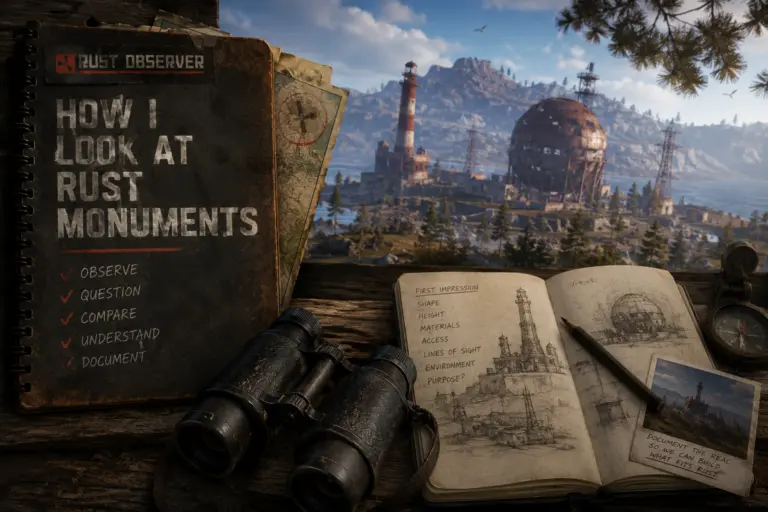
Rust Observer is a field notebook for places.
Monuments are not just monuments
In Rust, monuments are more than named locations. They are social machines.
A monument controls movement.
It creates risk.
It attracts players.
It creates stories.
It gives a server rhythm.
Some monuments are loud and obvious. Others are small, almost invisible, but still shape the way players move through the island. A lonely road sign, a broken structure, a tunnel entrance, a shoreline, a lighthouse, or a bus stop can change the mood of a whole area.
That is especially important for custom maps.
When you create a map, you are not only placing objects. You are creating reasons for players to move, hesitate, explore, hide, fight, return, or remember a place.
A good monument is not just a building.
It is a situation.
The real world behind the island
One of the most interesting things about Rust is how often its world seems to echo real places.
Industrial ruins.
Remote lighthouses.
Soviet-era structures.
Roadside infrastructure.
Coastal buildings.
Military leftovers.
Abandoned transport systems.
Weathered concrete, metal, pipes, towers, fences, and platforms.
Rust does not need to explain everything directly. In fact, part of its strength is that it does not.
The island feels like it came after something.
After a project.
After a collapse.
After an evacuation.
After a test.
After a society that left behind just enough for us to wonder what happened.
Rust Observer will look at those echoes.
Sometimes the link will be strong.
Sometimes it will be only a visual comparison.
Sometimes it will be a hypothesis.
Sometimes it will simply be a useful reference for building something new.
The point is not to pretend that every shape has one official answer. The point is to observe carefully, compare honestly, and separate facts, observations, and hypotheses.
From reference to playable space
Copying a real building into Rust is not enough.
A real lighthouse, factory, bunker, pier, radar station, or roadside building may be beautiful, historically interesting, or visually perfect. But once it enters Rust, it has to become playable.
Can players climb it?
Can they get trapped?
Can they hide too easily?
Can they defend it too well?
Does it create unfair sightlines?
Does it reward exploration?
Does it make sense with terrain, water, roads, cliffs, and player movement?
Does it feel like Rust?
That translation is where things become interesting.
A custom monument is not a museum model. It has to survive contact with players.
Players will jump where they are not supposed to jump.
They will build where you hoped they would not build.
They will camp the one shadow you forgot.
They will turn a decorative detail into a tactical advantage.
They will find the hole in your idea.
That is part of the work.
Rust Observer will document that process: the references, the mistakes, the technical constraints, the terrain problems, the underwater surprises, the gameplay decisions, and the compromises that turn a real-world idea into a Rust location.
Archives, new maps, and old ghosts
Rust Observer is also a return. It was first called Rust.Exposed
Over the years, many ideas, maps, monuments, articles, screenshots, tests, and unfinished projects have been created, shared, lost, archived, or left behind. Some deserve to come back. Some deserve to be corrected. Some deserve to be rebuilt from the ground up.
This site will bring those pieces together.
Old Rust Exposed archives.
New monument studies.
Custom map development notes.
Real-world inspiration files.
Backstory hypotheses.
Technical breakdowns.
Community observations.
Playable experiments.
Not everything will be polished from day one. That is fine. Rust itself is a world of half-broken things, improvised shelters, unfinished structures, and strange ruins that somehow still matter.
The important thing is to start observing again.
A different way to look at Rust
Rust has enough guides about how to win.
Rust Observer is more interested in another question:
What are we actually looking at?
What is this place?
Why does it feel familiar?
What could it have been?
What can it become?
How does a monument change the way players move, fight, build, and imagine the island?
That is the work.
Observe the ruins.
Understand the places.
Rebuild the island.
Welcome back to Rust Observer.