Frog Boots: The Wellipets Connection
The old Rust Hazmat disappeared, but its strangest boot survived. From a British Frog Wellington born in 1983 to an Early Access reward and an official Wellipets collaboration forty-one years later, the Frog Boots made an extraordinary round trip between the real world and Rust.
Rust once had one of the strangest pieces of radiation protection imaginable.
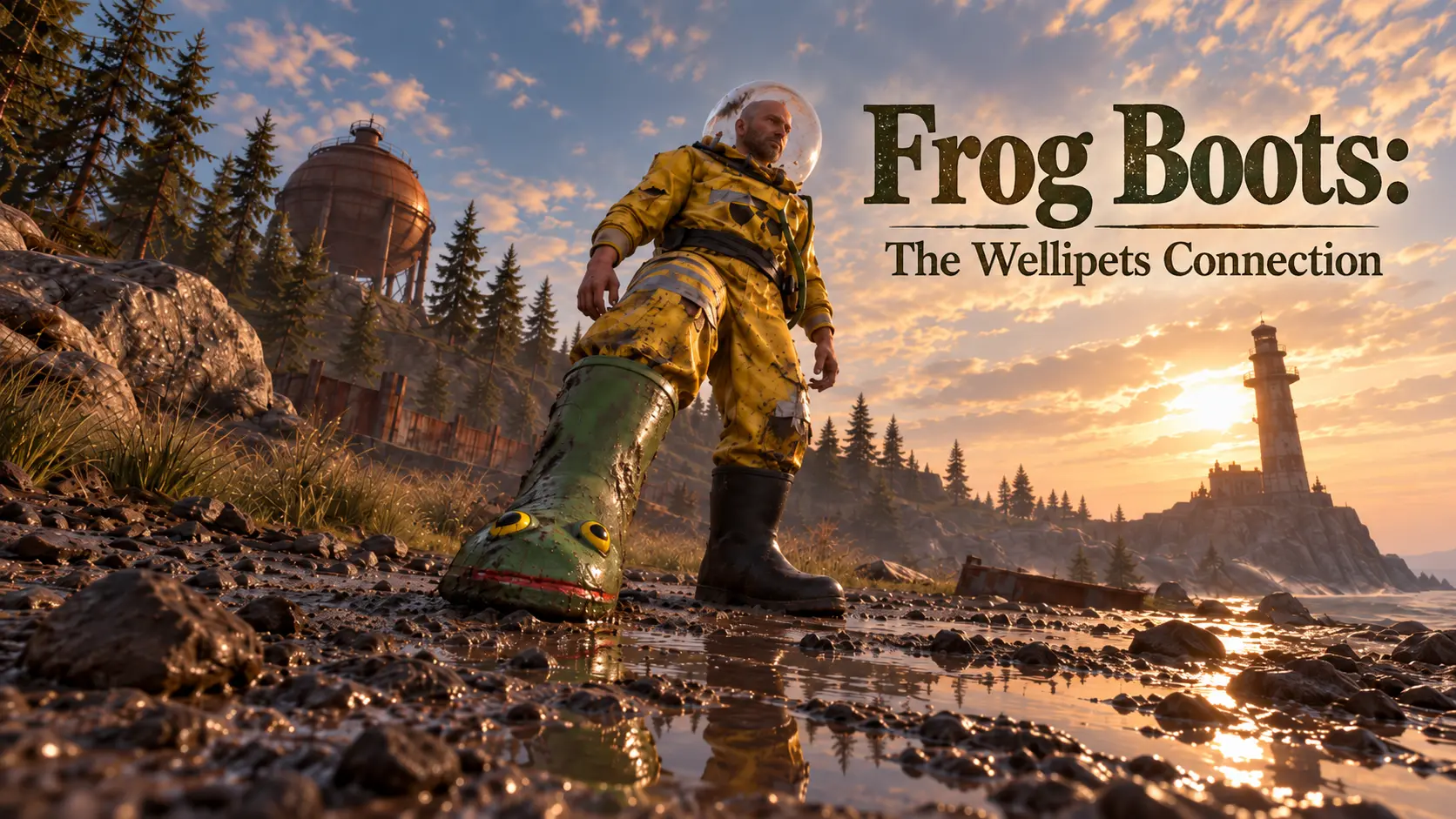
The old Hazmat suit wore mismatched boots. One was a plain dark rubber boot. The other was tall, green, and had two protruding yellow eyes and a smiling red mouth.
A frog Wellington.
Taken by itself, it looked ridiculous.
On that Hazmat, it made perfect sense.
Whatever Was Available
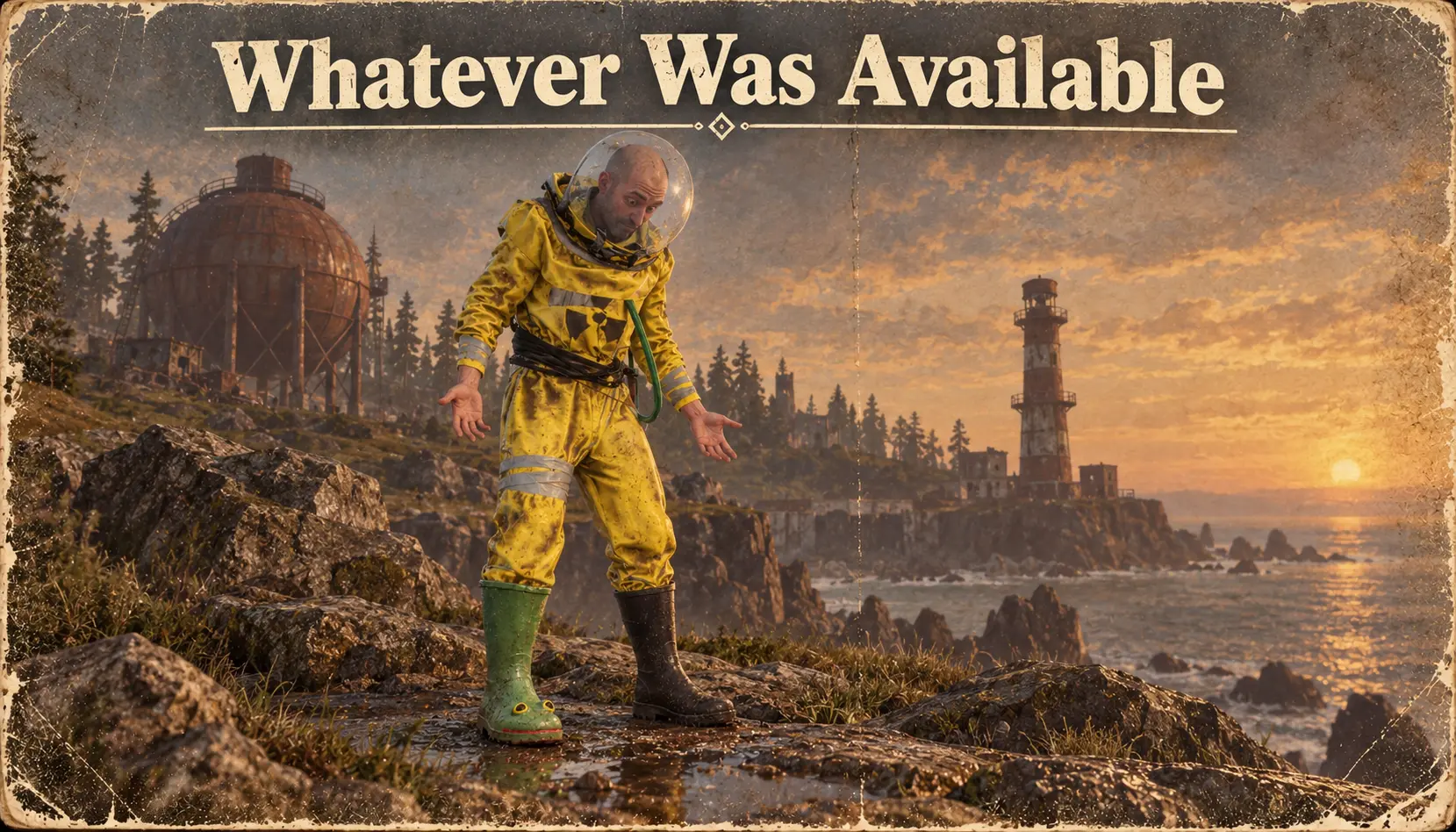
The old Hazmat was deliberately built to look improvised.
It was torn, patched, taped and assembled from mismatched pieces. This is not just an interpretation made years later: when Taylor Reynolds worked on its replacement in 2017, he described the old radsuit as more “MacGyver’d”, adding the little obituary: “RIP frog booties.” (Rust)
That makes the Frog Boot more than a visual joke.
The suit looks as though one proper boot had been lost or damaged, and someone simply replaced it with whatever happened to be available.
And apparently, what was available was a child’s frog Wellington.
Two clean matching boots would have made the outfit more believable as manufactured protective equipment, but less believable as the cobbled-together object Facepunch wanted.
The Frog Boot was funny because it made sense.
The surviving Rust Art Trello material also helps establish the design lineage. The archived Refined Hazmat Concept notes that the work was based on one of Megan Tupper’s concepts. Later, Taylor Reynolds explicitly credits Paul’s concept art while blockouting the craftable Hazmat. Refined Hazmat Concept — Rust Art Trello (Rust)
So the path is not simply “old Hazmat discarded, unrelated Hazmat created.” Concept work was refined through several hands and several variations.
And one curious detail survived.
The frog disappeared.
The green boot did not.
The old Hazmat had one dark boot and one green Frog Boot. The refined concepts still explored that asymmetry, and the final modern Hazmat kept a green boot opposite a darker one — only without the frog face.
The redesign removed the joke, but retained part of its silhouette.
Goodbye, Mr. Froggy Boots
On January 18, 2018, Facepunch released the new craftable makeshift Hazmat Suit, modeled by Taylor Reynolds, replacing the previous item visuals. (Rust)
The following day, Shadowfrax presented it in his Rust update video and immediately acknowledged the missing frog:
“I’m sorry to say that sadly none of your relatives were invited to this party.”
New Hazmat Suit, Water Well Monuments — Shadowfrax, 19 Jan 2018
The joke works because players already knew exactly who “Mr. Froggy Boots” was.
The Frog Boot had become one of the recognizable quirks of the old Hazmat.
Facepunch was moving toward something cleaner and more coherent, though still deliberately scavenged. Taylor himself described the replacement as less MacGyver’d while still looking cobbled together from various pieces. (Rust)
The frog no longer belonged on the suit.
But Facepunch was not finished with it.
The Boots Escaped
On February 8, 2018, Rust left Early Access.
And the Frog Boots came back.
Facepunch gave the standalone Frog Boots to the players who had supported Rust during its Early Access run. The changelog announced their return with the wonderfully serious entry:
“Added Frog Boots, My Dudes.”
(Rust)
Five days later, Community Update 171 described their return explicitly as a re-introduction and a special thanks to Early Access players. (Rust)
That is an important transformation.
Originally, the Frog Boot existed as part of the Hazmat. A player did not choose one boot independently; it belonged to the suit.
After 2018, the mismatched pair became an item of its own.
The old Hazmat disappeared, but its strangest component survived independently on the accounts of Early Access players. The Frog Boots remain an actual craftable clothing item in Rust today. (Facepunch Wiki)
So it can still happen.
Meet the right veteran player on a server and you may encounter a fragment of a discarded Hazmat design walking around the island on somebody’s feet.
The suit disappeared. The boots escaped.
They Came From Somewhere
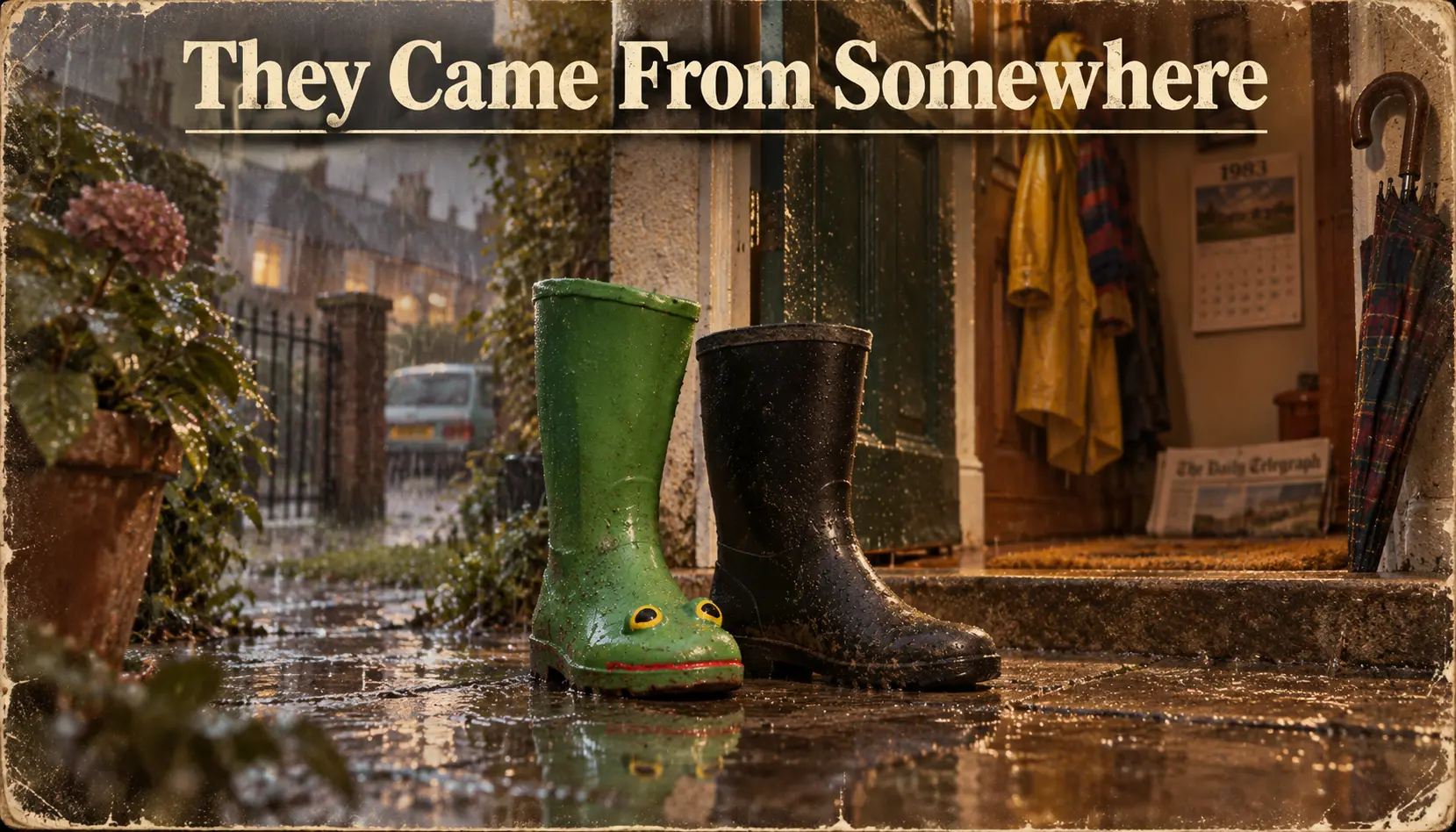
Rust did not invent the frog Wellington.
Wellipets traces its history to 1983, when the company was founded in the United Kingdom. Wellipets describes itself as the first rain boot to combine the traditional Wellington form with a playful frog design. (Wellipets.co.uk)
That distinction matters.
Rust’s boot is not simply a generic Wellington that happens to be green.
The frog is the product identity.
The protruding eyes, rounded frog face and red mouth make it immediately recognizable. Wellipets still describes those elements — including its green colour and yellow eyes — as recurring parts of its visual language. (Wellipets.co.uk)
And the resemblance becomes even more interesting when the historical Wellipets shape is compared with Rust’s model.
The older Wellipets design is simpler and rougher: a tall uncomplicated shaft, a large projecting frog face and comparatively crude detailing. Rust’s Frog Boot resembles that older form much more closely than today’s refined fashion version.
Modern Wellipets are deliberately reworked. The company describes its current boots as a reinterpretation of the iconic shape, now made in Italy with carefully developed fit, soles and hand-painted details. (Wellipets.co.uk)
That does not tell us which photograph, boot or drawing a Rust artist had beside the desk.
It does not need to.
The visual relationship is already obvious enough.
A British Memory
There is another reason not to treat Wellipets as some obscure object Facepunch happened to discover decades later.
They belong to British popular memory.
Wellipets says the boots became particularly successful in the United Kingdom, and Princess Diana famously dressed Princes William and Harry in them. (Wellipets.co.uk)
We cannot claim that any particular Facepunch developer owned a pair as a child. There is no evidence for that.
But we also do not need to pretend that the reference would have been culturally exotic to people growing up in Britain.
Designer Jonathan Anderson gives us a particularly useful independent example. Discussing his own later collaboration with Wellipets, he said the boots reminded him of childhood — “they were such a thing to have” — and described them as an icon of design. (Wellipets.co.uk)
So a British studio putting a ridiculous Frog Wellington onto a scavenged Hazmat does not require a complicated origin story.
It may simply have been a very familiar funny object placed exactly where a funny object was needed.
1983, Again
And then there is the coincidence that Rust Observer cannot possibly ignore.
Wellipets: 1983.
Our reconstructed modern Rust chronology: April 26, 1983.
Wellipets only documents the year, not a sufficiently precise British retail launch date for us to put a pair confidently on a shelf by April 26. (Wellipets.co.uk)
But that is not actually required.
The old Hazmat design should not be forced retroactively into every chronological constraint we can establish for the later Rust world. The prop was created by artists working with real-world references available to them, and the game itself changed enormously during development.
So 1983 is not evidence that the Frog Boot belongs on the island.
It is simply an exceptionally appropriate collision.
One of Rust’s strangest props originates from a real product born in exactly the year in which Rust Observer finds the modern island.
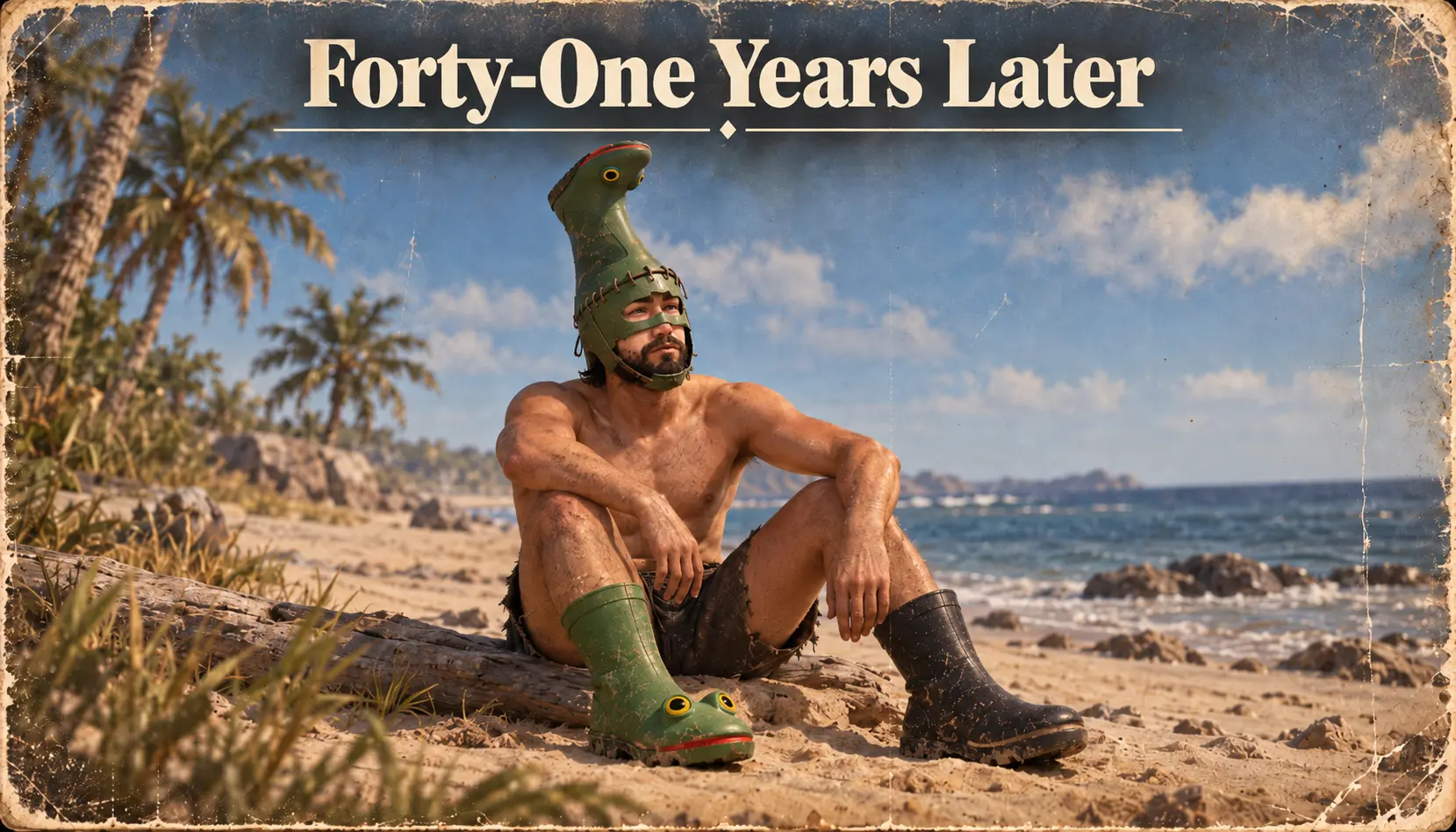
Forty-One Years Later
Then, in 2024, the implicit relationship became explicit.
Facepunch officially partnered with Wellipets.
And Facepunch itself removed any remaining ambiguity about what those old Frog Boots represented: its announcement calls them Wellipets’ iconic Frog Boots and directly connects the collaboration to the boots previously given to Rust’s Early Access players. (Rust)
This was not simply a shoe company putting a Rust logo onto an unrelated product.
Wellipets was already, visually, inside Rust.
And the physical collaboration did something particularly clever.
Wellipets did not manufacture two identical green boots.
They manufactured Rust’s pair:
one green Frog Wellington and one black boot.
Facepunch called them the original Rust colours. (Rust)
So the direction of influence folded back onto itself.
Wellipets created the frog Wellington.
Rust turned it into one half of a mismatched survival outfit.
Wellipets then manufactured Rust’s mismatched interpretation in the real world.
The source had become the replica of its own descendant.
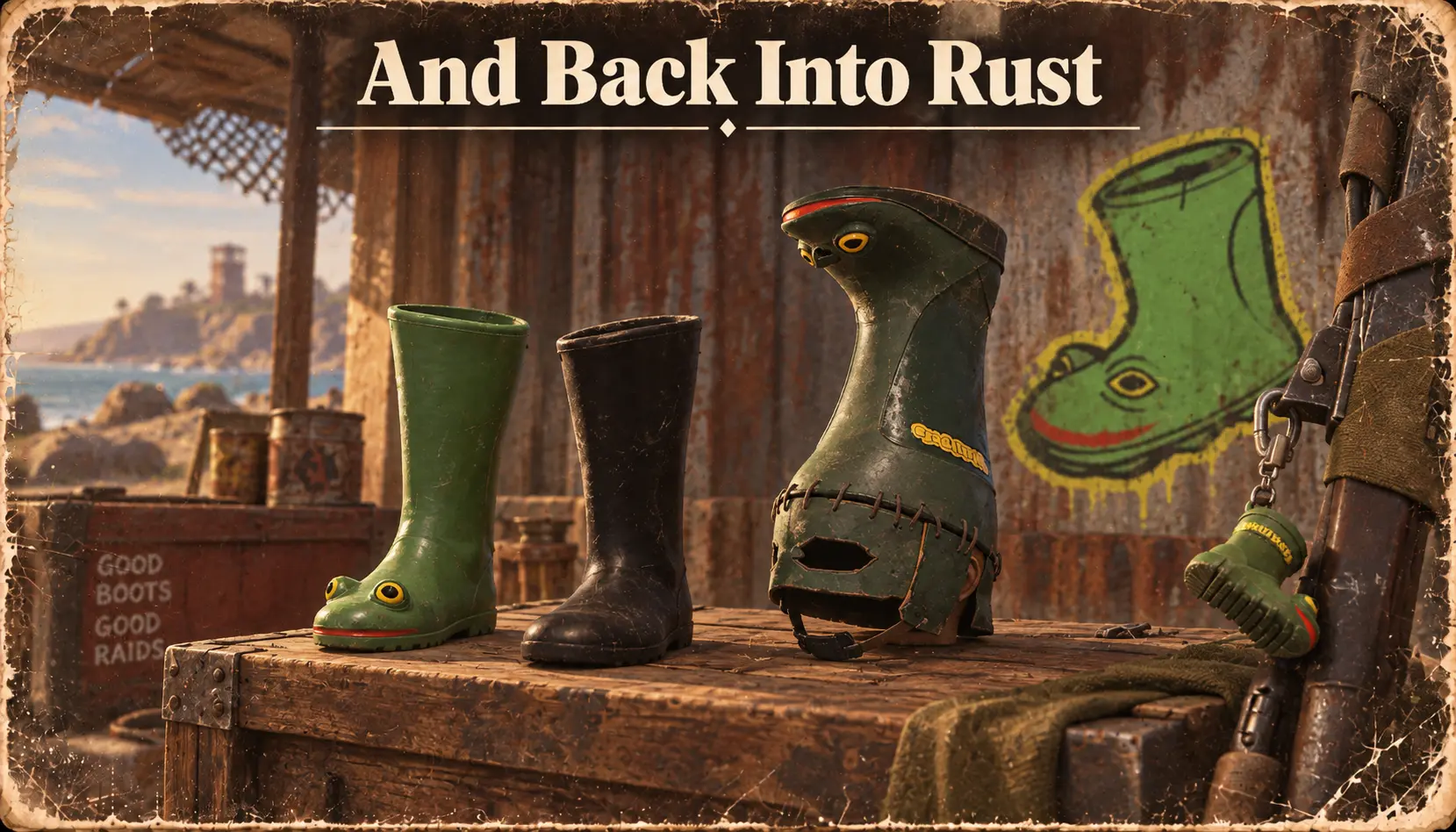
And Back Into Rust
Even that was not the end of the trip.
The physical Wellipets x Rust pair included a unique digital key for an exclusive in-game item. Facepunch identifies that item as the Frog Boot Helmet; Wellipets likewise confirms that every physical pair came with a complementary digital item for the PC version of Rust. (Rust)
That distinction is worth keeping straight.
The physical boots did not originally unlock the Frog Boots weapon charm.
The Frog Boots motif has subsequently appeared elsewhere in Rust — including as a graffiti spray and as a Frog Boots-themed weapon charm — but the digital reward attached to the Wellipets footwear was the helmet. The weapon charm exists as a separate Rust item. (Rust Skin Wiki)
So by now the frog has multiplied.
There are the standalone Early Access Frog Boots.
There is the Frog Boot image players can spray onto surfaces.
There is the Frog Boot Helmet created for the Wellipets collaboration.
There is a Frog Boots weapon charm.
What began as one absurd replacement boot on a damaged Hazmat became a small visual vocabulary of its own.
The Frog Never Really Left
That may be the best part of the story.
Facepunch redesigned the Hazmat because it wanted something less heavily MacGyver’d.
The crude old suit disappeared.
The frog face disappeared from the replacement boot.
But the green boot remained in the Hazmat’s silhouette.
Then the original Frog Boots were separated from the suit and preserved for Early Access players.
Then the frog became imagery elsewhere in the game.
Then Facepunch finally partnered with Wellipets.
Then Wellipets manufactured Rust’s black-and-green pair.
Then the physical product sent another Frog Boot back into Rust.
The Frog Boot started as the answer to a very simple visual problem:
What would a survivor wear if one of his proper boots was gone?
More than a decade later, it has become one of those tiny pieces of Rust history that refuses to disappear.
Facepunch removed the frog from the Hazmat.
It never really removed the frog from Rust.
Wellipets is unusual because the collaboration did not create the connection between the product and Rust. It revealed how old that connection already was.
The Frog Boots began with something far more ordinary: the developers had brought a familiar pair of rain boots from everyday life into the game. Over time, that mundane real-world object became part of Rust’s own visual history. Years later, the manufacturer behind those boots stepped back into the story, revived that old feature through an official collaboration, and gave players something that could hardly be reproduced by an ordinary promotional item: a new piece of a memory they already had.
Sources & References
For the concept lineage: Refined Hazmat Concept — Rust Art Trello
For Taylor Reynolds’ description of the old suit as MacGyver’d, the “RIP frog booties” comment and Paul’s refined concept art: Facepunch — Devblog 175, 31 August 2017
For the new makeshift Hazmat entering the game: Facepunch — Devblog 194, 18 January 2018
For the contemporary video showing the change and joking about “Mr. Froggy Boots”: Shadowfrax — New Hazmat Suit, Water Well Monuments, 19 January 2018
For Rust leaving Early Access and the standalone Frog Boots: Facepunch — Devblog 197, 8 February 2018
For Facepunch explicitly describing them as a re-introduction for Early Access players: Facepunch — Community Update 171, 13 February 2018
For the current standalone Frog Boots item: Official Rust Wiki — Frog Boots
For Wellipets’ 1983 British history: Wellipets — British Heritage / Our History
For the modern Wellipets design and manufacturing: Wellipets — Frog Wellingtons and Craftsmanship
For the childhood-memory/context example: Wellipets — JW Anderson x Wellipets
For Facepunch’s official 2024 Wellipets partnership and the one-green/one-black physical pair: Facepunch — Time To Kill, 5 September 2024
For the physical product and digital key: Wellipets x Rust — Frog Wellingtons Black-Green
For the separate Frog Boots weapon charm: Frog Boots Charm — item reference